India's Next Tech Wave. AI Data Centers for the World. Adani, Reliance, Airtel, L&T. Same Pattern as Software in the 2000s.
Published: May 24, 2026
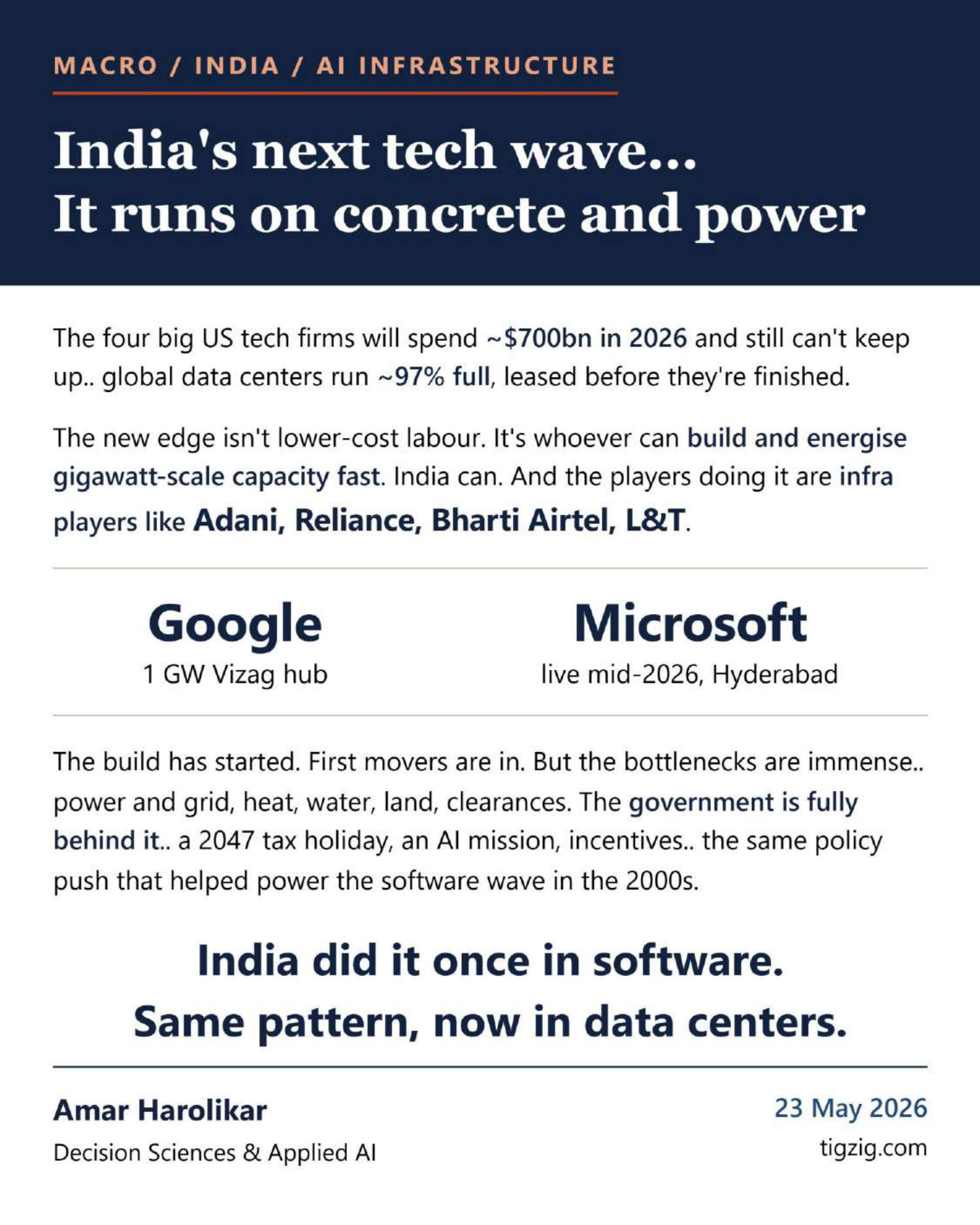
India's next tech wave - building AI data centers for the world... will be built by Adani, Reliance, Airtel, L&T. The companies that pour concrete, build power plants and lay cables.
The world is out of compute and out of power. Data centers globally are ~97% full, leased before they're even finished. The edge today is whoever can build and power gigawatt-scale capacity fast.
The first movers are in. Google's 1 GW Vizag hub, Adani at $100bn over ten years, Reliance at $110bn. Microsoft's Hyderabad site goes live mid-2026.
The government is fully behind this: a 2047 tax holiday, an AI mission, real incentives. Same kind of policy push that helped power the software wave in the 2000s.
The hurdles are real... power, water, heat, land, US ties.
India did it once in software.
Same pattern, now in data centers.
tigzig.com
Analytics, Quants & Macro Signals
India's Next Tech Wave - Full Deck
Browse the slides or download the PDF
Full Deck Content (Text Format)
Text below was extracted from the source deck. Chart visuals stay in the PDF and as slide images above the post.
Macro / India / AI Infrastructure - 23 May 2026
The four big US tech firms will spend ~$700bn in 2026 and still can't keep up. Global data centers run ~97% full, leased before they're finished.
The new edge isn't lower-cost labour. It's whoever can build and energise gigawatt-scale capacity fast. India can. And the players doing it are infra players like Adani, Reliance, Bharti Airtel, L&T.
- Google - 1 GW Vizag hub.
- Microsoft - live mid-2026, Hyderabad.
The build has started. First movers are in. But the bottlenecks are immense - power and grid, heat, water, land, clearances. The government is fully behind it - a 2047 tax holiday, an AI mission, incentives - the same policy push that helped power the software wave in the 2000s.
India did it once in software. Same pattern, now in data centers.
The Global Picture - The World is Out of Compute and Out of Power
Everyone is bidding for energised, large-scale sites. There aren't enough - and even the US can't build them fast.
- ~$700bn - Big-4 hyperscaler capex guided for 2026, up ~77% on 2025.
- 103 → 200 GW - global capacity, today to 2030 (JLL).
The binding constraints are power and time. In primary markets, grid-connection lead times exceed four years (JLL). In the US, large transformers are running at 2.5 to 3 year averages, with little near-term relief expected (Wood Mackenzie). Capacity is leased before it's finished - global occupancy ~97%, ~77% of construction already pre-committed (both JLL, global).
If even the US - with all its capital - can't energise capacity fast enough, the case for building where you can gets stronger.
My read. When supply is this tight, whoever can actually deliver capacity sets the terms. Nobody is haggling on price right now - they're scrambling for megawatts.
Sources: JLL 2026 Outlook, Jan 2026; Tom's Hardware / FT, Q1 2026; CBRE, H2 2025; Wood Mackenzie, 2025.
The Natural Parallel - India Did This Once Before, with Software
India's software industry got big by doing the world's IT work cheaper, in English, at scale.
- ~$315bn - IT/BPM revenue, FY26.
- ~$246bn - of it exports.
- ~5.95m - people employed.
It didn't happen by luck - the software takeoff in the late 90s and early 2000s was a combination: leadership drive + timing + government support. That's what turned a small industry into a global one.
My read. The same three elements are lining up again: the timing is right, the players are ready, and the government is already moving with incentives and policy.
Sources: NASSCOM Strategic Review, 2026; Times of India, 2026.
The Core Idea - The Arbitrage is Now in Fast Capacity
This wave runs on land, power, water, hard engineering and skilled trades - and the ability to build a campus and switch it on.
What an AI data center actually costs. Approximate split (McKinsey). The ~40% that's local is India's edge; the 60% hardware is the same everywhere.
India's local cost (land, labor, electrical, civil work) is roughly half the global average of ~$11.3M per MW (shell and core only, JLL 2026 Global Data Center Outlook). The chips and AI networking are the same global price for everyone. India's edge is on the local build and execution.
So cost isn't the scarce thing. Speed to energised capacity is.
A 60 MW data center loses roughly $14.2 million for every month of delay (Dr A Ansar, The Fast Mode). That's ~$250M on a 1 GW one, before chip-depreciation is even counted.
My read. The edge is being a player who can get a data center built and powered fast, into a world that's starving for supply.
Sources: McKinsey (cost split), 2025; JLL 2026 Outlook, Jan 2026; Fast Mode, 2025.
Not a Brochure - And the Buildout is Already Happening
India's capacity has tripled in five years, runs near-full, and is set to grow several times over again.
Forecast approximately 10 GW by 2030 on stated commitments. Indian colocation runs ~90%+ occupancy.
My read. "Is it happening" is settled. Yes. The real questions are who's building, who'll own it, what's in the way, and how global it can get.
Sources: CEEW, Feb 2026; Colliers, 2025; Jefferies, Oct 2025.
What's on the Table - The Money Being Announced is Serious
Google's Vizag bet is its largest anywhere outside the US, and it's global-serving by design.
| Project | Scale | Status |
|---|---|---|
| Google + Adani + Airtel, Vizag | $15bn, up to 1 GW | Broke ground Apr '26 |
| Adani (AdaniConnex) | $100bn by 2035, 2 → 5 GW | Announced Feb '26 |
| Reliance, Jamnagar | $110bn / 7yr; 3 GW flagship | Announced |
| Microsoft, Hyderabad | $17.5bn by 2029 | Live mid-2026 |
| AWS, India | $12.7bn by 2030 | Committed |
| TCS HyperVault | 1 GW+, w/ TPG | JV signed |
Google itself says Vizag will be a hub that "not only serves India but the rest of the world," wired by new subsea cables. At up to 1 GW, that one campus alone matches roughly two-thirds of India's current capacity.
My read. Early days, yes - but there's real concrete here, not just paper. And the biggest commitments are coming from the conglomerates with the balance sheets to deliver.
Sources: Google blog, Oct 2025; BBC, 2026; ET Enterprise AI, Jan 2026; Submarine Networks, Oct 2025; Adani ($100bn), Feb 2026; TechCrunch (Reliance $110bn), Feb 2026; Microsoft, Dec 2025; Investment Monitor (AWS), Apr 2026; TCS/TPG, Nov 2025.
The Policy Backing - The Government is Already Pulling This In
The government isn't watching from the sidelines on this one. It's actively pulling the investment in, and the February 2026 budget is the clearest signal yet.
Tax holiday to 2047. The February 2026 budget gives foreign cloud firms zero tax on services sold outside India, as long as they run those workloads from Indian data centers. Today that income is taxed at 35%+. It's a direct pull for hyperscalers to build here and serve the world from here.
Tax is only part of it. There's a 15% cost-plus safe harbour for Indian operators, plus the IndiaAI Mission (~$1.2bn) already subsidising GPUs for startups. The pieces are being put in place.
"The tax holiday for foreign cloud service firms could do for India's cloud and data center ecosystem what the IT services incentives did in the early 2000s - it will catalyze large-scale global investment, expand export revenues, and lead to long-term job and capability creation."
- S. Anjani Kumar, Partner, Deloitte India (to CNBC).
Sources: CNBC (tax breaks, Deloitte quote), Feb 2026; ET Telecom, 2026; PIB (safe harbour), Feb 2026; BusinessWorld (GPU subsidy), 2024; IndiaAI Mission (gov), Mar 2024.
The Clever Part - India Can Take the Load That Doesn't Need Frontier Chips
Not all AI compute is training. Serving and inference - running the models for users - is a huge load, and it can move to where land and power are cheap.
Every megawatt of serving and inference a hyperscaler runs from India frees up scarce US capacity for the frontier training that has to stay home.
On the chips, the real question is access. India was set for "Tier 2" caps under the US AI Diffusion Rule, which would have limited how many advanced chips it could import. That rule was rescinded in 2025, and as of early 2026 no replacement cap is in force - so the path is open, for now. Washington has said a new rule could come.
My read. The crunch isn't only about AI chips - it's about total compute and total power. India winning the serving-and-inference load is a massive market on its own.
The chip-access rules are the variable I'd watch. Right now the door is open. If a new US rule re-caps India, this whole thesis gets harder. It's not settled.
Sources: JLL (inference ~2027), Jan 2026; Google blog, Oct 2025; US BIS (Diffusion Rule rescinded), May 2025.
The Real Surprise - The Winners are Builders of Power and Ports
The companies that win this are the ones who build ports, power plants and telecom networks.
Top operators by share of India capacity today (Jefferies):
- NTT - Japan telecom giant.
- Sify - Indian, early ISP.
- STT - ST Telemedia, Singapore.
- Nxtra - Airtel (Bharti).
- CtrlS - Indian, Hyderabad.
- Yotta - Hiranandani Group.
3 of the top 5 are telco-owned. Today's players are mostly telecom and foreign infra.
A data center is land, substations, cooling, fibre and subsea cable - industrial build muscle, not coding. Jefferies sees Adani, Reliance and Airtel together at ~35-40% by 2030, and L&T (which builds ports, power plants and metros) is moving in too, under its Vyoma brand.
My read. Building gigawatt-scale physical infrastructure - land, substations, technicians - is what the conglomerates who already run India's ports, power and telecom do every day. That's why this is their story.
Sources: Jefferies via Outlook Business, Oct 2025; L&T Vyoma (data centers), 2026.
What Could Stop It (1 of 2) - The Risks You Can't Engineer Away
The big one: US-India relations. When ties soured in 2025 (US tariffs spiked, new $100k H-1B fees), hyperscalers paused India data-center deals for months. The two sides have since signed a trade deal and tariffs have come down sharply, but the friction isn't fully gone - H-1B and visa pressure is still live in 2026. The demand side can pull back for reasons India doesn't control. A big swing factor, and one of the few India can't engineer its way around.
Power & build-time. Physical capacity takes time - transmission and grid connections, construction, and regulatory approvals all run long, and the pace varies state to state. Globally, grid-connection waits already exceed four years in primary markets (JLL).
The workaround. "Bring your own power" - captive generation on-site. Reliance's Jamnagar runs on its own clean-energy complex; Adani is building dedicated power at Vizag. The conglomerates can bypass the grid bottleneck.
My read. The US relationship is the real swing factor - it's the one variable India doesn't fully control. But on its own side India is already moving hard: the policy, the incentives, the captive-power workarounds. I read this as a bumpy start while the geopolitics settles, then a faster rise.
Sources: CNBC (hyperscaler pause), Oct 2025; White House (trade deal), Feb 2026; White House (H-1B fee), Sept 2025; JLL (grid waits), Jan 2026; IEEFA (power), 2025; Adani ($100bn), Feb 2026; TechCrunch (Reliance $110bn), Feb 2026.
What Could Stop It (2 of 2) - The Physical Limits, and the Bubble Question
Water & heat. A typical 100 MW site uses ~2 million litres a day for cooling. S&P says 60-80% of India's data centers face high water stress this decade. And more than half of existing centers already sit in water-stressed regions (WRI India) - exactly the metros where India's heat makes cooling harder.
Land & approvals. A large campus needs multiple sign-offs - environmental clearance, groundwater permits, state committee approvals - and the rules differ state to state. Slow and unpredictable.
Is it an AI bubble? For the infrastructure, no - the supply shortage is so real it prevents overbuilding (Cushman & Wakefield, May 2026; JLL says the same). AI stock valuations are a separate question.
My read. The approval maze gets cleared - states are already moving to single-window clearance and data-center zones, the same fast path-clearing I watched when IT took off.
Water and heat are the ones I'd watch hardest - they'll bite before power does. The fixes exist - closed-loop cooling, captive water, seawater at coastal sites. It shapes where they build, not whether they build.
Sources: S&P (water stress), 2025; S&P Sustainable1 (water), 2025; WRI India (water stress), 2025; CEEW / WRI (siting), Feb 2026; Cushman & Wakefield (bubble), May 2026.
What's Next - What India Actually Wins
Most of the world's compute is the serving, the inference, and the everyday internet that has to run somewhere. That huge pool is the part India can actually win.
Serving and inference is the bigger share of demand over time. JLL expects inference to overtake training around 2027, and inference goes where the users and the capacity are, not where the model was built.
On top of that sits the regular, non-AI data-center load - the Google searches, the streaming, the everyday cloud. That can be served from India too.
My read. Frontier training is centralised and power-hungry - it sits where the chips and the policy are, mostly the US for now. India probably won't win that piece soon.
But serving, inference and the everyday data-center load is a far bigger pool, and it can move to where land and power can be built. Domestic Indian demand is the smaller, lower-margin side story - the global build is the real opening. And India has turned an opening like this into an industry before.
Sources: JLL (inference ~2027), Jan 2026; McKinsey, 2025.
Sources Index
- JLL, 2026 Global Data Center Outlook (103→200 GW, 97% occupancy), Jan 2026
- Tom's Hardware / FT, Big Tech 2026 capex ~$700bn, Q1 2026
- CBRE, North America Data Center Trends (US vacancy), H2 2025
- Wood Mackenzie, Mind the gap: supply chain challenges in the electric T&D sector (transformer lead times), 2025
- NASSCOM, Technology Sector in India: Strategic Review 2026, 2026
- Times of India, IT biz to grow 6.1% in FY26 despite AI headwinds, 2026
- McKinsey, The cost of compute (cost split, inference share), 2025
- Fast Mode (Dr A Ansar), What we learned in 2025 about data center builds - delay cost, 2025
- Jefferies / Outlook Business, India DC boom: operator shares, 2030, $4-5m/MW, 8 GW, Oct 2025
- CBRE (via Tribune), India DC capacity past 1.5 GW, expansion by 2027, 2025
- CEEW / WRI India, India DC power & water use; over half of centers in water-stressed regions, Feb 2026
- Colliers, India DC growth forecast (4.5 GW), 2025
- Google blog, Our first AI hub in India ($15bn Vizag), Oct 2025
- BBC, Google's India AI hub (Vizag), 2026
- ET Enterprise AI, Google Cloud unveils $15bn data centre in Visakhapatnam with 5 GW capacity, Jan 2026
- Submarine Networks, Google announces first AI hub in Vizag (subsea cables), Oct 2025
- Adani, $100bn by 2035, AdaniConnex 2→5 GW, Feb 2026
- TechCrunch, Reliance $110bn / 7yr AI infrastructure; Jamnagar 3 GW flagship, Feb 2026
- Microsoft, $17.5bn India investment to drive AI diffusion at population scale, Dec 2025
- Investment Monitor, AWS $12.7bn India cloud/AI by 2030 (re-affirmed, AWS Summit 2026), Apr 2026
- TCS / TPG, HyperVault 1 GW, $1bn TPG investment, Nov 2025
- CNBC, India tax holiday to 2047 for foreign cloud firms; Deloitte quote, Feb 2026
- ET Telecom, India as next global data centre powerhouse in AI and cloud, 2026
- PIB (Press Information Bureau, Government of India), 15% cost-plus safe harbour for Indian operators, Feb 2026
- BusinessWorld, IndiaAI Mission to deploy 14,000 GPUs for compute capacity - subsidy plan, 2024
- IndiaAI.gov.in, Cabinet approves IndiaAI Mission at outlay of Rs 10,372 crore (~$1.25bn), Mar 2024
- US BIS (Commerce), AI Diffusion Rule rescinded (India chip access), May 2025
- L&T (Vyoma), data center roadmap (Chennai, Navi Mumbai), 2026
- CNBC, Big Tech delays India DC deals on trade tensions, Oct 2025
- White House, US-India joint statement; tariffs cut, relations reset, Feb 2026
- White House, Presidential proclamation - restriction on entry of certain nonimmigrant workers ($100k H-1B fee), Sept 2025
- IEEFA, India's power-hungry DC sector (grid, captive renewables), 2025
- S&P Global, India global hub status (water stress, 3% vs 20%), 2025
- S&P Sustainable1, Beneath the surface - water stress in data centers, 2025
- WRI India (LinkedIn), Data centre water stress / sustainable AI infrastructure, 2025
- Cushman & Wakefield / ANI, Shortages may prevent an AI DC bubble, May 2026
- JLL, Data Center Outlook (inference overtakes training ~2027), Jan 2026
Amar Harolikar - Decision Sciences & Applied AI - tigzig.com - Tools for Analytics, Quants & Macro Signals.
Working on something similar? How I work covers the rates, the availability and what I take on.