US Bank Exposure to Non-Bank Lenders - Now in an Interactive Analytics Tool
Published: April 4, 2026
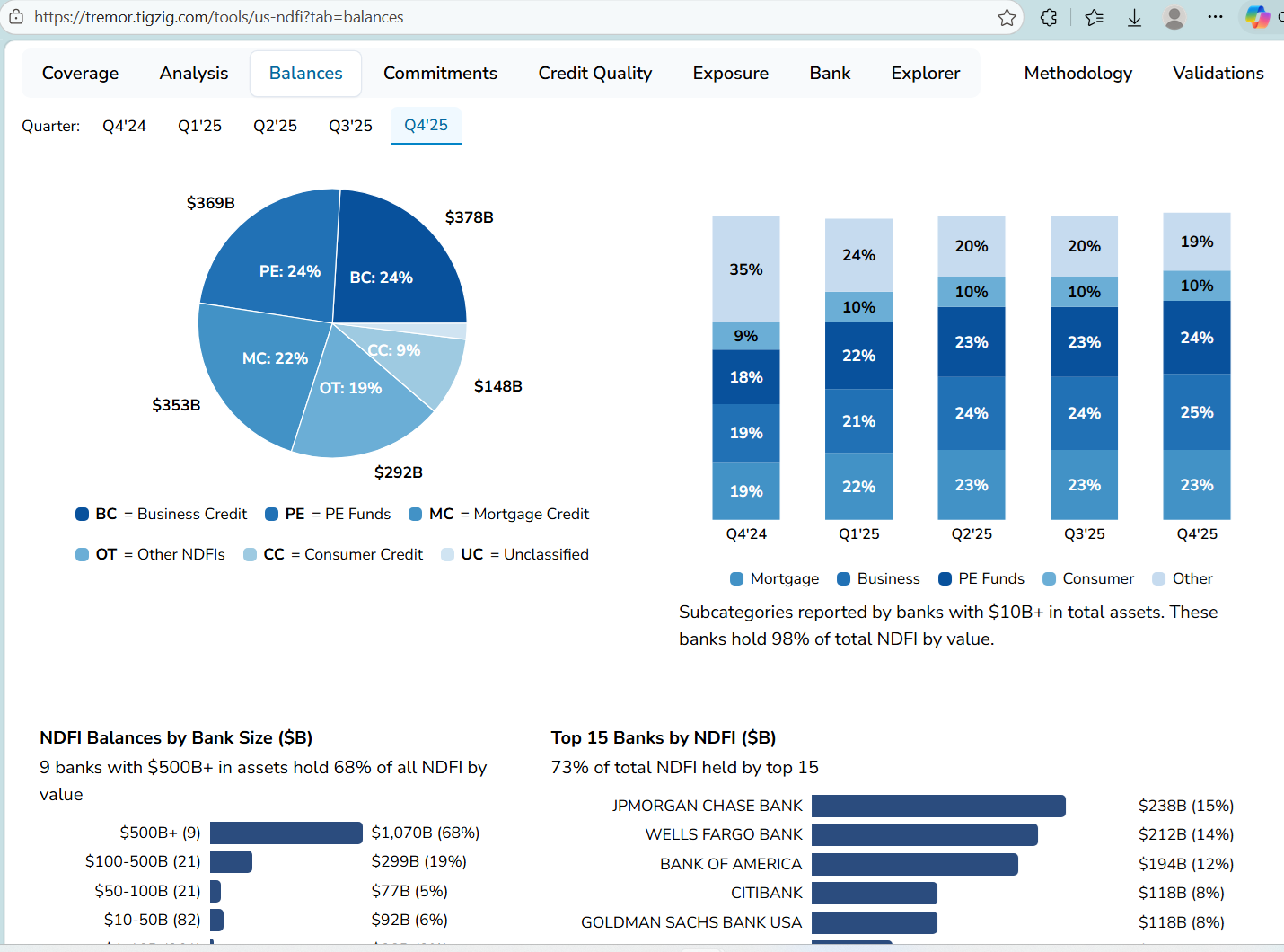
Run your own cuts. 629 banks, $1.57 trillion in NDFI loans, 5 quarters of FFIEC Call Report data.
Morgan Stanley projecting 8% default rate in direct lending. Investors demanding their money back. Which banks are most exposed? How thin are the reserves? The data is here - explore it yourself.
What you can do:
- Exposure levels and commitments broken by NDFI categories
- CET1 concentration and ACL reserve coverage across size segments
- Bank-level drill downs - click any bar to see the banks behind it
- Data explorer with filters across 55+ columns
- Methodology with MDRM codes. 7 levels of validation against FDIC and FRED
Full analysis decks inside the tool.
Plus - Dataset download. All 629 banks. All quarters. CSV.
tremor.tigzig.com ➔ US NDFI
Full Deck Content (Text Format)
Text below was extracted from the source deck. Chart visuals stay in the PDF and as slide images above the post.
US Banks & Non-Bank Lending
How Deep is the Exposure?
Private credit stress is rising. BDC defaults climbing, redemptions spiking, JPMorgan already marking down loans. Through mechanisms like back leverage, banks have $1.57 trillion on these lenders. If private credit losses start cascading, where does the stress land? And is there a systemic risk?
FFIEC Call Reports Analysis- Q424 to Q42526th March 2026 | TigZig.com
Amar Harolikar, ACA
Decision Sciences & Applied AI
How much stress can the system absorb?
At 5-10% loss rates on non-bank lending of $1.5T , the banking system absorbs the shock - existing loan loss reserves ($190B) cover it entirely. However, that would exhaust the reserves, leaving little coverage for rest of the $13T of loans.
Concentration risk is a further concern - 8 Large Financial Institutions (LFIs, Assets>$100B) have NDFI exposure exceeding 100% of their CET1 capital and 14 LFIs have ACL coverage of less than 15%. A 10% loss rate exhausts existing loan loss reserves at these banks. At 15-20%, losses start eroding CET1 capital directly - for the most concentrated banks, this could breach regulatory minimums and trigger forced capital raises
Correlated losses: The bigger risk isn't NDFI in isolation - it's NDFI losses hitting alongside private credit stress, rising consumer delinquencies, commercial real estate distress, and macro headwinds. Simultaneous stress across multiple asset classes is what turns manageable stress into systemic risk
The US Banking and NDFI Universe
629 NDFI lending banks cover nearly 88% of banks industry assets
NDFI Loans as of Q425 were >$1.5T and represent 13.7% loan book of these 629 banks
This single portfolio now exceeds 80% of NDFI lending banks’ CET1 Capital
Amar Harolikar. Decision Sciences & Applied AI | Data: FFIEC Call Reports | tremor.tigzig.com -> US-NDFI
Stress scenarios
At 5-10% loss rates, loan loss reserves ($190B) absorb the entire hit. No capital erosion.
At 15%+, losses start eating into CET1 capital directly. The 'After ACL' column shows how much passes through.
At 30%, $280B hits capital - that's 14.4% of system CET1. Manageable at system level, but not at the 41 banks where NDFI already exceeds 100% of their capital.
For reference: US bank writedowns in 2008 were ~$885B (IMF GFSR, April 2010 )
Amar Harolikar. Decision Sciences & Applied AI | Data: FFIEC Call Reports | tremor.tigzig.com -> US-NDFI
41 banks have NDFI / CET1 ratio exceeding 100%
Add the 75-100% bucket, and we have 59 banks holding 80% of all NDFI dollars with exposure above 75% of CET1 (Common Equity – Tier 1)
This is across all 629 NDFI lending banks Q425 (representing 88% of total banking assets)
Amar Harolikar. Decision Sciences & Applied AI | Data: FFIEC Call Reports | tremor.tigzig.com -> US-NDFI
Top banks by NDFI to CET1 concentration
Large Financial Institutions (Assets >$100B) ranked by NDFI concentration relative to CET1 capital. 8 of the top 15 have NDFI exceeding 100% of CET1
High NDFI/CET1 does not imply capital inadequacy - these banks maintain Tier 1 ratios well above regulatory minimums.
The ratio highlights concentration: how much of a bank's core capital is exposed to a single fast-growing loan category
Amar Harolikar. Decision Sciences & Applied AI | Data: FFIEC Call Reports | tremor.tigzig.com -> US-NDFI
62 banks have ACL coverage of less than 10%
For these 62 banks holding 59% of NDFI dollars a 10% loss on NDFI portfolio will wipe out 100% of their ACL (Allowance for Credit Losses) reserves
Amar Harolikar. Decision Sciences & Applied AI | Data: FFIEC Call Reports | tremor.tigzig.com -> US-NDFI
ACL coverage of NDFI balances
Large Financial Institutions (Assets >$100B) ranked by ACL (Allowance for Credit Losses). For 8 of top 15, a 5% loss will wipe out the bank level ACL provisions
Low ACL/NDFI at institutional banks reflects a historical bet: corporate and institutional lending has had very low loss rates.
If private credit stress breaks that pattern, these banks have no reserve cushion. Losses go straight to capital.
Amar Harolikar. Decision Sciences & Applied AI | Data: FFIEC Call Reports | tremor.tigzig.com -> US-NDFI
What are NDFI Loans
NDFI stands for Nondepository Financial Institution - any financial company that lends money but doesn't take deposits like a bank. Think private credit funds, mortgage companies, fintech lenders, PE funds.
Banks lend heavily to these entities. Starting December 2024, regulators required banks to break out these loans into five categories:
Mortgage lenders - companies that originate, service, or securitize home and commercial mortgages
Business lenders - direct lenders, private debt funds, BDCs, CLOs, finance companies. This is the bulk of private credit
Private equity funds - banks provide capital call lines and NAV loans to PE funds
Consumer lenders - fintech and non-bank companies lending directly to consumers
Other NDFIs - broker-dealers, insurance companies, hedge funds, pension funds, and other financial entities
Amar Harolikar. Decision Sciences & Applied AI | Data: FFIEC Call Reports | tremor.tigzig.com -> US-NDFI
What's the issue with NDFI loans? Back leverage
After 2008, regulators restricted banks from making risky loans directly - especially in real estate. Banks didn't stop. They found a workaround: lend to non-bank financial companies (NDFIs) who then make the risky loans instead. Same risk, different label on the balance sheet. Also called back leverage
Example - commercial real estate (CRE):
A bank can't easily make a high-risk CRE loan anymore
Instead, it lends to a mortgage company or private credit fund (an NDFI)
That fund makes the risky CRE loan using the bank's money
On the bank's books this shows up as a ‘loan to a financial institution’ - not CRE. The risk is identical, the classification is different
How big is this? As of Q4 2025:
NDFI balances are ~$1.6T , making up more than 13% of NDFI lenders’ loan book
Amar Harolikar. Decision Sciences & Applied AI | Data: FFIEC Call Reports | tremor.tigzig.com -> US-NDFI
NDFI grew by 35% over past year
Amar Harolikar. Decision Sciences & Applied AI | Data: FFIEC Call Reports | tremor.tigzig.com -> US-NDFI
Top 12 banks account for 77% of all NDFI loans
Amar Harolikar. Decision Sciences & Applied AI | Data: FFIEC Call Reports | tremor.tigzig.com -> US-NDFI
Banks have committed another 65% to NDFI
Commitments are additional lines granted to NDFI’s but not yet utilized
As of Q425, banks had committed additional $1T over and above the $1.5T outstanding
If fully utilized that takes potential exposure to >$2.6T
Amar Harolikar. Decision Sciences & Applied AI | Data: FFIEC Call Reports | tremor.tigzig.com -> US-NDFI
NDFI Nonaccrual rate is currently just 0.20%
Nonaccrual means the bank has stopped recognizing interest income on the loan, signaling it no longer expects full collection.
NDFI nonaccrual rate is 0.20%, well below the bank-wide rate of 0.67%. However these losses can balloon suddenly as downstream delinquencies start and NDFI bankruptcies start to come in.
Already starting: JPMorgan has marked down the value of private credit loans held as collateral and reduced borrowing capacity for private credit firms - a preemptive move targeting software sector loans where AI disruption fears are driving a downcycle. (CNBC, March 11 2026)
Amar Harolikar. Decision Sciences & Applied AI | Data: FFIEC Call Reports | tremor.tigzig.com -> US-NDFI
Nonaccrual rate computed for banks with $10B+ in total assets (the only banks required to report NDFI subcategories). These banks hold 98% of total NDFI by value. Rate covers three subcategories that report nonaccrual: Mortgage Credit, Business Credit, and PE Funds (70% of NDFI). Consumer Credit and Other NDFIs (remaining 30%) do not report nonaccrual separately. The true combined NDFI nonaccrual rate could be higher or lower depending on stress in these unreported segments.
Where is the stress coming from?
Private credit market showing cracks. Blackstone's flagship fund posted its first loss in 3 years. Blue Owl halted redemptions. BDCs trading at 0.73x NAV, a 27% implied discount on their loan books.
Morgan Stanley projects direct lending defaults hitting 8%, approaching COVID peaks. Half of direct lending borrowers had negative free operating cash flow (IMF, October 2025).
NDFI loans are the transmission channel. Banks don't hold the risky loans directly. They lend to NDFIs who do. When downstream borrowers default, the stress travels back to bank balance sheets through this $1.6T pipeline.
Detailed analysis of private credit stress, market signals, and macro backdrop in companion deck : Private Credit - The $2.7 Trillion Shadow Lending Market Is Showing Cracks
Amar Harolikar. Decision Sciences & Applied AI | Data: FFIEC Call Reports | tremor.tigzig.com -> US-NDFI
Further Reading
S&P Global: US banks' NDFI lending pace reaccelerates in Q4 2025 (Feb 2026) - industry aggregate tallies at $1,569B, consistent with my FFIEC analysis
Moody's: US banks' private credit loan exposure nears $300 billion (Oct 2025) - breakdown by NDFI subcategory
FDIC: FDIC Quarterly Banking Profile Q4 2025 PDF - for validating industry numbers
George Smith Partners: The Loans Banks Aren't Supposed to Hold Anymore by William Letzer (March 2026)
Federal Reserve Board of Governors, FEDS Notes: Bank Lending to Private Credit: Size, Characteristics, and Financial Stability Implications (May 23, 2025)
Federal Reserve Bank of Boston: Current Policy Perspectives 25-8, May 2025
ABA Banking Journal: Loans to non-depository financial institutions: new granularity and a rapidly growing segment (Feb 2026)
Mayer Brown: Private Credit Portfolio Back Leverage (March 2025)
PYMNTS: Private Credit's Gold Rush Draws Regulators and Bank Warnings (March 2026)
CNBC: JPMorgan reins in lending to private credit firms, marks down software loans (March 2026)
Amar Harolikar. Decision Sciences & Applied AI | Data: FFIEC Call Reports | tremor.tigzig.com -> US-NDFI
US-NDFI Tool Live with data from Q424 to Q425
tremor.tigzig.com ➜ US-NDFI
Coverage
Balances
Commitments
Credit Quality
Exposure
Bank View
Data Explorer
Methodology
Validations
Interactive tool with drill down, bank view and full data download
Amar Harolikar. Decision Sciences & Applied AI | Data: FFIEC Call Reports | tremor.tigzig.com -> US-NDFI
Working on something similar? How I work covers the rates, the availability and what I take on.