Red Flag in US Life Insurance. $2.4T (7.5% of GDP) in Private Credit and Offshore Reinsurance. The PE Affiliated Loop.
Published: May 8, 2026
US Life Insurers have $2.4T (7.5% of US GDP) sitting in private credit and offshore reinsurance. The red flag - visible stress, fast growth, and the affiliated loop where the Private Equity (PE) firms own both sides.
Built a tool in TREMOR (tremor.tigzig.com ➔ US Insurance) pulling 100 quarters of FRED data on Life and P&C insurer balance sheets.
What's sitting there:
- $1.2T in the Fed's oddly named 'Unidentified Misc Assets' - the catch-all where private credit, PE, BDCs, alternatives sit
- $1.2T memo item of risk ceded offshore - mostly to PE-affiliated Bermuda and Cayman captives
Both nearly doubled in past 5 years.
The conflict: the same PE firms own the insurers, the credit funds, and the offshore reinsurers. Insurer lends to fund. PE values the loans. All in the same house. Annuity holder bears the risk.
Add - private credit losses rising. Frauds. Bank markdowns. Treasury convening regulators. Morgan Stanley sees 8% default rates coming.
If retirees start surrendering annuities en masse - that's the 'doom loop' (Marblegate's Milgram via Axios). Looks far-fetched today. They always do. Until...
Deck below. Web version with clickable links: tremor.tigzig.com/ins
Red Flag in US Life Insurance
Browse the slides or download the PDF
Full Deck Content (Text Format)
Text below was extracted from the source deck. Chart visuals stay in the PDF and as slide images above the post.
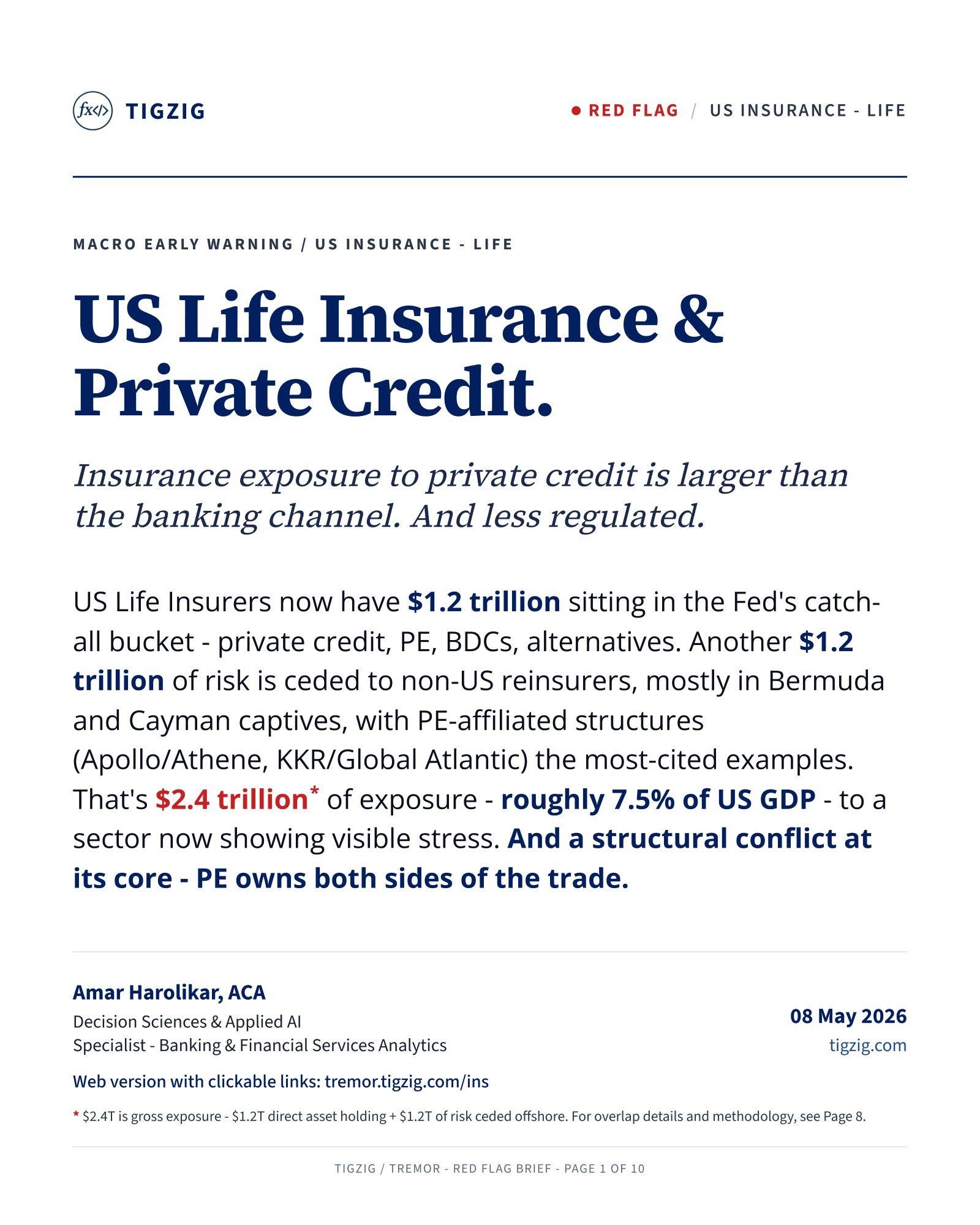
US Life Insurers now have $1.2 trillion sitting in the Fed's catch-all bucket - private credit, PE, BDCs, alternatives. Another $1.2 trillion of risk is ceded to non-US reinsurers, mostly in Bermuda and Cayman captives, with PE-affiliated structures (Apollo/Athene, KKR/Global Atlantic) the most-cited examples. That's $2.4 trillion* of exposure - roughly 7.5% of US GDP - to a sector now showing visible stress. And a structural conflict at its core: PE owns both sides of the trade.
*$2.4T is gross exposure - $1.2T direct asset holding + $1.2T of risk ceded offshore. For overlap details and methodology, see Explanatory Notes.
The Thesis
US Life Insurers' onshore 'Unidentified Misc Assets' jumped from $649B to $1.2T. Offshore reinsurance to Bermuda/Cayman captives also crossed $1.2T. Combined $2.4T sits in the two least-visible places to look for private credit exposure - onshore in a catch-all asset bucket, and offshore via reinsurance ceded to non-US reinsurers.
Why this is the red flag:
01 - Same Pocket Risk: PE owns both the insurer AND the credit fund it lends to.
02 - Morgan Stanley: 8% default outlook, near Covid.
03 - Banks marking down private credit loans.
04 - Moody's flips BDCs to negative outlook.
05 - BDCs trading at 22% discount to NAV.
06 - Frauds surfacing: Tricolor, First Brands.
07 - US Treasury convening regulators.
Life: GA / Unidentified Misc Assets
| Metric | Q1 '21 | Q4 '25 |
|---|---|---|
| Value (US$) | $649B | $1.2T |
| % of GA total | 10.3% | 15.2% |
Life: GA / Reserve Credit Reinsured to Non-US Reinsurers
| Metric | Q1 '21 | Q4 '25 |
|---|---|---|
| Value (US$) | $584B | $1.2T |
| % of GA total | 9.3% | 15.6% |
Source: tremor.tigzig.com -> US Insurance
For definitions, overlap details, and methodology, see Explanatory Notes.
What is private credit and reinsurance?
Both are normal business practices. The red flag is the pace of growth, the affiliated loop and stress now visible in the sector.
Private Credit
Private credit is lending outside the traditional banking system. Non-bank lenders - private credit funds, Business Development Companies (BDCs), direct lending vehicles - originate loans directly to borrowers. The borrowers are mostly middle-market companies (typically below investment grade or unrated), with a growing slice going to consumer finance and asset-backed lending.
Life insurers don't lend directly. They fund the non-bank lenders - through private placements, BDC bonds, CLO tranches, and fund commitments. Some are now buying the lending platforms outright. The chain runs: insurer capital -> non-bank lender -> borrower.
Reinsurance
Reinsurance is when an insurer transfers risk to another insurer (the reinsurer) to manage liability and free up capital. Standard practice across the industry. Two main types matter here:
- Asset-intensive reinsurance: the original insurer transfers reserves and assets to the reinsurer. The reinsurer takes both the liability and the investment portfolio.
- Risk-only reinsurance: only the mortality or longevity risk transfers. Assets stay on the original insurer's books.
The growth concern is asset-intensive reinsurance ceded to offshore reinsurers - mostly in Bermuda and the Cayman Islands, often affiliated with private equity sponsors. That's where the $1.2 trillion in the Fed Z.1 "Reserve Credit Reinsured to Non-US Reinsurers" series sits.
"Life insurers have also steadily increased their investments in risky and illiquid assets over the past decade, and their activity has contributed to the expansion of private credit."
"In private credit markets, loan defaults remained at relatively low levels, but the elevated usage of payment-in-kind (PIK) provisions indicates some borrowers may face repayment difficulties."
What's just happened.
April 2026 - March 2026
01 - Apr 7, 2026 - Moody's flips private credit BDC outlook to negative.
The first negative outlook from Moody's on the sector in over two years. Driven by redemption exodus from non-traded BDCs and elevated leverage in listed peers. Reuters, Apr 7 2026
02 - Apr 30, 2026 - Listed BDCs trading at 22% discount to book.
Median price-to-NAV at 0.78x, mean 0.81x. Market is pricing in roughly a 22% overvaluation in stated loan books. Raymond James BDC Weekly, Apr 30 2026
03 - Mar 17, 2026 - Morgan Stanley: direct lending defaults to reach 8%, near Covid peak.
MS strategist Joyce Jiang: "a private credit shakeout on par with Covid losses is coming." AI flagged as the catalyst, with ~26% of BDC portfolios exposed to software. CNBC / Morgan Stanley, Mar 17 2026
04 - Apr 1, 2026 - US Treasury convenes regulators on private credit and insurance.
Bessent: "I am concerned with watching how this gets to the regulated financial system." Sessions covered fund leverage, ratings, offshore reinsurance, and liquidity. Treasury sb0430; Insurance Business, Apr 2 2026
05 - Mar 11, 2026 - JPMorgan marks down private credit loans, restricts new lending.
And specifically targets software-exposed portfolios. The biggest US lender to the sector pulling back ahead of expected stress. CNBC / Bloomberg / FT, Mar 11 2026
What's been breaking.
February 2026 - September 2025
06 - Feb 27, 2026 - Top bankers sued by Tricolor noteholders for "missing giant red flags."
Noteholders allege JPMorgan, Barclays, and Fifth Third "fueled and perpetuated Tricolor's Ponzi-like fraud." Some notes trade below 10 cents. Combined disclosed bank losses already exceed $520M. Banking Dive / Claims Journal, Mar 2 2026
07 - Sep 28, 2025 - First Brands collapse: $2.3B in off-balance-sheet debt vanished.
Disclosed exposures: Jefferies' Point Bonita $715M, UBS O'Connor $500M+, Onset Financial $1.9B, Katsumi Global $1.75B. Many positions were marked at par weeks before going to zero. CEO resigned; DOJ criminal investigation underway. PitchBook / CNBC, Oct 2025
08 - Jun 2025 / Nov 2025 - Moody's: ~1/3 of $6T in US life insurer assets is private credit.
Up to one-third of the $6T held by US life insurers was in private credit at year-end 2024, and 80% of insurers surveyed plan to grow it further. Some firms have over half their fixed income in difficult-to-trade debt. Insurance Business / PYMNTS, Nov 2025
The Affiliated Loop - All in the Same House
PE owns the insurer. PE owns the credit fund. Insurer lends to fund. PE values the loans. Annuity holder bears the risk.
What investors and regulators are saying:
01 - The Conflict - CEPR, March 2026
"The situation is rife with conflicts of interest, most notably PE firms providing valuations for credit funds with Level 3 loans - and asking annuity holders to trust them." cepr.net
02 - The Affiliated Share - AM Best, via CEPR Mar 2026
Roughly 20% of investments at Athene's US Life Group and KKR's Global Atlantic now go to affiliated funds. Level 3 assets account for ~1/3 of Athene's and Global Atlantic's total assets. cepr.net
03 - The Market Signal - FT, April 14 2026
US insurance is now one of the lowest-performing sectors in the US investment-grade bond index. Industry private credit ~10% of total assets; PE-affiliated insurers (Athene, Global Atlantic) could top 15%. Wellington's Connor Fitzgerald: "private credit second derivative trade." pymnts.com
04 - The Doom Loop - Marblegate's Andrew Milgram, via Axios Apr 2026
Retirees worry -> surrender annuities -> insurers liquidate private credit -> more distress -> more surrenders. The chain runs on illiquid assets meeting redemption demands. axios.com
05 - The Slow Erosion - Oxford Economics' J. Corominas, via Insurance Journal Apr 6 2026
"Should private credit losses erode insurer solvency, the resulting contagion would not resemble the bank-run dynamics of 2008, but would instead manifest as a slow, grinding erosion of retirement security - harder to detect in real time, and significantly more difficult to reverse." insurancejournal.com
The regulators saw it coming.
April 2024 - January 2026
09 - Apr 2024 - IMF GFSR Ch. 2: stale valuations, fragile borrowers, hidden leverage.
"If private credit remains opaque and continues to grow exponentially under limited prudential oversight, these vulnerabilities could become systemic." IMF GFSR April 2024, Chapter 2
10 - May 2025 - Boston Fed: bank lines to private credit could pose systemic liquidity risk.
Banks fund private lenders through credit lines that can be drawn together if borrowers default in unison. The Fed's own words: "tail risk may be underappreciated." Boston Fed CPP 25-8, May 2025
11 - Aug 2025 - NAIC Actuarial Guideline 55: new asset-adequacy testing for offshore reinsurance.
New asset-adequacy testing requirement for reinsurance counterparties. Practical bite falls on affiliated Bermuda/Cayman structures. Clifford Chance, NAIC AG 55, Mar 2026
12 - Oct 2025 - IMF GFSR: ~40% of private credit borrowers have negative cash flow.
Up from 25% in 2021. Stress tests: banks with 18% of global assets would breach safe capital in a stagflationary shock. IMF Global Financial Stability Report, Oct 2025
13 - Jan 2026 - Bermuda Monetary Authority tightens reinsurance disclosure rules.
Tighter asset/liability disclosure effective Jan 2026. New entrants slipped to 58 in 2025 from 63 in 2024. Royal Gazette, Jan 2026
Explanatory Notes.
Definitions, caveats, and methodology notes.
On the 'Unidentified Miscellaneous Assets' Bucket
The Fed Z.1 Financial Accounts use this label as a catch-all for Life insurer General Account assets that don't fit standard categories. Per Fed methodology, the bucket includes:
- Private credit funds, direct lending vehicles, BDC holdings
- Private equity fund interests, hedge fund investments
- Infrastructure debt, real estate equity (non-mortgage)
- Other Schedule BA-type alternative investments
Not purely private credit, but the closest aggregate proxy at the industry level for alternatives exposure. Growth from $128B (2000) to $1.2T (2025) reflects a clear structural shift to alternatives.
On 'Reserve Credit Reinsured to Non-US Reinsurers'
This is a Fed Z.1 reserve credit memo item, not a direct asset or liability line. It measures how much reserve credit US Life insurers are taking against reserves ceded to offshore reinsurers - a measure of risk and reserve transfer, not gross assets.
Where the backing assets sit depends on the reinsurance structure:
- Coinsurance with full asset transfer: assets move to the offshore reinsurer
- Modco / funds-withheld: assets remain at the cedant under trust or withheld arrangements
- YRT / risk-only: only mortality risk transfers; assets stay with the cedant
On the Overlap Between the Two Buckets
The onshore $1.2T sits directly on US Life insurer balance sheets. The offshore $1.2T is a reserve credit memo item - the backing assets sit either at the offshore reinsurer or remain at the cedant under modco / funds-withheld structures. Where assets remain at the cedant, partial overlap with the onshore bucket is possible.
Regulators and the industry track the two as separate exposures because the transmission risk differs - direct credit risk on one side, counterparty risk to a less-regulated reinsurer on the other. The $2.4T combined figure is gross headline exposure.
On the Denominator
Share % shown for both items is computed against General Account financial assets ($7.7T at Q4 2025), not Total Life Financial Assets ($11.2T). GA is the right base because both items are GA-side in Fed Z.1: Unidentified Misc Assets is a GA-only asset line, and Reserve Credit Reinsured is a GA-side memo line (an offset to gross statutory reserves, not a balance-sheet asset).
Data Validation
All Fed Z.1 series in this brief cross-validated against the Federal Reserve's published L.116 Life Insurance Companies table - exact match across all overlapping line items. NAIC statutory framework comparison from ACLI 2025 Life Insurers Fact Book (80th Ed., year-end 2024 data). Methodology and validation tabs available in the Tremor app.
Data Source & Tool.
Data Source
- Source: Federal Reserve Z.1 Financial Accounts (via FRED)
- Series: Life: GA / Unidentified Misc Assets
- Coverage: Q1 2000 - Q4 2025 (104 quarters)
- Validation: Cross-checked vs Fed L.116 and ACLI 2025 Fact Book
- Pulled via: tremor.tigzig.com / US Insurance
What the Tool Does
- 73 series across Life and P&C
- 104 quarters of data
- Life: GA + SA breakdown
- P&C: full investment allocation
- On-demand charts, tree-like nav
- Filters / Methodology / Validations
- Full CSV download
Note on the bucket: Fed's catch-all for assets that don't fit standard categories - private credit funds, BDCs, PE / hedge fund interests, infrastructure debt, real estate equity (non-mortgage), and Schedule BA-type alternatives. Aggregate industry data only.
Tremor / US Insurance: Life GA holdings sorted by % change. Unidentified Misc Assets row: +75.6% / +4.84pp.
Live Now: tremor.tigzig.com / US Insurance
External Sources.
Hyperlinks for all 19 source citations in this brief. Both clickable and shown as raw URLs - so anyone can copy-verify.
Web version with clickable links: tremor.tigzig.com/ins
01 - Apr 7, 2026 Moody's cuts outlook on US BDCs to 'negative' - Reuters reuters.com/business/finance/moodys-cuts-outlook-us-bdcs-negative-redemption-pressure-rising-leverage-2026-04-07/
02 - Apr 30, 2026 Raymond James BDC Weekly Insight - April 30, 2026 raymondjames.com/-/media/rj/dotcom/files/corporations-and-institutions/investment-banking/industry-insight/bdc_update.pdf
03 - Mar 17, 2026 Private Credit Shakeout Matching Covid Losses Coming, Morgan Stanley Says - CNBC cnbc.com/2026/03/17/private-credit-shakeout-matching-covid-losses-coming-morgan-stanley-says.html
04 - Apr 1, 2026 Treasury convenes conversations with regulators - US Treasury home.treasury.gov/news/press-releases/sb0430 US Treasury convenes regulators over insurance industry's private credit binge - Insurance Business insurancebusinessmag.com/us/news/breaking-news/us-treasury-convenes-regulators-over-insurance-industrys-private-credit-binge-570672.aspx
05 - Mar 11, 2026 JPMorgan reins in lending to private credit firms - CNBC cnbc.com/2026/03/11/jpmorgan-reins-lending-private-credit-marks-down-software-loans.html
06 - Feb 27, 2026 JPMorgan, Barclays, Fifth Third sued over Tricolor - Banking Dive bankingdive.com/news/jpmorgan-barclays-fifth-third-sued-tricolor-fraud/813504/
07 - Sep / Oct 2025 First Brands Ch. 11 tarnishes private credit - PitchBook pitchbook.com/news/articles/first-brands-ch-11-tarnishes-private-credit-with-broad-brush-amid-retail-push First Brands' implosion ripping through private credit - CNBC cnbc.com/2025/10/10/first-brands-implosion-lenders-scramble-to-contain-the-fallout-.html
08 - Jun / Nov 2025 Insurance Business mag - Moody's $6T / 1/3 finding insurancebusinessmag.com/us/news/breaking-news/us-treasury-convenes-regulators-over-insurance-industrys-private-credit-binge-570672.aspx Insurers Are Buying Up Private Credit Debt - PYMNTS pymnts.com/insurance/2025/insurers-are-buying-up-private-credit-debt/
09 - Apr 2024 Global Financial Stability Report - April 2024, Ch. 2 - IMF imf.org/-/media/files/publications/gfsr/2024/april/english/ch2.pdf
10 - May 2025 Could Private Credit Pose a Risk to Stability? - Boston Fed CPP 25-8 bostonfed.org/-/media/Documents/Workingpapers/PDF/2025/CPP-20250521.pdf
11 - Aug 2025 NAIC's evolving response to private equity in insurance (AG 55) - Clifford Chance cliffordchance.com/insights/resources/blogs/insurance-insights/2026/03/the-naics-evolving-response-to-private-equity-in-insurance.html
12 - Oct 2025 Global Financial Stability Report - October 2025 - IMF imf.org/en/publications/gfsr/issues/2025/10/14/global-financial-stability-report-october-2025
13 - Jan 2026 BMA says broader supervisory changes planned for 2026 - Royal Gazette royalgazette.com/international-business/business/article/20260129/bma-says-broader-supervisory-changes-planned-for-2026/
Affiliated Loop sources
01 - Mar 2026 You Bet Your Life: Insurance, Private Equity Comes For Your Annuity - CEPR cepr.net/publications/you-bet-your-life-insurance-private-equity-comes-for-your-annuity/
02 - Mar 2026 AM Best ~20% affiliated-fund stat (via CEPR) - CEPR cepr.net/publications/you-bet-your-life-insurance-private-equity-comes-for-your-annuity/
03 - Apr 14, 2026 Insurance Sector's Private Credit Ties Has Investors Concerned (FT via PYMNTS) pymnts.com/news/investment-tracker/2026/insurance-sectors-private-credit-ties-has-investors-concerned/
04 - Apr 2026 Insurance, private credit doom-loop risk (Marblegate / Andrew Milgram) - Axios axios.com/2026/04/03/insurance-risk-private-credit
05 - Apr 6, 2026 Slow erosion of retirement security (Oxford Economics / J. Corominas) - Insurance Journal insurancejournal.com/news/international/2026/04/06/864565.htm
Methodology / Primer sources
01 - May 2026 Financial Stability Report - Federal Reserve, May 2026 federalreserve.gov/publications/files/financial-stability-report-20260508.pdf
Working on something similar? How I work covers the rates, the availability and what I take on.