Red Flag: US Credit Unions. A $1.73T System at GFC-Era Losses. Card Charge-Offs 10 Straight Quarters Past the Crisis Peak.
Published: June 10, 2026
Red flag: US credit unions. A $1.73 trillion lending system running GFC-level losses in consumer. A regulator stripped to a single board member, talking in measured tones. Banks have Jamie Dimon warning every quarter. Credit unions have... none.
Q1-2026 numbers just out from NCUA:
- Card charge-offs at 5.30% - above the 2008-09 crisis peak for 10 straight quarters now... with no recession on the board
- Real estate and commercial are calm... consumer is 41% of loans and 95% of the losses
- Auto losses at a fresh series record. Cards 5% of loans, a third of all losses
The silver lining... consumer balances are $19B below their end-2023 peak and falling. Looks like risk teams clamping down. The catch: the vintages already booked will play out their losses either way.
Banks? At 38% of their own GFC peak on cards. Credit unions past theirs. The stress sits with the credit unions.
Analysis attached.
Run the cuts yourself on tigzig.com → TREMOR → US Credit... or point your AI agent at agents.tigzig.com.
Credit Union Red Flag - 13-Slide Deck
Browse the slides or download the PDF
Full Deck Content (Text Format)
Text below was extracted from the source deck. Chart visuals stay in the PDF and as slide images above the post.
Slide 1 - Red flag: US credit unions
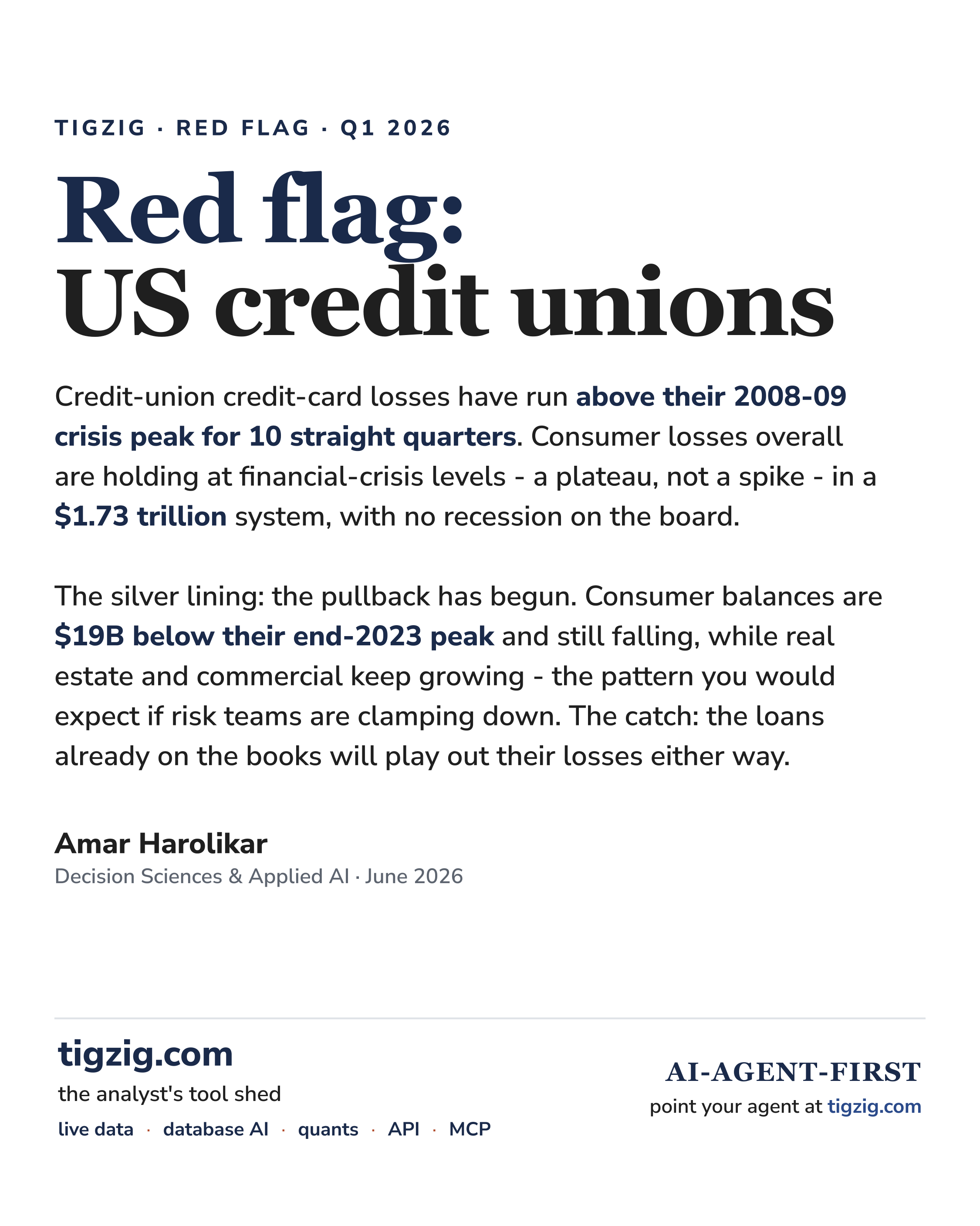
Credit-union credit-card losses have run above their 2008-09 crisis peak for 10 straight quarters. Consumer losses overall are holding at financial-crisis levels - a plateau, not a spike - in a $1.73 trillion system, with no recession on the board. The silver lining: the pullback has begun. Consumer balances are $19B below their end-2023 peak and still falling, while real estate and commercial keep growing - the pattern you would expect if risk teams are clamping down. The catch: the loans already on the books will play out their losses either way.
Slide 2 - One book, three layers - one of them is bleeding
Start at the top, then dig down. Credit unions hold $1.73T in loans (Q1 2026, +4.6% YoY). The total looks moderate: 0.81% net charge-offs vs a 1.32% GFC peak. But the total is an average of three very different layers - and the calm layers are hiding the hot one.
| Level (Q1 2026) | Book | % loans | NCO | 60+ delq | Book QoQ | Flag |
|---|---|---|---|---|---|---|
| Real estate | $816B | 47% | 0.023% | 0.63% | +$9.8B | quiet |
| Commercial | $196B | 11% | 0.22% | 1.01% | +$3.4B | watch |
| Consumer | $717B | 41% | 1.85% | 1.05% | -$4.8B | elevated |
| Total | $1.73T | 100% | 0.81% | 0.85% | +0.5% | 13-yr highs |
That split is unlikely to be an accident. The consumer book has been shrinking since end-2023 ($19B below its peak) while real estate and commercial keep growing - the pattern you would expect when lenders see crisis-level losses and clamp down where the losses are. A red flag, with a silver lining.
NCO = net charge-offs, quarterly annualized, % of loans. Delinquency = 60+ days past due, % of loans (NCUA convention).
Slide 3 - 59% of the book is calm
Real estate ($816B) and commercial ($196B) are the two biggest balances - and the two quietest books. RE charge-offs are a third-decimal number: 0.023%. Commercial is lumpy but small: 0.22%. Together they hold 59% of the loans and produce 4% of the losses. This is what keeps the total looking moderate.
Context for the calm: in 2008-09 real estate was where credit unions bled (NCO peaked at 0.61%, delinquency at 2.09%). Today RE delinquency is 0.63%, up from 0.54% a year ago but still a fraction of the crisis mark. This cycle is not a real-estate event. It is a consumer event.
The watch item: commercial 60+ delinquency was the only major line to rise against the usual Q1 seasonal dip: 0.97% to 1.01%, up from 0.93% a year ago. Trade press reports the pain is concentrated: seven credit unions hold a fifth of all commercial delinquencies. Still modest vs 3.7% in 2011 - a watch item, not an alarm.
Slide 4 - 41% of the loans, 95% of the losses
The consumer book ($717B) is where the stress is. Consumer net charge-offs are 1.85% - roughly double the mid-2000s norm, inside the 2008-09 crisis band, and flat on a year ago (1.85%). Not accelerating, not improving: a plateau at crisis-era levels.
Share of loans vs share of losses (annualised $14B loss run-rate):
Credit cards: 5% of loans, 33% of losses ($86B book)
Auto: 28% of loans, 33% of losses ($480B book)
Other consumer: 8% of loans, 28% of losses ($139B book)
RE + commercial: 59% of loans, just 4% of losses ($1,013B book)
Cards alone: 5% of loans, 33% of losses. A small slice is doing the damage.
Slide 5 - Card losses: 10 straight quarters past the GFC peak
The hardest number in the book. Credit-union card net charge-offs hit 5.30% in Q1 2026 - worse than Q4, and above the 4.68% peak of the 2008-09 crisis for the 10th consecutive quarter. Not a one-quarter spike. A plateau above the crisis line.
Card book: $86B (5% of CU loans)
Annualised losses: $4.6B (33% of all CU loan losses)
Banks, same product: 4.12% vs their 10.9% GFC peak
At 5.30%, card losses are 13% above the worst of the financial crisis - with no recession. Banks lose more on cards in absolute terms (4.12%), but that is just 38% of their own crisis peak. Credit unions are past theirs.
Slide 6 - It is not just cards
Auto - the biggest consumer book at $480B - just set a fresh series record: 0.97% NCO, the highest since the data begins in 2013. In the smaller books, other-secured keeps making new highs while other-unsecured cools from its 2023 peak.
| NCUA - net charge-off rate | Book | Q1 25 | Q4 25 | Q1 26 | Read |
|---|---|---|---|---|---|
| Auto (all) | $480B | 0.94% | 0.94% | 0.97% | record |
| of which used | $321B | 1.18% | 1.17% | 1.18% | near record |
| Other secured | $68B | 1.22% | 1.25% | 1.29% | record, rising |
| Other unsecured | $70B | 4.64% | 4.44% | 4.34% | high, easing |
| Payday-alternative (PAL) | $142M | 13.4% | 12.2% | 14.0% | volatile |
Series limits: auto and used-auto begin 2013; other-secured and other-unsecured begin 2022; PAL begins 2011 - none has a usable GFC benchmark.
Slide 7 - Delinquency: the seasonal dip changes little
Charge-offs are today's losses; delinquency is tomorrow's. Total 60+ day delinquency eased to 0.85% in Q1 - but Q1 always eases (tax refunds, fresh-year cures), and this dip was the same size as last year's. The honest read is the level: the highest Q1 reading since 2013, up from 0.80% a year ago.
| NCUA - 60+ DPD, % of loans | GFC peak | Q4 25 | Q1 26 | Read |
|---|---|---|---|---|
| Credit cards | 2.06% | 2.15% | 2.04% | back under GFC |
| Consumer (all) | 1.48% | 1.20% | 1.05% | below GFC, flat YoY |
| Used auto | n/a | 1.13% | 0.93% | elevated |
| Total (all loans) | 1.84% | 1.03% | 0.85% | highest Q1 since 2013 |
Worth noting on cards: delinquency crossed its 2.06% GFC peak in Q4 2025 (2.15%) and slipped back under it in Q1 (2.04%) on the seasonal. One quarter above, one back below - the line is being tested, not decisively broken. Card charge-offs remain decisively past their GFC peak either way.
Slide 8 - The breach is localized
Same borrowers, same economy. Banks are stressed but subdued - they tightened earlier and pulled back toward pre-GFC levels. Measured against each sector's own 2008-09 crisis peak, banks sit at a fraction of theirs; credit unions are at or past theirs.
Net charge-off rate as % of own GFC peak
| Segment | Q1 2026 | GFC peak | % of GFC peak |
|---|---|---|---|
| Credit unions - cards | 5.30% | 4.68% | 113% |
| Banks - cards | 4.12% | 10.9% | 38% |
| Credit unions - consumer | 1.85% | 2.21% | 84% |
| Banks - consumer | 2.87% | 6.64% | 43% |
| Credit unions - total | 0.81% | 1.32% | 61% |
| Banks - total | 0.58% | 2.89% | 20% |
Banks sit at 20% of their crisis peak overall, 38% on cards. Credit unions are at 113% on cards - past the line. This is not system-wide banking stress. It is concentrated in credit unions.
Slide 9 - If it intensifies, what breaks?
The stress has started - the question is how far it runs. Failures lag a loss cycle: in the GFC, closures peaked in 2010, after the bottom, not on day one. The transmission channel, if consumer losses deepen from here, is clear and has precedent:
1. Failures and forced consolidation
Failures today are low and idiosyncratic - 0 in 2024, 5 in 2025, mostly fraud at tiny credit unions, not credit losses. In a systemic stress they rise off that low base, and NCUA-assisted mergers accelerate. Precedent: post-GFC the system went from 7,339 credit unions (2010) to 4,331 (2025) - mostly voluntary mergers (2,676), with 145 actual failures across 2010-2020 (GAO). The smallest credit unions, with the thinnest buffers, go first.
2. The insurance fund, and who pays
Losses flow to the Share Insurance Fund, whose equity ratio is 1.30% - below the 1.33% normal operating level the NCUA board has set for it - with 117 credit unions rated CAMELS 4/5 holding $13.6B in assets. A loss wave can force a premium assessment on every surviving credit union, as happened in the 2009-10 corporate credit-union crisis. The cost is mutualized: healthy members foot the bill.
The honest read: today's failures are fraud-driven and small, not a credit-loss wave. The loss cycle is real and running; whether it stays a manageable earnings problem or compounds into the failure channel above is the open question.
Slide 10 - Crisis-grade losses, no recession
The signal is the plateau. Card losses above the GFC peak for 10 quarters, consumer losses flat at the crisis band, auto at a series record - all reached and held without a downturn. That is what makes it a red flag worth watching now, ahead of any macro turn.
The regulator, on the record (Jan 2026): the NCUA's 2026 Supervisory Priorities letter says loan performance "is at its highest point in over a decade," with "asset quality deterioration and elevated loan losses" a material drag on the system.
What would move this from red flag to red alert: total delinquency above its 1.84% GFC peak; consumer losses breaking above the plateau; commercial delinquency continuing to climb against the seasonals; a rise in CAMELS 4/5 institutions; or a large failure driven by loan losses rather than fraud. Not there yet.
Slide 11 - The clamp-down has begun. The losses will lag it.
Q1 answered last quarter's test: the seasonal held (delinquency dipped on schedule) while charge-offs got worse on cards, auto and other-secured. Plateau confirmed, at crisis altitude. But Q1 also sharpened the second signal - the pullback.
The silver lining, read honestly: consumer balances have fallen in every segment but used auto - $19B (2.5%) below their end-2023 peak, led by auto. Consumer delinquency has been flat for three Q1s, and the YoY rise in delinquent dollars now comes from RE and commercial, not consumer. Risk teams track these numbers in real time - they would have seen this long before we did. It has the shape of a deliberate tightening.
The catch - vintages play out: tightening only protects loans not yet made. The vintages already booked will run their loss curves; collections can soften them, not cancel them. Expect charge-offs to stay elevated for several more quarters even in the good scenario.
| NCUA - credit unions | Q4 25 | Q1 26 | vs benchmark |
|---|---|---|---|
| Card net charge-offs | 5.11% | 5.30% | past 4.68% GFC peak, 10 qtrs |
| Auto net charge-offs | 0.94% | 0.97% | series record (post-2013) |
| Consumer net charge-offs | 1.82% | 1.85% | vs 2.21% GFC peak, in the band |
| Consumer balances | $722B | $717B | $19B below end-2023 peak |
Slide 12 - The data is loud. The room is quiet.
Banks have Jamie Dimon warning every quarter. Credit unions - a $1.73T system at crisis-era loss rates - have almost no marquee voice. The loudest on-record warning is the regulator's own, in measured language.
"The overall delinquency rate and rolling 12-month loss rate within federally insured credit union loan portfolios is at its highest point in over a decade. Asset quality deterioration and elevated loan losses remain material contributors to balance sheet stress." - NCUA, 2026 Supervisory Priorities (Letter 26-CU-01), Chairman Kyle Hauptman, Jan 14, 2026 (ncua.gov)
The tell: the 2026 sector outlooks from Moody's, Fitch and S&P cover banks, consumer ABS and private credit - not credit unions. No ratings agency, no marquee economist, is sounding an alarm on a $1.73T book running at GFC-era losses. The silence is itself the signal.
And the referee is short-handed: the NCUA is built as a three-member board. The two other members were removed in April 2025; a federal court ruled the removals unlawful and ordered them reinstated, an appeals court paused that order, and the dispute now sits with the Supreme Court. Meanwhile the agency is run by a single member serving past his expired term, and the nominee to replace him would also sit alone. A one-person regulator in litigation with its own former board is one more reason to lean on the raw call-report numbers.
Slide 13 - Sources, tools, method
Every number is pulled from the regulator's own aggregates, disaggregated by quarter, validated, and served through one platform - run the cuts yourself or point an AI agent at the API.
Charge-off rates are quarterly-annualized (% of loans), matching the Tremor app. Delinquency = 60+ DPD, % of loans (NCUA convention). "GFC peak" = highest reading 2008-2011. Series limits: auto and used-auto begin 2013; other-secured and other-unsecured begin 2022; PAL begins 2011; commercial NCO begins 2011 - flagged on-page wherever a GFC comparison is unavailable. $ losses = quarterly-annualized NCO rate x segment balance (a run-rate, not a cash total). Bank figures (comparison page) are FDIC Q1 2026. All credit-union figures are NCUA Q1 2026, pulled June 2026.
tigzig.com - the analyst's tool shed. live data · database AI · quants · API · MCP. AI-agent-first · point your agent at tigzig.com.
Amar Harolikar · Decision Sciences & Applied AI · builder of tigzig.com.
Working on something similar? How I work covers the rates, the availability and what I take on.