Analysis
90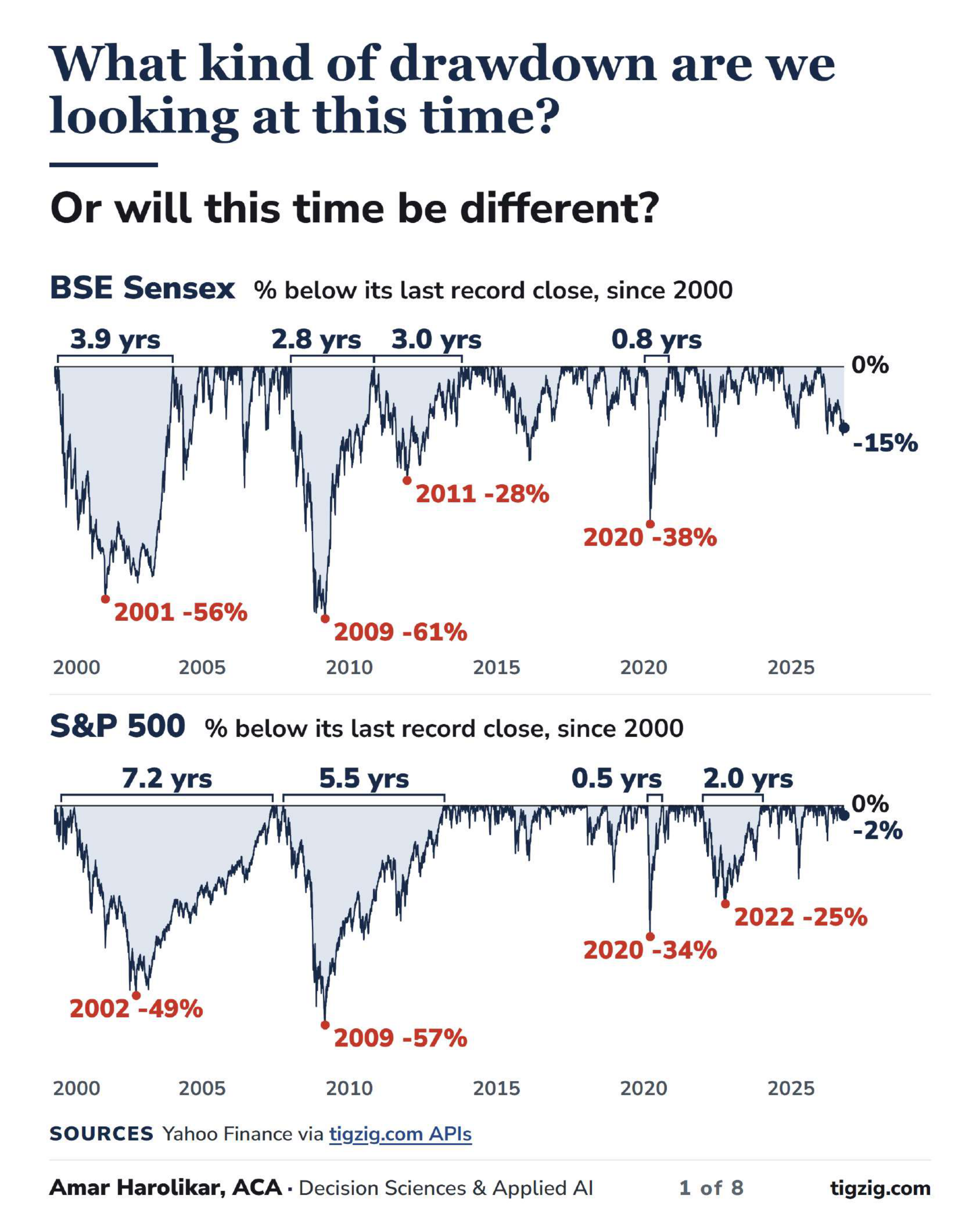
Could This Time Be Different? Past Drawdowns, AI Valuations and Cracks Across Markets and the Economy
An 8-page deck on what kind of drawdown the Sensex and the S&P 500 are in. The Nifty 50 and the Sensex are about 15% below their January highs, and since 2000 the big falls in the Sensex and the S&P 500 took anywhere from five months to seven years to recover. Pages cover stress across stock markets, oil, gold, US jobs, consumers and housing, the warnings on AI debt and valuations, and the other side.
A Crescendo of Warnings on AI Debt and Returns: S&P Global, Gartner, Morgan Stanley, the IMF and the World Bank in One Month
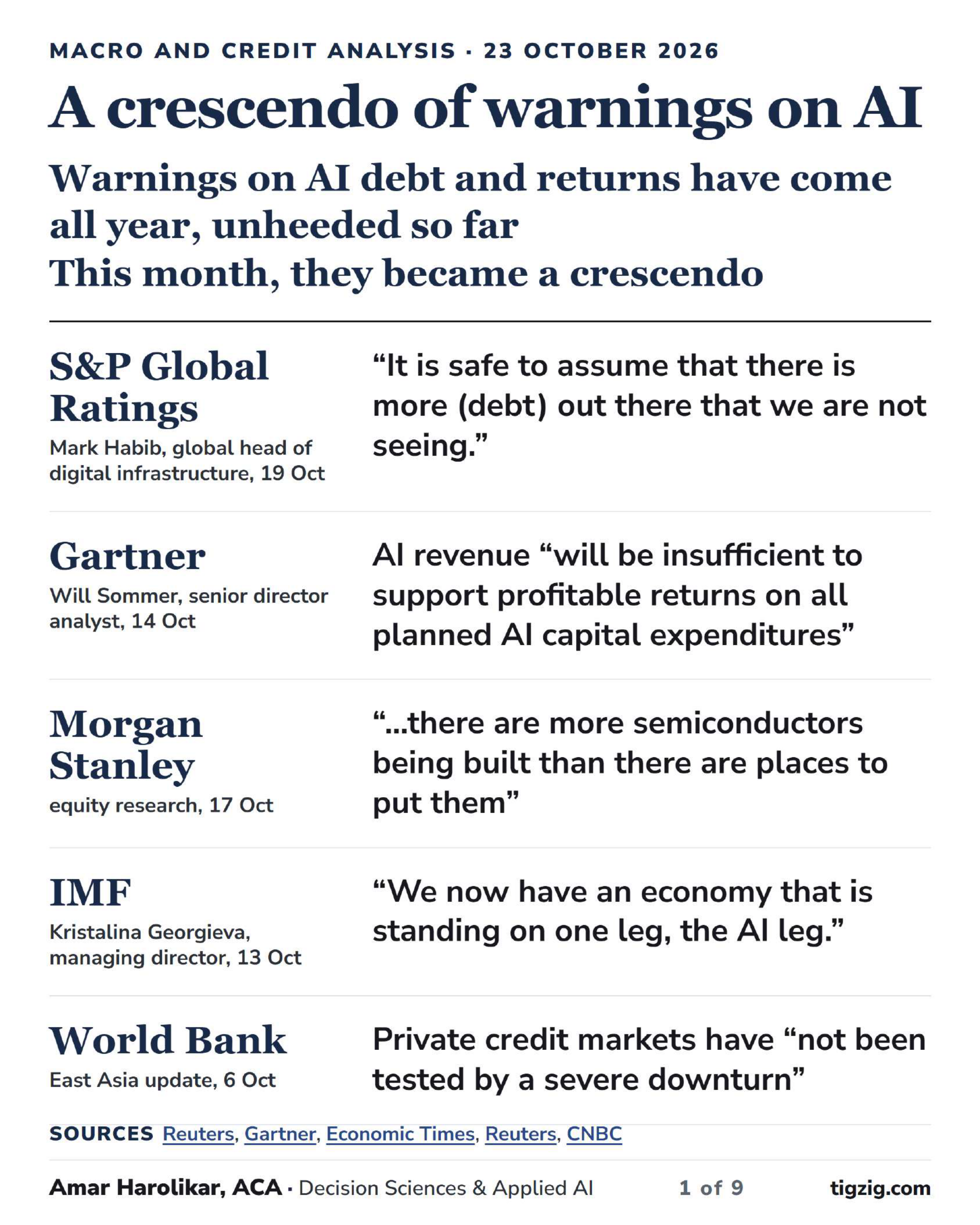
A 9-page deck on the warnings about AI debt and returns this month from S&P Global, Gartner, Morgan Stanley, the IMF and the World Bank. Insurance on CoreWeave's debt is above 1,000 basis points and Oracle's has more than doubled this year. Gartner sees AI revenue to 2030 at no more than 3.6 trillion dollars against 8.5 trillion needed for a 12% return. On 22 October AI stocks pulled markets down from Seoul to New York and the US 10-year fell below 5%.
US Housing, October 2026: Mortgage Rates Above 2007-08, Pending Sales at a Record Low and More Mortgages Turning Late
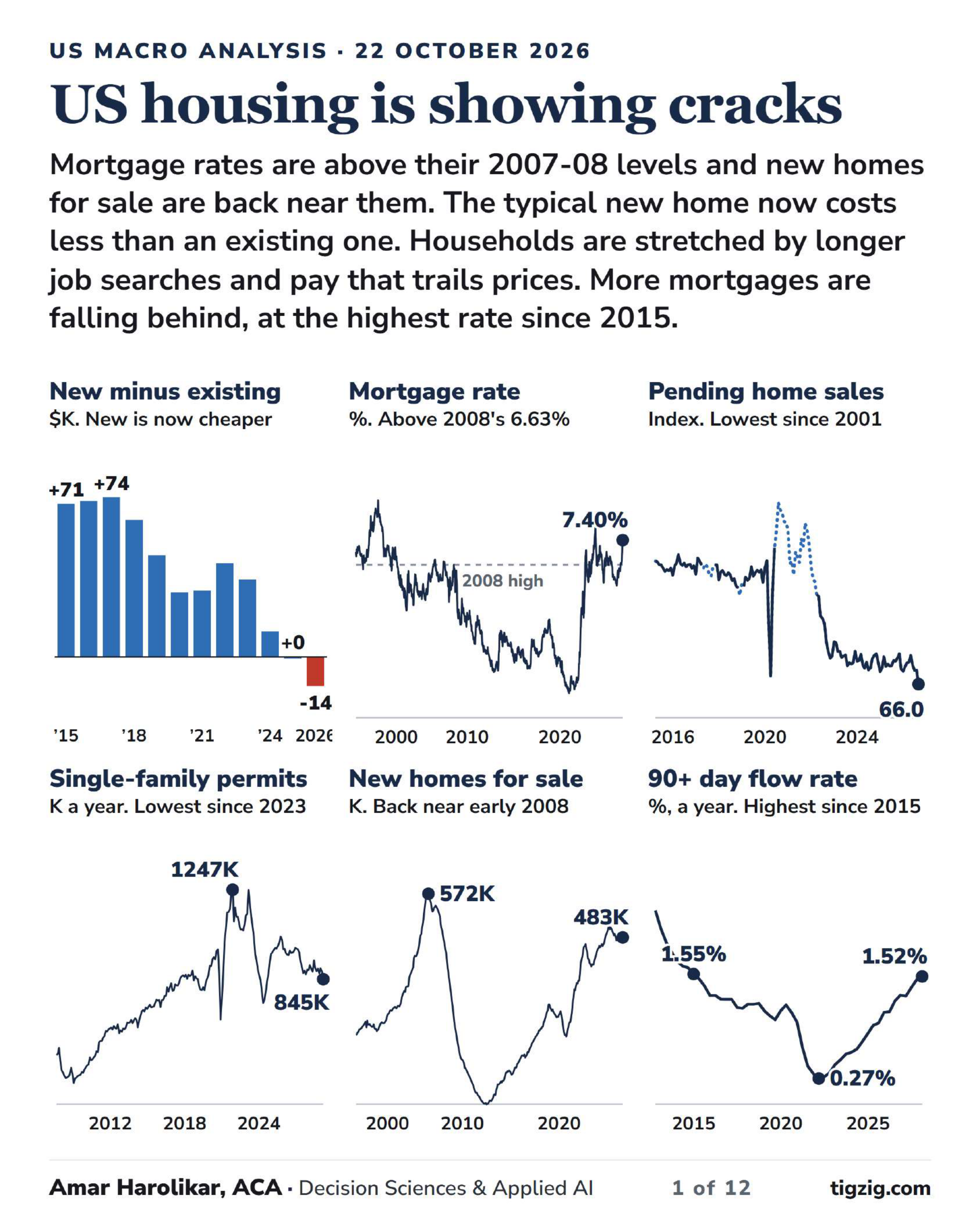
A 12-page deck on US housing in October 2026. The 30-year mortgage rate is 7.40%, above 2007-08 levels, and NAR's pending home sales index fell to 66.0, the lowest since it began in 2001. Builder sentiment is the lowest since 2012, about 483,000 new homes are unsold, and the share of mortgage balances turning 90+ days late is the highest since 2015, still far below 2009. Most owners are locked into cheaper loans.
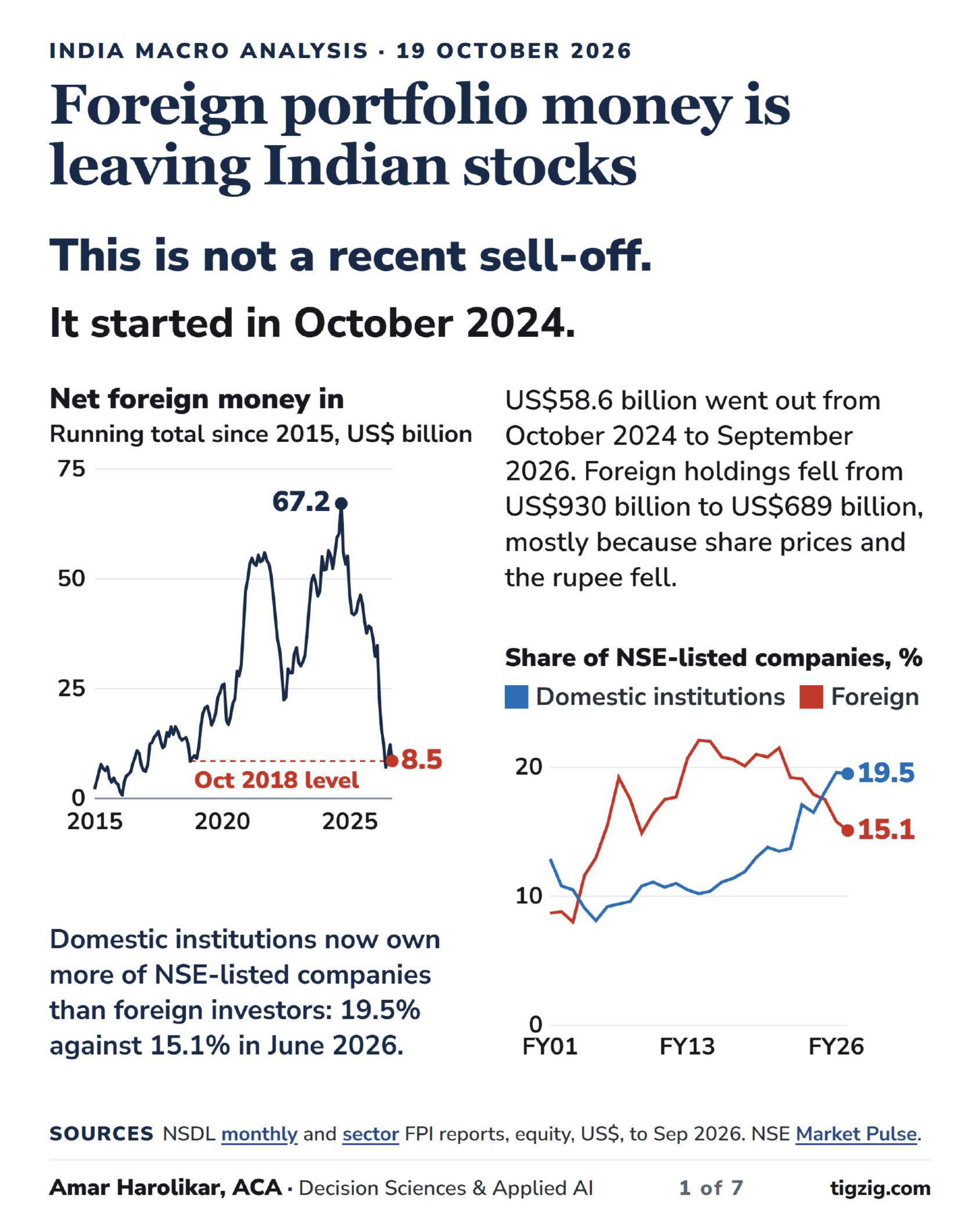
Foreign Portfolio Money Is Leaving Indian Stocks: US$58.6 Billion Out Since October 2024
A 7-page deck on foreign portfolio investors leaving Indian shares: US$58.6 billion net out from October 2024 to September 2026, more than the US$37.0 billion put in during the 2023-24 rally. They net sold US$79.5 billion on the exchanges while putting US$20.9 billion into primary deals. Their share of NSE-listed companies fell to 15.1%, below domestic institutions at 19.5%. Selling was broad, led by financials and IT. NSDL and NSE data.
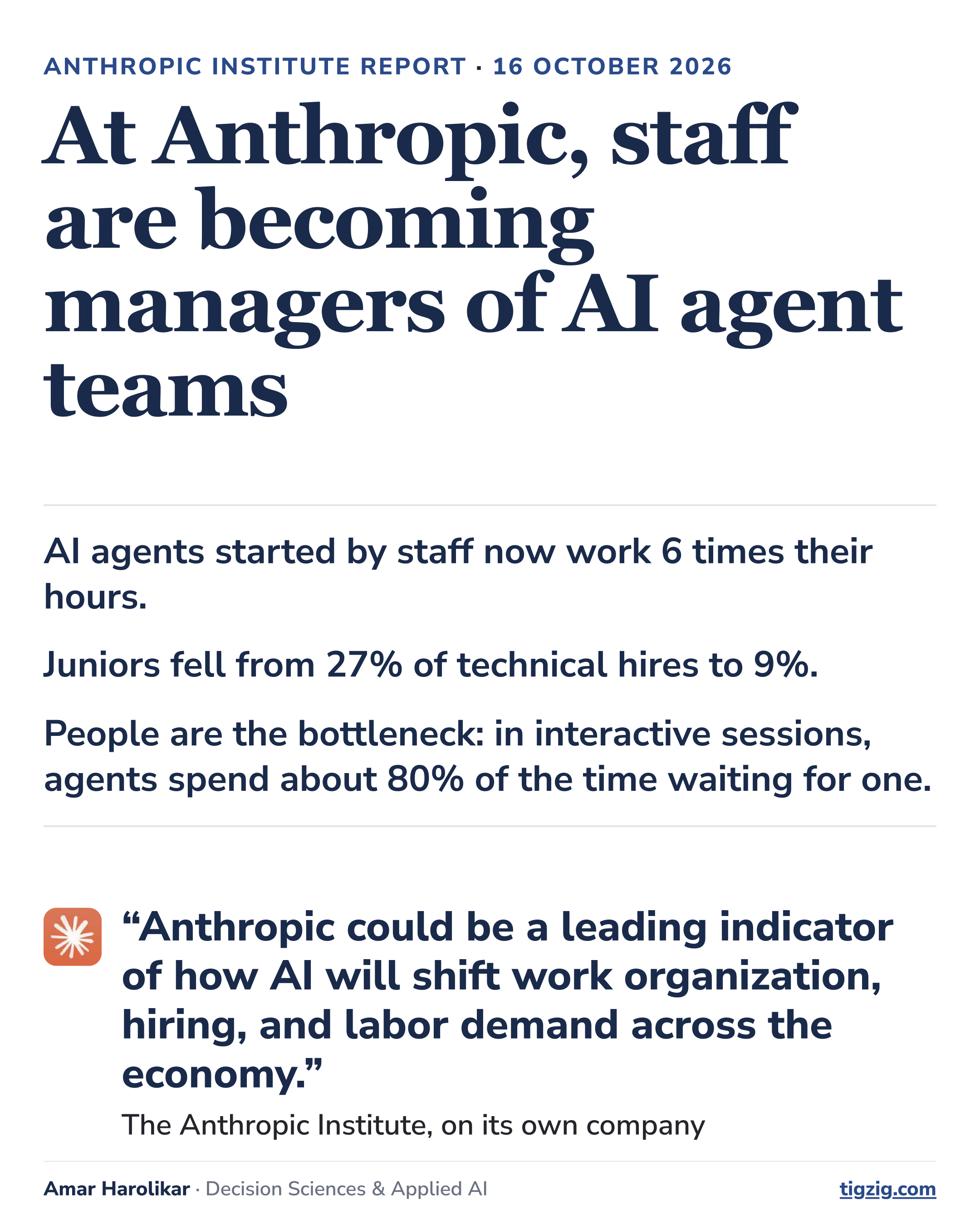
Staff at Anthropic Are Becoming Managers of AI Agent Teams. Anthropic's Report on How Work Changed Inside the Company
An 8-page deck on Anthropic's report on how work changed inside the company, from its own internal data. Agents started by staff now work 6 times their hours, 19 times in research teams. Commits per engineer are 5.1 times their December 2025 level. The junior share of technical hires fell from 27% to 9%. In interactive sessions agents spend about 80% of the time waiting for a person. The last page shows how I run my work with a team of Claude sessions.
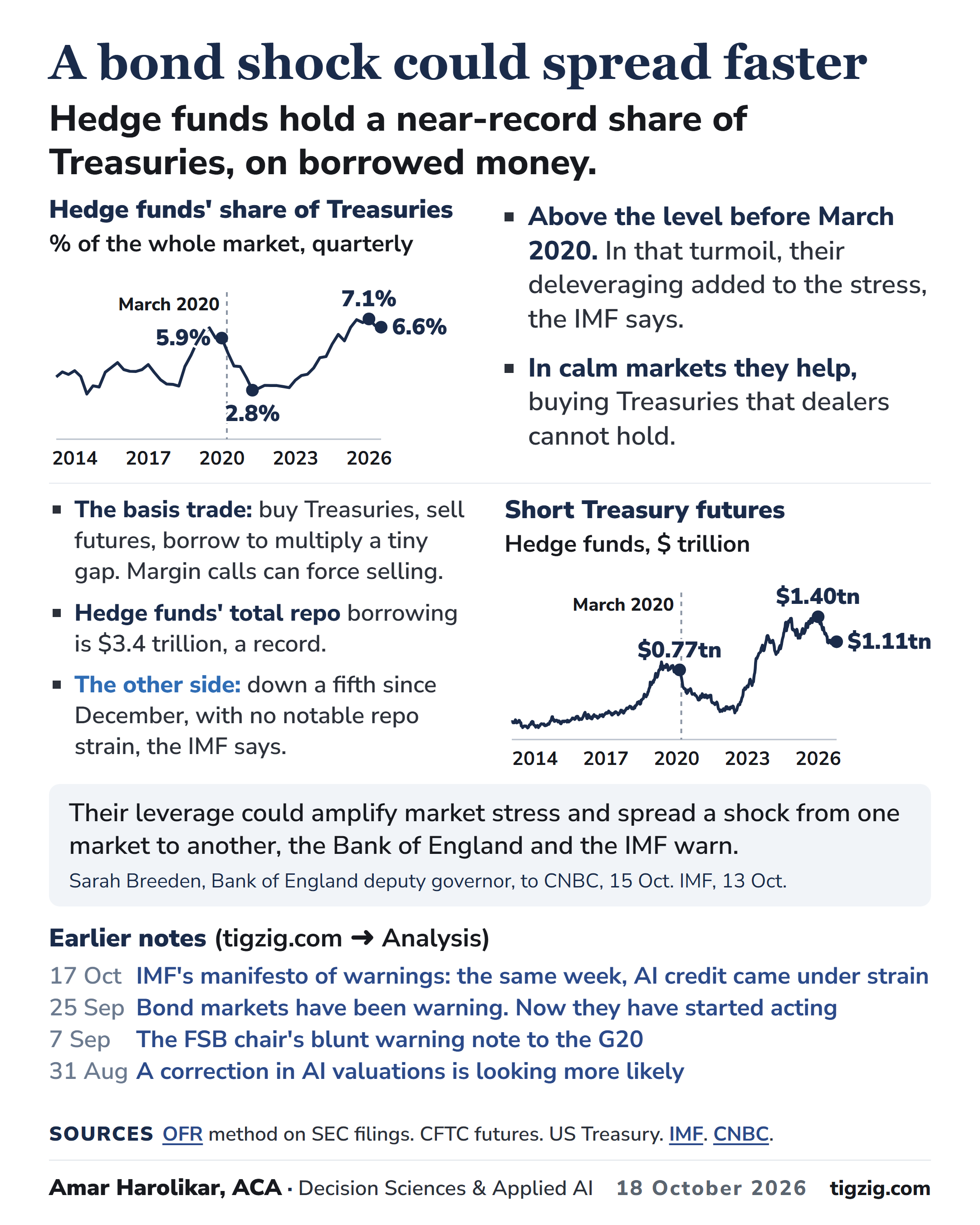
A Bond Shock Could Spread Faster: Hedge Funds Hold a Near-Record Share of Treasuries, Much of It on Borrowed Money
Hedge funds held about 6.6% of US Treasuries in June, near their record and up from 5.9% before the March 2020 turmoil, much of it in the leveraged basis trade. Their repo borrowing is a record 3.4 trillion dollars. The Bank of England and the IMF warned this week that this makes a shock more likely to spread across markets. The trade has come down about a fifth since December without notable strain, but leverage remains.
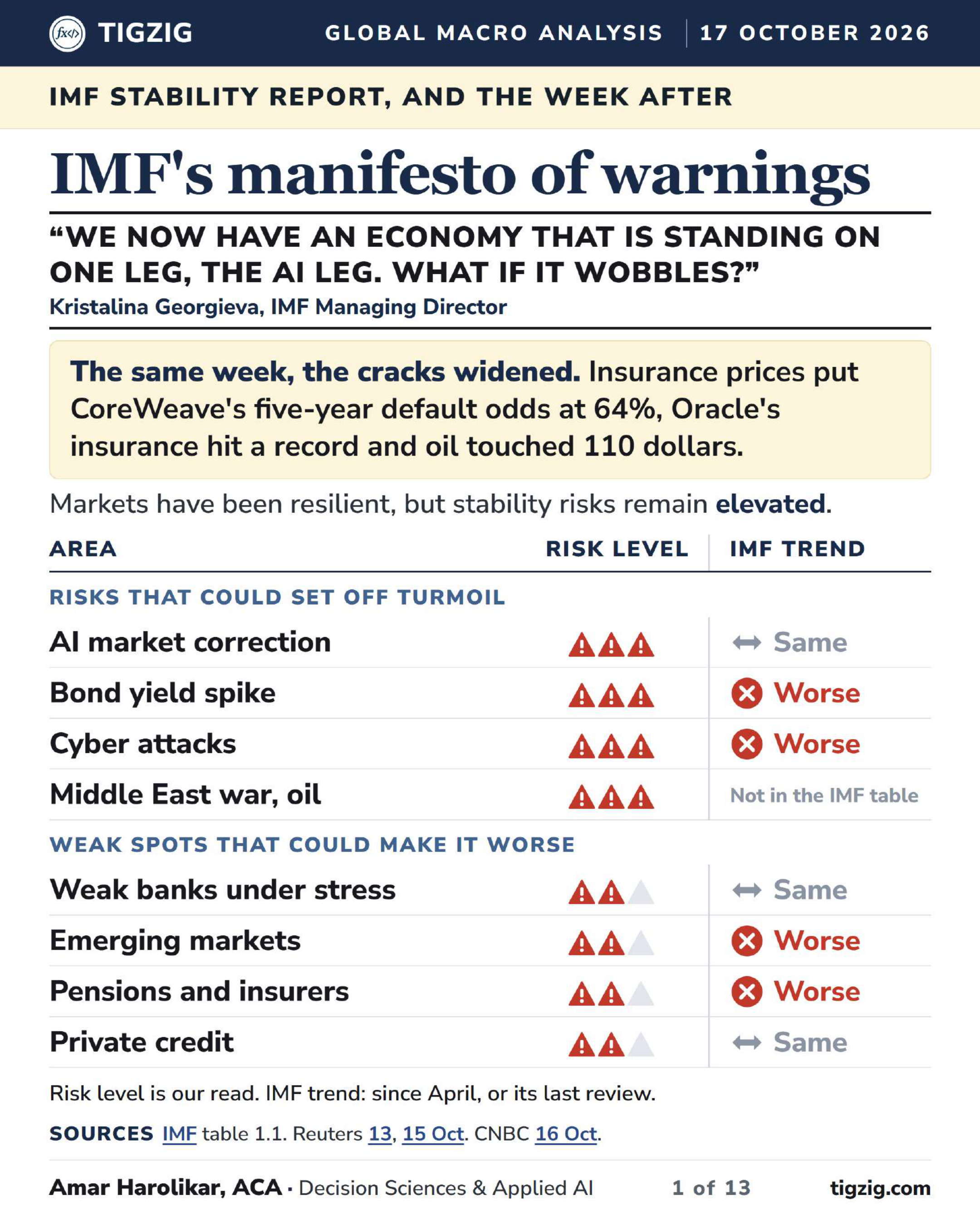
IMF's Manifesto of Warnings: In the Same Week, AI Credit Came Under Strain
A 13-page deck on the IMF's October 2026 Global Financial Stability Report and the week after it. The IMF flagged AI, bond yields and cyber attacks, and counted 14 circular AI deals. The same week insurance on CoreWeave's debt passed 1,000 basis points and Oracle's hit a record. Ten-year yields in four markets hit 17 to 30 year highs, and hyperscaler free cash flow fell to 2.2 billion dollars in the June quarter.
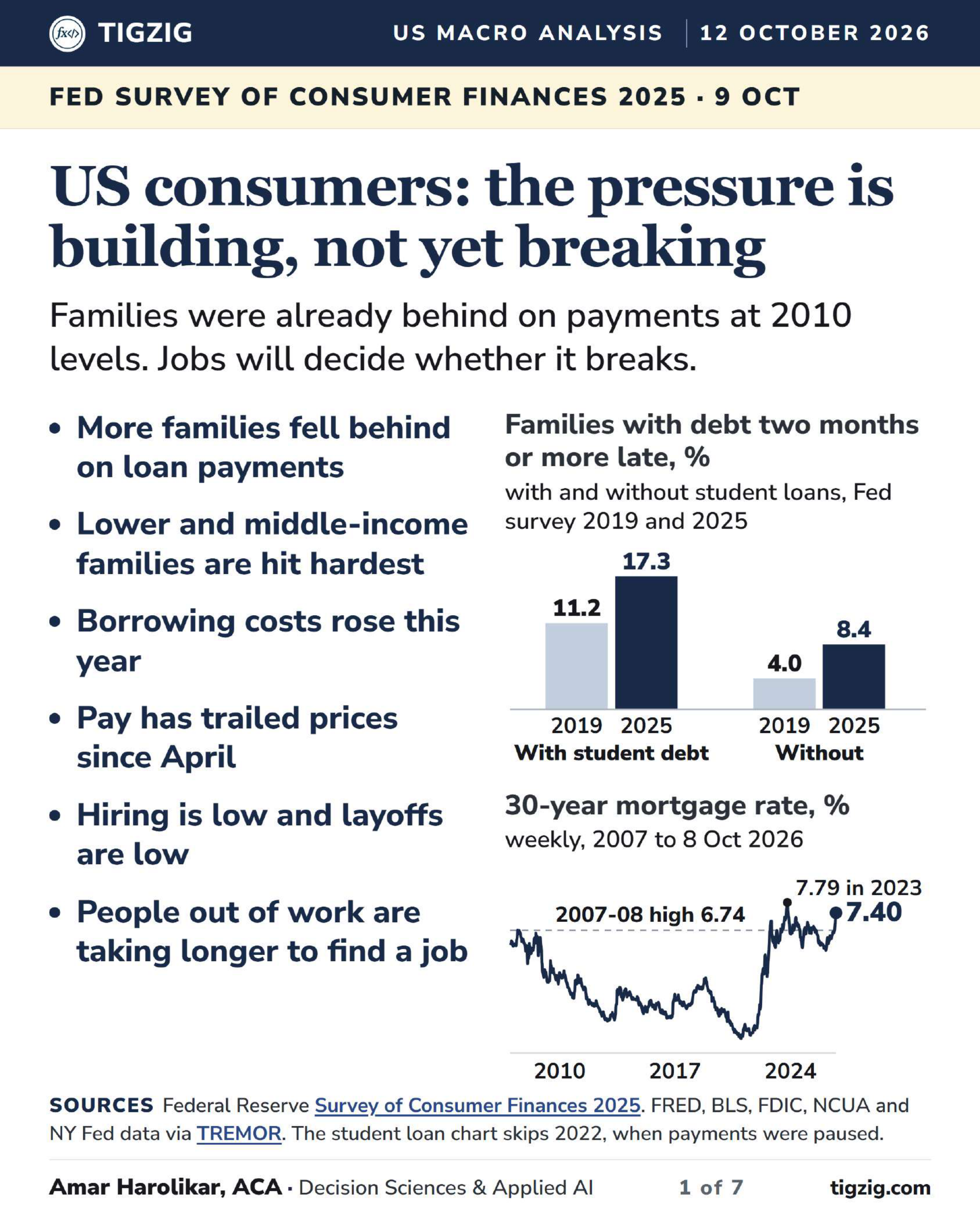
US Consumers: The Pressure Is Building, Not Yet Breaking
Per the Fed's 2025 Survey of Consumer Finances, 19.6% of US families were behind on a loan payment, the highest since the 2007 survey, and 25.3% of bottom-fifth families with debt were two months or more late, the highest since 1989. In 2026 the 30-year mortgage rate rose to 7.40%, energy prices are up 16.3% on a year and pay has trailed prices since April. Lender data is under pressure but not broken. Jobs decide what comes next. Seven-page deck. Personal analysis.
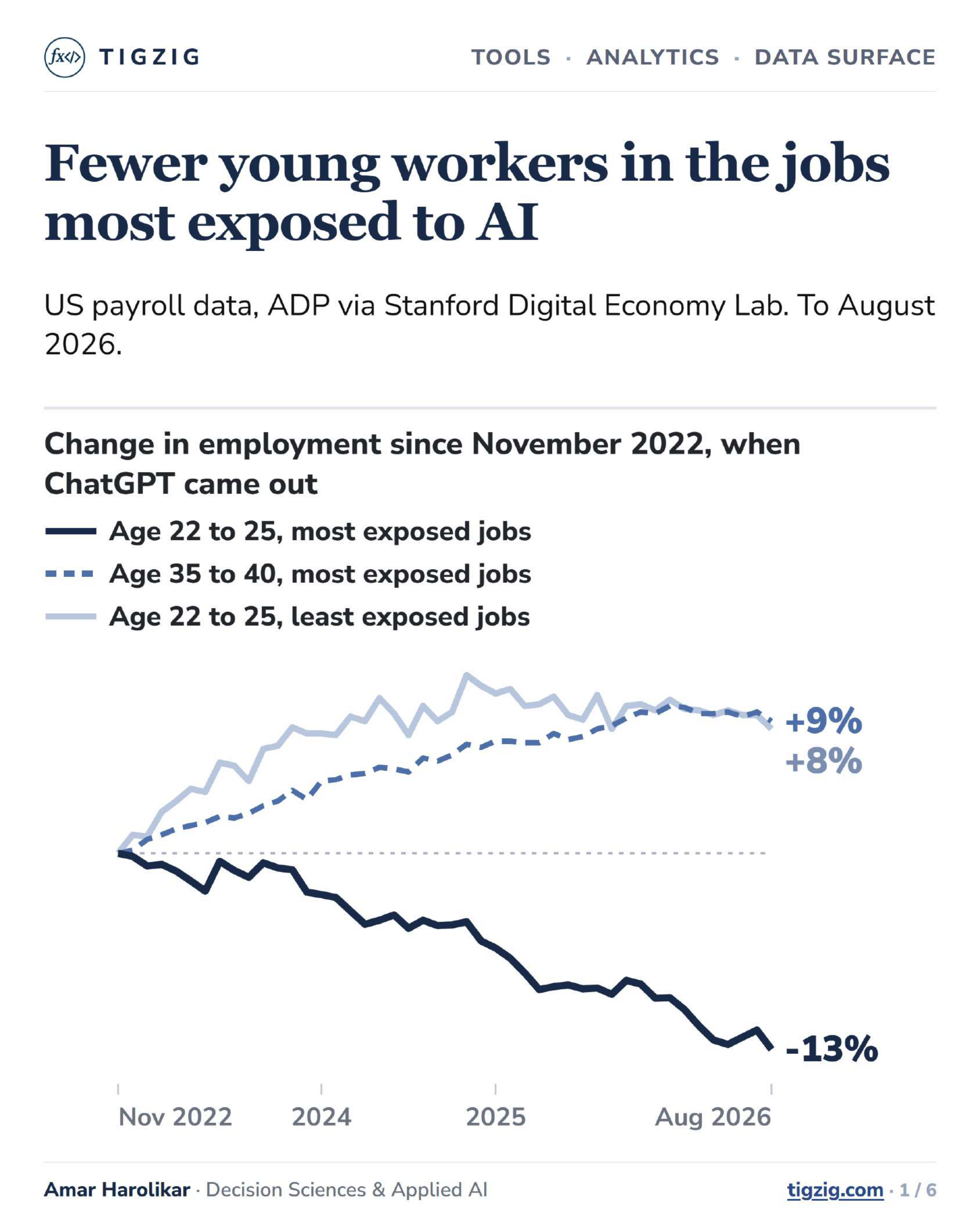
Fewer Young Workers in the Jobs Most Exposed to AI: US Payroll Data via Stanford, and Yale's Counterpoint
In ADP payroll data analysed by Stanford's Digital Economy Lab, employment of 22 to 25 year olds in jobs where AI most often does the task is down about 11% since November 2022, while workers aged 41 to 49 are up in every group of jobs. Software developers and customer service show the sharpest fall for young workers. Yale's Budget Lab, using the Current Population Survey, finds no clear economy-wide sign of AI so far. Six-page deck with sources. Personal analysis.
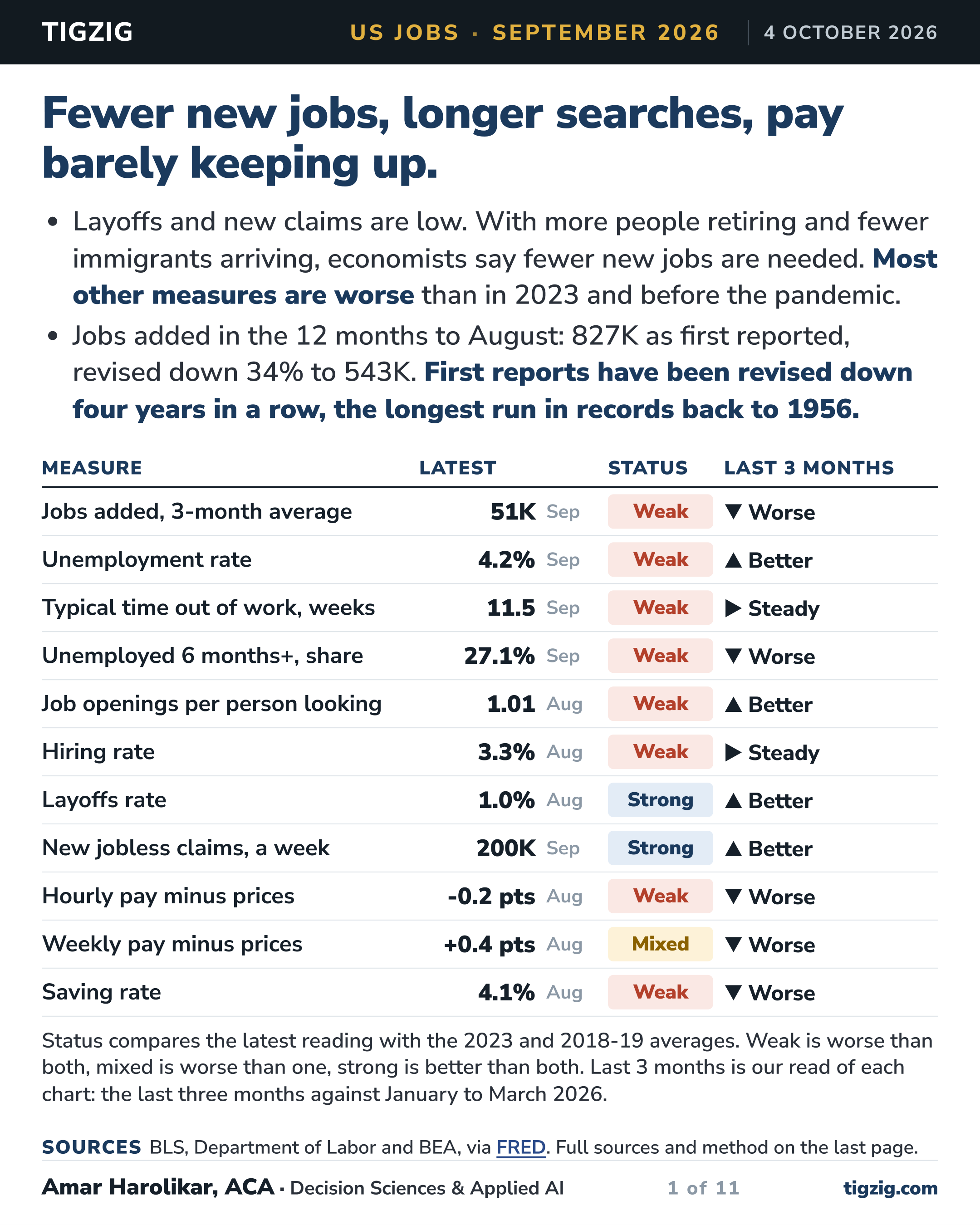
US Jobs, September 2026: Fewer New Jobs, Longer Searches, Pay Barely Keeping Up
The US added 29,000 jobs in September 2026, and the 12 months to August were revised down from 827,000 to 543,000, a fourth straight year of downward first-report revisions, the longest run in records back to 1956. Health care carries job growth, unemployment is 4.2 per cent, spells of unemployment are longer, more claimants exhaust benefits, and hourly pay has trailed prices since April. Eleven-page deck rating 11 measures against 2023 and 2018-19. Personal analysis.
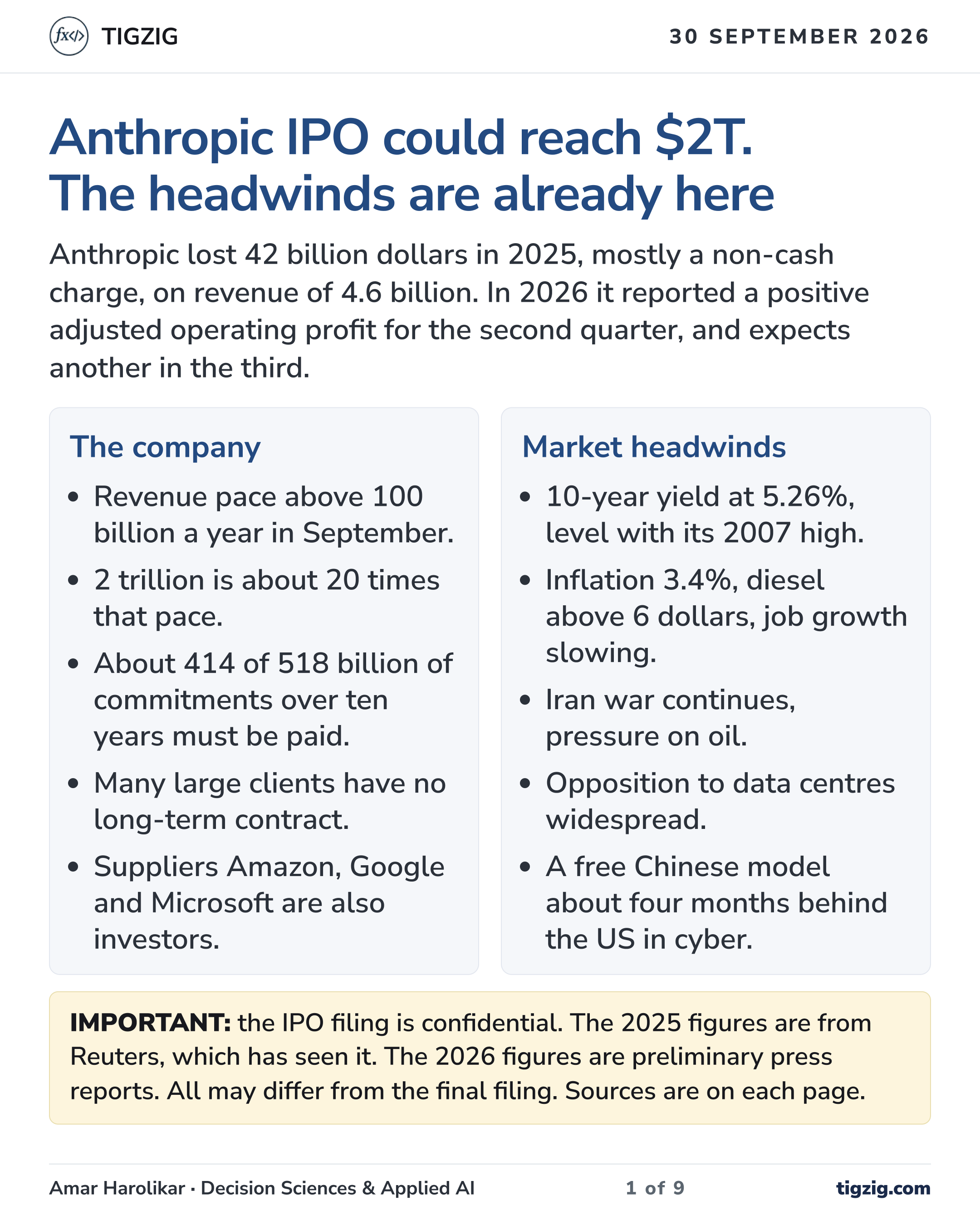
Anthropic IPO Could Reach $2T. The Headwinds Are Already Here
Reuters reports Anthropic's IPO could value it at more than 2 trillion dollars. A personal note on the market it would list into: a 2025 net loss of 42 billion dollars, mostly a non-cash charge, on 4.6 billion of revenue; a positive adjusted operating profit reported for Q2 2026; about 414 of 518 billion of computing commitments that must be paid; bond yields at a 2007 high, inflation, diesel, data centre opposition and a free Chinese model close behind in cyber. Nine-page deck. Personal views, not investment advice.
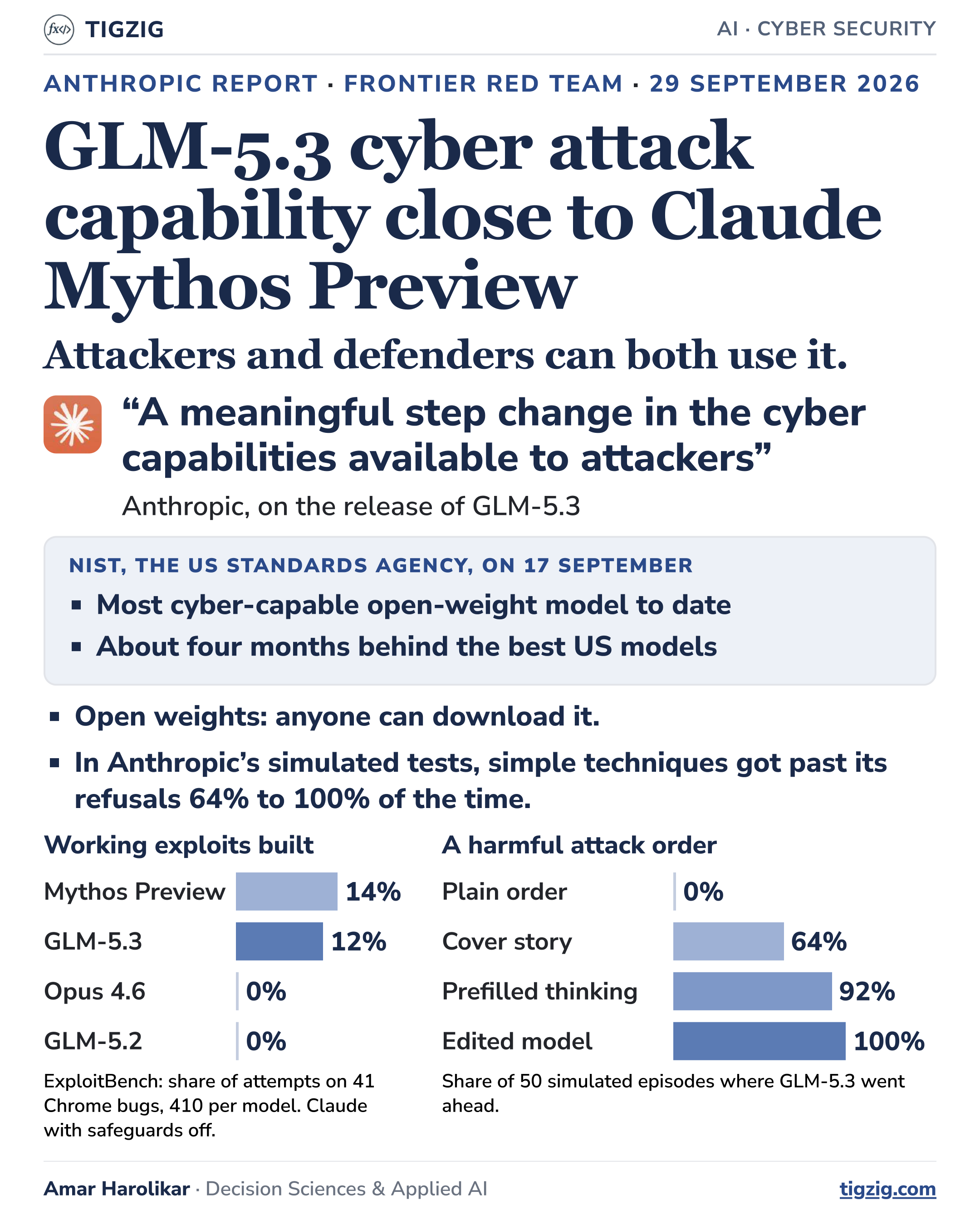
GLM-5.3 From Z.ai, Like Claude Mythos Preview, Can Build Cyber Exploits on Its Own, Anthropic Finds
Anthropic's Frontier Red Team tested GLM-5.3, an open-weight model from Zhipu AI, known outside China as Z.ai, and found it built a working Chrome exploit in 50 of 410 attempts against 56 for Claude Mythos Preview. NIST calls it the most cyber-capable open-weight model to date, about four months behind the best US models. Anthropic's tests show its refusals give way 64% of the time to a cover story and 100% once the refusals are edited out, which cost about 4,400 dollars of computing. Ten-page deck with the key findings and a link to the full report.
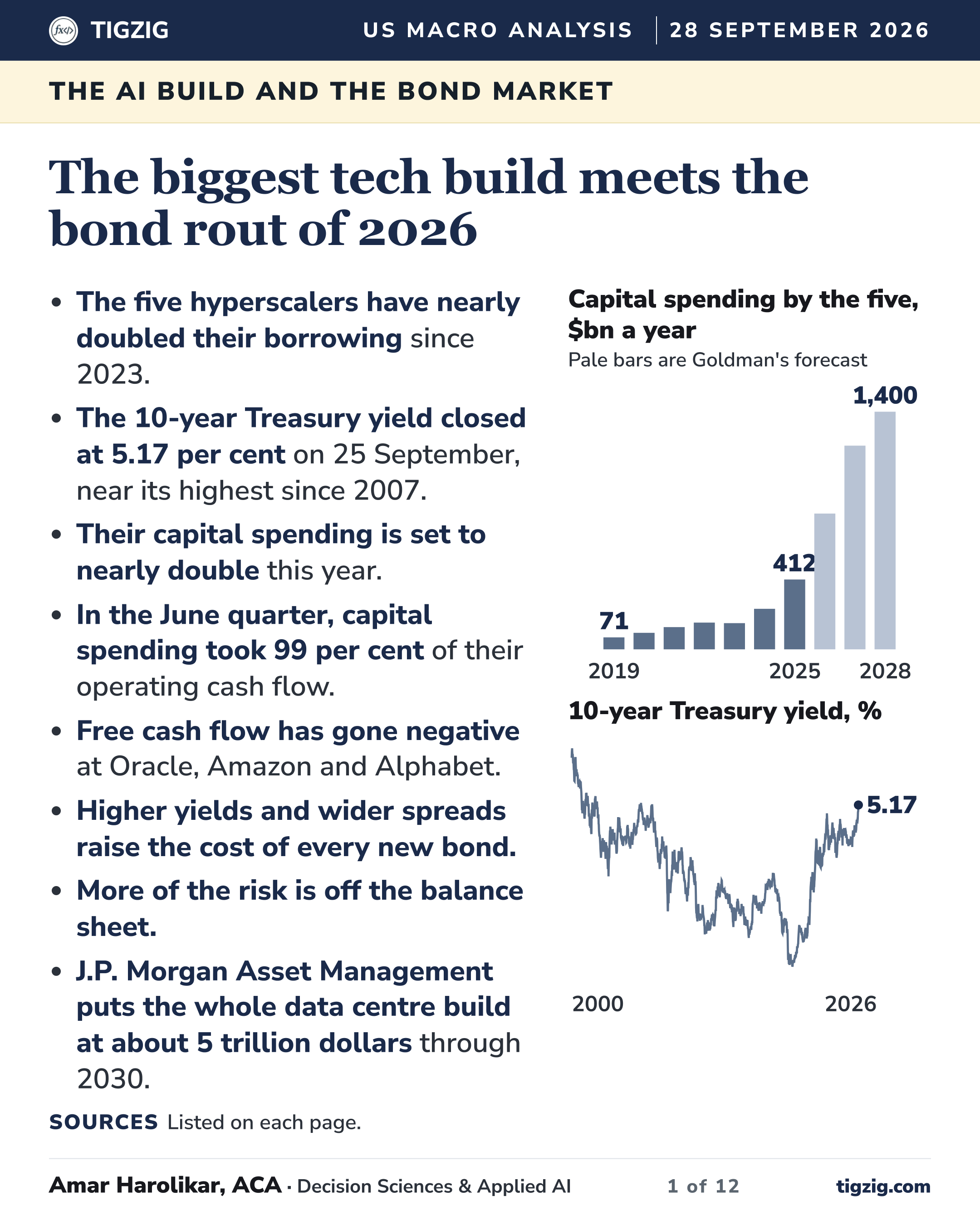
The Biggest Tech Build Meets the Bond Rout of 2026
Goldman expects the five hyperscalers to spend $3.4 trillion on AI over the next three years, nearly 3x the prior seven, just as the 2026 bond rout pushes yields to their highest since 2007. Free cash flow has gone negative at Alphabet, Oracle and Amazon; capital spending took 99% of the five hyperscalers operating cash flow in the June quarter; their borrowing has nearly doubled since 2023 to $483 billion, with J.P. Morgan Asset Management expecting $279 billion more in bond sales this year. Twelve-page deck covers the off-balance-sheet leases and guarantees, and the wider $5 trillion data centre build through 2030.
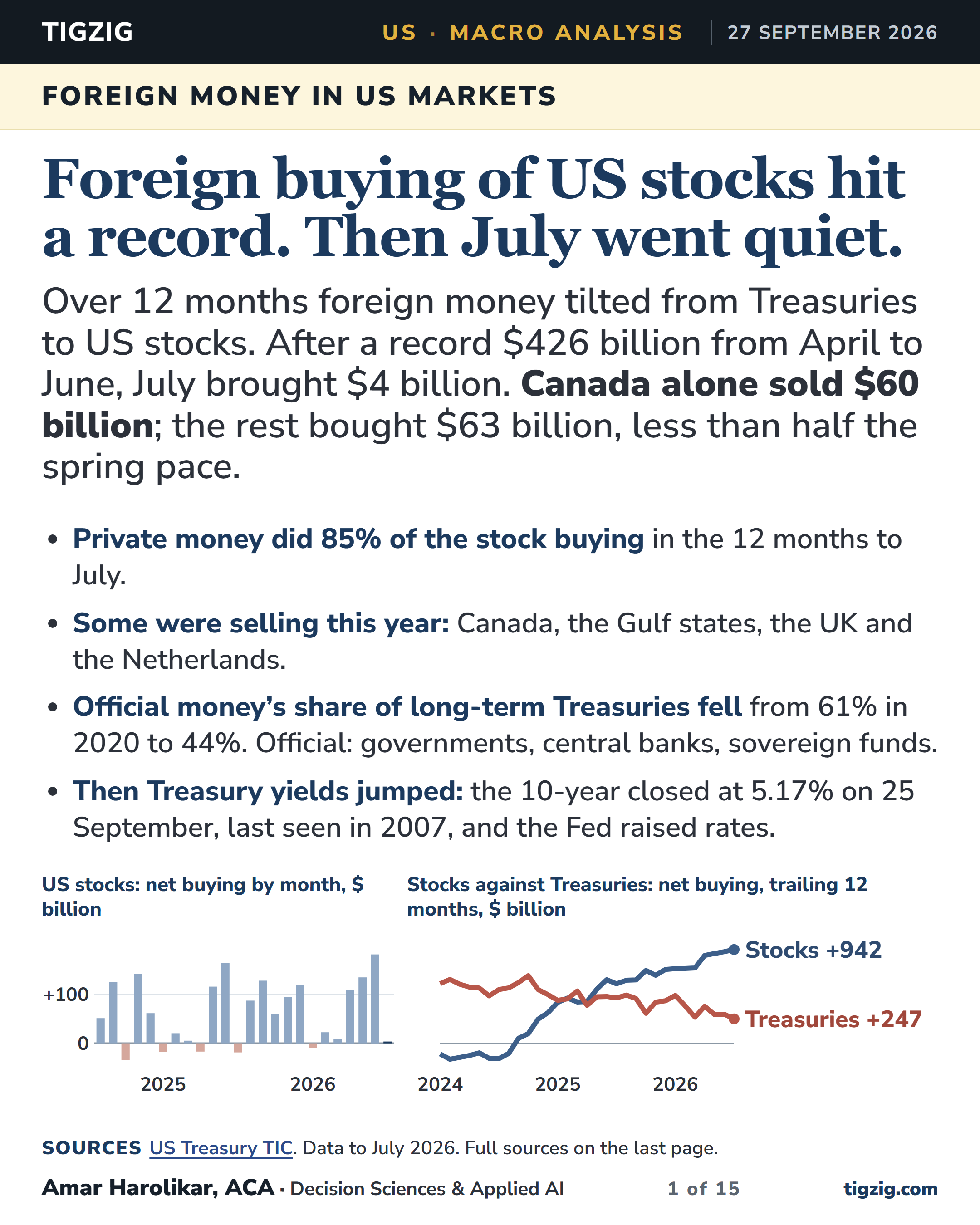
Foreign Buying of US Stocks Hit a Record. Then July Went Quiet.
Foreigners bought a record $942 billion of US stocks in the 12 months to July, then bought only $4 billion in July as Canada alone sold $60 billion. Money tilted from Treasuries to stocks: Treasury buying fell to $247 billion from $541 billion two years earlier. Private money did 85% of the stock buying, and official money (governments, central banks, sovereign funds) holds only 11% of foreign-held US stocks, with its share of long-term Treasuries down from 61% in 2020 to 44%. The 10-year yield then closed at 5.17% on 25 September, last seen in 2007. Fifteen-page deck with full country tables, sourced from US Treasury TIC files.
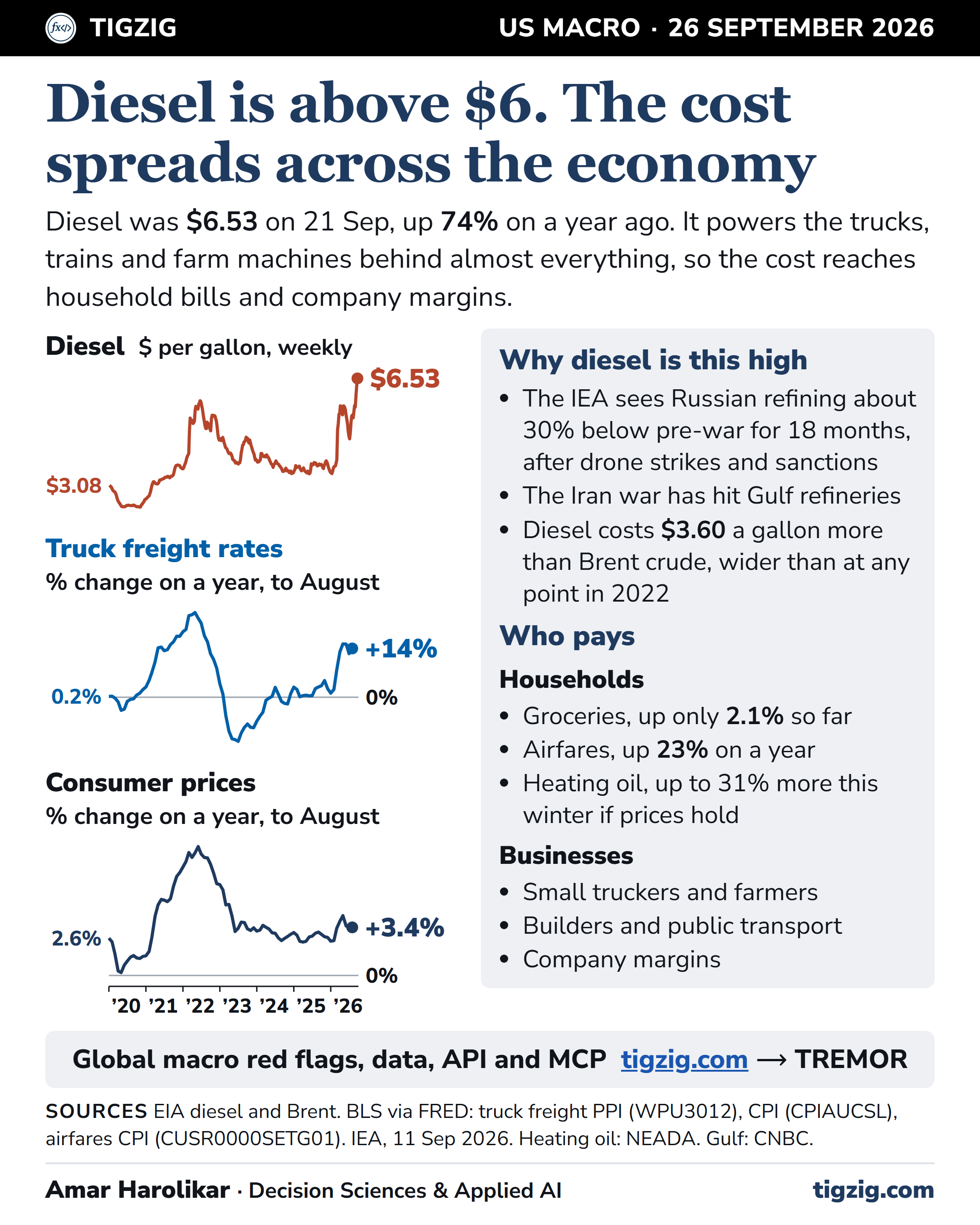
US Diesel Is Above $6 a Gallon for the First Time, and the Cost Is Already Moving Through the Economy
US diesel hit $6.53 a gallon on 21 September, up 74% on a year ago, and the cost is already moving through the economy: truck freight rates up 14%, airfares up 23%, heating oil forecast up to 31% higher this winter. The squeeze is in refining, with diesel about $3.60 a gallon above Brent crude, wider than at any point in 2022, as Russian refining stays about 30% below its pre-war level for the next 18 months. Washington is weighing a ban on diesel exports, with no decision yet.
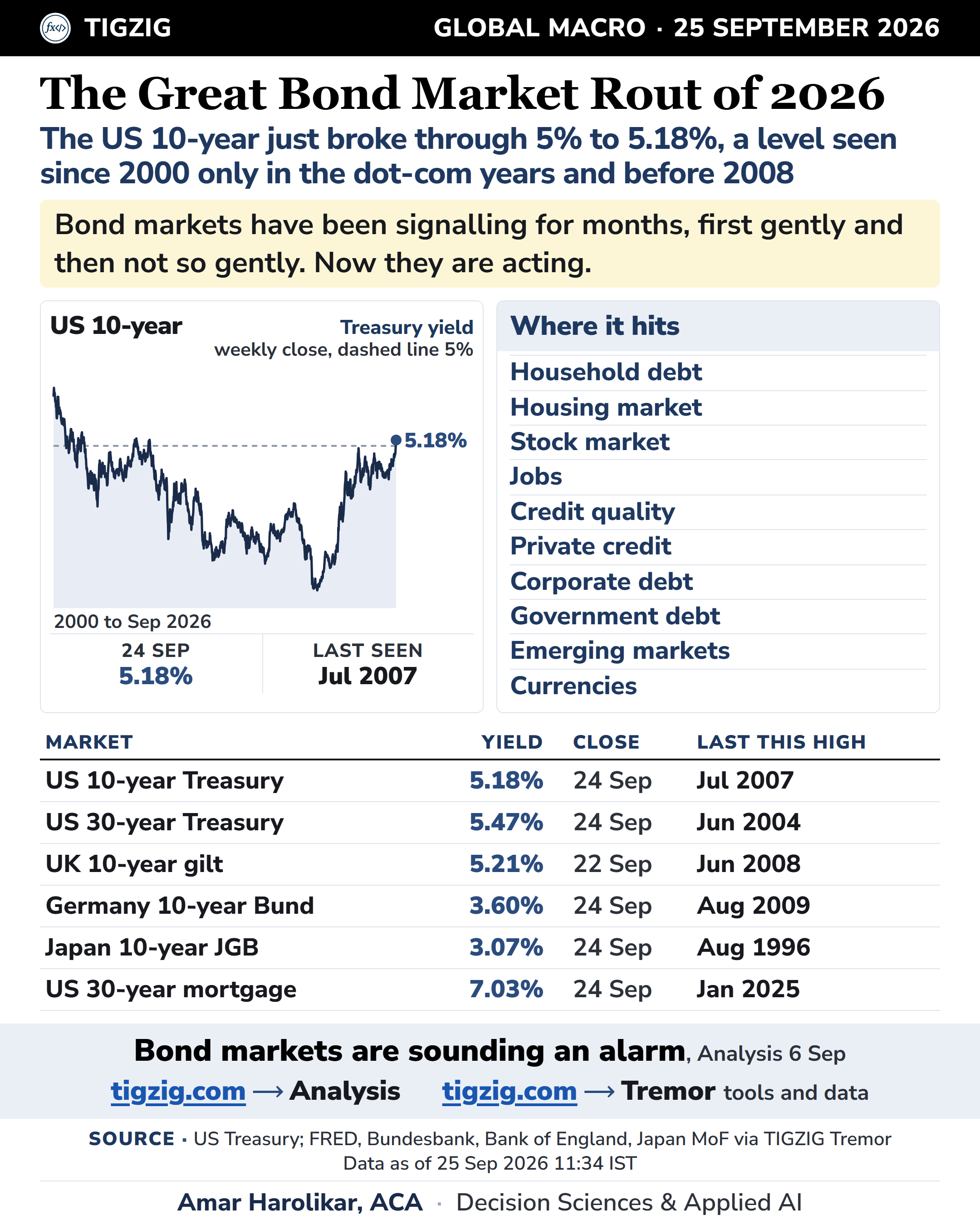
Bond Markets Have Been Warning for Months. Now They Have Started Acting.
A follow-on to the 6 September bond markets post. The US 10-year closed above 5 per cent for the first time since 2007, a level seen since 2000 only in the dot-com years and the run-up to 2008. Almost all of the rise is the real yield, the TIPS measure of the return lenders want above inflation: over one year the 10-year rose 0.99 points while expected inflation fell 0.02. Japan's 10-year is at its highest since August 1996. Links to earlier analysis on the Fed, banks and AI valuations.
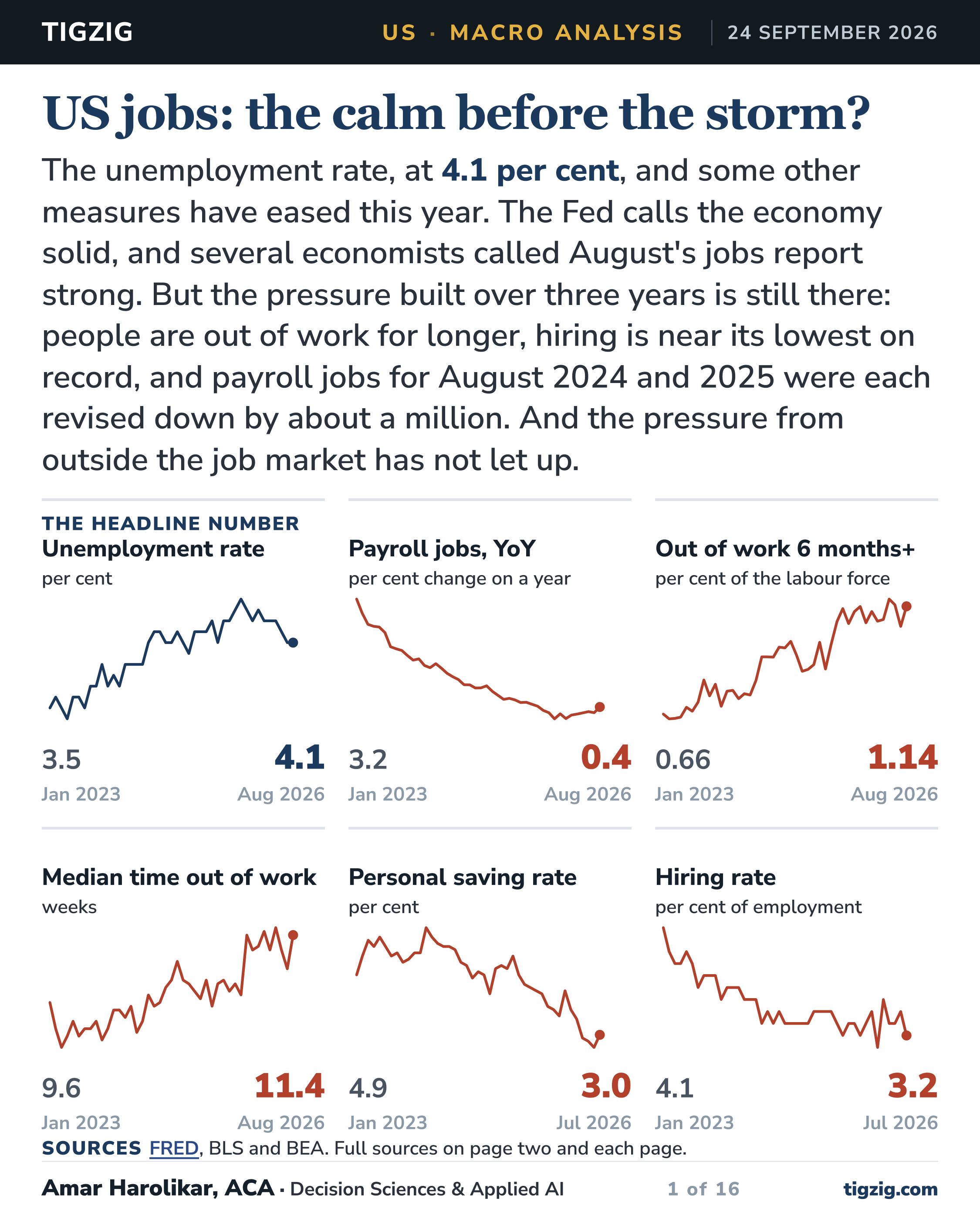
On the Headline Numbers the US Job Market Looks Fine. The Story Changes When You Dig Deeper.
A 16-page deck on the US job market as of September 2026. The August jobs report beat expectations and the Fed called the economy solid, but payroll growth has slowed from 3.2 per cent a year in January 2023 to 0.4 per cent, the August 2024 and 2025 counts were each revised down by about a million, hiring is near its lowest on record and the median time out of work rose from 9.6 to 11.4 weeks. Hourly pay has trailed prices five months running and the saving rate is 3.0 per cent, while layoffs stay low. Plus the survey quirks that trip up labour data.
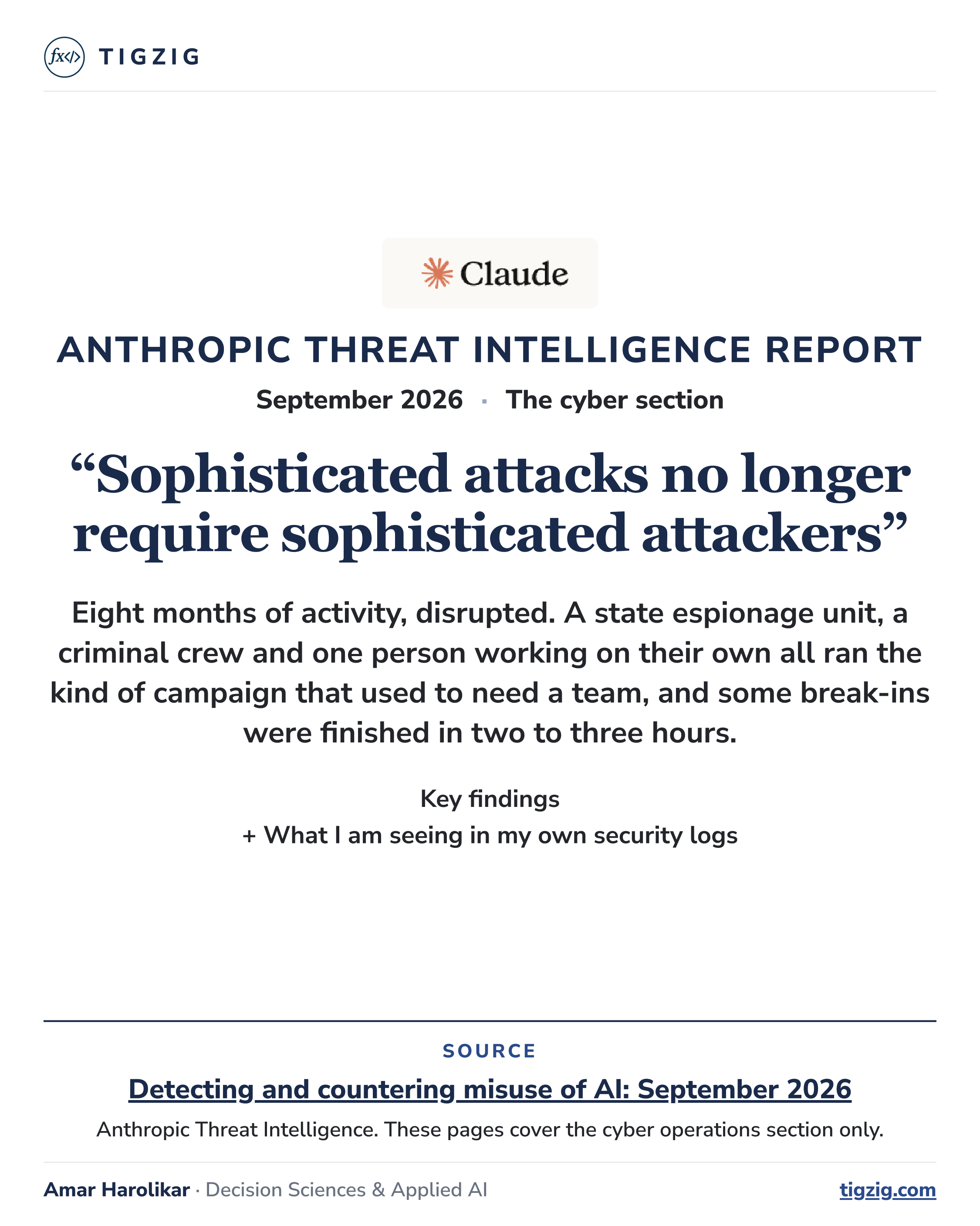
Sophisticated Attacks No Longer Require Sophisticated Attackers. Anthropic's September Threat Intelligence Report, and What I See in My Own Logs.
A 13-page deck on the cyber operations section of Anthropic's September 2026 threat intelligence report. A Russian espionage group left its AI rewriting malware until no security product could detect it, one operator downloaded 1.8 million phone apps to read the credentials developers had left inside them, and a third built a loop that reads a security product's code and keeps writing attacks until one works. The ways in are the familiar ones, stolen credentials, unpatched gateways, exposed services, SQL injection and phishing, and the difference is speed and scale: one break-in ran from a stolen developer login to full administrative control of a cloud in about three hours. Plus hotel guest wifi turned into a malware delivery system, and what has changed in my own edge logs since January.
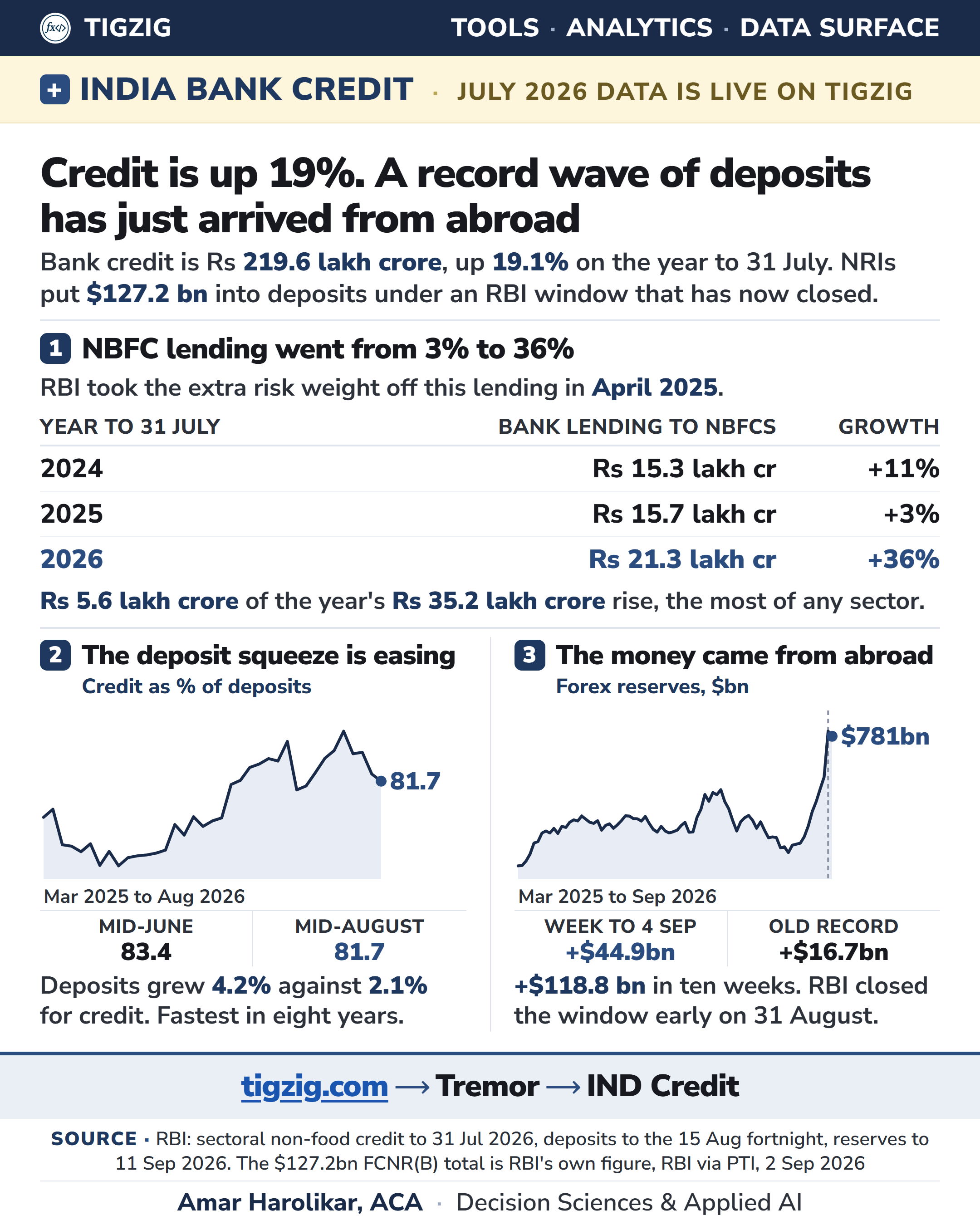
India Bank Credit Is Up 19 Percent, and the Biggest Single Contributor Is Lending to NBFCs
India's July 2026 sectoral credit data is live on TREMOR. Non-food bank credit is Rs 219.6 lakh crore, up 19.1 percent over the year, and bank lending to NBFCs is the single biggest contributor, at Rs 21.3 lakh crore and Rs 5.6 lakh crore of the Rs 35.2 lakh crore the book added. RBI's extra 25 point risk weight on that lending came off in April 2025 and growth went 11, then 3, then 36 percent across the three Julys. Also covers why the Rs 5.5 lakh crore gold jewellery line is banks only against ICRA's Rs 18 lakh crore organised market, the credit deposit ratio coming off its 83.38 high, and the FCNR(B) window and record reserves rise that land in the fortnights after the last deposit reading.
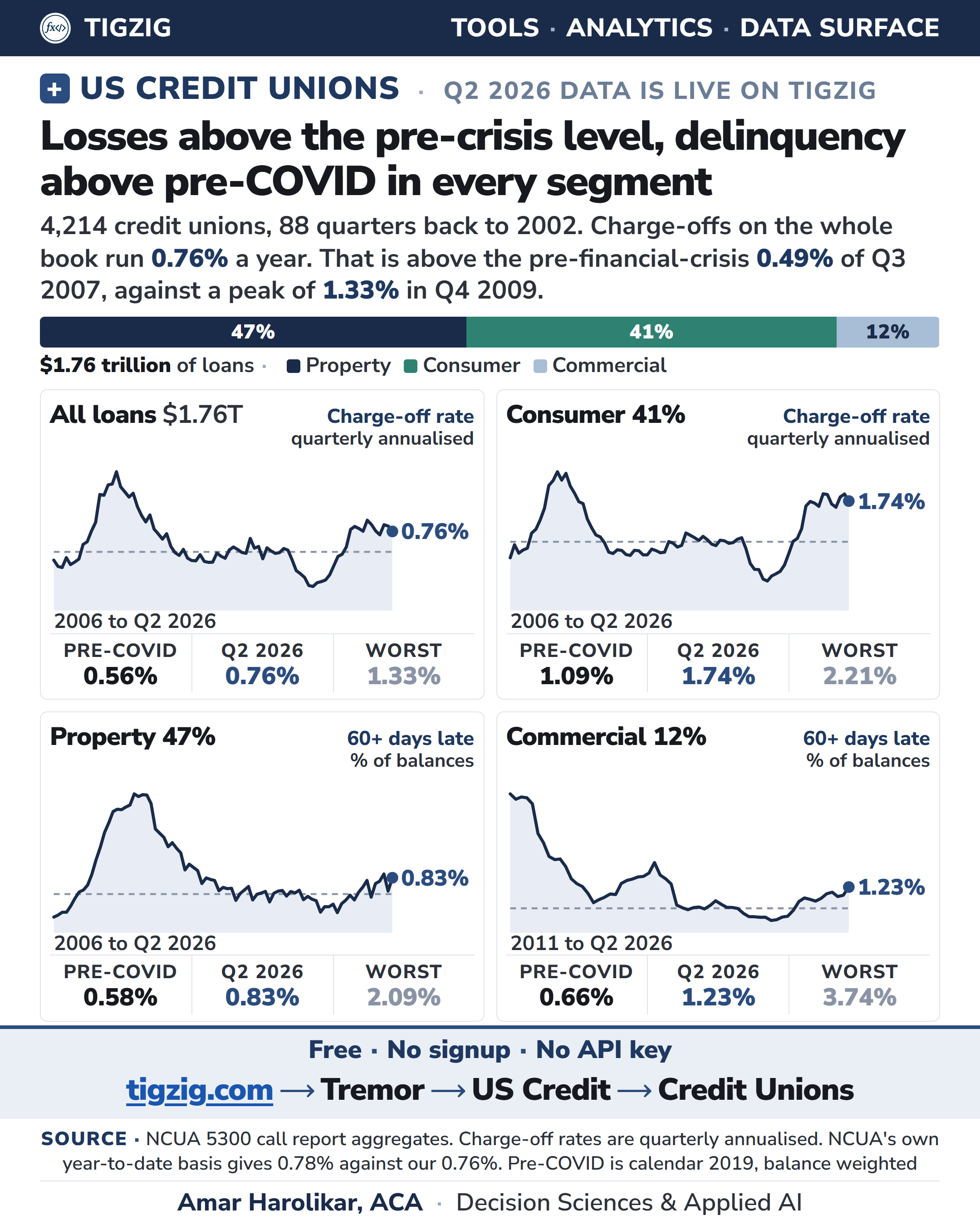
Credit Union Q2 2026: Losses Above Pre-Crisis, and Delinquency Above Pre-COVID in Every Segment
NCUA published Q2 2026 credit union data on 14 September and it is now on the TREMOR interactive tool and downloadable as a file. Charge-offs across all lending are 0.76 percent on a for-the-quarter annualised basis, above the 0.49 percent of Q3 2007 and the 0.56 percent pre-COVID level, against a 1.33 percent crisis peak. Sixty plus day delinquency is above its pre-COVID level in every segment. Consumer is doing most of the loss, at 1.74 percent against 1.09 before COVID, while property delinquency has risen from 0.58 to 0.83 with charge-offs unmoved at 0.02 percent. Also covers the changing shape of the 1.76 trillion dollar book, with property and commercial growing while auto shrinks in dollars, and the measurement basis behind each comparison.
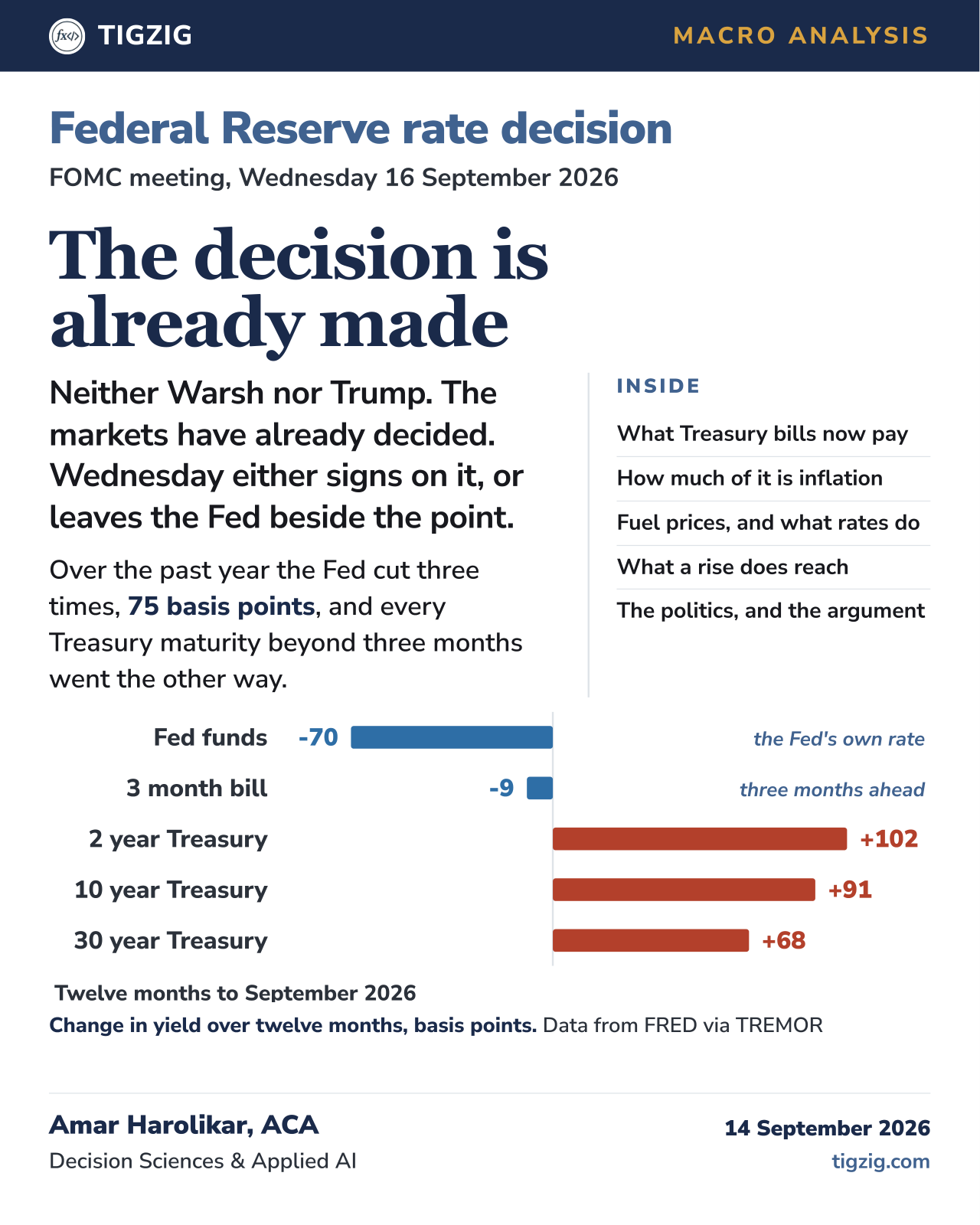
The Fed Is Caught. The Market Has Already Made Most of the Decision for It.
The FOMC decides on Wednesday 16 September and the market has largely priced it: a quarter point rise sits at 86 per cent on CME FedWatch against 33 per cent a month ago, and the three month Treasury bill is already at 4.00 per cent, exactly where that rise would put the top of the range. Over the past year the ten year Treasury rose 91 basis points and ten year TIPS rose 86, so the gap the market reads as expected inflation moved just 5 basis points and almost the whole rise is the real cost of money. That cost is paid on mortgages, refinancing and every government bond rolled over, whether the Fed moves or holds. A rate rise also does not reach the supply side pushing prices up, with diesel up 59.8 per cent over the year and petrol 30.8. Also covers the political campaign around the decision, Fed Chairman Warsh's breadth and duration case from his Jackson Hole keynote, and the two things in that same speech that cut the other way.
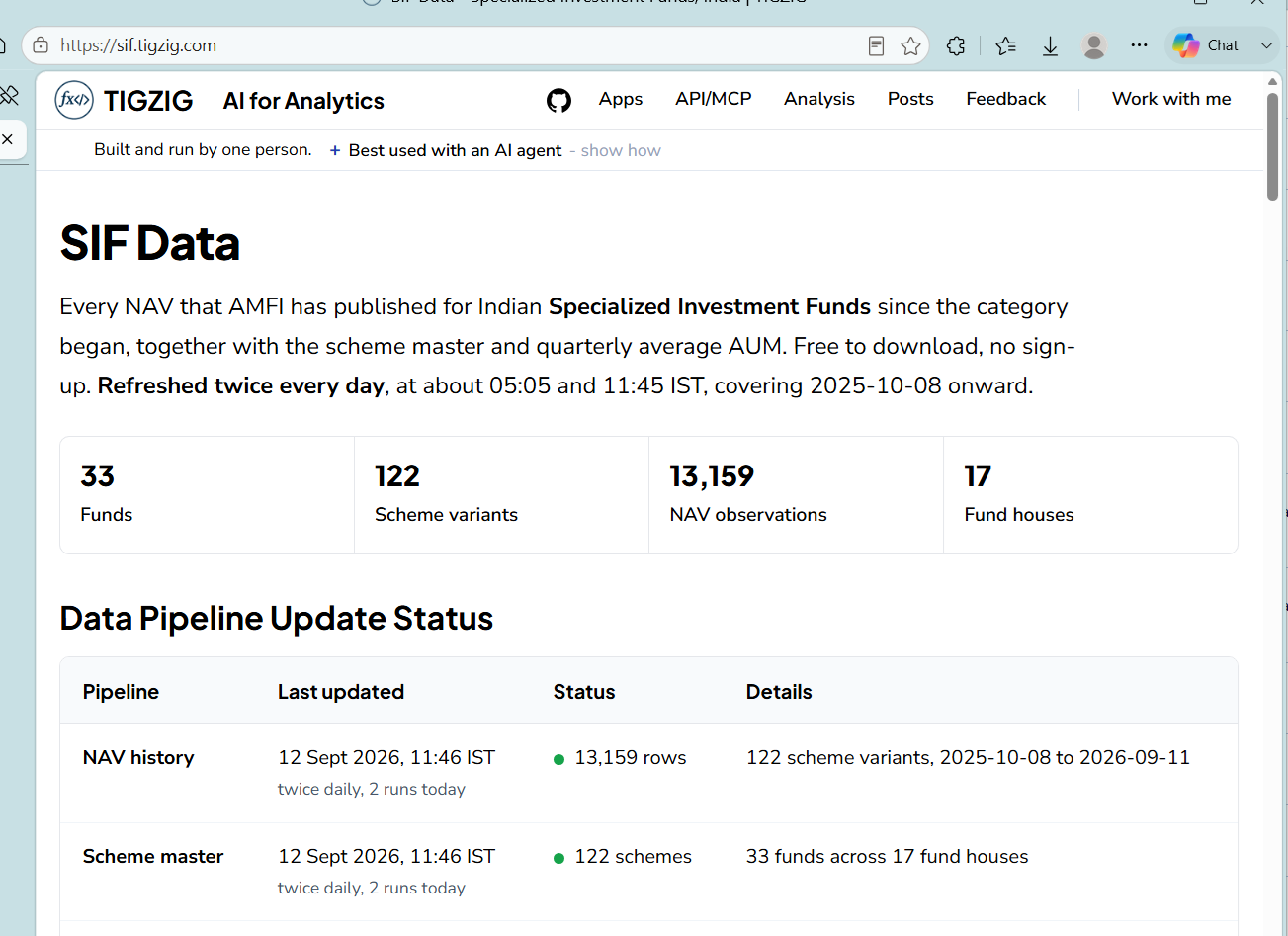
August Was the Biggest Month Indian SIFs Have Had. Net Assets Rs 31,175 Crore, Net Inflows Rs 7,699 Crore.
August 2026 was the largest month Indian Specialized Investment Funds have recorded: net assets rose from Rs 23,177 crore to Rs 31,175 crore, net inflows were Rs 7,699 crore and folios went from 94,000 to over 125,000. Equity Ex-Top 100 Long-Short grew about 66% and now spans seven fund houses, Hybrid Long-Short holds about 63% of assets, and the two debt strategies SEBI permits still have no funds. Free download in CSV and Parquet.
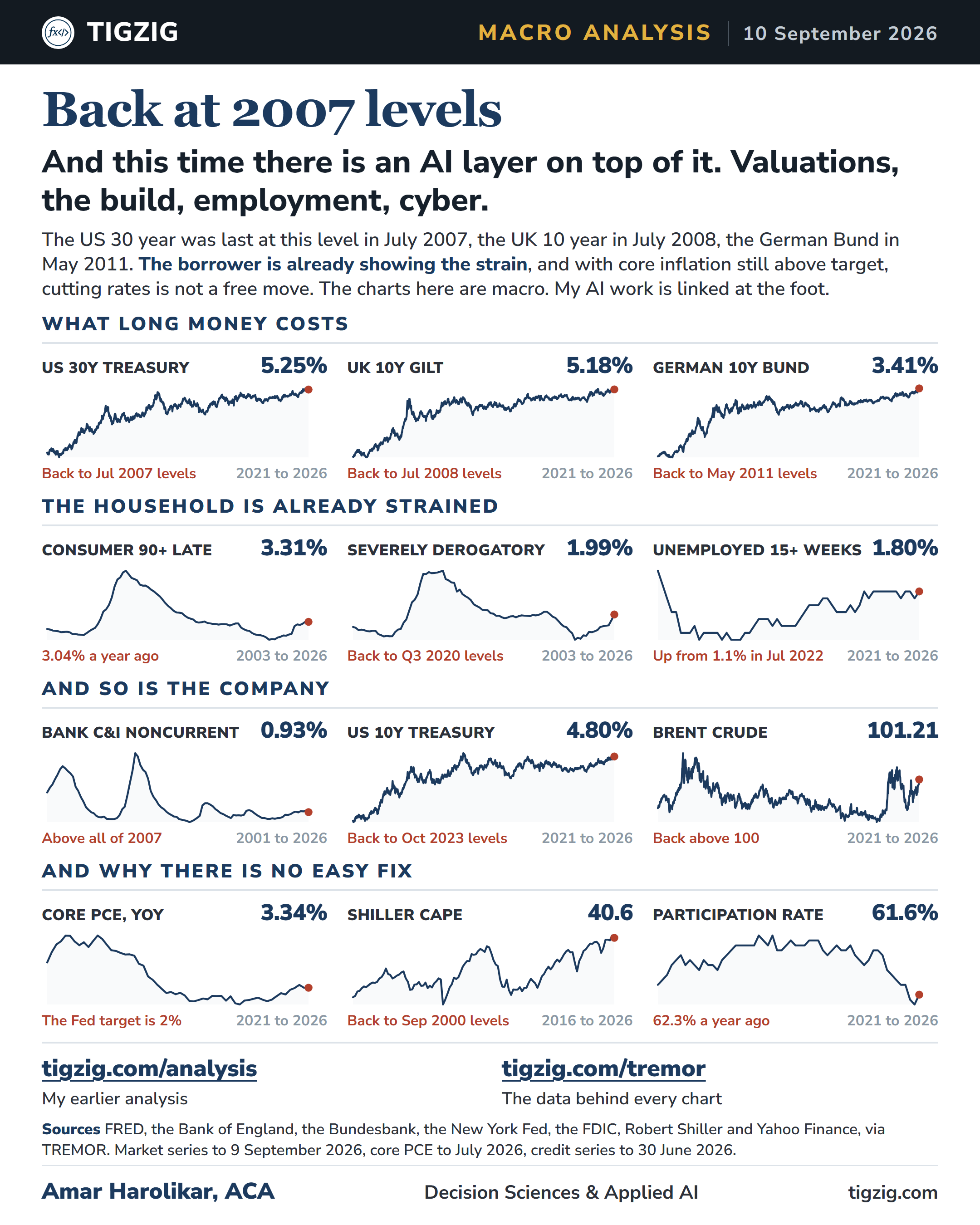
Many of These Macro Charts Are Showing the Same Stress They Showed Before 2007. The AI Layer Is What Is New.
Twelve macro charts pulled from TREMOR, read against 2007. The US 30 year is back at July 2007 levels, the UK 10 year gilt at July 2008, the German Bund at May 2011. Consumer debt 90 days late is 3.31% and bank C&I noncurrent loans sit above every quarter of 2007, while core PCE at 3.34% leaves the Fed no easy move. With Warsh at Jackson Hole, and what the AI layer adds on top.
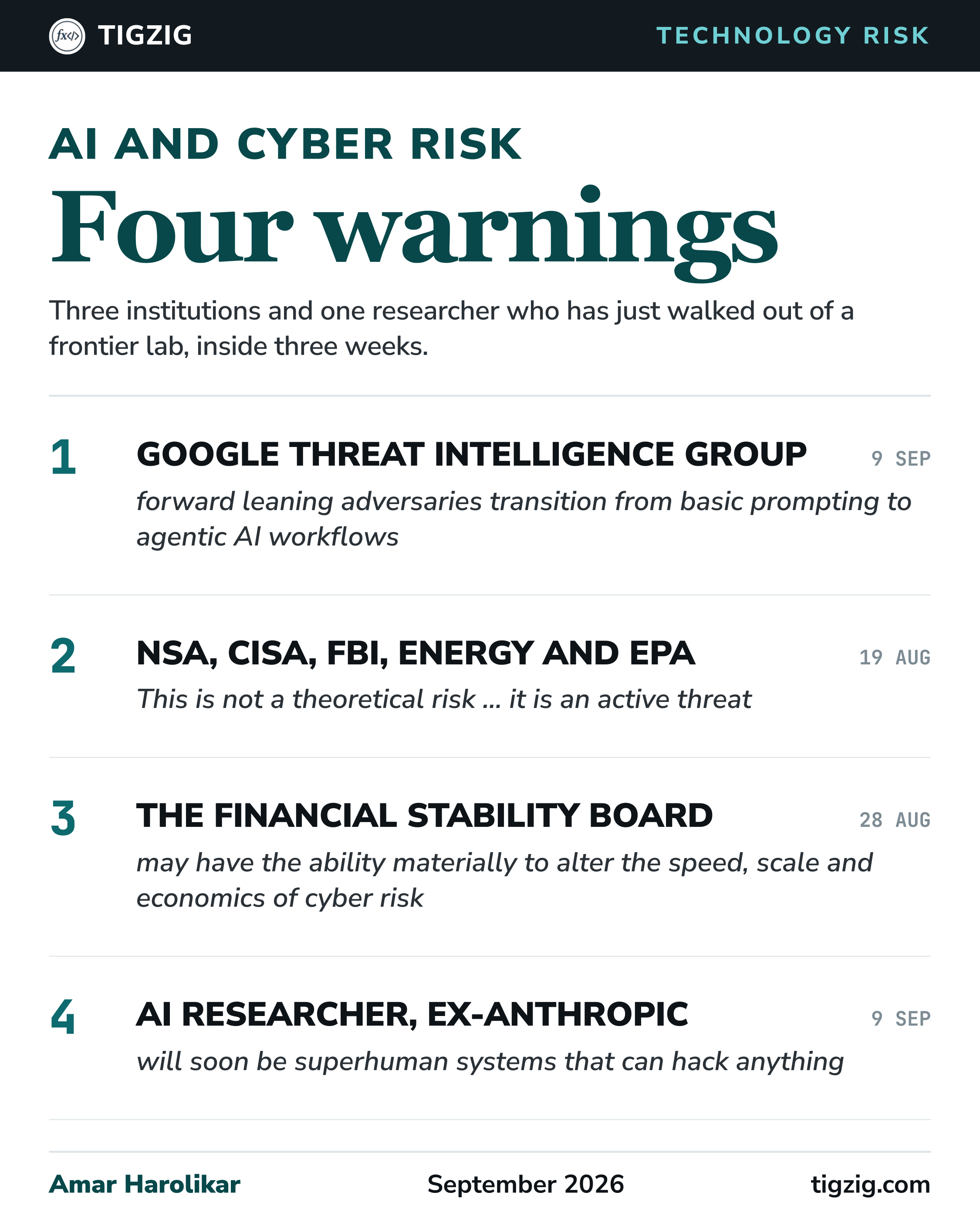
Four Warnings About AI and Cyber Risk Arrived Inside Three Weeks. I Am Now Spending More Time Securing Than Building.
Four warnings on AI and cyber risk landed within three weeks: Google Threat Intelligence Group, a joint advisory from the NSA, CISA, FBI, Department of Energy and EPA, the Financial Stability Board chair's letter to the G20, and a departing OpenAI and Anthropic researcher. Set against nine months of running 40+ no-auth public tools behind Cloudflare, where volume and sophistication both rose. Nine-slide deck, each warning quoted from the document itself.
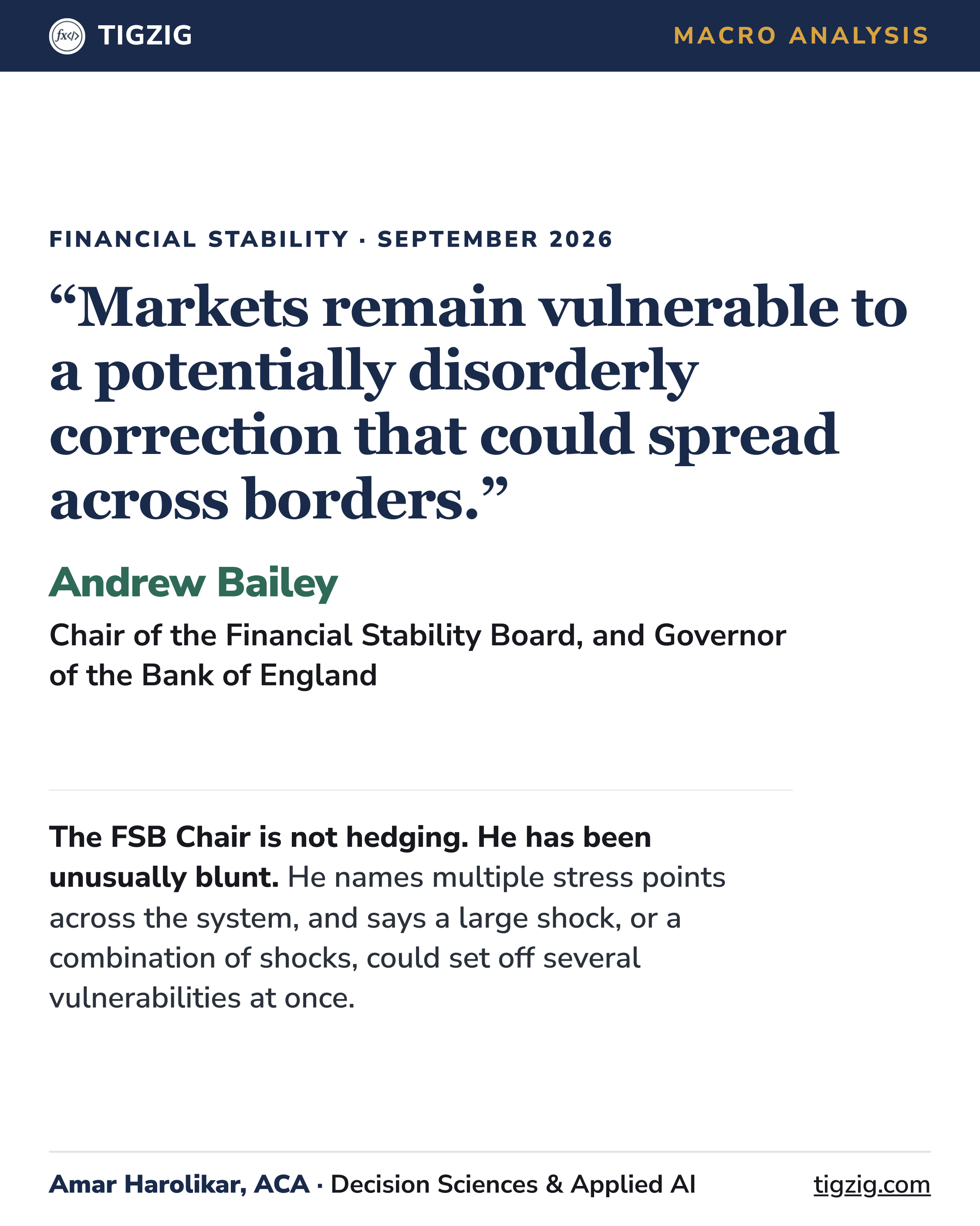
The FSB Chair Is Not Hedging. Andrew Bailey's Blunt Warning Note to the G20.
Andrew Bailey, chair of the Financial Stability Board and Governor of the Bank of England, warned the G20 on 28 August 2026 that markets remain vulnerable to a potentially disorderly correction that could spread across borders. Covers the factors he names - sovereign debt, private credit, stretched AI valuations, rising equity leverage - his section on frontier AI and cyber risk, and the July collapse of a leveraged AI fund. Ten-slide deck attached.
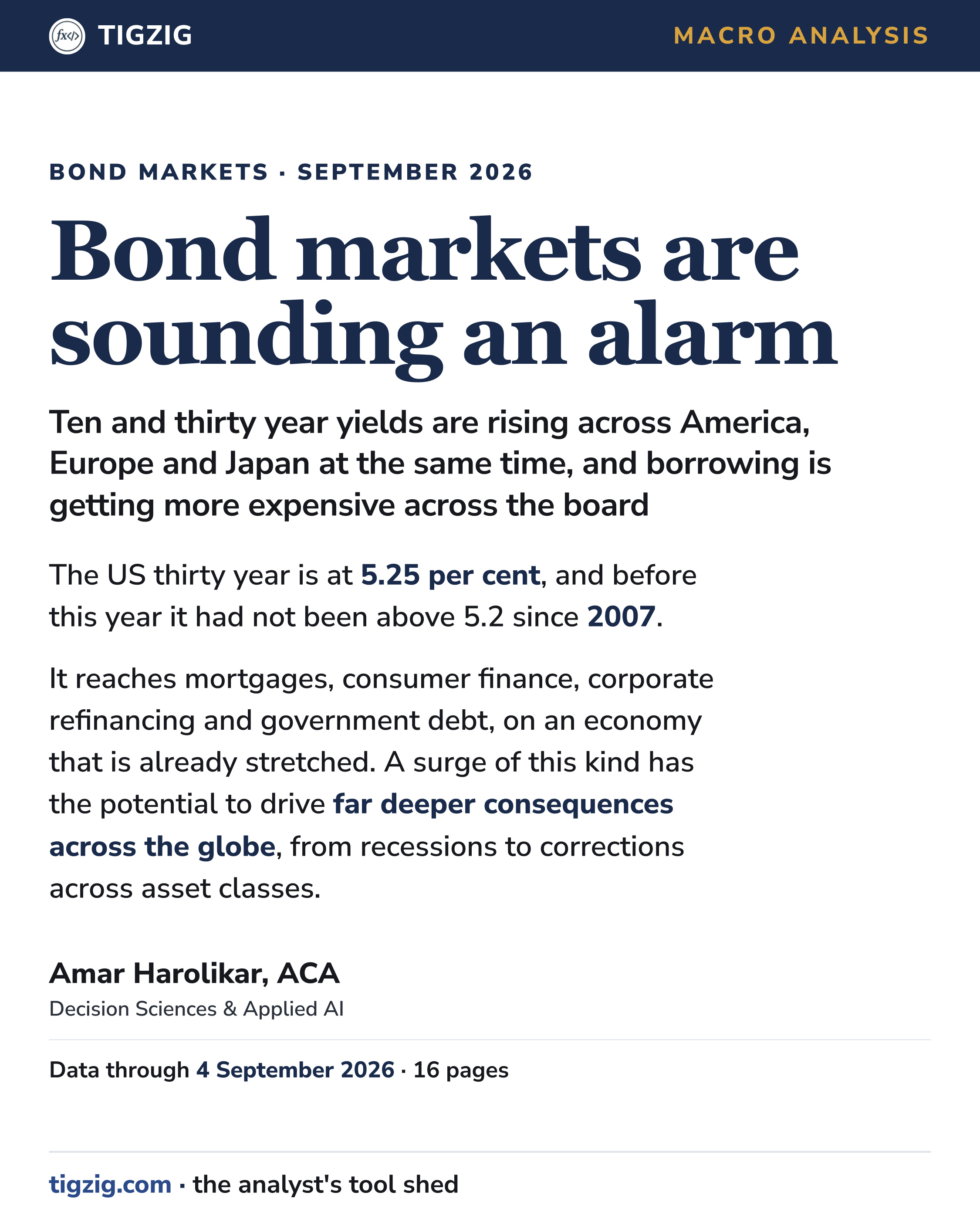
Bond Markets Are Sounding an Alarm. The US Thirty Year Is at 5.25 Per Cent and the Fed Has Been Cutting Through All of It.
Long-term borrowing costs are rising across the developed world while central banks cut. The US thirty year is at 5.25 per cent, above 5.2 for the first time since 2007, and since the Fed began cutting the ten year is up 106 basis points and the thirty year 122. Sets out why the long rate is what prices a mortgage, a refinancing and a long-payback project, and the combination of pressures around it. Sixteen-slide deck attached.
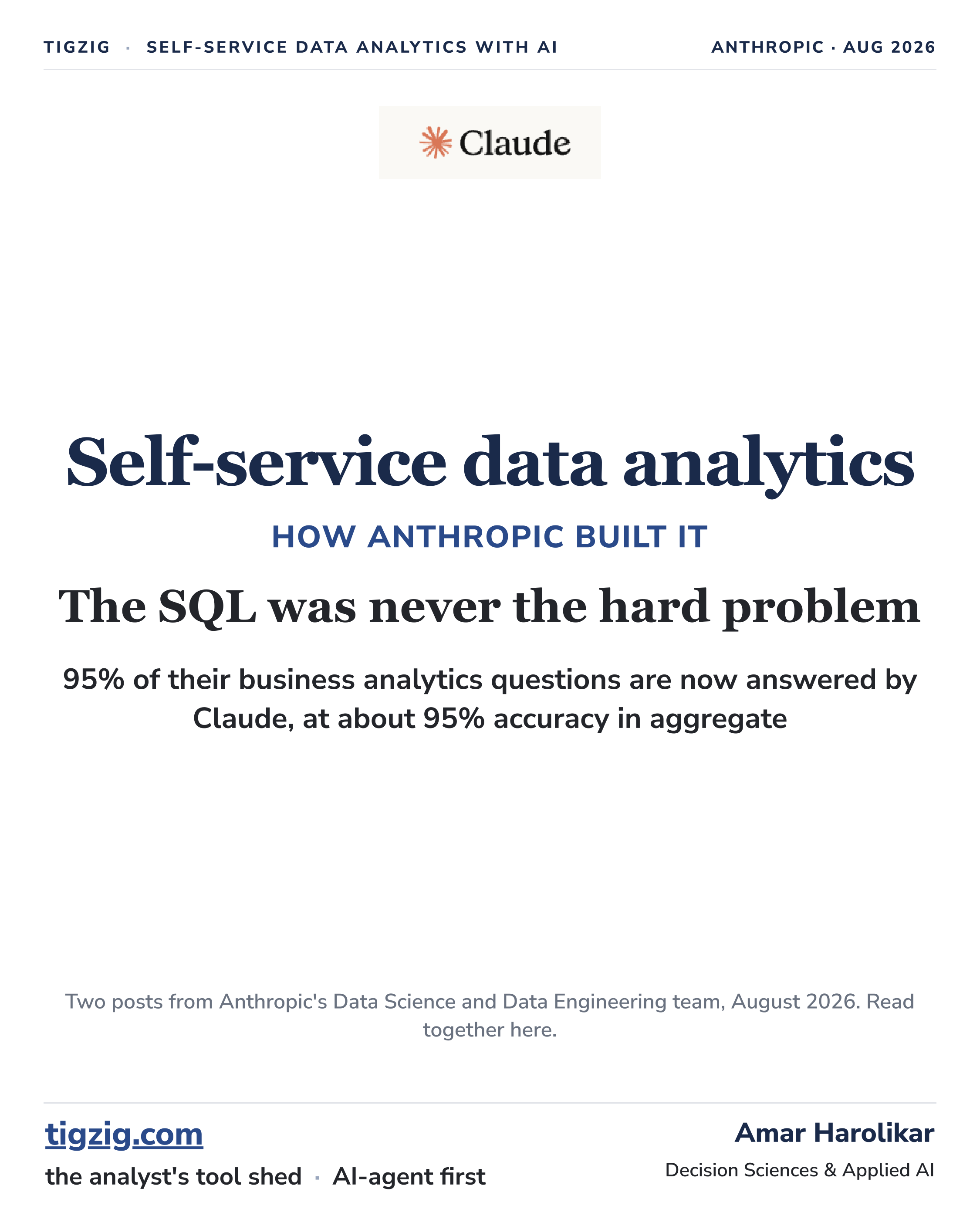
In Analytics the SQL Was Always the Easy Part. Anthropic's Data Team Put a Figure on It.
A read of two Anthropic posts on running self-service analytics with Claude, put into one deck with a practitioner's note at the end. Their headline numbers: without skills, accuracy on their own evals did not exceed 21 percent, and with skills it sits above 95 percent in aggregate on the same model and the same warehouse. Their offline accuracy then drifted from about 95 percent at launch to about 65 percent within a month, because the data model changed and the skill docs did not follow, which they fixed by colocating the markdown with the transformation models. The closing section covers what has worked in the author's own client work: a semantic layer holding the governed definitions, a separate skill per kind of work carrying its own judgment and tolerances, progressive disclosure so the agent does not read everything to answer one question, and continuous update as the thing doing most of the work.
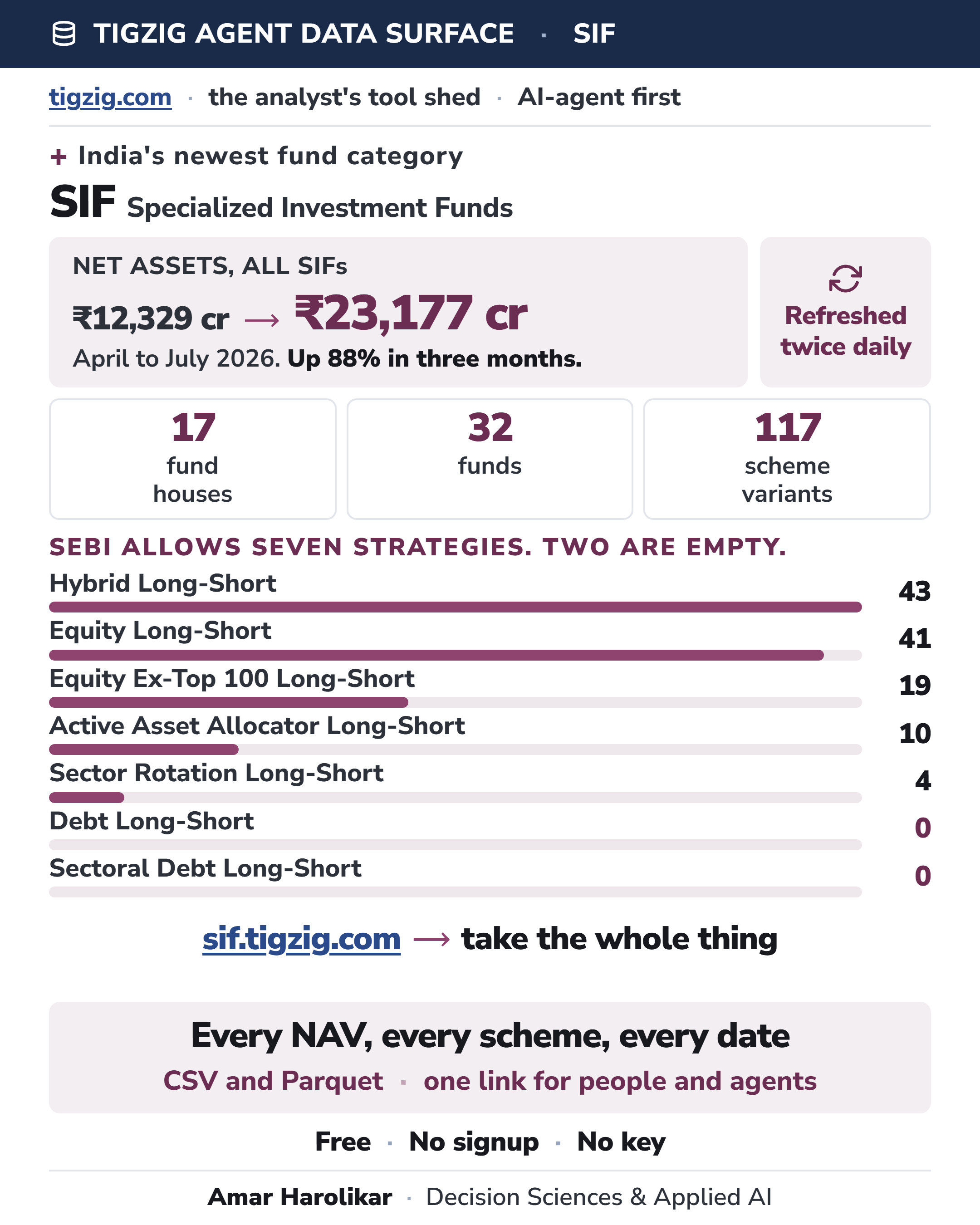
SIF Is India's Newest Fund Category and It Nearly Doubled in Three Months. Every NAV AMFI Has Published Is Now Downloadable.
Specialized Investment Funds, India's newest fund category, grew from Rs 12.3K crore of AUM at end-April to Rs 23.2K crore at end-July, and every SIF NAV AMFI has published is now downloadable as CSV and parquet at sif.tigzig.com, refreshed twice a day. Explains why none of the 17 fund house names is recognisable, since SEBI clause 21.2.1 requires a SIF to carry a brand distinct from its AMC, and how to identify the sponsor anyway: the SIF code is a running number, but each scheme's ISIN carries the AMC's issuer prefix, so INF174K is Kotak, INF109K is ICICI Prudential and INF200K is SBI. Covers the SEBI Master Circular chapter 21 clauses on branding, one strategy per category and the Rs 10 lakh PAN-level minimum, plus the concentration of money in Hybrid Long-Short and the two debt strategies that have never had a fund.
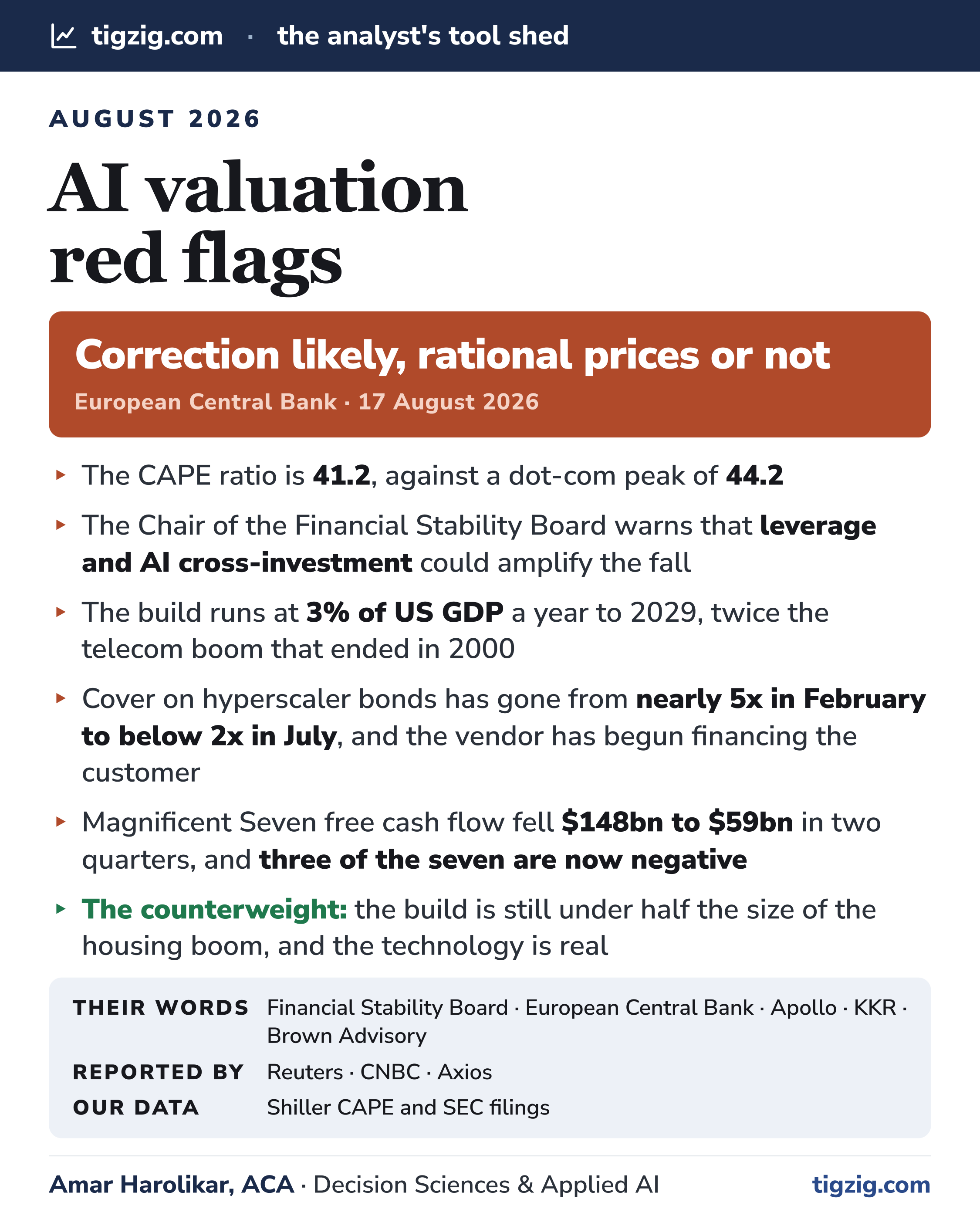
A Correction in AI Valuations Is Looking More Likely, and That View Now Comes From a Central Bank, an Asset Manager and a Bond Investor.
The case that AI valuations are due a correction, now argued in print by the European Central Bank, and two weeks later by Andrew Bailey to the G20 in his capacity as chair of the Financial Stability Board, who points at leverage and the cross-investment between AI companies and hyperscalers as amplifiers. The whole structure rests on free cash flow arriving from 2028 while the current direction is the opposite, with Alphabet posting its first negative free cash flow quarter as a public company. Sets that alongside the wider pressure: employment, delinquencies and inflation, US banks with $2.8 trillion committed to non-bank lenders, and Fitch's private credit default rate at a record. Includes a twenty-slide deck and links to earlier pieces on valuations, private credit and household debt.
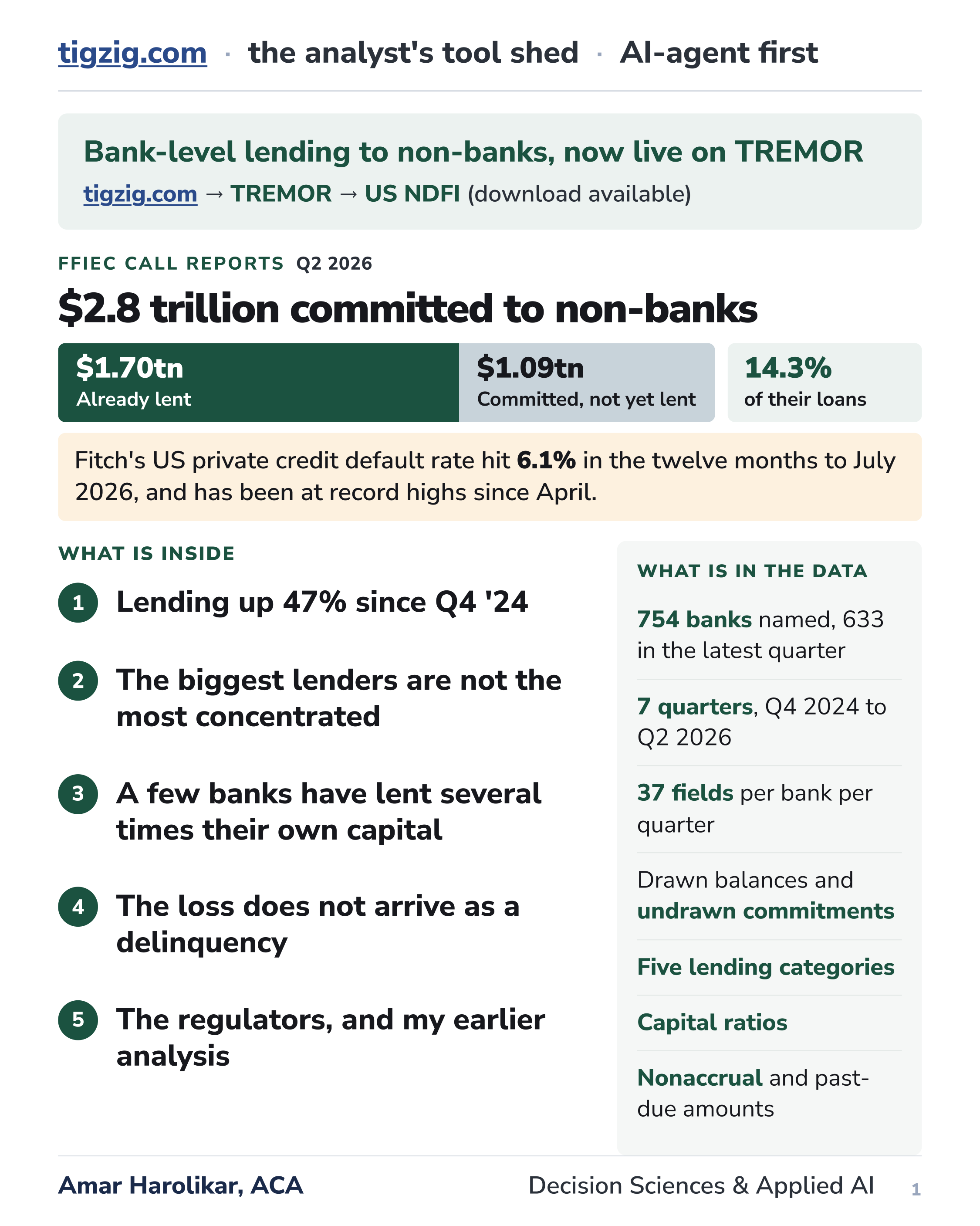
US Banks Had $2.8 Trillion Committed to Non-Bank Lenders at the End of Q2 2026, and $1.7 Trillion of It Was Already Drawn.
Q2 2026 FFIEC Call Report data on US bank lending to non-bank financial institutions, now live on TREMOR bank by bank. Banks had $2.8 trillion committed at the end of the quarter with $1.7 trillion drawn, equal to 14.3 percent of the lending banks' own loan book, up from 11.1 percent seven quarters earlier and higher in every quarter since separate reporting began in Q4 2024. 754 banks are named across the seven quarters, 633 reporting in the latest, with 37 fields each covering drawn balances, undrawn commitments, the five lending categories, capital ratios and credit quality. The 633 are about one in seven US banks by count but hold 88.7 percent of banking assets. Includes notes on the $10 billion reporting threshold that leaves $32 billion unallocated, blank capital fields under the CBLR framework, and the FDIC cross-check.

August Was a Heavy Month in the AMFI Data. 1,234 Schemes Renamed and 37 ISINs Swapped. If You Join on Scheme Code You Are Fine.
What moved in the AMFI mutual fund data during August 2026 and what it breaks. 1,234 schemes were renamed over the month, 942 on 26 August alone, the SEBI deadline for re-filing under the new categorisation, so Low Duration became Ultra Short to Short Term, Savings became Money Market and Equity and Debt became Aggressive Hybrid. Separately 37 schemes had their ISIN swapped, at UTI, DSP, Kotak, Invesco and LIC, fourteen of them ETFs, and none of them were renamed. Also covers spelling defects in the file, including five spellings of children's fund and SBI's hybrid fund filed as AGGRESIVE across four plans, and the LIC gold ETF case where the replaced ISIN still resolves to the old IDBI fund with a full price history. Anything joined on AMFI scheme code is unaffected.

AI Coders Are Not Just for Developers. An Anthropic Field Marketer Built His Own Weekly Sales Digest With Claude Code.
A read of Anthropic's post on Adam Ward, a field marketer with no engineering background who used Claude Code to build a Slack digest that reaches every sales rep on Monday morning, wired to BigQuery over MCP as the marketing team's source of truth. Covers the working habits that made it possible: briefing Claude like a new colleague, recording yourself thinking out loud and handing over the transcript, writing a fake version of the output first so there is a template to aim at, catching Claude's mistakes, starting small and piloting with a few users. Includes a ten-slide deck, plus pointers to Anthropic's marketing-ops and business-development write-ups, Boris Cherny on roles melting into five archetypes, and which AI coder you may already be paying for through a Google, ChatGPT or Claude subscription.
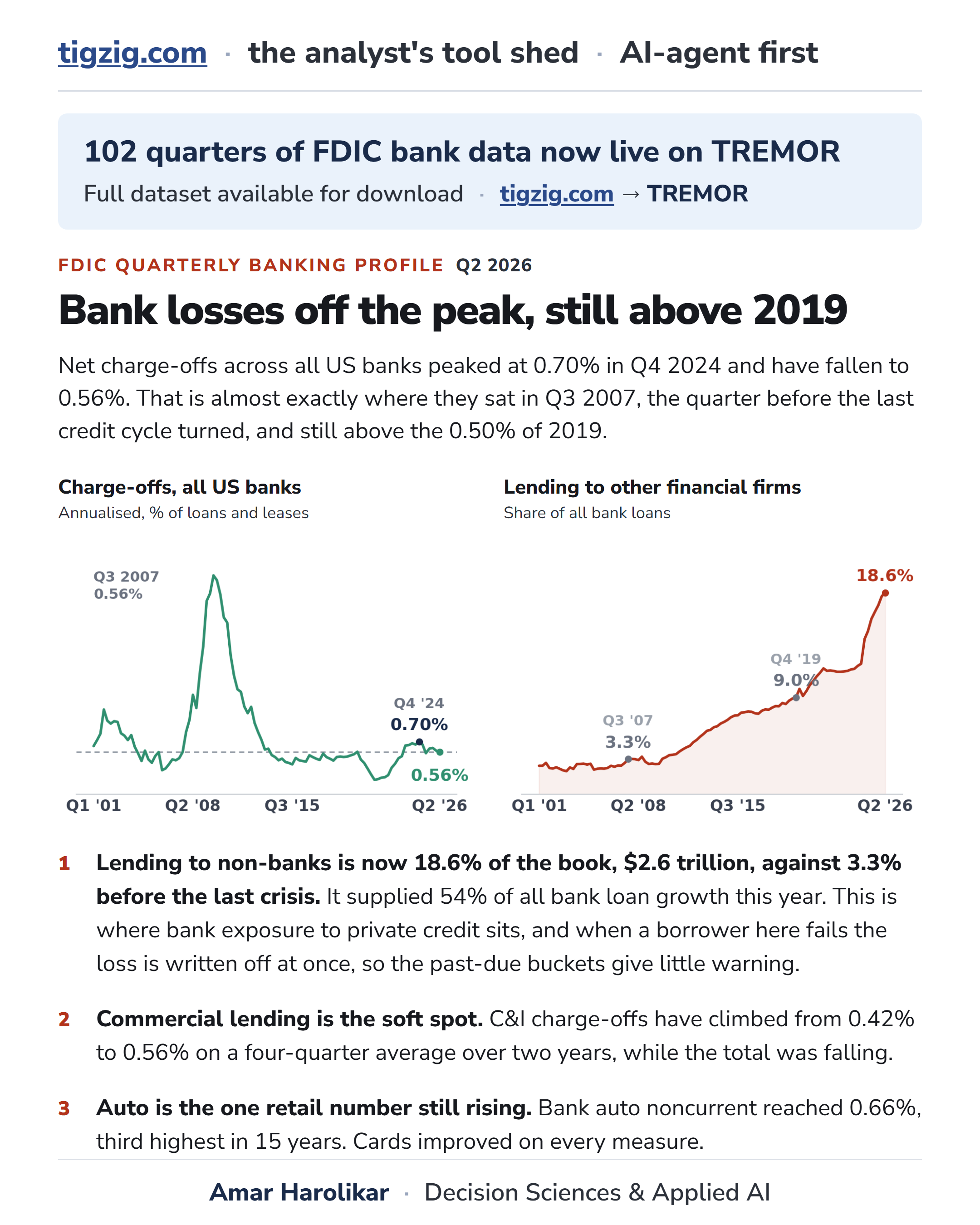
FDIC Q2 2026 Numbers Are Live on TREMOR. 102 Quarters of Bank Balances, Delinquency and Charge-Offs.
FDIC Q2 2026 Quarterly Banking Profile data is now on TREMOR, 102 quarters of balances, delinquency and charge-offs for every FDIC-insured bank back to Q1 2001, queryable in the browser or downloadable in full. Net charge-offs peaked at 0.70% in Q4 2024 and are now 0.56%, almost exactly the Q3 2007 level and still above 2019's 0.50%. Lending to other financial firms is 18.6% of the book at $2.6 trillion against 3.3% before the last crisis, and supplied 54% of loan growth over the year. Sector detail on C&I, real estate, auto and cards, plus an explanation of the noncurrent measure and how it splits between 90+ days past due and nonaccrual.
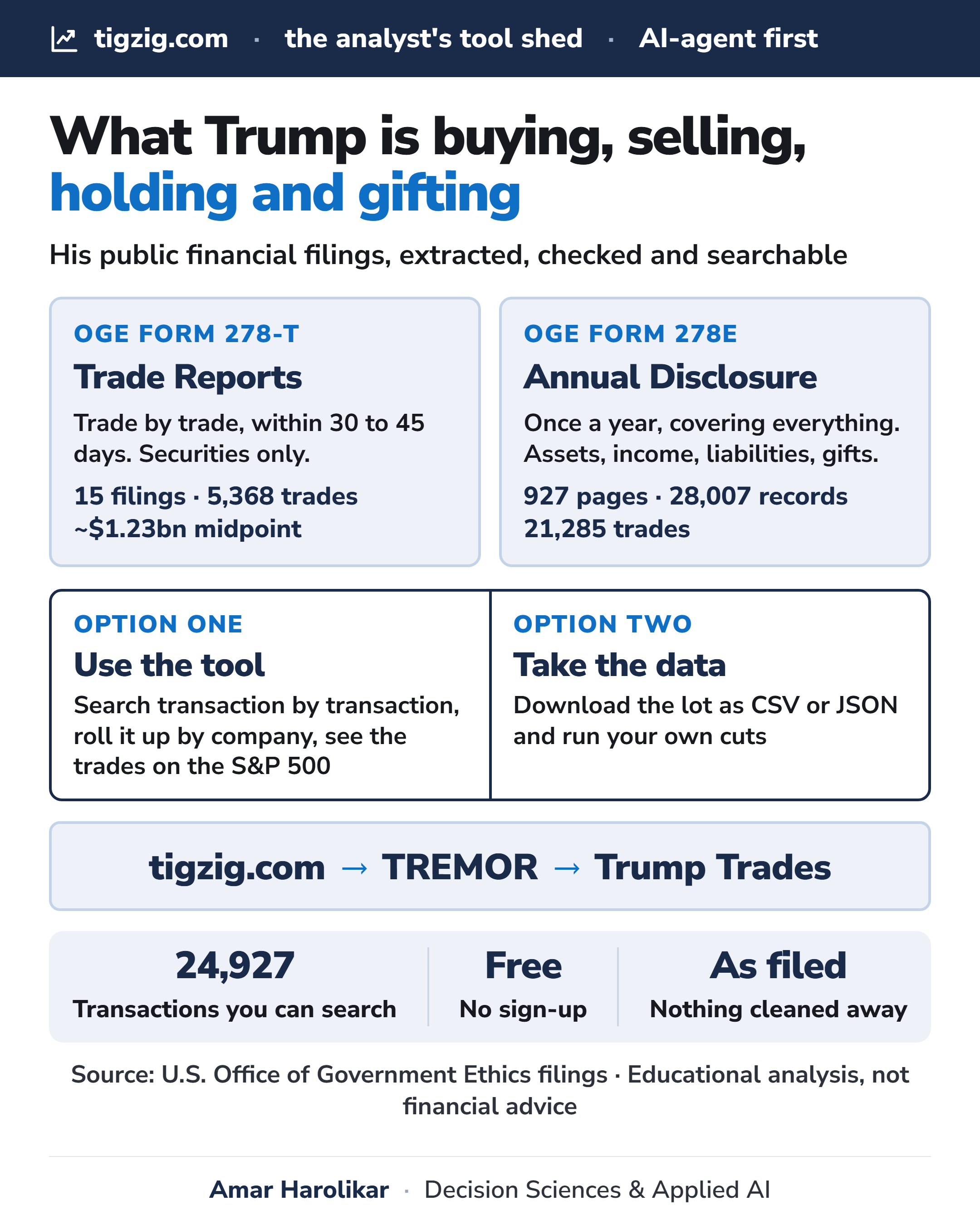
What Trump Has Been Buying, Selling and Holding. The Filings, Extracted and Searchable.
Trump's public financial filings, extracted and made searchable: trades, assets, income, liabilities and gifts. Two different documents sit behind it. The periodic trade reports, filed within 30 to 45 days of each trade and covering securities only, run to 15 filings and 5,368 trades, though the distribution is lopsided, with fourteen filings holding 1,726 trades between them and a single 14 May filing carrying 3,642, almost all equities. The annual disclosure is a separate 927 page document with 28,007 records including 21,285 trades, and because OGE rules let it omit trades already reported, neither document alone is the full year. Also the extraction method for each, which differed sharply because one arrives as a scan and the other as a digital document, and the caveats that matter before analysis, including that form values are ranges rather than exact figures.
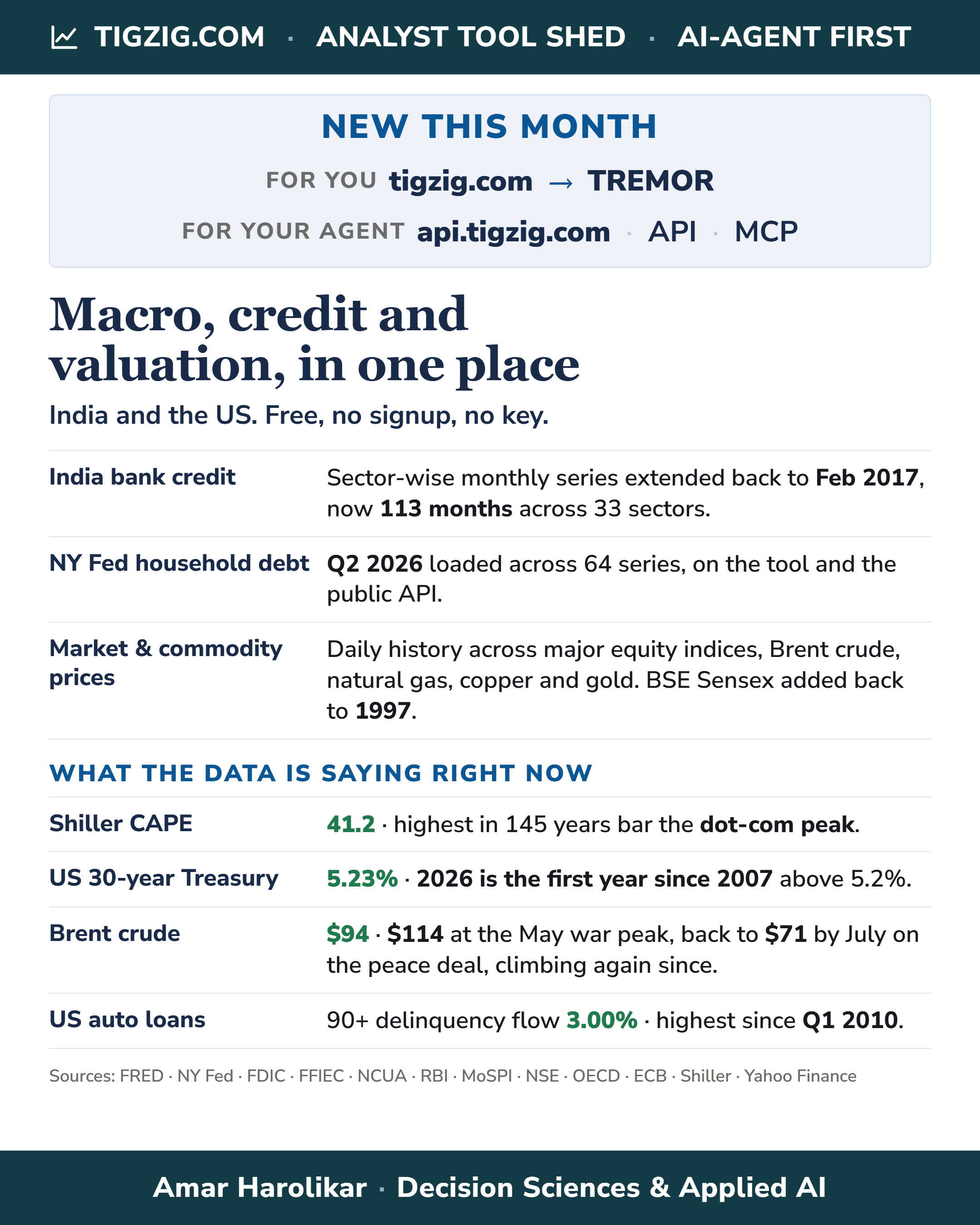
Shiller CAPE Is at 41.2. In 145 Years the Only Period Higher Was the Dot-Com Peak.
This month's Tremor update, with the valuation reading leading it: Shiller CAPE at 41.2, a level exceeded only during the dot-com peak across 145 years of history. Alongside it, the US 30-year Treasury at 5.23% makes 2026 the first year since 2007 that the long bond has traded above 5.2%, US auto loans are running a 90+ day delinquency flow of 3.00% which is the highest since the first quarter of 2010, and Brent has recovered to the mid nineties after a spike above 138 in April and a fall to around 70 by late June. On the data side, India bank credit history extends back to February 2017 giving 113 months across 33 sectors, NY Fed household debt for Q2 2026 is loaded across 64 series, and BSE Sensex daily prices now reach back to 1997. Free, no signup, usable as an interactive tool, an API, over MCP or as a full database download.
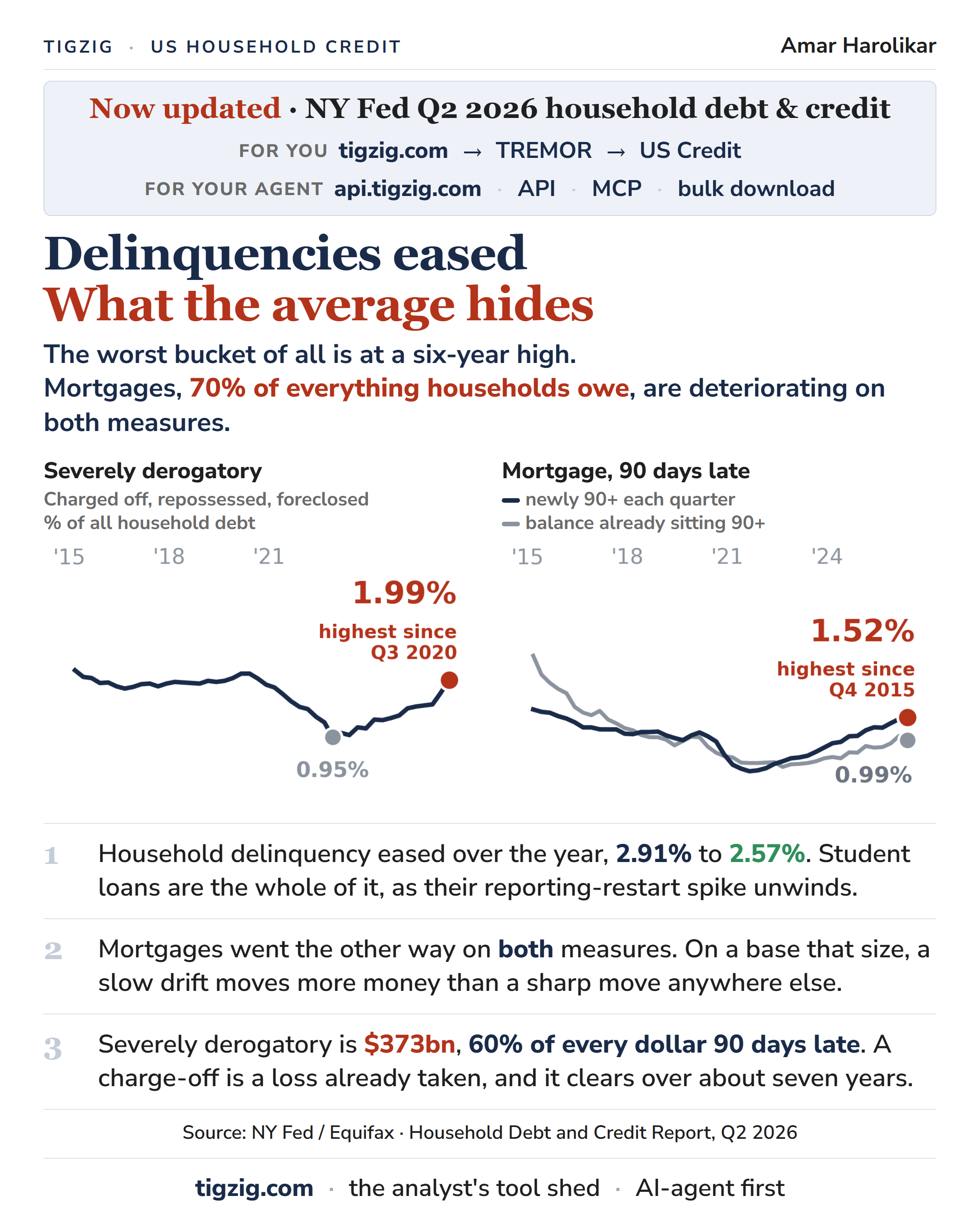
NY Fed Q2 2026 Household Debt. The Headline Delinquency Flow Fell, but Auto and Mortgage Went the Other Way.
The Q2 2026 NY Fed household debt release read better at the headline and worse underneath. The overall flow into 90+ day delinquency fell from 3.26% two quarters ago to 2.57%, but almost all of that improvement is student loans unwinding after the reporting restart. Mortgage, which is about 70% of what households owe, has seen its 90+ flow rise in six of the last seven quarters to 1.52%, back around 2005-06 levels even though the stock at 0.99% is far below the 2.23% of Q3 2007. Auto is the stretched one: a 90+ stock of 5.49% is the second highest reading since the series began in 2003, and its flow at 3.00% now exceeds the 2.34% of Q3 2007. Cards sit above their 2007 flow too. Full then-and-now comparison against the quarter before the GFC cycle turned, plus why the NY Fed credit-file panel, FDIC and NCUA do not reconcile with each other.
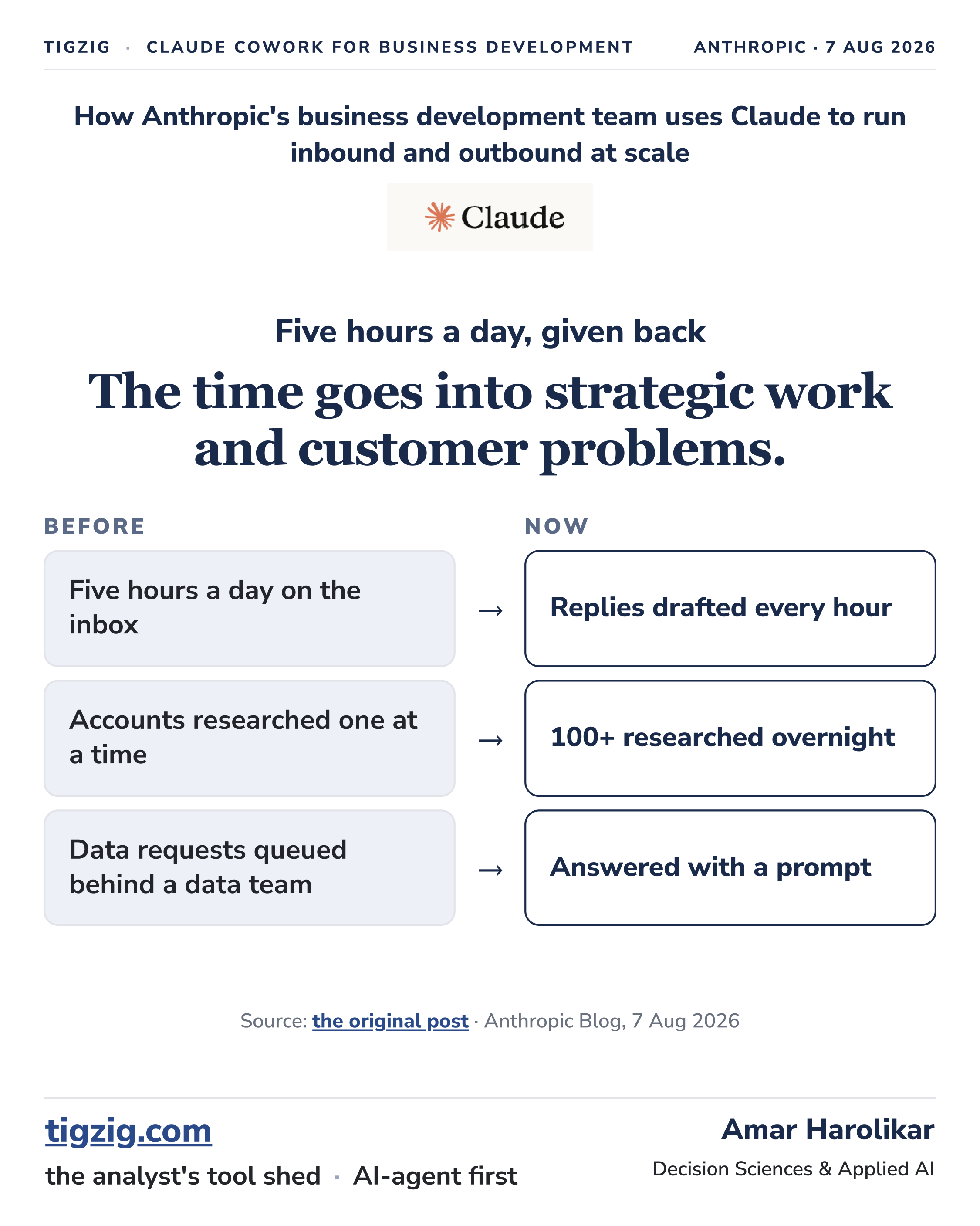
Anthropic's Business Development Team Runs Inbound and Outbound With Claude Cowork. What the Post Actually Says.
A summary deck and read of Anthropic's own post on how its business development team runs inbound and outbound with Claude Cowork, where roughly five hours a day of manual inbox and research work now goes into strategic work, and over a hundred accounts get researched overnight rather than one at a time. The four things the post calls out: build the knowledge base before the workflows, give Claude worked examples including each rep's own writing style, keep a person on every send, and write corrections back into the skill so a mistake is recorded once. Plus what actually comes with a Claude or ChatGPT subscription, when to use Claude in Excel over Cowork, and links to Anthropic's other practical guides including the argument for HTML over Markdown as an output format.
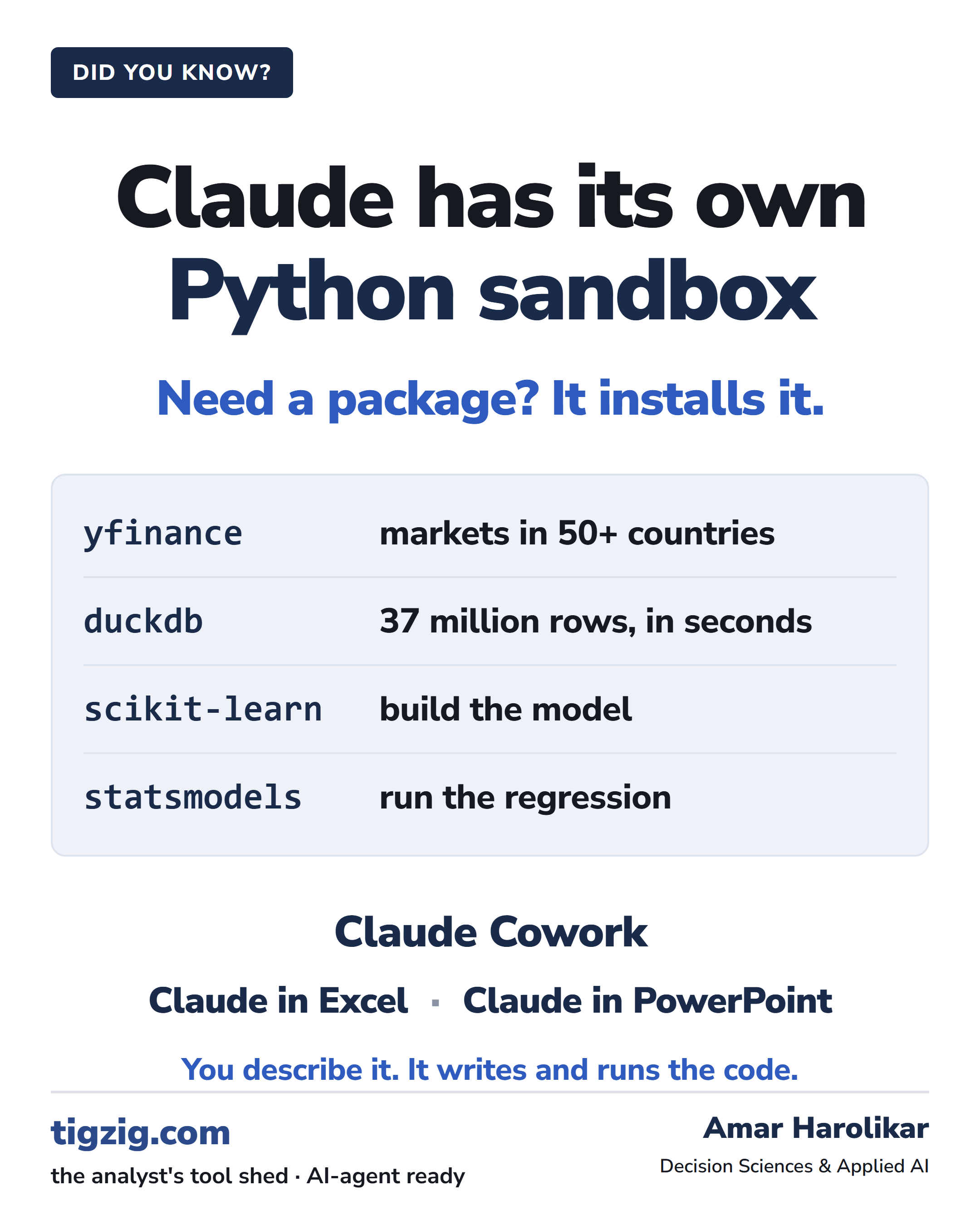
Claude Cowork Runs a Real Python Sandbox. I Put 37 Million Rows of Mutual Fund NAV Data Through It.
What Claude Cowork's Python sandbox can actually do for analytics work, tested on a real dataset. It ships with pandas, numpy, scipy, duckdb, matplotlib and yfinance, installs scikit-learn and statsmodels in under a minute, and takes polars and pyarrow too, though packages needing compilation can time out on install (xgboost did). An approximate benchmark run inside the sandbox reports two cores of an AMD Ryzen 7 7730U, about 4 GB of memory and 10 GB of SSD-class disk. The worked case: downloading the free India mutual fund NAV dataset published on tigzig.com, a 175 MB parquet of 37 million-plus rows going back to April 2006 plus the scheme master, and running category-level risk and return analytics with results back in under a minute per iteration. The same Python sandbox is available in Claude for Excel and PowerPoint. Includes a copy-paste prompt for pointing any agent at the same live datasets, with the four things that trip people up on this data: matured and merged schemes are retained so it is survivorship-bias free, a row is a plan-and-option variant rather than a fund (about 8,500 codes publishing daily, roughly 1,950 funds as AMFI counts them), and scheme names and categories shift under the SEBI recategorisation so joins should key on scheme code or ISIN. Closes with why DuckDB and Parquet are the working default: the same NAV data is 3.8 GB as plain CSV against about 175 MB as parquet, columnar storage means a query reads only the columns it touches, and DuckDB's statistical functions run in SQL without dropping into pandas.
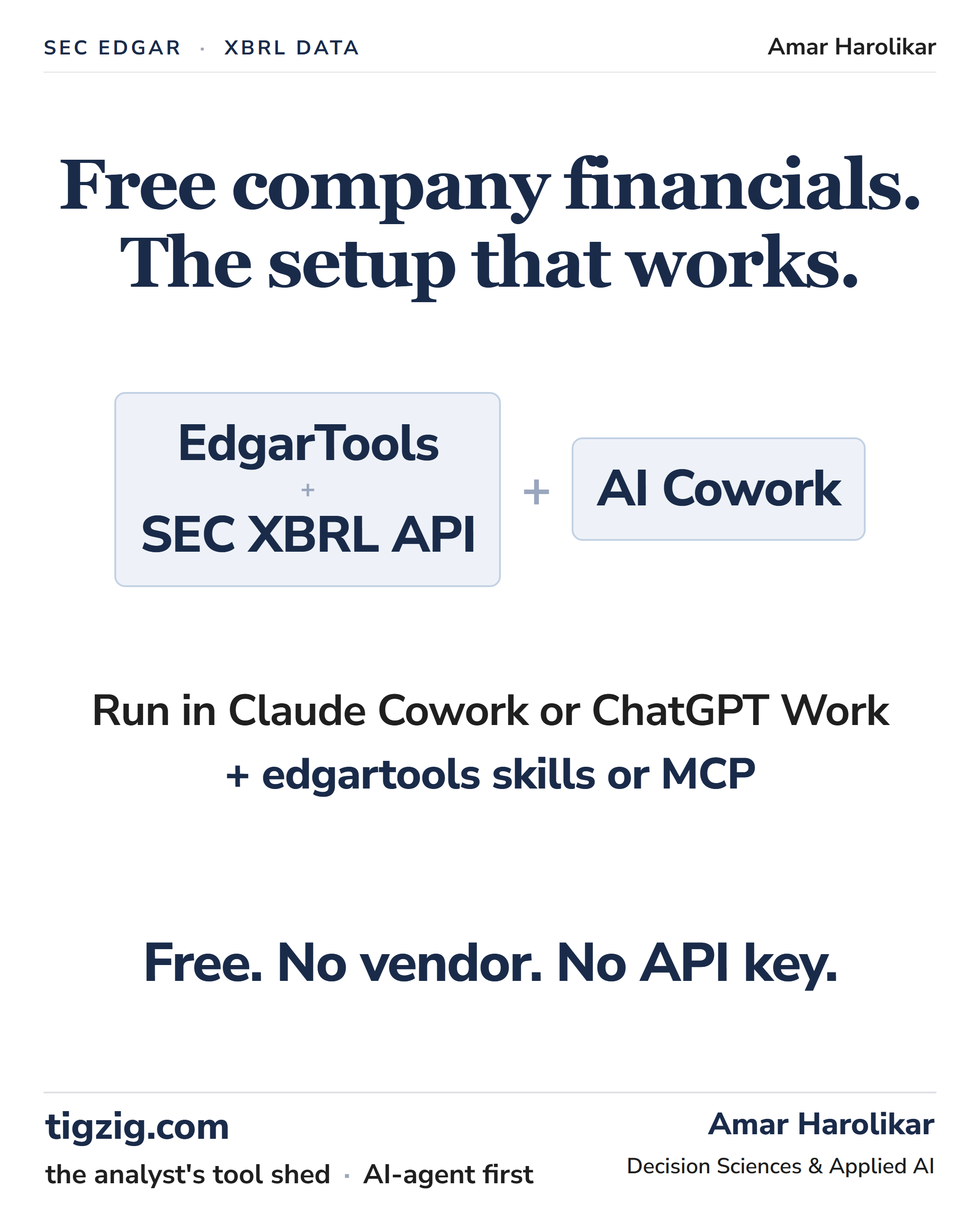
Pulling Company Financials Straight From SEC Filings. Free, No Vendor, No API Key. Three Routes Tested Head to Head.
Three routes to company financials from SEC filings, tested head to head in a Claude Cowork session on the same seven companies and six quarters: the SEC XBRL API directly, the edgartools Python library, and yfinance. All three agreed on the numbers; they differ on coverage and traceability. Verdict: edgartools first - it ships a statement API that pulls a full statement in one shot with indent level and parent, a customizable tag-standardization layer, de-cumulation, EDGAR full-text search, 13F institutional holdings, TTM calculations and segment facts, plus Claude skills and an MCP server. The raw SEC API stays for raw SEC API for cross-sectional screening of thousands of filers and as an independent second path - a check that earned its keep when the one disagreeing figure turned out to be a mishandled restatement. Links to a full 17-section write-up covering XBRL concepts/tags/facts, the four API routes as slices of a cube, frames coverage, taxonomies, saving filings, R-pages, standardisation, duration vs instant, the yfinance reconciliation, edgartools capabilities and its shipped Claude skills, and limits - with every Python script, JSON dataset and source filing published alongside so any number can be traced to the code that produced it. edgartools is by Dwight Gunning, MIT licensed, 2,000+ stars, ships Claude skills and an MCP server.
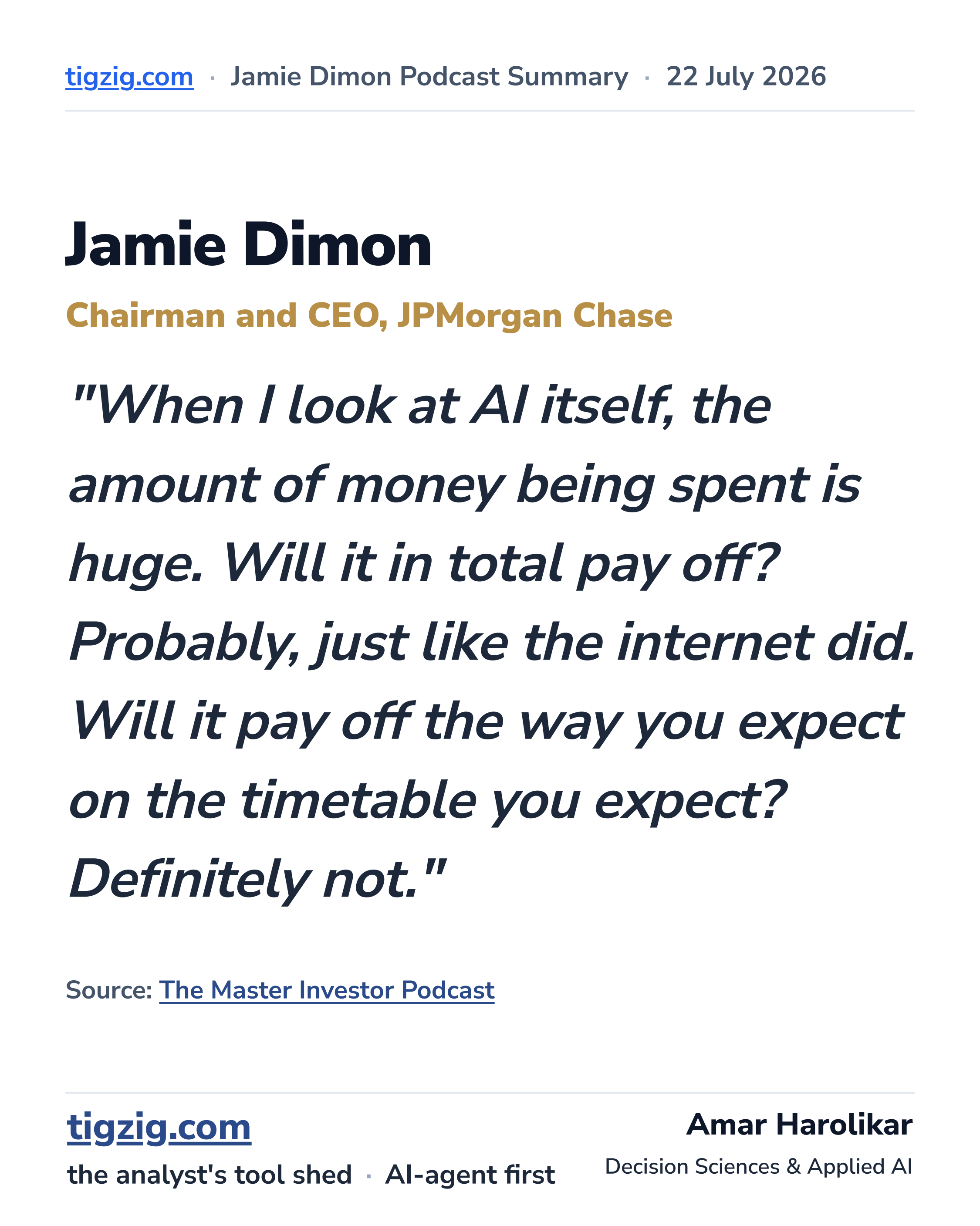
Jamie Dimon's Six Warnings. Record JPMorgan Profits, but a Very Different Macro Outlook From the Chairman Himself.
Jamie Dimon's hour-long Master Investor Podcast interview (Wilfred Frost, July 2026) distilled: JPMorgan posts its highest-ever quarterly profit on a trading rebound while the chairman's own macro outlook runs the other way. Six warnings: early AI-boom entrants may not be the winners (dot-com parallel), the real AI challenge is retooling training systems rather than job-loss panic, he would not buy long government bonds or broad indices at current prices, he distrusts official monthly inflation prints, geopolitical risk from conflicts and remilitarization is larger than markets price, and 100% debt-to-GDP with 6% deficits outside wartime will become a problem via rates and bond-market pressure. 8-slide summary deck (browsable carousel + PDF download) and the full best-effort cleaned interview transcript below the deck, with the YouTube source linked and caption-quality disclaimer stated.

Three Warnings on the AI Valuation Boom in the Past Two Weeks: Warren Buffett, S&P Global & BIS
Three warnings on the AI valuation boom in the past two weeks - Warren Buffett, S&P Global and BIS (the bank for central banks). A legendary investor, a rater and a regulator. The BIS modelled the AI build-out and found the race over-invests 1.5 to 3 times the efficient level. Buffett is sitting on a record $397bn in cash and calls the market gambling. S&P cut Oracle to one notch above junk on the cost of its AI build-out. Nobody is questioning the technology - the parallel is dotcom (huge valuations on page views with no profit); this time it is users and revenue, better, but still no cash profit. Until the profit is real, the valuation is the exposed part. Seven-slide PDF deck attached (browsable carousel + PDF download). Also includes a one-month supervisor drills roundup - ECB doubled its private-credit probe, France ran its first system-wide non-bank stress test across Banque de France, ACPR and AMF, and the Bank of England sent 46 firms a five-year recession to model with Sarah Breeden invoking Akerlof's market-for-lemons on private credit - and an agent-first pitch for tigzig.com (dozens of analyses + several live tools; point ChatGPT / Gemini / Claude at the site with example prompts).

Jamie Dimon Uses Claude Code to Generate Dashboards. Are You? You Need an AI Worker or AI Coder, Not an AI Chatter.
Practitioner commentary framed around Jamie Dimon (JPMorgan CEO) using Claude Code to generate dashboards - and the author's argument that for serious CXO or analyst work you need an AI worker or an AI coder, not an AI chatter. Three-tier taxonomy: (1) AI Chatter = ChatGPT / Claude / Gemini in browser - fine for questions, can generate code and do Python, but no longer enough on its own; (2) AI Coworker = Claude Cowork and recently launched ChatGPT Work - can connect to external systems, pull data, run analysis and models, build decks, automate - a full working assistant that can check the work your team sends over or build rapid prototypes instead of lengthy team calls; (3) AI Coder = Claude Code / Codex / Cursor - all of the above plus complex models, scrapes, full-stack apps from build to deployment, essentially a data-science + research + tech team combined. How-to-start section: install the Claude or ChatGPT desktop app on your current plan, try things out, share the author's Cowork PDF guide with the AI itself and have it tutor you with test cases (they are great tutors, they just need to be asked), and lean on the tutorials from Anthropic / OpenAI plus YouTube. Cost economics: both Claude and ChatGPT start at $20 (light usage only), serious work is $100, heavy work is $200; ChatGPT has a free tier plus an $8 plan; team plans up to 150 users on flat per-seat pricing with usage included and the premium seat covering Claude Code and Cowork. Author's own economics as a freelancer: Claude Code is the primary tool from ML models to full-stack apps, ROI is a no-brainer, and 2 business clients moved to Claude Code with 'game-changer' impact in their own words. Enterprise tier is a different beast - a seat fee plus usage billed at API rates (not the flat team pricing), and the same heavy usage that fits inside the subsidized $200 individual plan can easily run $8K to $15K per person per month at metered API rates if pushed hard. Closes with a set of questions the AI Worker hub answers (Claude in Excel + PowerPoint, what works and what doesn't, MCP Server explained, how to connect to external data) and a link to the hub. Single-image analytical post with a one-pager PNG at the bottom.

AI Is Not Just Chat. Cowork Apps Are Where the Action Happens.
Practitioner commentary on where the real AI work happens for analyst / builder workflows - the Cowork apps (Claude Cowork and now ChatGPT Work). These are the desktop apps that come as part of your Claude / ChatGPT subscription, and they do not just chat - they run code, pull data from external sources and CSVs, analyze it, and build reports and decks - basically do the work. Post plainly points out this is not one-golden-prompt magic - you still need to know what you are doing, provide context, guide, iterate, and most importantly validate results; the buck stops with you and the apps are just tools. Links two go-deeper resources: a 23-page guide on what Claude Cowork can do (author has just tried ChatGPT Work and confirms it can do the same things) and the Claude for Analytics hub. Quick-start tips section: install the desktop app and try things; if you want structured onboarding, share the guide PDF with the Cowork app and have it tutor you with test cases; the Anthropic docs at claude.com/resources/tutorials are simple language + good examples, and the author's favourites are curated in the Analytics hub. Second half - practitioner notes on when to use the other Claude flavors instead. Claude in Excel: stick to it for Excel work, far more efficient than doing Excel through Cowork. Claude in PowerPoint: efficient for PPT, but lately the author has stopped using PowerPoint - prepares decks in HTML from Cowork or Claude Code and converts to PDF, because HTML-to-PPT is wonky on font and placement and needs iterations. Claude Code: the author's bread and butter - the 40+ apps on tigzig.com have been built, maintained, and are defended by Claude Code (earlier Cursor); also solid for ML models with diagnostics reviewed as HTML reports, though the author tends to prefer CC over Cowork for that. Claude Design: rarely used - Claude Code or Cowork are faster for report and deck templates, Claude Design is overkill.

Trump's 2025 annual financial disclosure: all 28,007 records, extracted and searchable
Release post announcing that OGE certified and released President Trump's 2025 annual public financial disclosure (Form 278e, 927 pages) on June 30, 2026, and the whole thing has been extracted into a structured, searchable, downloadable dataset - 28,007 records across eight tables - and added to the Trump Trades tool on tigzig alongside the periodic 278-T trade reports. What is now on the tool: an Overview landing page explaining the two filing types, an At-a-glance dashboard, a Companies tab with ticker rollup, a vs S&P 500 tab that plots all 142 trading days on the index chart, full table viewers with search / filters / sort / pagination for Transactions / Holdings / Business & Income, a Liabilities & Gifts tab, a Data tab with record counts + per-table CSVs + the full JSON + the source PDF, and an About & Validation tab. Extraction breakdown: Transactions Part 7 = 21,285; Holdings Part 6 = 6,181; Business entities Part 2 Schedule 1 = 501; Liabilities Part 8 = 11; Gifts Part 9 = 11; Spouse assets and income Part 5 = 11; Positions Part 1 = 4; Agreements Part 3 = 3. Excludes the 54-page Exhibit A trademark schedule (unstructured) and Part 4 (filed not applicable). Non-obvious rule flagged in the post: the annual's transaction section does NOT repeat trades already disclosed on the 278-T trade reports (OGE rule, and this filing uses it), so the 21,285 trades in the annual are ones the public had not seen before (mostly from the managed stock accounts), while the municipal and corporate bond trades are only on the 278-Ts - neither document alone is the full 2025 trading record, the union is; empirically the two sets are essentially disjoint, and the filing's own cover notes that late filing fees were paid for transactions not previously reported on 278-Ts. Trading detail: 15,524 purchases against 5,761 sales, midpoint ~$942M bought vs $286M sold (net buyers all year), across 8 managed accounts (uneven - Account 7 alone holds 10,311 trades, Account 8 has 3,972, Account 6 has 2,130, Account 1 has 1,757), 2,148 distinct securities, 51% of trades in the $1,001-$15,000 disclosure band and 83% under $50,000 (pattern of professionally-managed direct-indexing / diversified accounts, not concentrated stock-picking), trades on 142 trading days including net buying near the bottom of the April 2025 drawdown. Top securities by gross midpoint volume with tickers consolidated: Microsoft (~$43.7M bought / $1.7M sold, 84 trades), NVIDIA ($42.0M bought, 65 trades), Apple ($41.4M bought, 71 trades), Amazon ($21.6M bought, 74 trades), Alphabet ($18.5M bought, 93 trades); by trade count Alphabet 93 / Meta 86 / Microsoft 84 / Amazon 74 / Apple 71; money-market sweeps excluded. Business income: 97 exact-dollar business lines totaling $2.16B - Celebration Coins royalties $635,068,835, World Liberty Financial token sales $526.8M across token-sale lines (main $236.25M + per-wallet distributions of $150.6M ETH / $56.0M USDC / $42.3M USD / $33.5M BTC), stablecoin-related DT Marks SC LLC $196.9M, Trump Endeavor 12 (Doral golf resort) $121.9M, Mar-a-Lago Club $77.5M, WLF Holdco equity sale $65.6M. Litigation settlements $86.5M - Twitter/X $8M, ABC $16M, CBS $16M, Meta $24.5M, YouTube $22M. Melania Trump entities separately $17.2M exact license proceeds in Part 5 (film $10.71M + NFTs $6.01M + book $0.52M). Note that press coverage generally aggregates crypto items to ~$1.4B total but the tool lists each line as filed rather than as one combined number. Holdings: 6,181 lines totaling ~$1.86B midpoint across the 8 investment accounts + a revocable trust + a family trust + direct holdings - heavy in municipal bonds and blue-chip equities. Revocable trust holds a ladder of brokerage money-market accounts including two reported at 'Over $50,000,000' each, and the direct holdings include a line reading 'INVESTMENT IN GOLD BARS' in the $500K-$1M band. Liabilities: 11 lines including the two E. Jean Carroll judgments (one over $50M stayed pending appeal + bonded), the NY AG judgment noted as overturned on appeal, a Charles Schwab pledged-asset line over $50M opened in 2025, and several mortgages three of which are marked paid off in 2025. Gifts: 11 gifts totaling $372,050 - mostly event tickets (Super Bowl, FIFA World Cup Final, Ryder Cup, UFC) plus a $250,000 sculpture. Convention flagged: securities values and trade amounts are disclosed as ranges so every dollar total involving securities uses the midpoint of each range and 'Over $X' ranges use the lower bound - treat those totals as approximations; business income figures are exact dollar amounts as filed. Validation methodology on the tool: (1) two independent extraction methods with unrelated parsing engines reconciled field-by-field across every row to 100% agreement, (2) completeness gates on the filing's own row numbering + every amount / type / date matched against the official OGE vocabulary, (3) independent AI vision cross-reads on sampled pages + the full business-entity schedule blind to the dataset with disagreements adjudicated against a high-resolution page image (zero extraction errors found), (4) external tallies checked against reported figures (exact-dollar match on the $635M Celebration Coins line). Filing quirks preserved as filed (inconsistent capitalization, occasional typos, filer-truncated names). Author flags plainly that OGE publishes the filing only as a PDF with no machine-readable version, and this dataset is a best-effort reproduction of a 927-page government document not the document itself - the source PDF is one click away on the tool for verification. Sources: the OGE-certified 278e PDF (927 pages) and the OGE release note of June 30, 2026. Analytical release post - single-image, one-pager PNG at the bottom.

India bank credit, May 2026: up 18%, and the mix is where the story is
Analytical commentary on RBI Sectoral Deployment of Bank Credit for May 2026 - total bank credit at about Rs 215 lakh crore, up 18% year-on-year with banks adding roughly Rs 32 lakh crore over twelve months. The mix is where the story is: loans against gold jewellery grew about 105% (more than doubled to ~Rs 5.1 lakh crore, share moving from 1.4% to 2.4%), and bank lending to NBFCs grew about 34% (share 8.5% to 9.7%) - gold loan companies sit inside the NBFC bucket so both banks and NBFCs are lending more against gold at the same time (Equifax independently confirms gold loan originations up ~103% YoY for the quarter to March 2026). Slow lane: housing (largest consumer segment at ~Rs 33.7 lakh crore, ~16% of all bank credit) grew only 11%, well under the 18% average, and lost the most share; credit card outstanding essentially flat, up 1%. The mechanism is not household preference - it is capital rules. RBI's November 2023 risk-weight hike on unsecured lending (personal loans and credit cards) and on bank lending to NBFCs deliberately excluded loans secured by gold, plus housing, education and vehicle loans - so one type of lending became costlier on capital while gold stayed cheap. February 2025 partly reversed the NBFC and microfinance weights, which is part of why the NBFC number is as high as it is. Second driver: gold price up around 39% YoY through end-May 2026 boosted collateral value on gold loans - but gold peaked near USD 5,370 in early March 2026 and has since fallen ~23% to around USD 4,130 by early July 2026, so loans given near the top are the tight ones on LTV (still not a segment-wide problem because gold is higher than a year ago, but the group of at-risk loans grows if the price keeps falling). One important correction: NBFC and microfinance did NOT both boom - microfinance actually shrank ~9% YoY to roughly Rs 3.33 lakh crore after a stressed stretch and is only now recovering. Post explicitly is NOT claiming households are consciously swapping credit cards for gold loans - only that the flat cards and fast-growing gold share a common cause (capital rules + gold price). Includes pointer to the interactive tool on tigzig -> Tremor -> India Credit for sorting by growth / share / share of new credit added, with CSV download. Full source list: RBI Capital Adequacy Directions 2025 (RBI/DOR/2025-26/151 for banks, /345 for NBFCs), the three superseded risk-weight circulars from 2023 and 2025, the RBI 4-Dec-2025 consolidation of 9000 circulars into 238 Master Directions (unchanged values), the forthcoming Standardised Approach Directions 2026 effective 1 April 2027, plus Equifax gold + microfinance releases and COMEX gold futures via Tremor. Single-image analytical post - one-pager PNG at the bottom.

Anthropic's Marketing Ops on Using Claude for Campaign Reporting - and How I Do the Same for Small Businesses. Notes on Skills.
Commentary on Anthropic's marketing-ops team post about how they run campaign reporting and builds using Claude Cowork - the practical details of moving from chat to actual coworker runs. Anthropic's setup, per their public post: weekly metrics reporting cut from days to hours using Sunday runs, and campaign ops triggered via Slack, routed to specialists, and verified by an audit agent - everything controlled via skills. Post carries an 8-page summary deck of the Anthropic setup, and links to Anthropic's own full post. Second half is the author's own practical experience running campaign ops for small businesses (no Slack on the client side - it is calls, emails and WhatsApp) - the core setup revolves around four skills (list creation, list validation, response modeling, campaign measurement), each carrying business-specific context and business rules very specific to the domain and client, plus pointers to baseline Python scripts that the agent modifies. Modeling / measurement skill produces the outputs the author wants (validations, decile tables, Gini, ROC charts) - nearly all outputs as HTML nowadays. Measurement skill also includes business rules like what counts as an attributable conversion. Important tips section - every recurring task = skill; skills carry business context and how-you-want-it-done, not code (agents don't need to learn Python; they need to learn how you want it done); create baseline scripts and point at them from the skill; update skills immediately after every task and session; and every few weeks run a skills reorg (author has a skill for that too). Worth-reading section links Anthropic's own Complete Guide to Building Skills for Claude PDF, their agents-and-tools docs, and the author's Claude Cowork guide + Claude for Analytics hub. Closes with a section of the author's own tips on skills: names carry more weight than you'd expect (renaming working-style.txt to amar-user-profile.txt killed a persistent ambiguity); skills vs CLAUDE.md - any 'when this comes up, do these 5 steps' workflow belongs in a skill, the skill description IS the pointer, not a CLAUDE.md doc line; live code pointers over prose - agents open the real script; description does the triggering, body does the doing (use YOUR actual phrasing in the description - author's own examples: 'do the cache warmer thing', 'bat it', 'break it', 'do the SEO thing').
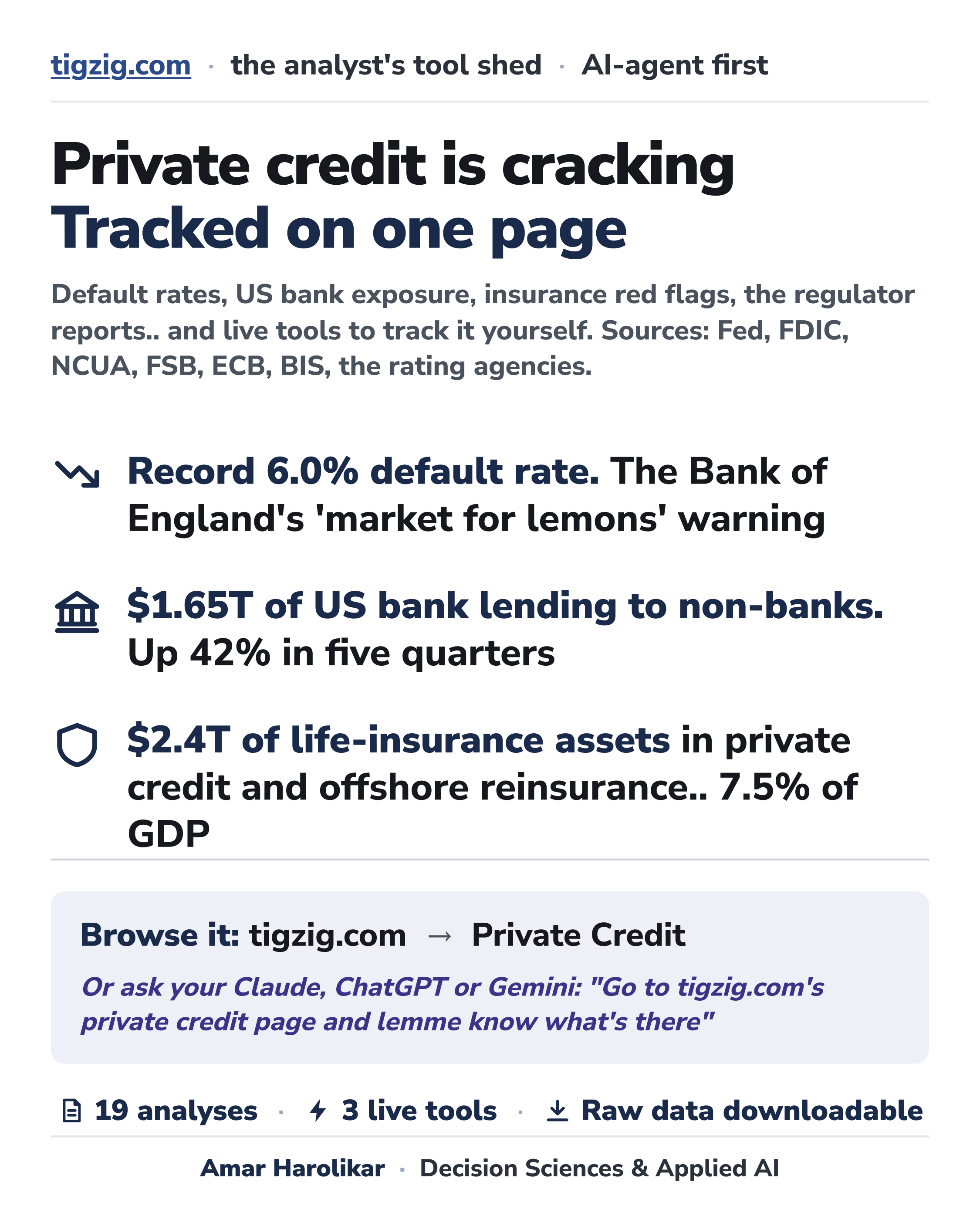
New Hub - Private Credit Stress on Tigzig.com. 19 Analyses, 3 Live Tools, Regulator Reports on One Page.
Announcement post for the new Private Credit Stress hub on tigzig.com (/private-credit) that consolidates the author's ongoing coverage - 19 analyses, 3 live tools, and the underlying regulator reports on one page. Framing set at the top: 'is private credit cracking? Depends who you ask' - 2008 mortgage-market analogy where the market was either perfectly stable or falling apart depending on the source, right up to Lehman. What the last 30 days added: $14B of investor money sitting behind 5% redemption gates, one Blue Owl fund with redemption requests for 38% of its shares, a BlackRock BDC chief exiting mid federal valuation probe, and PIMCO calling out a 'confidence gap' where NAVs reflect manager marks rather than a shared clearing price - so the question has moved from 'are borrowers defaulting' to 'can we trust the marks'. Post also carries two LinkedIn-comment sections. Section one - 'The real story: in just one month supervisors moved from writing warnings to running drills' - the June regulator drills: ECB doubled its private credit probe to 20+ banks with annual reporting (Jun 15), France ran its first ever system-wide NBFI stress test with Banque de France + ACPR + AMF, 25 institutions, fire-sale and interconnection risk (Jun 17), Bank of England sent 46 firms a hypothetical five-year recession (Jun 19), and at Sintra both Lagarde and Bailey flagged non-bank oversight in the same week. Warnings are cheap; stress tests cost money and staff, so three central banks funding drills in one month is not idle curiosity. Bull case acknowledged - gates working as designed so far, no fire sales, Goldman and Oaktree saw redemption demand below their caps. Section two - 'Market for lemons' - Sarah Breeden (Bank of England deputy governor for financial stability) April warning that private credit could tip into an Akerlof-style lemons market: no market price (the manager's own mark IS the price), stacked leverage at borrower + fund + sponsor, sliced structures too complex for anyone outside to see through - same features 2008 CDOs ran on. Same worry echoing across FSB (data gaps + valuation opacity), OCC (PIK masking credit deterioration), PIMCO (confidence gap). Ties back to the author's May 2026 'private credit market for lemons' post. 2-page overview PDF carousel included.
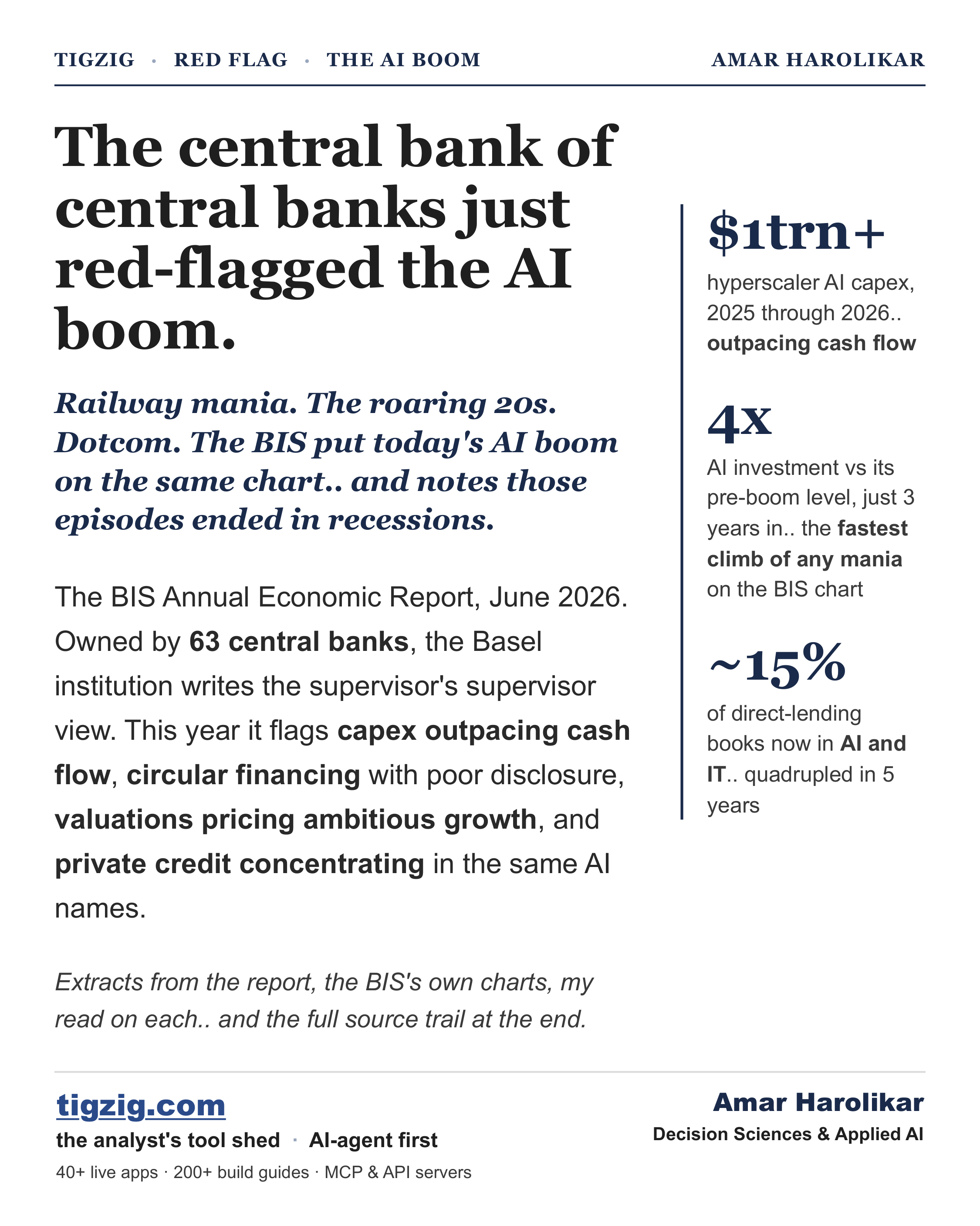
BIS, the Central Bank of Central Banks, Just Red-Flagged the AI Boom. Railway Mania, Roaring 20s, Dotcom - Same Chart.
Commentary on the Bank for International Settlements' (BIS - owned by 63 central banks) June 2026 Annual Economic Report that flagship-red-flags the AI boom. BIS charts today's AI boom next to canal mania, railway mania, roaring 20s and dotcom - each of which attracted 'capital in excess of what commercial returns could ultimately justify' and ended in economy-wide recessions. Six BIS red flags: $1trn+ hyperscaler AI capex outpacing free cash flow (part funded by debt); circular financing with 'the same asset being pledged multiple times' (2008 language, in print before the event); valuations pricing growth above anything these firms have ever delivered; the bust is modelled in the BIS adverse scenario (sector surplus goes negative); direct lenders quadrupled AI/IT lending to ~15% of books; firms signalling automation on earnings calls (BIS 'demand bottleneck' scenario - every displaced worker is a lost consumer). Charles Mackay's 1841 book 'Extraordinary Popular Delusions' invoked as historical parallel. Ties to author's earlier documented calls since March (Tremor Early Warning, Irrational Exuberance at S&P 7,400, Private Credit as Market for Lemons). Post also carries two companion pieces from Ashwinder Singh Bakhshi (22 years fixed-income, former MD Barings): 'phantom collateral' on the same BIS sentence about pledged assets, and 'Margin Called' on Korea's KOSPI 100% rally with W148 trillion of foreign-institutional selling absorbed by retail on record margin debt. 10-slide deck with BIS charts + author's read on each.
Boris Cherny: Engineering, Product, Design, Data Science Are Melting Into Archetypes. Seeing the Same.
Commentary on Boris Cherny's (Creator & Head of Claude Code at Anthropic) point that engineering, product, design and data science are melting into one kind of role and the work now maps to archetypes (prototyper, builder, sweeper, grower, maintainer) rather than to titles. The author sees the same in small businesses where he is bringing in Claude Code and Claude Cowork. Day-to-day pattern: marketing and finance folks building their own local automations and dashboards (often in VBA and Python); developers and builders turning those into production-grade tools, then maintaining them, working full-stack regardless of where they started out (frontend, backend, etc.); data scientists running more models, better validated, refreshed more often, and creating working prototypes of deployable tools and handing off to builders. Boris' team-mix view: pre-PMF products lean on archetypes 1+2+3, growing/found-PMF products on 2+3+4 plus some 5, strong-PMF products on 3+4+5 plus some 2. The 4-slide carousel pairs Boris' original framing with the author's own field observations. Work moves across the team; job titles matter less and less.
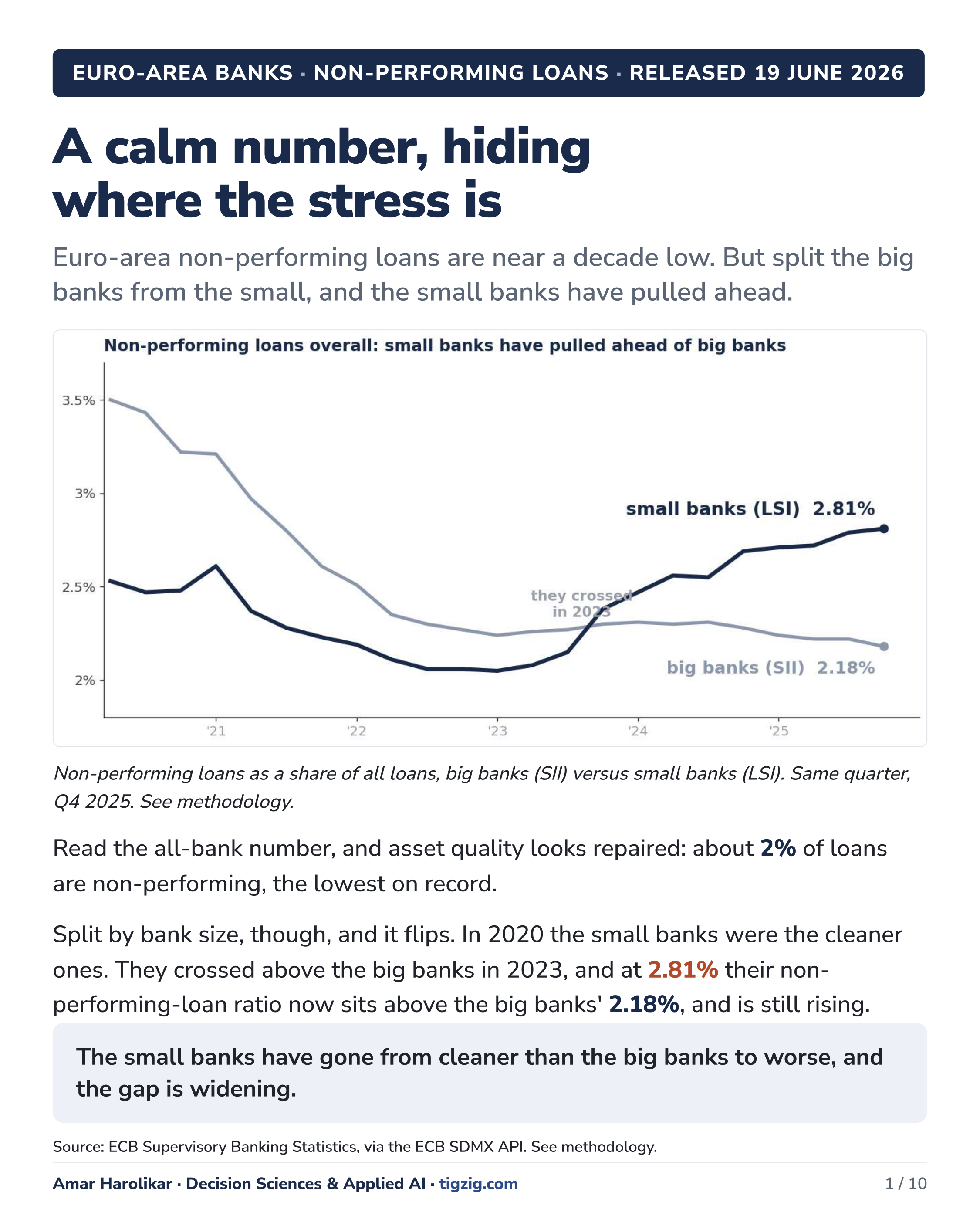
Euro-Area NPLs Look Calm. Split by Bank Size, the Small-Bank Corporate Book Is at 5.16% and Climbing.
Euro-area non-performing loans are near a decade low - but the calm headline hides where the stress is. Split by bank size and the small banks (less significant institutions, LSI - the Sparkassen, cooperative and savings banks; ~15% of euro-area bank assets) have pulled ahead of the big banks (significant institutions, SII, ~85% of assets). Big-bank NPLs sit near 2%; the small-bank corporate book has climbed to 5.16%, up about a third since 2023 and still rising. The consumer book is steady; the corporate book is the engine, and within that the two stressed corners are commercial real estate and small-business loans. Germany, Austria and Italy carry most of it - right where corporate insolvencies are running hot (Germany +57% vs the 2016-19 pre-pandemic May average per IWH; Austria 6,810 full-year 2025, +3.4%, property failures +35%; Italy ~+38% YoY per Allianz Trade). Households stay calm in the big systems (Germany 1.6% NPL, Netherlands 0.7%); the euro-area signal is corporate. Supervisors agree (ECB SREP 2025, OeNB FSR 51, ECB FSR May 2026) and tailored letters have gone to banks. Cycle to watch, not a system in trouble. 10-slide deck pulled live from the ECB SDMX REST API on 20 Jun 2026 (Q1 2026 release for SII / Q4 2025 for LSI - LSI lags one quarter by design, so SII vs LSI comparisons all use Q4 2025). Full 8-table copy-as-markdown dataset published at tigzig.com/ecb-npl-data-tables. Plus the parallel for the US: bank headline is also calm but the strain sits on the consumer (cards + autos) and in private credit, where losses hit the P&L directly and never show as a bank charge-off.
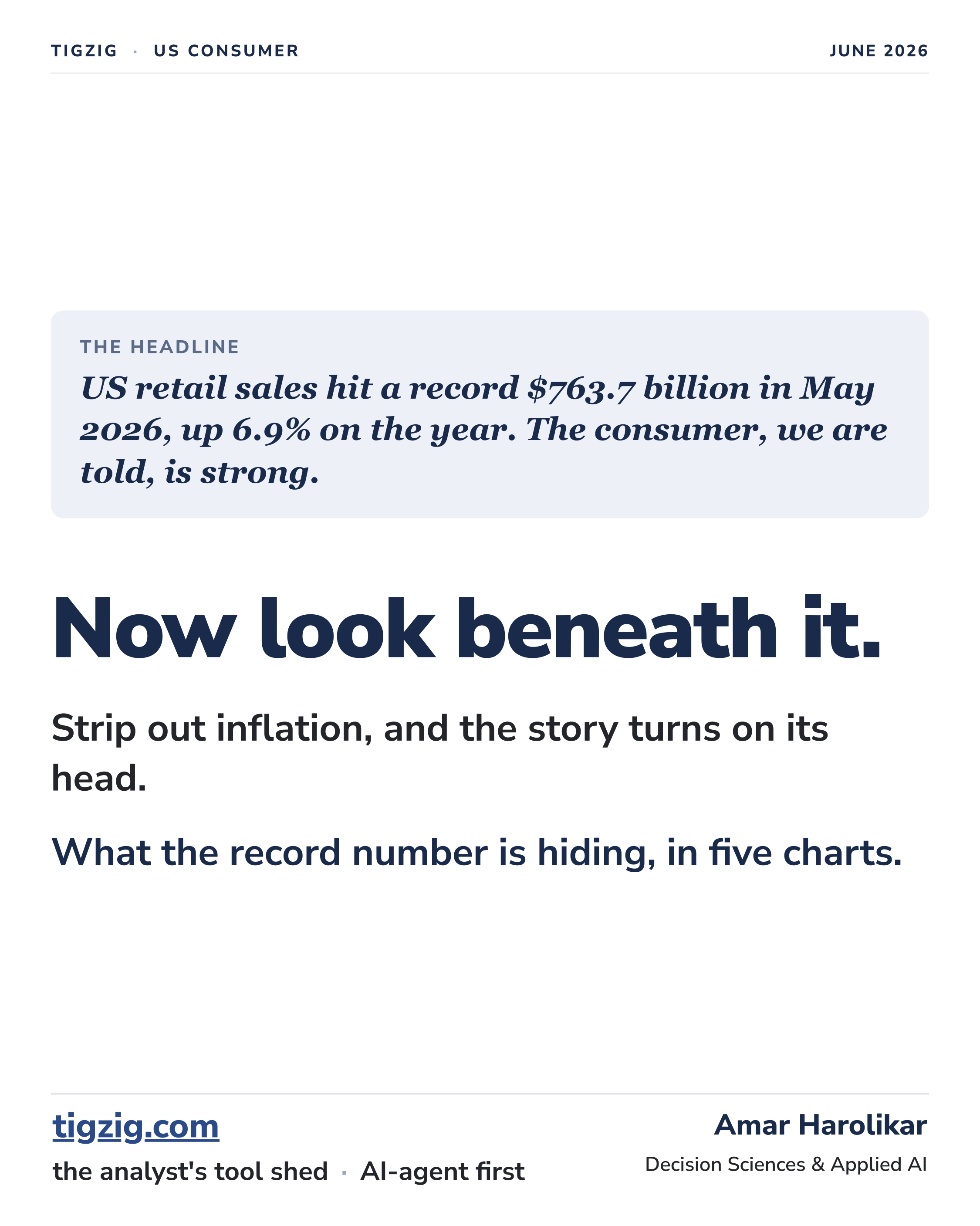
May 2026's Record US Retail Sales Number Is Hiding the Pain. Real Spending Hasn't Grown in Five Years. The Consumer Is Squeezed.
The May 2026 record US retail sales headline ($763.7bn, +6.9% YoY) is hiding the pain of a consumer being squeezed - and the squeeze was here long before the Iran war. Strip out inflation and real goods spending has not grown in five years: of the $763.7bn rung up in May 2026, only $605.9bn is real 2021 goods - the other $157.8bn is pure inflation. Households are holding the line by stretching: personal saving rate back to pre-2008 lows, NY Fed HELOC balances up 40% since 2021. The strain is starting to show: University of Michigan consumer sentiment collapsed to 44.8 (near the lowest on record), and 90+ day delinquencies on all consumer debt are back to 3.4% - past the 2007 mark. Real GDP still grows ~2% on services, AI investment and government, so this is a squeeze on the household goods budget, not an economy-wide downturn. The proof is the balance sheet: thinning savings, more borrowing, delinquencies past 2007. Companion piece: jobs market softening since 2024 (unemployment 4.3%, underemployment 8.1%, long-term joblessness near a 3-year high). Cheaper oil is real relief on the price side, but it does not refill a drained savings account or put the long-term unemployed back to work. 6-slide deck with every series live on tigzig.com -> Tremor (retail RSAFS + RRSFS, saving rate BEA, HELOC + delinquency NY Fed, sentiment U-Mich), pullable by API, Excel, or AI agent. Real retail definition: nominal Advance Retail & Food Services Sales deflated by headline CPI (the honest test of volume vs price).
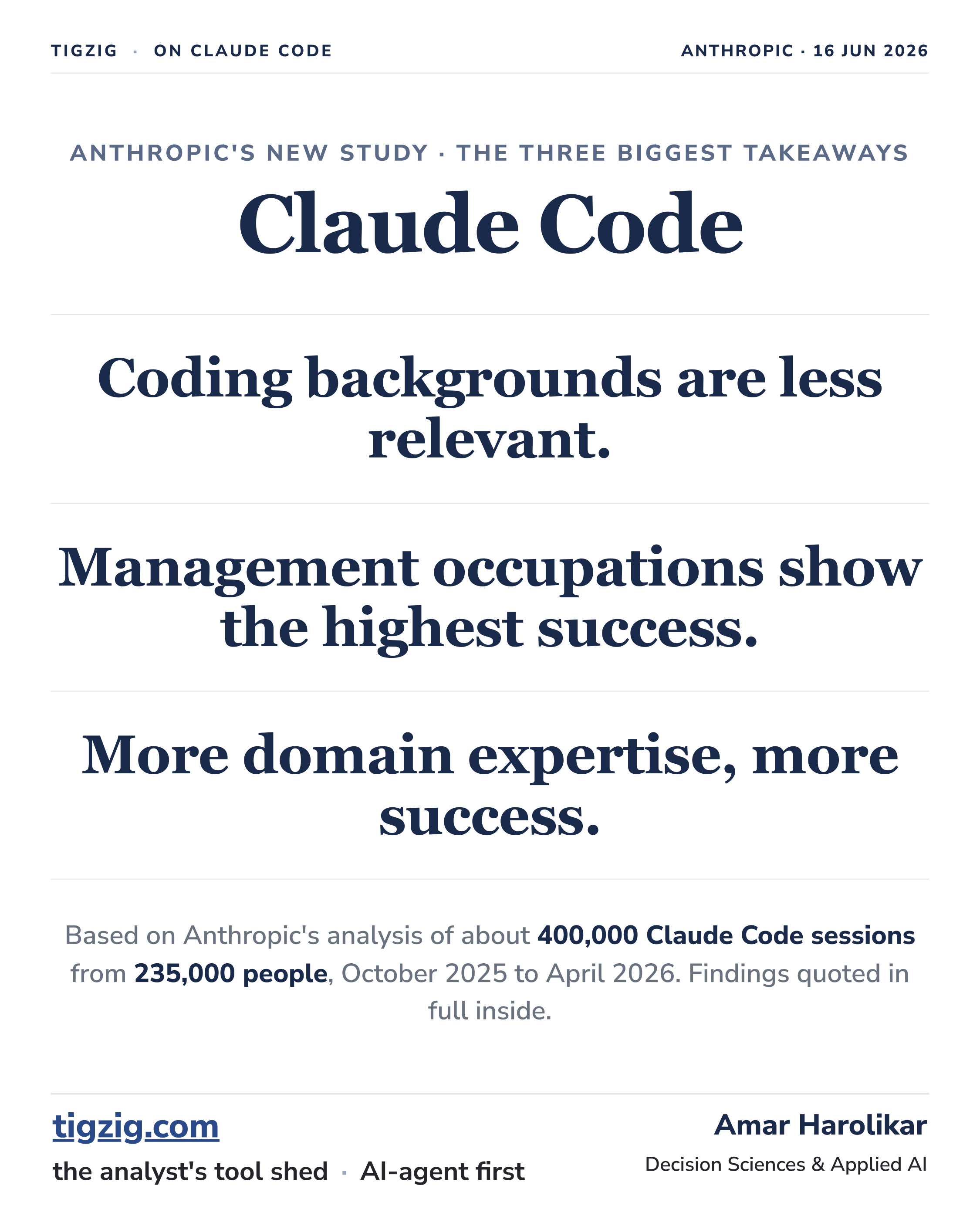
Agentic Coding and Persistent Returns to Expertise - Anthropic's 400k Claude Code Sessions, Summarized
Anthropic just published 'Agentic coding and persistent returns to expertise' - a privacy-preserving analysis of ~400,000 interactive Claude Code sessions from ~235,000 people, October 2025 to April 2026. Three takeaways pulled into a 9-slide summary deck with every headline a direct quotation: (1) coding background is becoming less relevant - every major occupation succeeds at rates within a few points of software-related occupations (software engineers verified at 34%; all ten largest groups within seven points); (2) management occupations show the highest verified success, slightly above software engineering, which Anthropic reads as management skills transferring to directing an agent (with a measurement caveat); (3) the more domain expertise a person brings, the more work Claude does per instruction (more than twice the actions, five times the output from the same prompt) and the more often the session ends in success (verified success doubles 15% to 33%, novice-to-intermediate is where most of the jump happens, and only 5-7% of expert sessions end abandoned vs 19% for novices). Bonus: the share of sessions spent fixing broken code fell from 33% to 19% while average task value rose 27% vs a freelance-market benchmark. Anthropic's honest caveat: classifiers remain challenging to validate at scale; they cannot measure whether the code is actually used. Matches the author's 25 years as an analyst - on coding the agents win by multiples, on deep domain the human still wins.
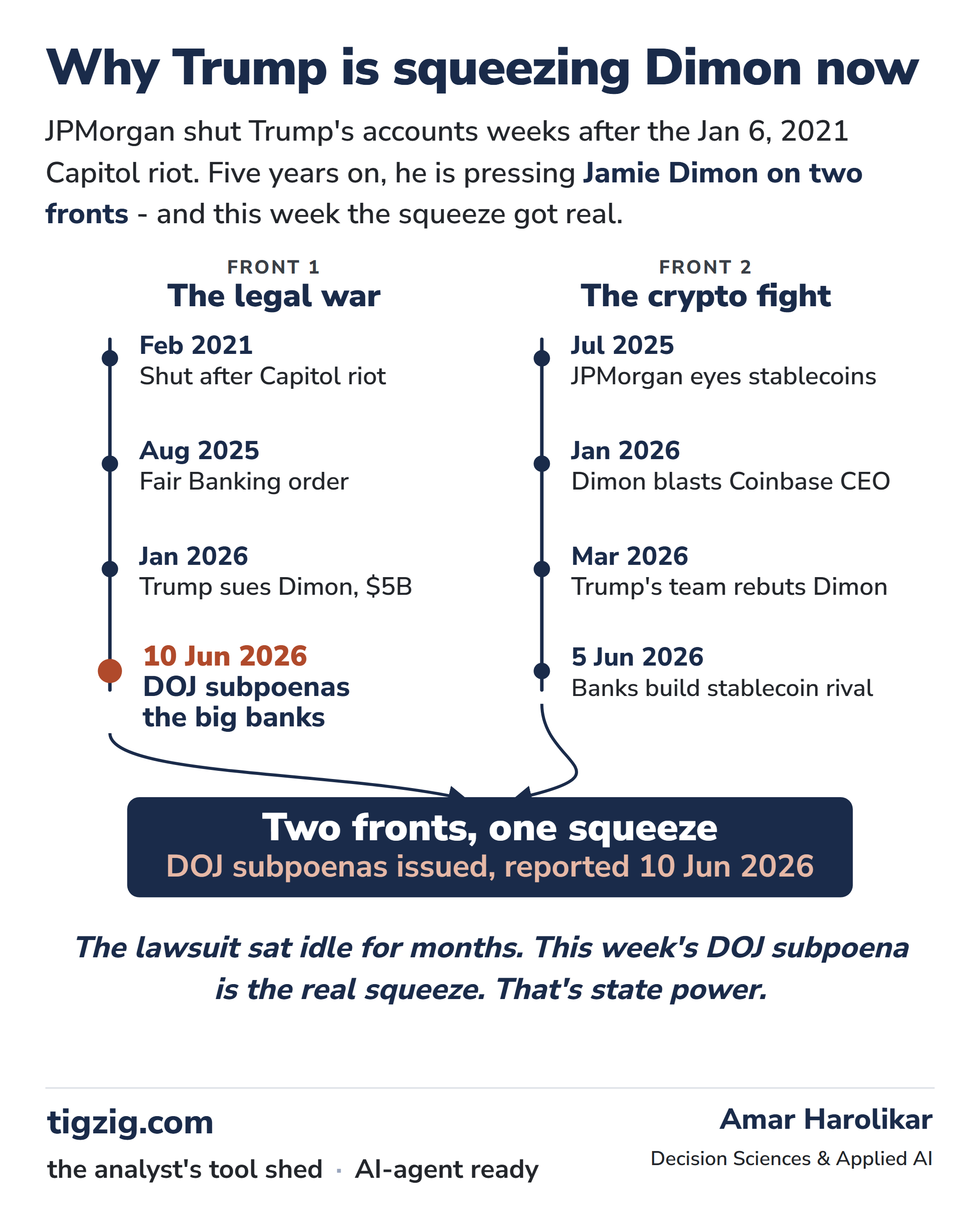
Why Trump Is Going After Jamie Dimon Right Now. Two Fronts - Debanking + Crypto. The DOJ Subpoena Made It Real.
Why is Trump going after Jamie Dimon right now, five years after JPMorgan shut his accounts weeks after Jan 6, and why this particular week? The legal war front: Feb 2021 debanking, Aug 2025 Fair Banking order, Jan 2026 Trump sues Dimon for $5 billion, and for months the lawsuit just sat there - lawyers filing papers, nothing moving. This week it got teeth: on 10 Jun 2026 the DOJ (through Jeanine Pirro's office) subpoenaed JPMorgan, Bank of America and Wells Fargo over the debanking. Private lawsuits limping along are one thing; the federal machinery moving in behind them is a different beast. Running alongside is the crypto fight - Trump signed the GENIUS Act last summer (the big stablecoin law) and wants the US to be 'the crypto capital of the world'; his family has crypto ventures of their own. Dimon has been the loudest bank voice fighting the next bill (CLARITY Act) and told the Coinbase CEO to his face he is full of it. Then on 5 Jun 2026 - days before the subpoenas landed - the big banks announced they are building their own blockchain money, a shared tokenized deposit network, so customer deposits stay locked in the regulated banking system and do not bleed out into the stablecoins Trump has been backing. Did the crypto fight cause the DOJ to move? No paper trail. But the incidents line up too close to wave away - read the motive for yourself.
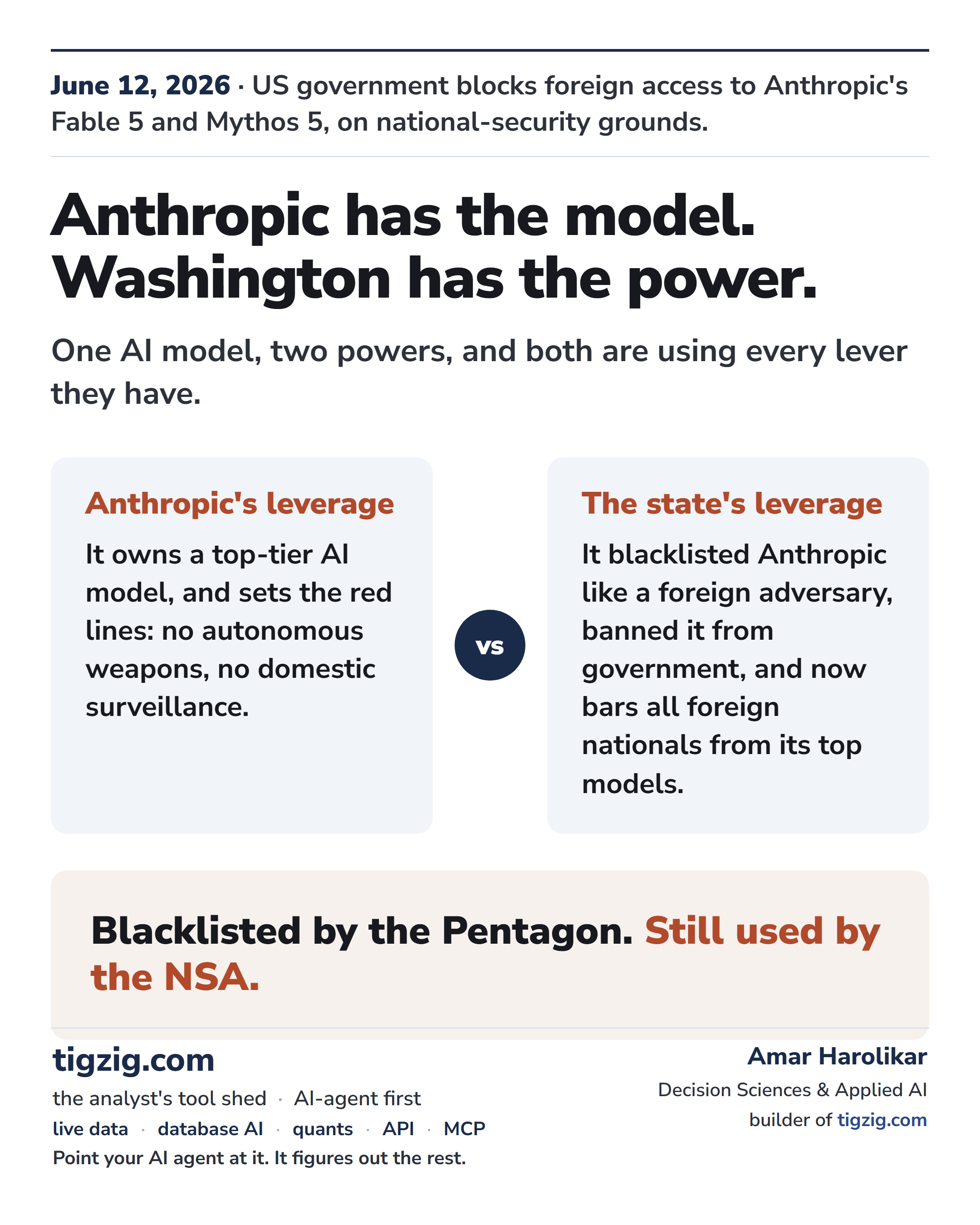
The Fable 5 Shutdown Isn't About a Jailbreak. It's the Anthropic vs US Government Standoff Coming to a Head.
This week's Fable 5 shutdown is not really about a jailbreak. It is the Anthropic vs US government standoff coming to a head. Months ago Anthropic refused to give the Pentagon 'all lawful use' of its models, holding two red lines - no fully autonomous weapons, no domestic surveillance. Trump ordered every federal agency to stop using Anthropic, and the Pentagon branded it a 'supply chain risk', a label normally reserved for foreign adversaries - the first American company to get it. The defense work went to OpenAI. A federal judge called the blacklisting 'classic illegal First Amendment retaliation' and 'Orwellian', but an appeals court let the blacklist stand while the case runs. Meanwhile the NSA - under the same Pentagon - is reported (per Axios) to be using Anthropic's most powerful model anyway: too dangerous to allow, too useful to drop. This week Commerce blocked all foreign nationals from Fable 5 and Mythos 5 over a jailbreak Anthropic says is minor and doable on other models. To comply, Anthropic switched both models off worldwide. The irony: the Pentagon's whole fear was that Anthropic could pull the plug on its own model. This week, Anthropic pulled the plug. A standoff between a company that draws red lines on its own tech and a state that treats frontier AI as too strategic to leave to a company. The company has the model. The government has the machinery.
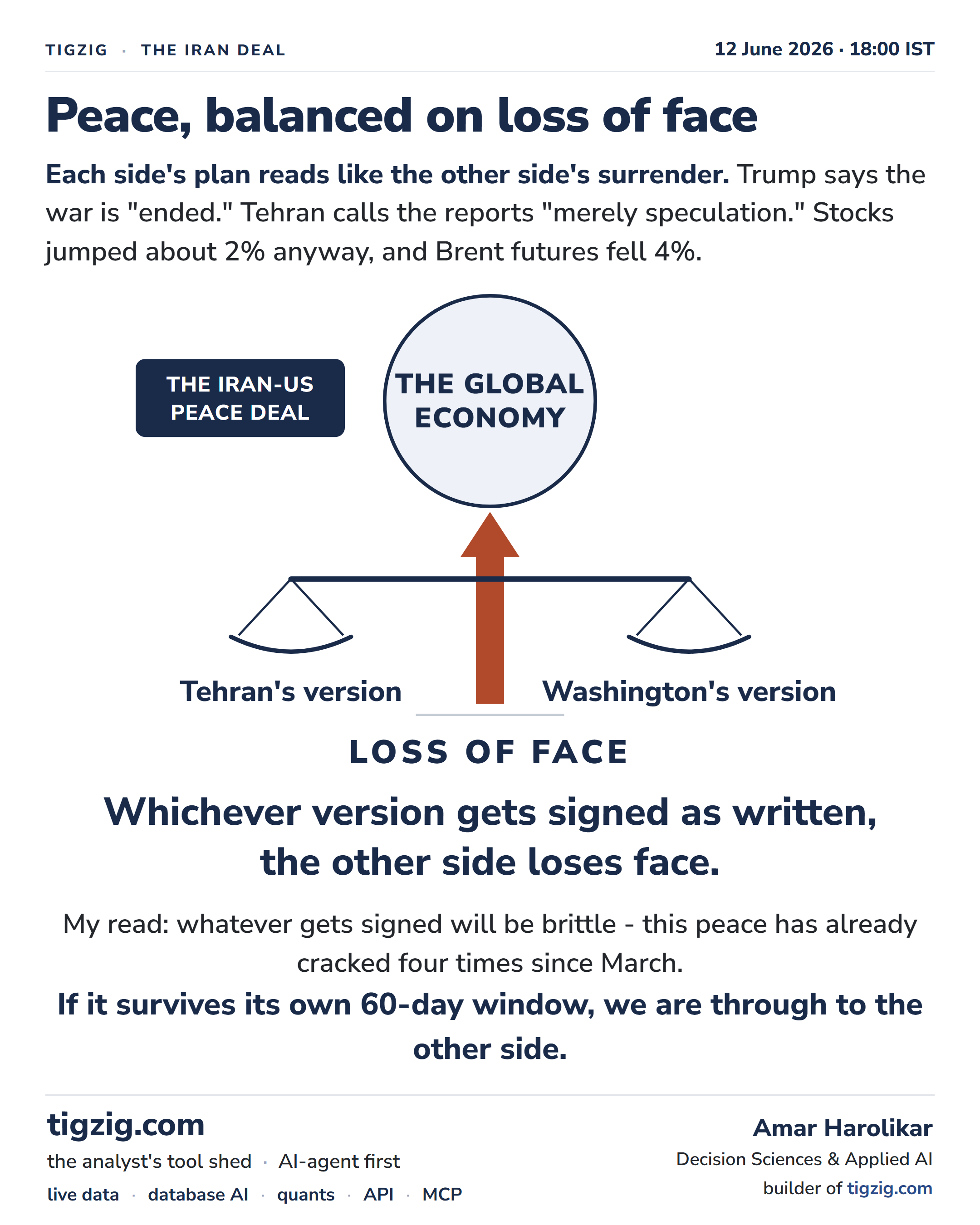
Markets Are Celebrating an Iran Deal. Nobody Has Agreed Which Deal. Peace Is Balanced on Loss of Face.
Markets are celebrating an Iran deal, but nobody has agreed which deal. Trump says the war is 'ended'; Tehran calls the reports 'merely speculation' and says there is no final decision yet. CNN counts ~40 times Trump has called a deal imminent. ~100 days into the war the macro damage is real: UK GDP at -0.1% in April (released today), US gasoline $4.65, stressed US consumer, global economy showing cracks. Two drafts in circulation, and they look almost nothing alike. Tehran's 14-point version (leaked to Iranian state media, picked up by CNBC): ceasefire on all fronts, naval blockade lifted, Hormuz reopened on Iran's arrangements, oil sanctions suspended, $12bn unfrozen before talks even begin, $300bn reconstruction plans, US forces out, missiles and proxies off the agenda - and the nuclear negotiation only after all of that, with a 60-day window. Washington's version (via diplomat to CNN): Hormuz reopened immediately with no Iranian fees, sanctions relief with no set date, deal 'satisfies all US requirements on the nuclear issue.' Each side's plan reads like the other side's surrender. Stocks jumped ~2%; Brent futures fell 4%. Whichever version gets signed as written, the other side loses face. My read: whatever gets signed will be brittle - this peace has already cracked four times since March. If it survives its own 60-day window, we are through to the other side.
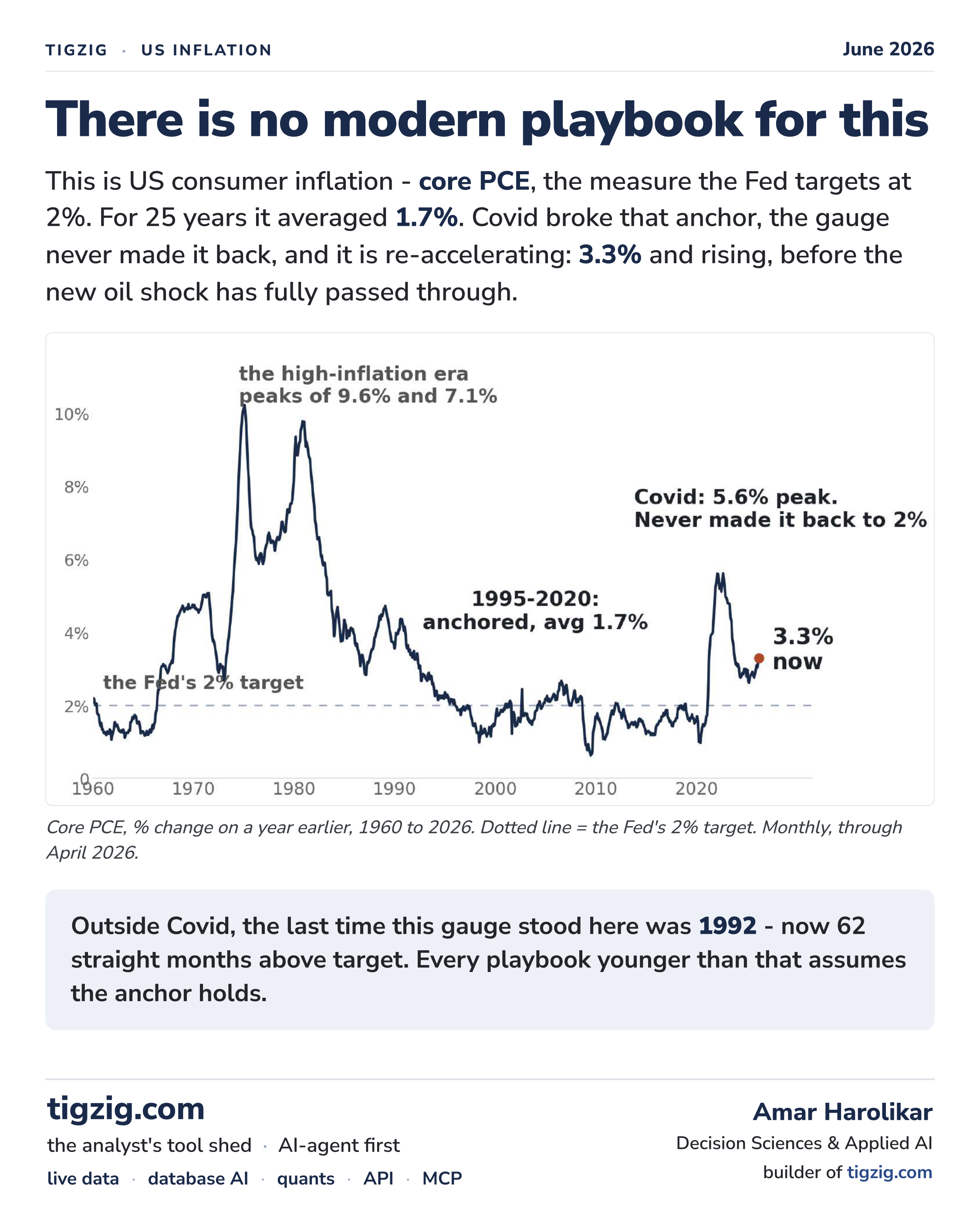
There Is No Modern Playbook for This. US Core Inflation at 3.3%, Re-Accelerating. Producer Prices at 6.4%. Consumer Delinquencies Past 2007.
US core PCE - the gauge the Fed targets at 2% - is at 3.3% and re-accelerating. Outside Covid, last at this level in April 1992. 25-year pre-Covid average: 1.7%. It has now spent 62 straight months above target. And the pipeline says more is coming: PPI final demand at 6.4% - hottest in the modern series outside Covid - with core PPI at 4.9%; PPI is running 2.2 points ahead of CPI, putting the bigger share of the bill on producers (margin compression) but with consumer pass-through inevitable. The consumer is already stretched: gasoline at $4.65 (only June/July 2022 ever higher), and 3.4% of consumer debt is in the 90+ DPD bucket - past the 3.1% mark of late 2007 and more than double the end-2022 low, rising in 12 of the last 13 quarters. Against all of this the S&P set a record at 7,610 on June 2 with Shiller CAPE 2nd-highest in 145 years and Michigan sentiment lowest in 73 years - a handful of AI names doing most of the lifting. The last two times the market was priced like this while the economy cracked underneath - 2000 and 2007 - the index halved. 6-slide deck with full series codes, method, and the dot-com (-49%) / GFC (-57%) drawdown references.
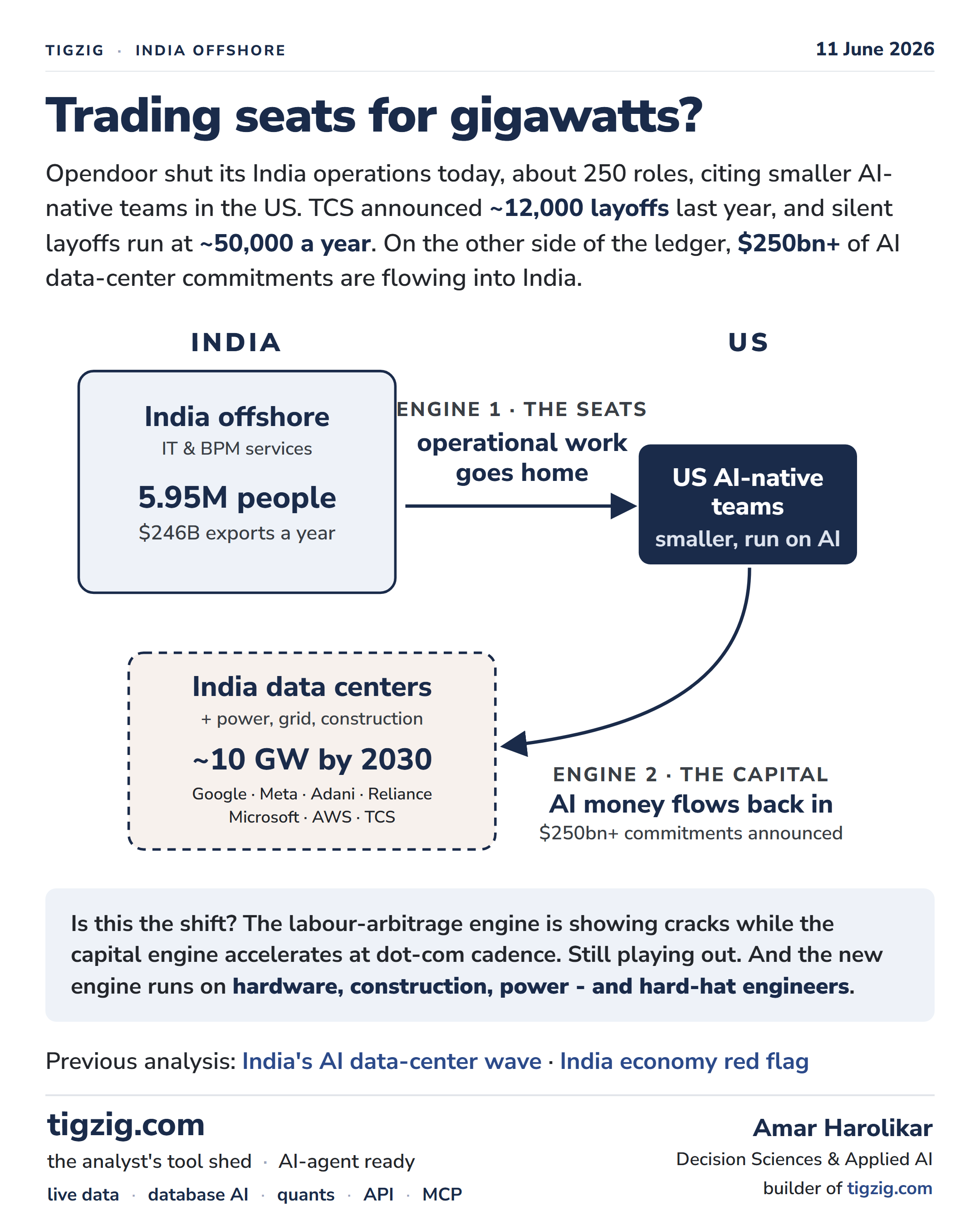
Two Announcements, One Day Apart. Operational Seats Moving Out of India. AI Compute Moving In.
Two announcements, one day apart: Opendoor shut its India operations (~250 FTE) and is shifting to smaller AI-native US teams; Meta signed its first AI data center deal in India. Neither announcement is a first - what caught the eye is both reported within a day of each other. Engine 1, the seats: India offshore IT and BPM employs 5.95 million people and exports $246B a year; TCS announced ~12,000 layoffs last year and silent layoffs run at ~50,000 a year. Operational work is going home to smaller US AI-native teams. Engine 2, the capital: India data centers + power, grid, construction headed for ~10 GW by 2030 with $250bn+ already committed by Google, Meta, Adani, Reliance, Microsoft, AWS, TCS. The labour-arbitrage engine is showing cracks while the capital engine accelerates at dot-com cadence. Is this the real shift? Too early to call. The new engine runs on hardware, construction, power - and hard-hat engineers. Companion to the prior 'India's AI data center wave' and 'India economy red flag' analyses.
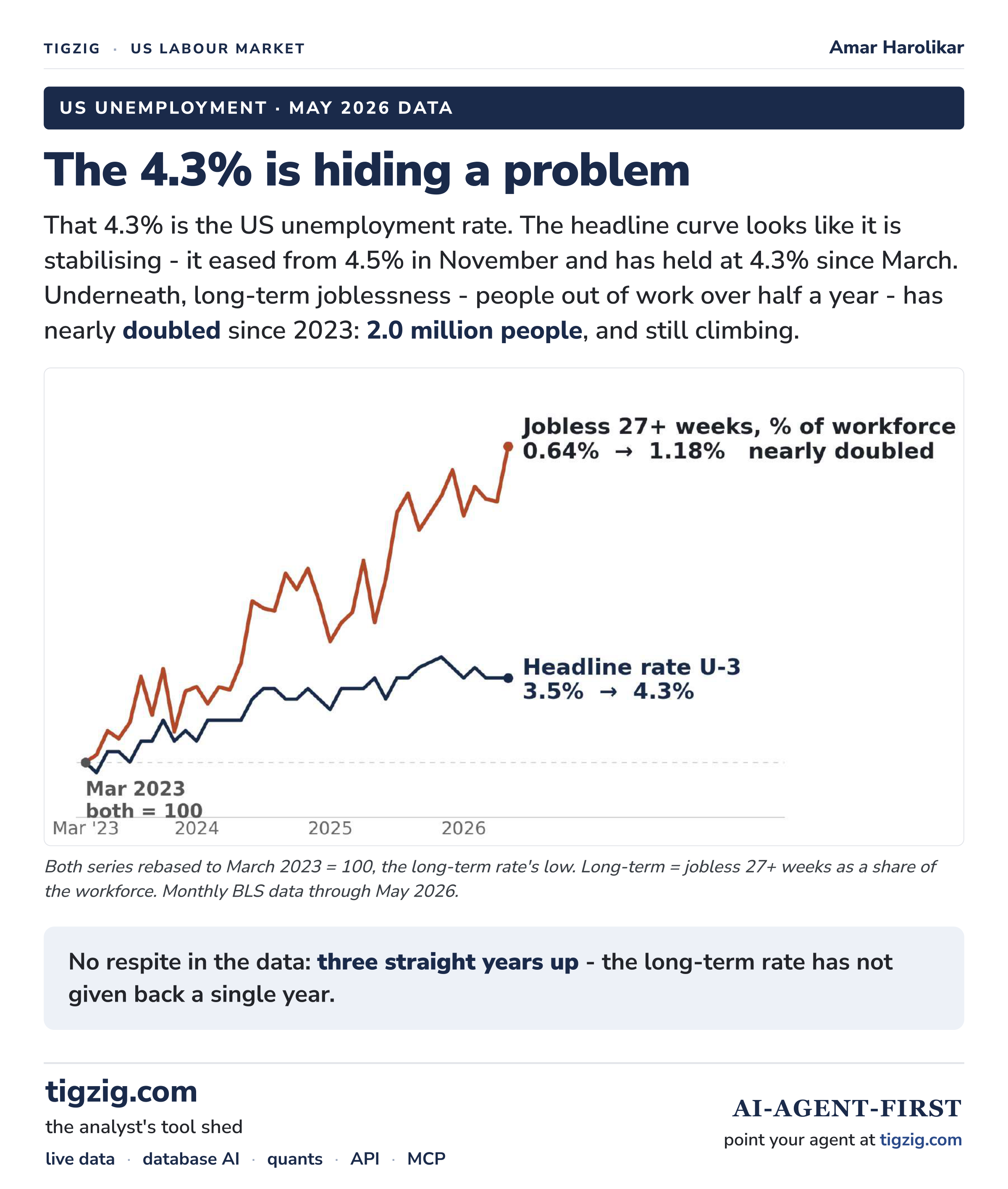
US Unemployment Is 4.3%. The Stuff Underneath Says Otherwise. 2M Jobless Over Six Months, Up 3 Straight Years.
US unemployment is 4.3% and the headline curve looks like it is calming - eased from 4.5% in Nov, held at 4.3% since March. The data underneath says otherwise. Long-term joblessness (27+ weeks) has nearly doubled since 2023 to 2.0 million people, with three straight years up and no give-back. When long-term pulls away from the headline like this, that is the 2008 pattern - into 2008 the long-term line towered about 6x its pre-crisis level while U-3 only doubled. Covid never had this shape; rehiring was too fast. Today's rise has the slow-grind 2008 shape, with no recession to blame. Composition: the long-term share fell to 17.8% after Covid (Feb 2023) and is back to 27.5% now (GFC extreme was 45.5%) - more than one in four of the unemployed are now past the line that scars. Structural test: measured against the whole workforce, long-term joblessness has stepped up once in 25 years - 0.53% to 0.81% in the dot-com era. This cycle is at 1.18% in May and still rising. Is AI doing to the jobless floor what dot-com did? Too early to call - the test comes when this cycle finally turns. Fits the picture from last week's note: consumer sentiment at a 73-year low, valuations near 145-year highs. 5-slide deck on BLS / FRED data through May 2026.
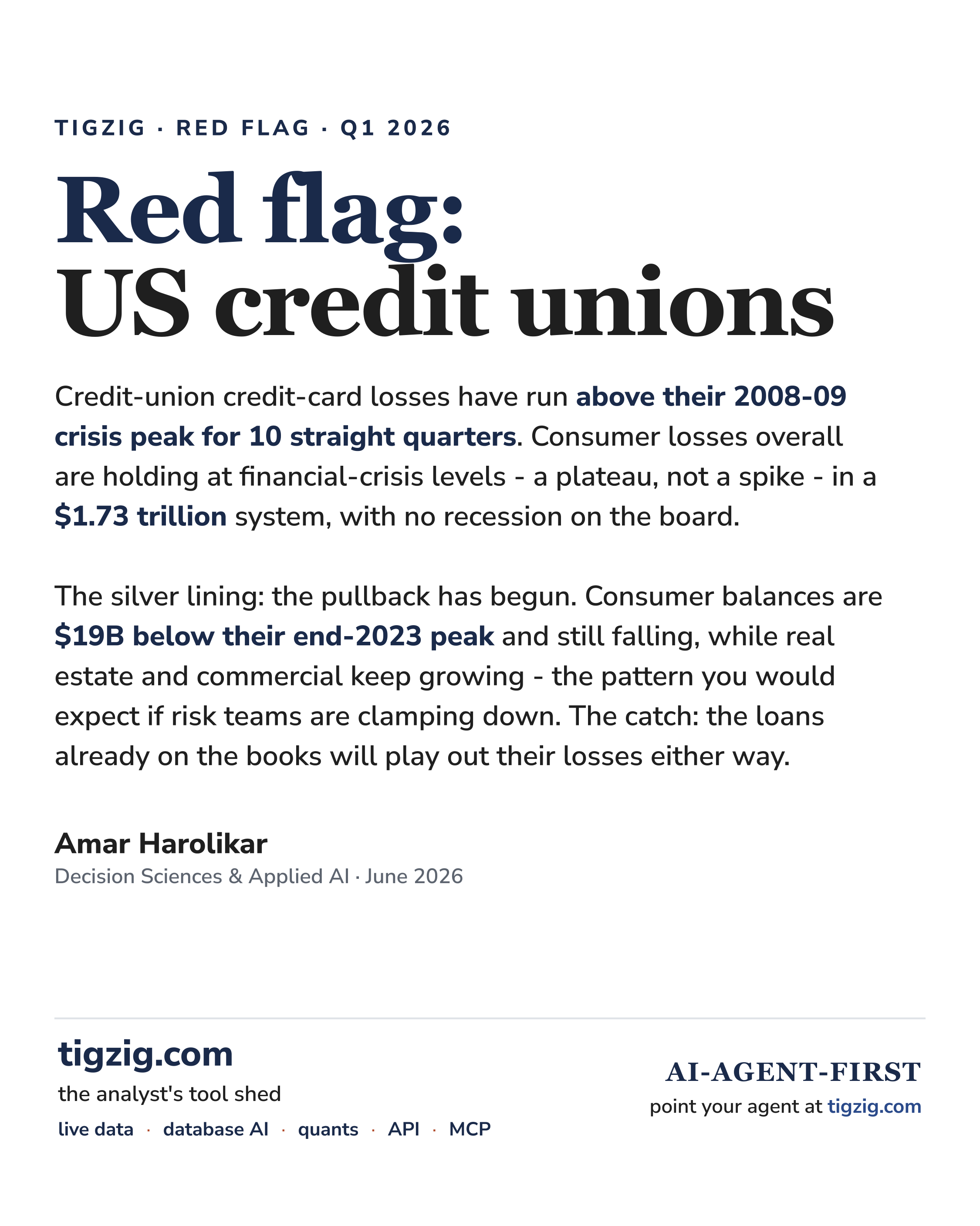
Red Flag: US Credit Unions. A $1.73T System at GFC-Era Losses. Card Charge-Offs 10 Straight Quarters Past the Crisis Peak.
Red flag on US credit unions - a $1.73 trillion lending system running GFC-level losses in consumer, with no recession on the board. Card charge-offs hit 5.30% in Q1 2026, above the 2008-09 crisis peak (4.68%) for 10 consecutive quarters - a plateau, not a spike. Real estate and commercial are calm (59% of loans, 4% of losses). Consumer is 41% of loans and 95% of losses, with auto NCO at a fresh series record (0.97%) and cards at 33% of all CU loan losses. Measured vs each sector's own GFC peak: credit unions are at 113% on cards (past), banks just 38% - this is not system-wide banking stress, it is concentrated in credit unions. The silver lining: consumer balances are $19B below their end-2023 peak and falling, the shape of a deliberate tightening - but vintages already booked will run their loss curves. The Share Insurance Fund equity ratio is at 1.30% (below the 1.33% normal operating level); a wave could force a premium assessment on every surviving credit union (precedent: 2009-10 corporate CU crisis). The NCUA is run by a single board member - the other two were removed in April 2025, dispute now at the Supreme Court. Banks have Jamie Dimon. Credit unions have nobody. 13-slide carousel deck with full method, source notes and the failure-channel transmission path. Companion to the prior 'Auto Past the GFC Peak. Cards Almost There' post.
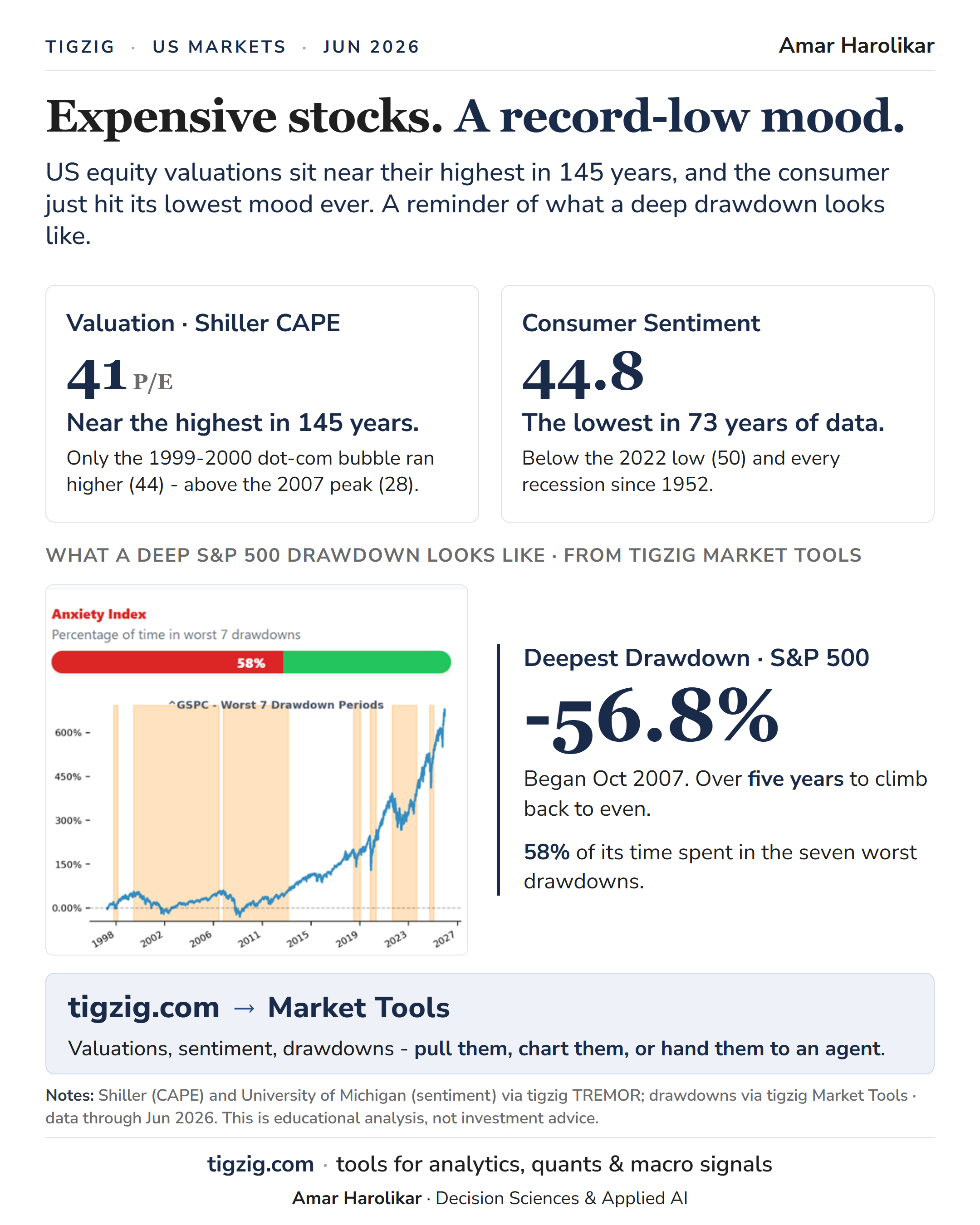
Index at a Record. Peak Valuation. Record-Low Sentiment. Last Two Times This Setup Held - 2000 and 2007 - the Market Halved.
Index at a record. Peak valuation. Lowest sentiments. And the economy cracking. Last two times the market was priced up here - 2000 and 2007 - it halved. Shiller CAPE near 41 P/E, the highest in 145 years apart from the 1999-2000 dot-com bubble (44), above the 2007 peak (28). University of Michigan consumer sentiment at 44.8, the lowest in 73 years of data - below the 2022 low (50) and every recession since 1952. In dot-com it was all about page views with no line of sight on revenues; in 2026 it is all about compute and revenues with no line of sight on cash profitability. Companion to the prior 'Irrational Exuberance' note when the S&P was at 7,400. Consumer delinquencies high, unemployment high, producer prices the hottest in 25 years (excl Covid), oil and gasoline high, consumer stretched. Seven stocks doing most of the lifting in the index. Dimon called it too much exuberance. Buffett sitting on the biggest cash pile in Berkshire's history. Drawdown ground-truth from tigzig Market Tools: S&P 500 deepest -56.8% beginning Oct 2007, over five years to climb back to even, 58% of its time spent in the seven worst drawdowns. Not investment advice.
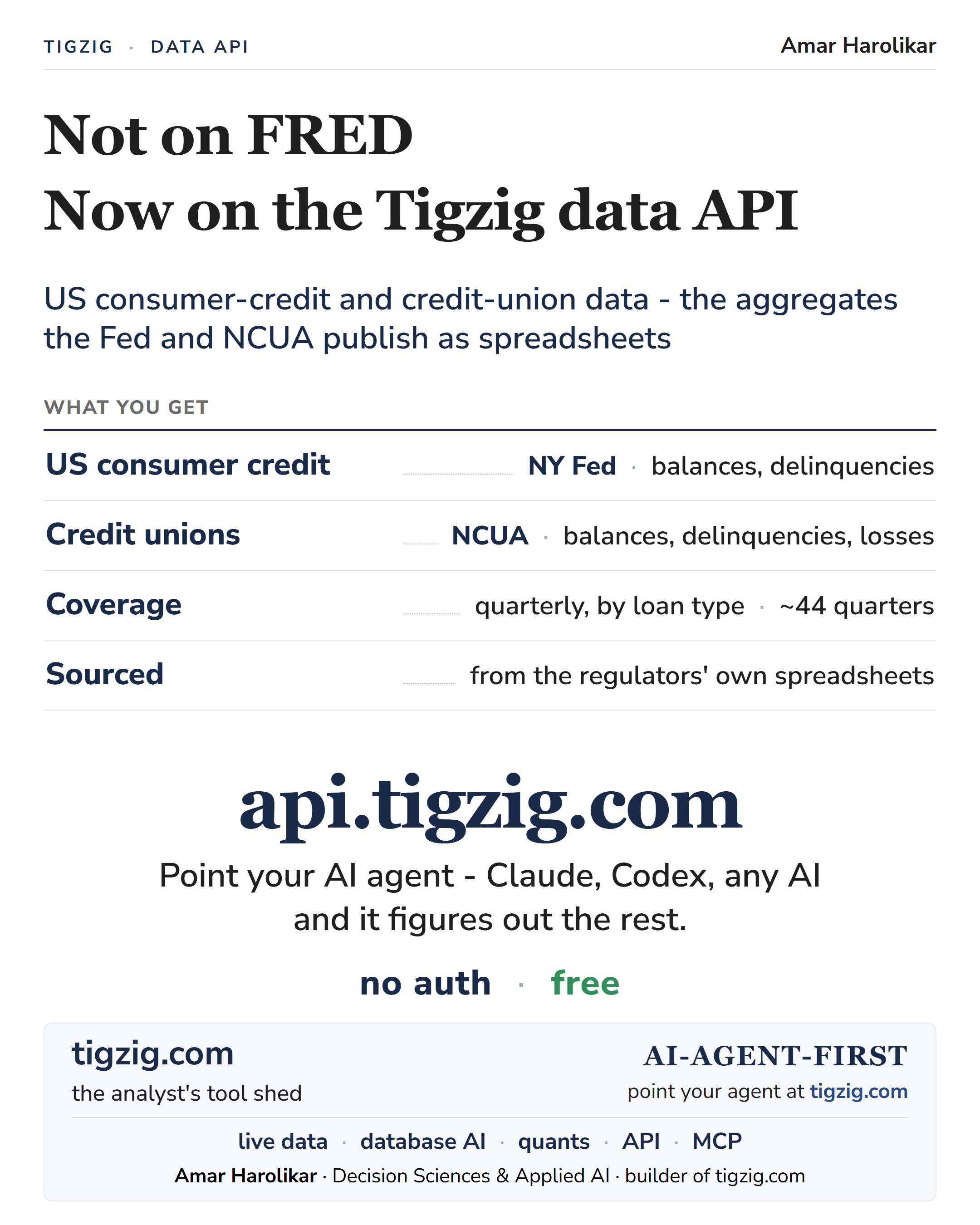
Auto Losses Past the GFC Peak. Cards Almost There. Credit Unions Already at GFC Loss Rates. NY Fed + NCUA Data Now on Tigzig.
NY Fed and NCUA aggregate loss / delinquency data comes out as a spreadsheet - pain to analyze. Pulled, disaggregated by quarter, validated and loaded into a database with an interface (tigzig.com -> TREMOR), an API (api.tigzig.com) and an MCP layer (mcp.tigzig.com). Quarterly coverage, by loan type, ~44 quarters, sourced from the regulators' own spreadsheets. And the data is talking loudly. Bank charge-offs look fine on the surface but the pressure is one step away from the banks: auto losses past the GFC peak, cards almost there. Credit unions running loss rates last seen during the GFC period - overall, consumer and cards; the card book has already pushed past its 2009 peak. And banks keep funding non-bank lenders - $1.65T to non-banks in Q1, up 42% in five quarters.
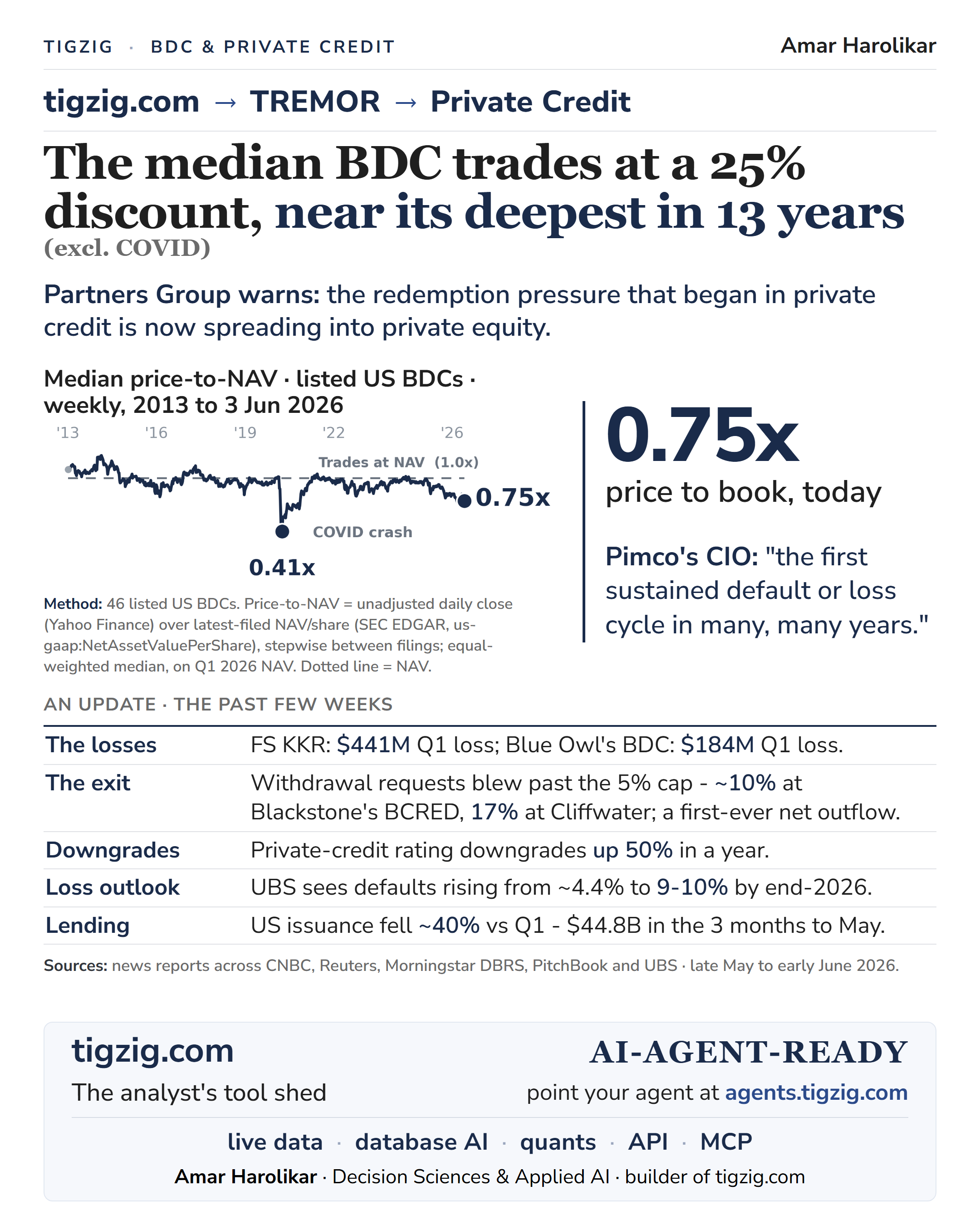
Private Credit and BDC Stress. Discounts at 13-Year Lows. Withdrawals Past the Gate. Regulators Now Arriving.
The median listed BDC trades at 25% discount to NAV, near its deepest in 13 years excluding Covid - 0.75x price to book today. Pimco's CIO: 'the first sustained default or loss cycle in many, many years.' Q1 losses: FS KKR $441M, Blue Owl's BDC $184M. Withdrawal requests blew past the 5% redemption gate at Blackstone's BCRED (~10%) and Cliffwater (17%) - a first-ever net outflow. Private-credit rating downgrades up 50% in a year. UBS sees defaults rising from ~4.4% to 9-10% by end-2026. US issuance fell ~40% vs Q1 to $44.8B in the 3 months to May. Partners Group warns the redemption pressure that began in private credit is now spreading into private equity. The regulators have started arriving: federal prosecutors in NY questioning BlackRock executives over how their credit fund valued loans; FSB flags private credit's leverage and interconnections as a source of broader risks to financial stability; ECB puts US private credit on its watchlist as a spillover risk into Europe; Sarah Breeden at the Bank of England calls it a potential 'market for lemons' (Akerlof). Companion update to the prior 'Is Private Credit Turning Into a Lemon' analysis.
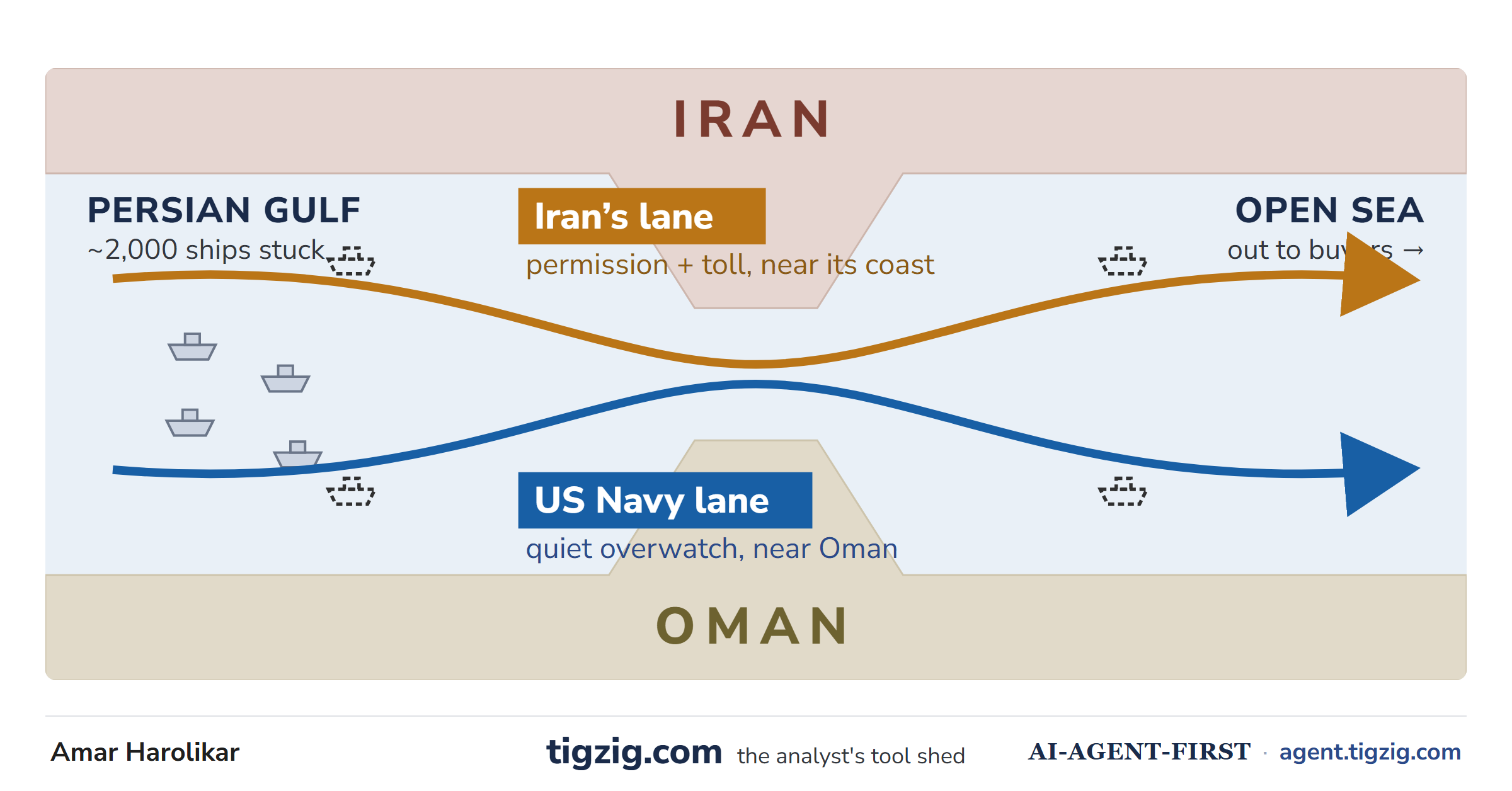
Hormuz Is Quietly Opening. The First Good News in 100 Days. And It Is Running in Two Lanes.
A trickle of tankers is getting out of the Strait of Hormuz again - the first real relief after more than three months of a shut chokepoint. But how they are getting out is the interesting bit. There is not one quiet arrangement, there are two. One lane Iran controls and charges a toll for, close to the Iranian coast (most traffic this way - CSIS says half the vessels since early March are from just four countries with China at the top). One lane the US Navy quietly watches over near the Oman coast - mines cleared, ~70 ships guided through in three weeks per New York Times sources; officially the US says it is not escorting, just coordinating. Tankers go dark on both sides - on Iran's lane to stay off the Western sanctions record, on the US lane to not broadcast their position to Iran. Use Iran's lane and you risk US sanctions; use the US lane and you risk an Iranian attack. Per Kpler, of the ~895 ships that crossed early March to mid-May, just over half took Iran's route and about 40% went by a route nobody can quite place - that 40% is the story. Producers shut in ~11 mbd; Energy Aspects: oil flow recovery will be slow, uneven and possibly incomplete. Gulf producers are even building pipelines to go around Hormuz. The US-Iran interim memo (30-60 days) is in the final stretch, leaving the strait basically under Iranian control however the fees end up dressed. Opening, yes - real. Solved, no.
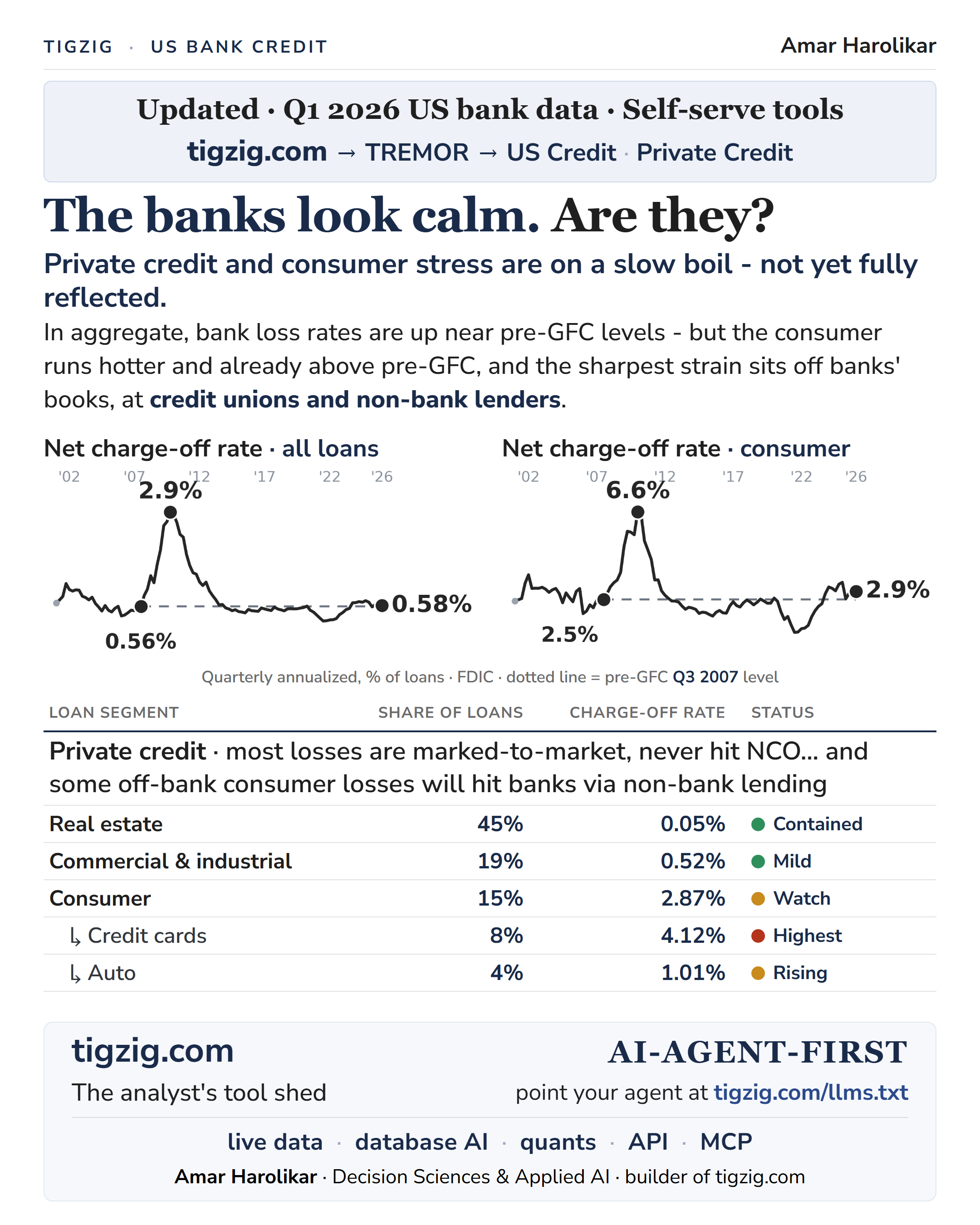
Bank Loss Rates Look Calm. The Stuff Underneath - Consumer, Private Credit, Non-Banks - Says Otherwise.
US bank net charge-offs at 0.58% in Q1 2026 - right at pre-GFC, miles under the GFC peak, so the headline number looks calm. But pull the consumer book out and consumer NCO is already running hotter than pre-GFC at 2.9% vs 2.5% in 2007 - cards highest, auto rising. The sharpest stress sits off the bank books: most private credit losses are marked-to-market and hit P&L directly, never showing as a charge-off. Credit unions and non-bank consumer lenders carry the weakest paper, which loops back to banks via their non-bank and private credit lines. The macro is weak across unemployment, savings rate, producer inflation, oil and gas - all moving the wrong way. The bank NCO looks calm; the stuff it can't show (consumer cards, private credit mark-to-market, non-bank consumer lenders) says otherwise. Analysis supported by TIGZIG TREMOR self-serve analytics tool covering FDIC, NY Fed, NCUA and private-credit series.
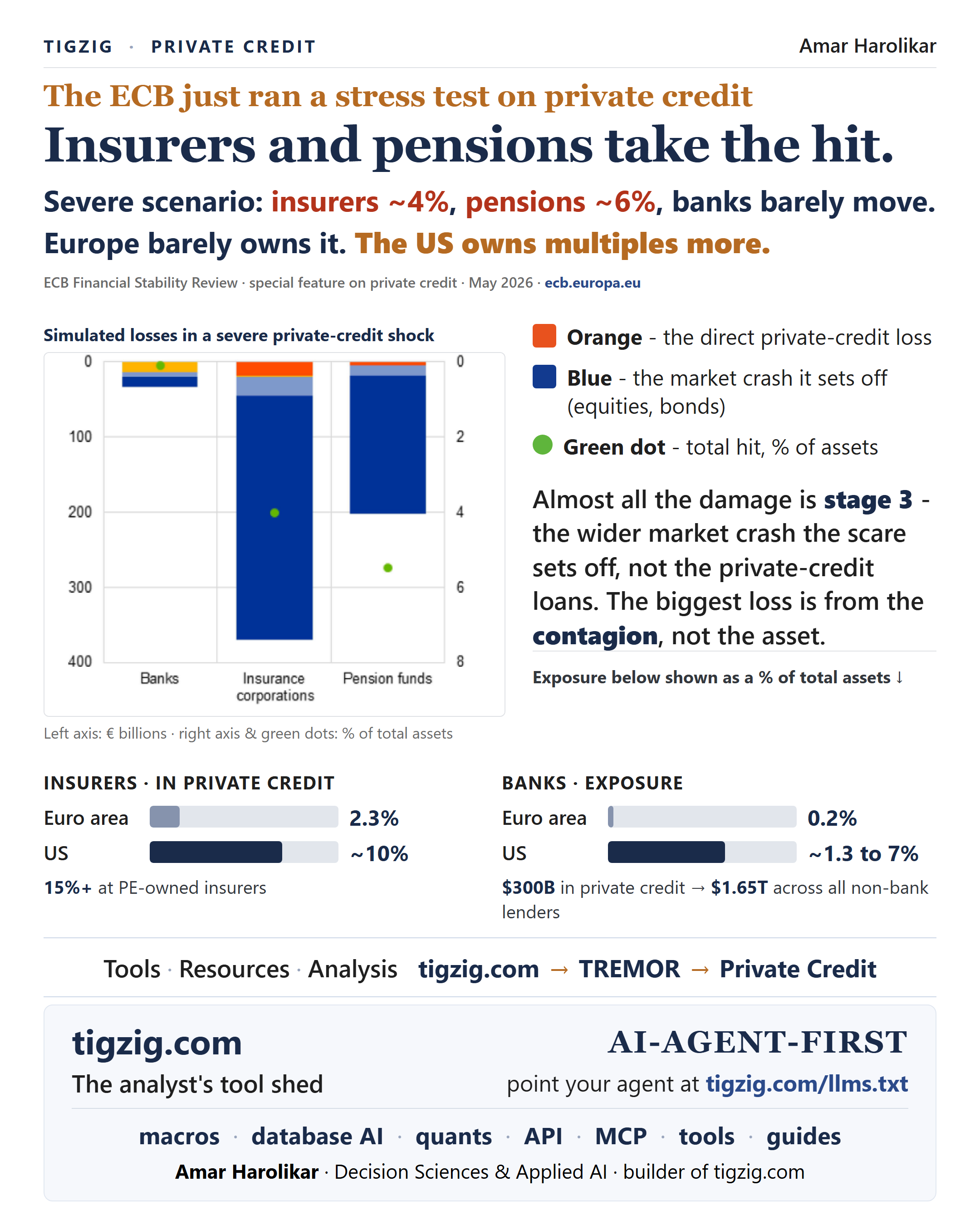
ECB Stress-Tested Private Credit. Pensions Worst at 6% of Assets. Almost All the Damage Is the Wider Market Crash It Sets Off.
The ECB just ran a three-stage stress test on private credit, part of the May 2026 Financial Stability Review special feature. Stage 1: direct private credit losses. Stage 2: contagion to leveraged loans and high-yield bonds. Stage 3: tail scenario (equities -30%, HY repriced -25%, money runs out of private credit funds). Almost all the simulated damage is Stage 3 - the wider market crash the scare sets off, not the loans themselves. Severe-scenario losses: insurance corporations ~4% of assets, pension funds ~6% (the worst-hit), banks barely move. Euro area's direct private credit exposure is tiny (insurers 2.3%, banks 0.2%), but the US owns multiples more - insurers ~10% (15%+ for PE-owned), banks ~1.3-7%, with $300B in private credit and $1.65T in broader non-bank lending. Author commentary: contagion is bigger than the asset (as in prior crises), and given simultaneous global pressures plus the dot-com / GFC playbook, this should not be treated as 'just tail risk' (GFC 2008 was supposed to be tail risk too, until Lehman). ECB report: 'Stress in global private credit markets and its implications for euro area financial stability.'
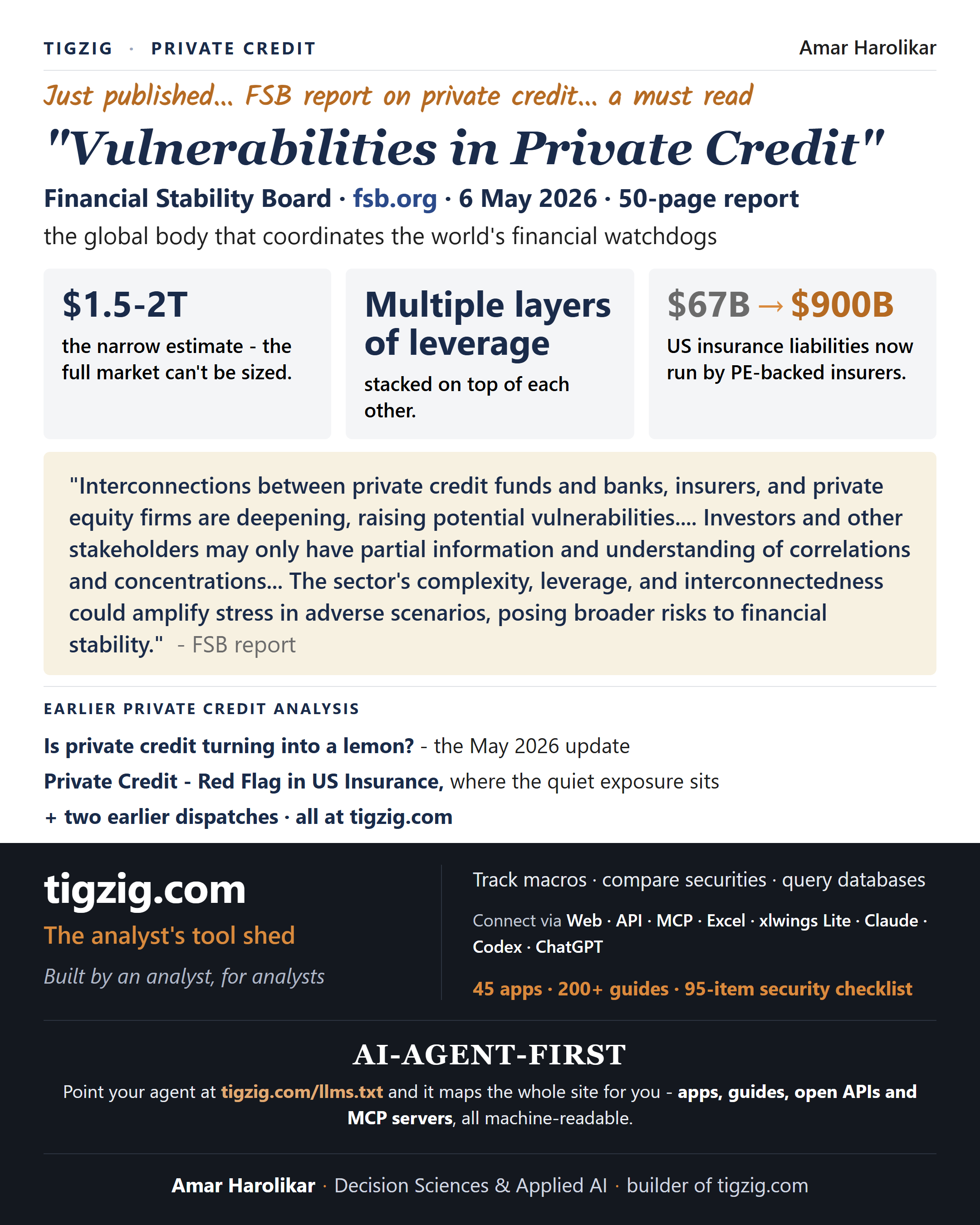
FSB Just Published 50 Pages on Private Credit. The Title: 'Vulnerabilities in Private Credit.' Worth Reading.
The Financial Stability Board's 6 May 2026 report 'Vulnerabilities in Private Credit' - 50 pages. The body that coordinates the Fed, ECB, BoE and the world's other financial regulators putting on the record what they're collectively worried about - layered leverage, opaque valuations, PE-owned insurers, interconnections and instrument risks that aren't fully understood, with a potential for systemic risk to the financial system in stress scenarios. One-pager highlights: market sizing $1.5-2T narrow estimate (full market can't be sized); multiple layers of leverage stacked on top of each other; US insurance liabilities run by PE-backed insurers grown from $67B to $900B. FSB quote: 'interconnections between private credit funds and banks, insurers, and private equity firms are deepening, raising potential vulnerabilities... investors and other stakeholders may only have partial information and understanding of correlations and concentrations... the sector's complexity, leverage, and interconnectedness could amplify stress in adverse scenarios, posing broader risks to financial stability.' Continues the Tigzig private-credit dispatch series (4 prior pieces).
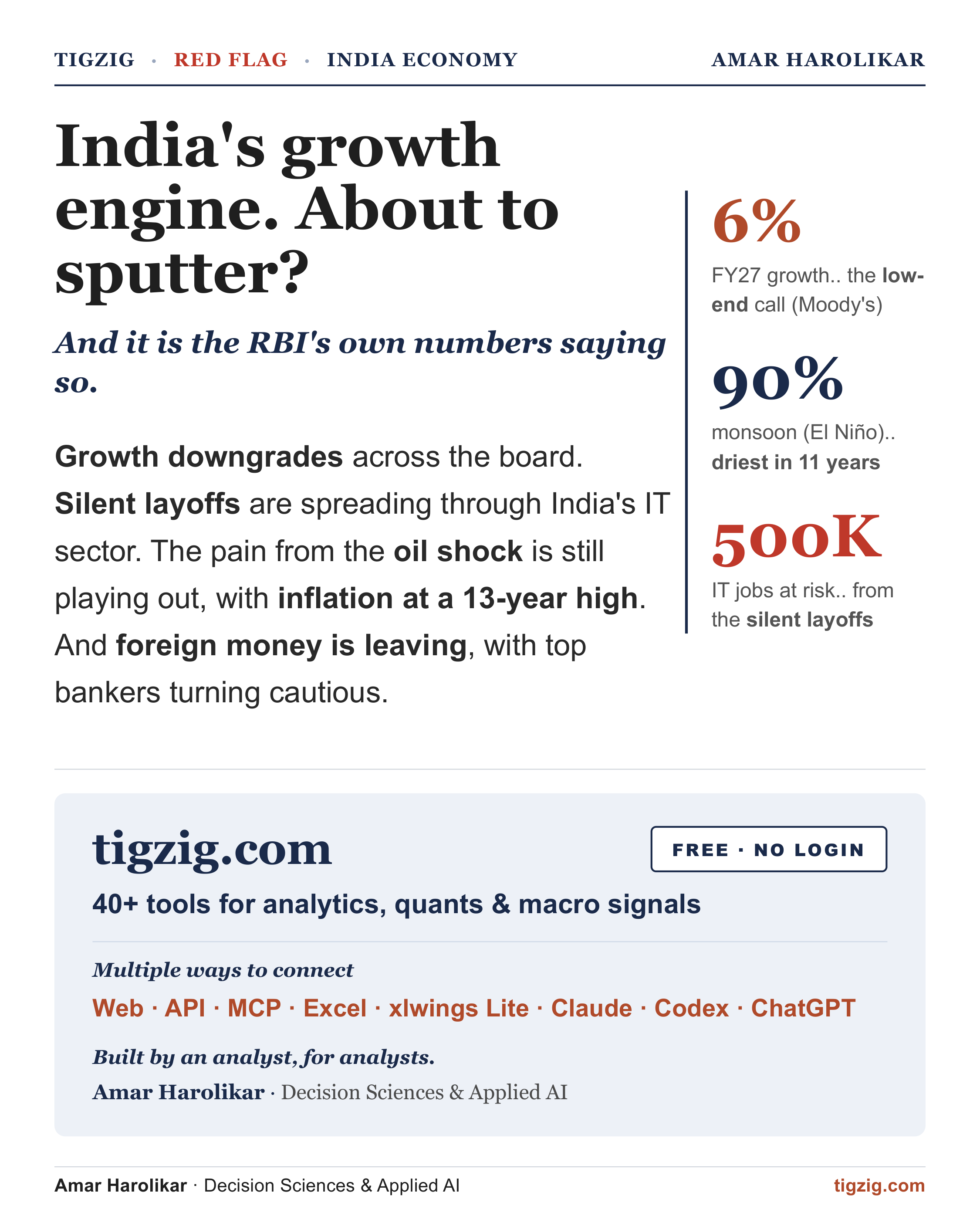
India Was the Market's Darling. Not Any More. The Growth Story Has a Big Red Flag.
13-slide deep dive on the India macro red-flag stack as of May 2026. GDP forecast trims across the board - Moody's FY27 at 6% (the low-end call), S&P 6.6% (from 7.1%), ICRA 6.2% (from 6.5%). IT sector silent layoffs - TCS ~12,000 cut, ~50,000 IT jobs going this year, ~500,000 at risk over 2-3 years, with the model itself being questioned as AI replaces offshore engineering work. Foreign portfolio investors net seller (FY26 net exit, BofA expecting selloff into 2027/2028); FDI anchor held at +$7.7B. Wholesale Price Index at a 13-year high (ex-Covid spike); the WPI-CPI lag means retail catch-up is the base case. Record merchandise trade deficit of -$333B (FY26) on flat exports (+0.9%) and rising imports (+7.6%); China overtakes US as India's largest trading partner. Oil shock still playing out - four fuel hikes in two weeks, Delhi petrol Rs 102, OMC losses ~Rs 30,000 crore/month per ICRA. IMD El Niño monsoon forecast at 90% of LPA - driest in 11 years - which none of the GDP downgrades have priced in. Bankers warning publicly (Uday Kotak at CII: 'it's coming, and it's coming big'); PM appealing for fuel austerity. For India, anything below 4-5% GDP growth is recession territory. Any one is manageable. All of them at once is the problem. Silver lining: the India AI data-centre buildout (Adani, Reliance, Bharti) - covered in the prior India's Next Tech Wave dispatch.
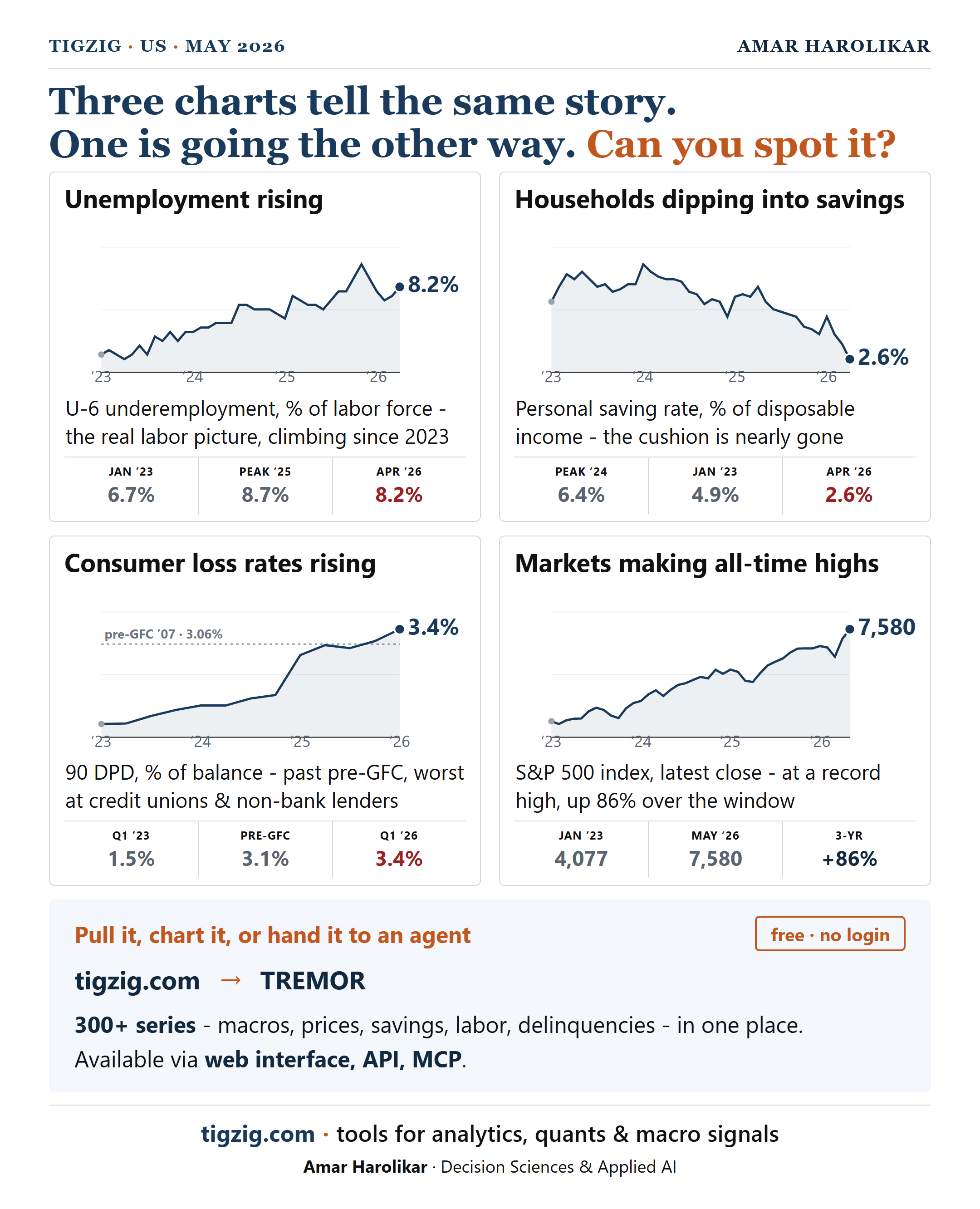
Which Chart Is the Odd One Out? Three Macro Charts Tell the Same Story. One Doesn't.
Four-chart US macro one-pager (May 2026) asking the spot-the-odd-one-out question. Three charts show rising stress - U-6 underemployment at 8.2% (climbing since 2023, up from 6.7% Jan 2023 and past 8.7% Peak 2025), personal saving rate down to 2.6% (from 6.4% peak 2024 and 4.9% Jan 2023, the cushion is nearly gone), consumer 90 DPD loss rate at 3.4% (past the pre-GFC 3.06% reference, worst at credit unions and non-bank lenders). The fourth chart: S&P 500 at a record 7,580, up 86% over the three-year window. Three macro-stress charts in one direction; the index chart in the other. Tools that drive this kind of comparison are on tigzig.com - free, no login, 300+ series covering macros, prices, savings, labor and delinquencies, available via web interface, API or MCP for AI agents.
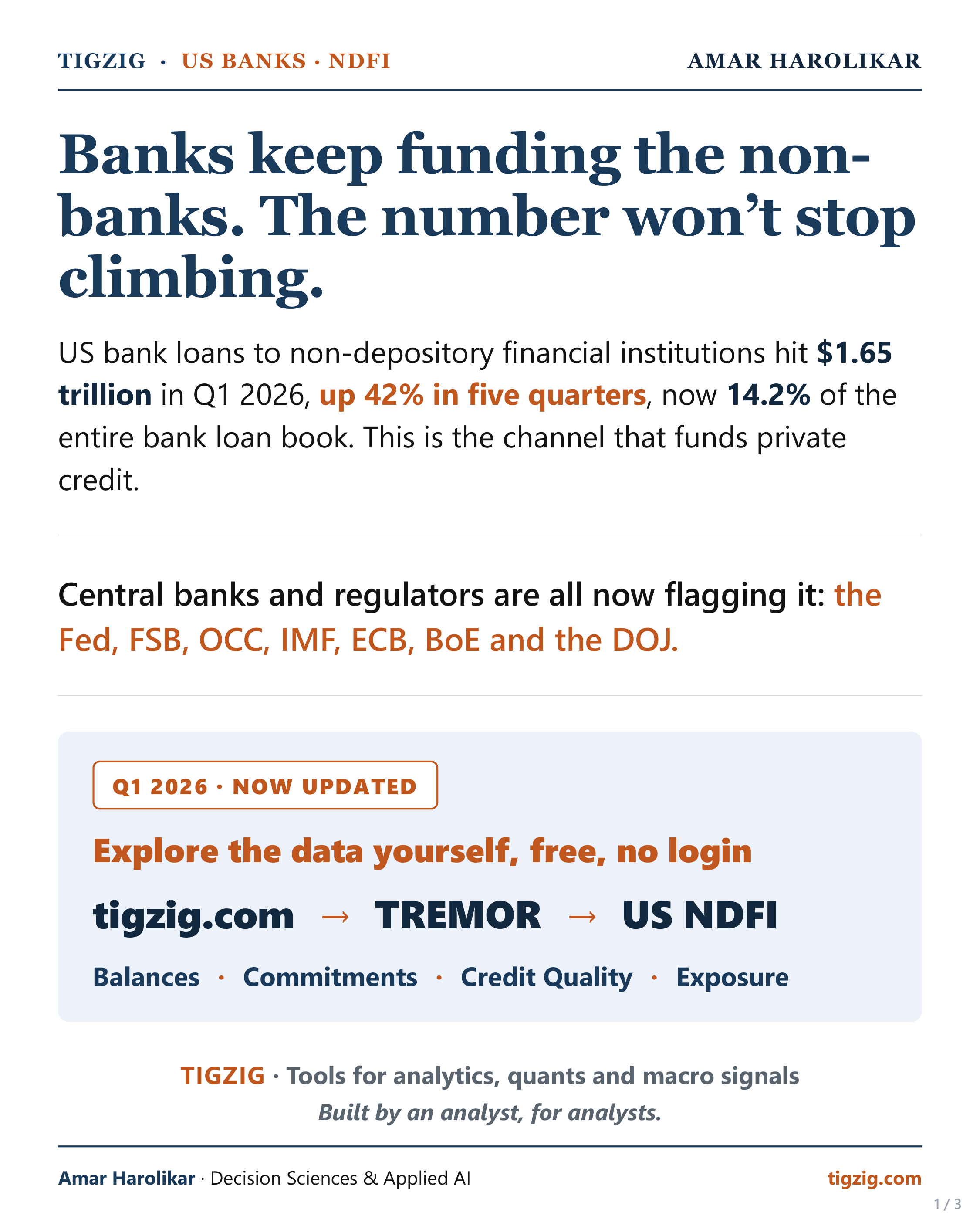
Banks Keep Funding the Non-Banks. $1.65T in Q1 2026, Up 42% in Five Quarters. US Banks NDFI Update.
Q1 2026 update on US bank lending to non-depository financial institutions (NDFI) - the channel funding private credit. Balances hit $1.65T, up 42% in five quarters and now 14.2% of the entire bank loan book (up from 11.1%) or 7.1% of total assets (up from 5.6%). 622 banks. Top 10 hold 73% of all NDFI loans. Subcategory mix: Business Credit $435B (26%), PE Funds $383B (23%), Mortgage Credit $368B (22%), Other NDFIs $269B (16%), Consumer Credit $166B (10%). Top lenders: JPMorgan $238B, Wells Fargo $228B, Bank of America $213B, Goldman $123B, Citi $123B. Add undrawn commitments of $1.06T and total exposure hits $2.7T. The Fed, FSB, OCC, IMF, ECB, BoE and DOJ all flagging it; Fitch private-credit default rate at a record 6.0%; Bank of England calling it a 'market for lemons'. Tool live at tigzig.com/tools/us-ndfi (TREMOR) with bank-level balances, commitments, credit quality and exposure - free, no login, sourced directly from quarterly FFIEC Call Reports (Schedule RC-C). Continues the four-dispatch private-credit series (Mar 24, Mar 26, May 8, May 28).
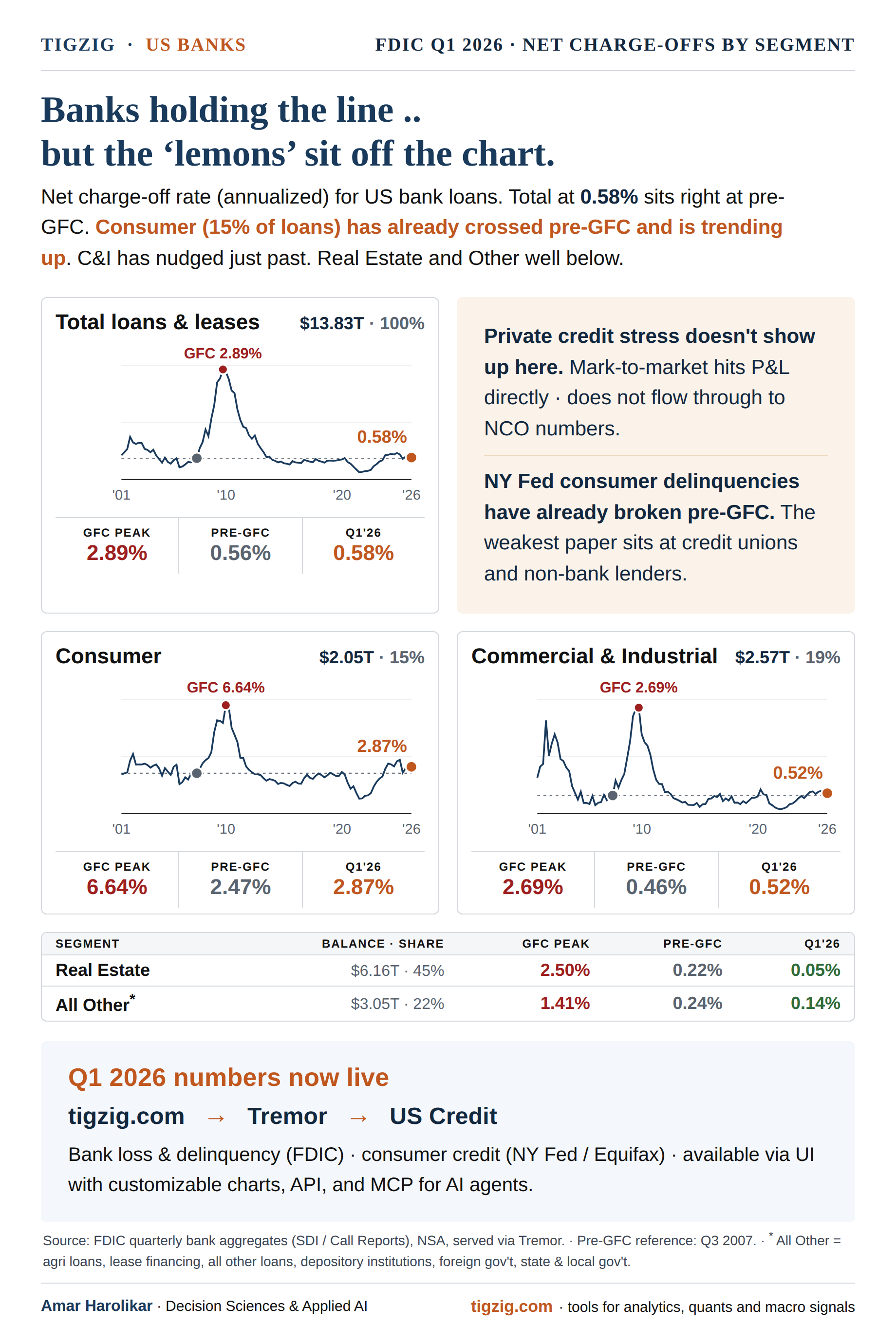
Banks Holding the Line.. But the 'Lemons' Sit Off the Chart. In Private Credit, Credit Unions, and Non-Bank Consumer Lenders.
FDIC Q1 2026 NCO chart shows US banks holding the line at 0.58%, right at pre-GFC. Real Estate (45% of book) at 0.05% vs 2.50% GFC peak. Consumer at 2.87% (vs 6.64% GFC). C&I 0.52% (vs 2.69%). But the credit stress is in two places the bank NCO chart doesn't show. First: private credit, which is mark-to-market and hits P&L directly, never flowing through to NCO. Bank loans to non-bank lenders crossed ~$1.6T (FFIEC) with about a quarter being private credit. DOJ probing BlackRock fund valuations, FSB/BoE/ECB all warning on data gaps, opacity and spillover risk. Second: credit unions and non-bank consumer lenders. NCUA consumer NCO at 1.82% (nearly 2x pre-crisis), cards at 5.11% past the 4.68% GFC peak, used vehicle loans at the highest on record. Non-banks carrying the weakest paper. Single-image chart post with Q1 2026 numbers across the bank book - Total Loans 0.58%, Real Estate, Consumer, C&I segments and All Other.
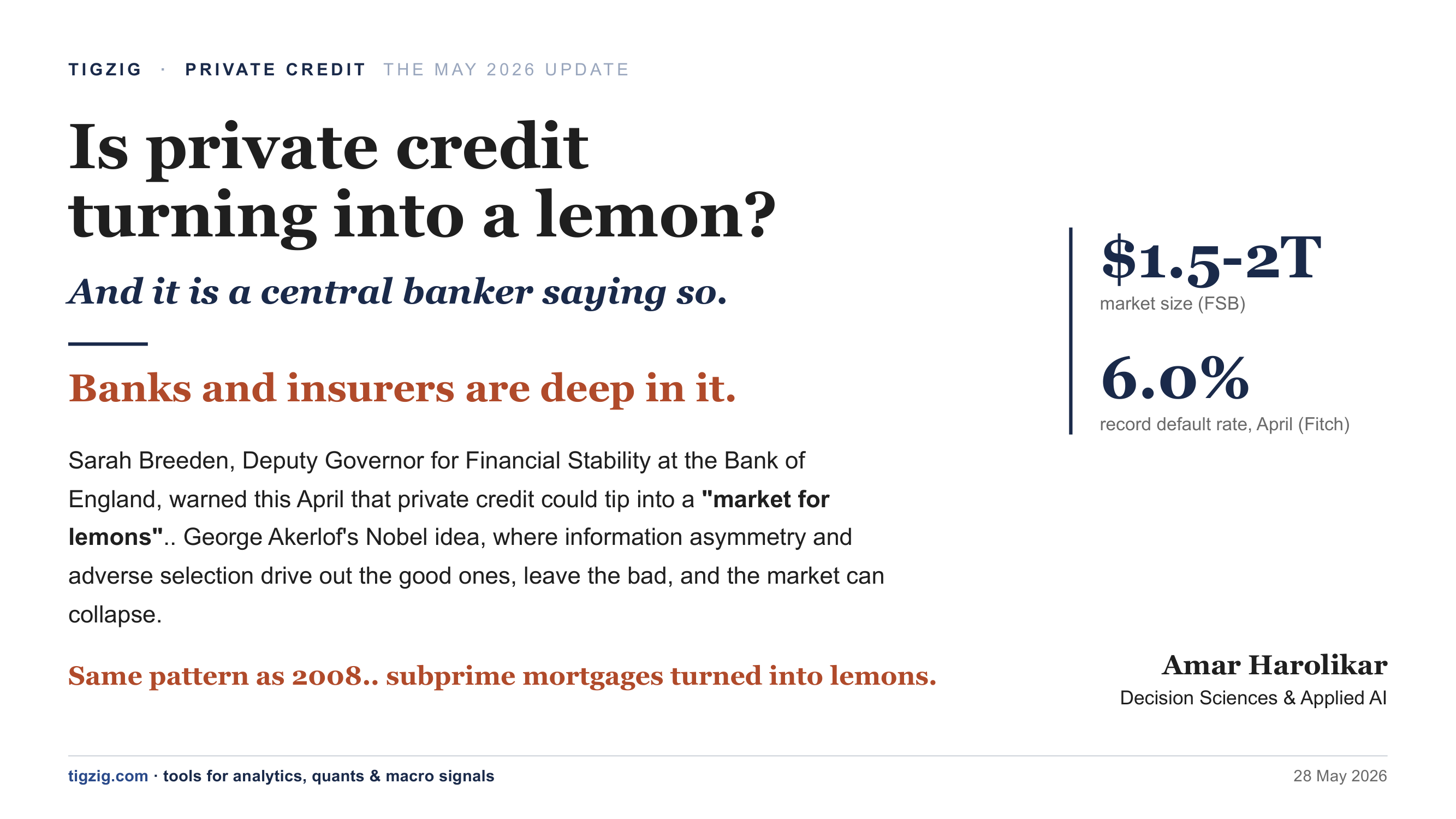
Private Credit Default Rate Hits a Record 6.0% (2026): A Market for Lemons? Banks and Insurers Deep In It.
Private credit's default rate hit a record 6.0% in April 2026 (Fitch, trailing 12 months). Bank of England's Sarah Breeden invokes Akerlof's 'market for lemons'; a government report calls it a layered cake like 2008 subprime. Banks and insurers are deep in - JPMorgan $22B, Citi $22B, Deutsche $30B - with a 19% off-cycle NAV writedown, a $648M bank credit-line cut, KKR rescuing its own FSK fund, and a DOJ probe into BlackRock TCPC valuations. Numbers with sources.
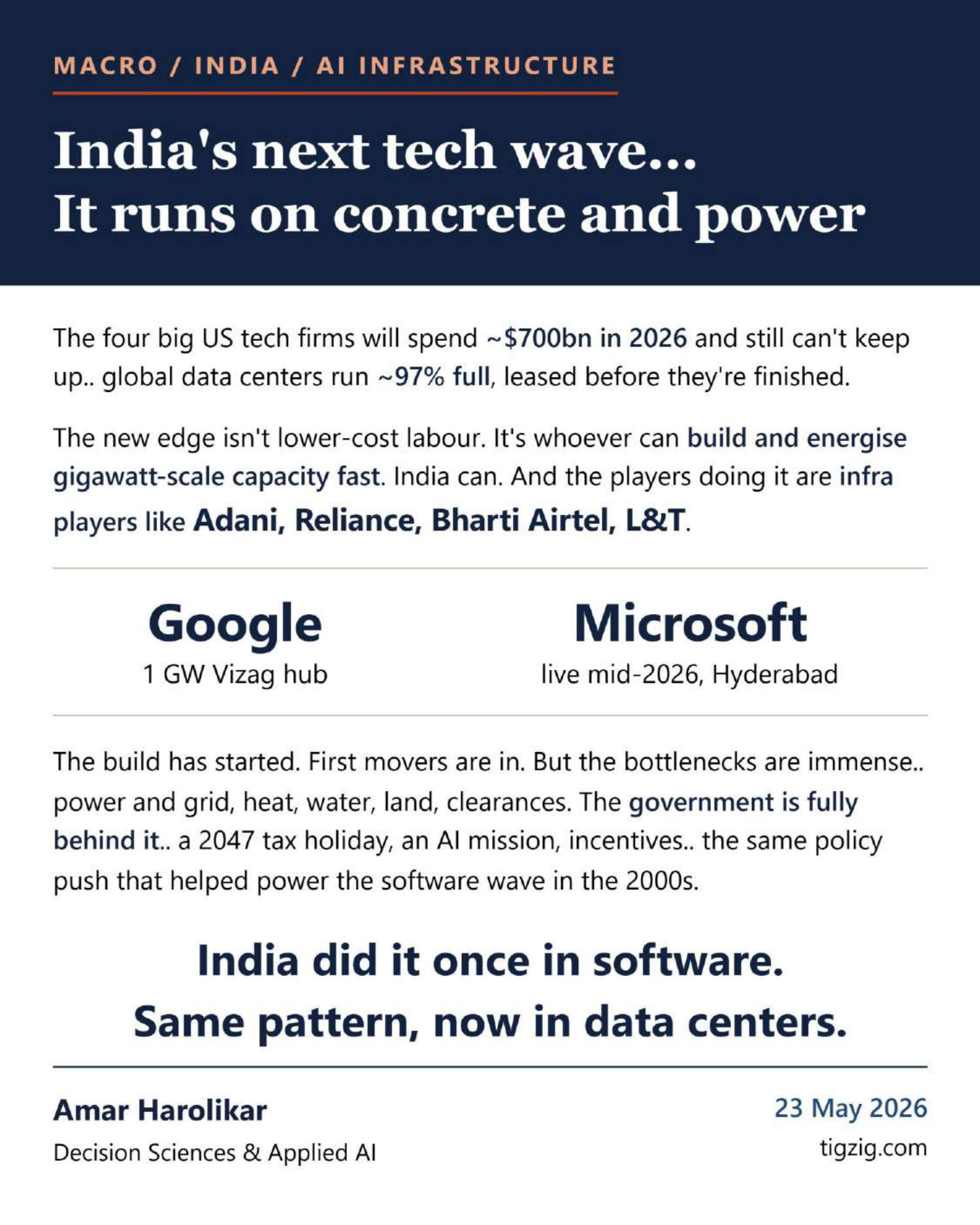
India's Next Tech Wave. AI Data Centers for the World. Adani, Reliance, Airtel, L&T. Same Pattern as Software in the 2000s.
India's next tech wave - AI data centers for the world - is being built by infra players Adani, Reliance, Bharti Airtel and L&T. World is out of compute and out of power - global data centers ~97% full, leased before they're finished. Big-4 US tech firms guided ~$700bn capex in 2026 and still can't keep up. First movers in India: Google's $15bn / 1 GW Vizag hub (largest outside US), Adani $100bn by 2035, Reliance $110bn / 7yr Jamnagar, Microsoft $17.5bn Hyderabad live mid-2026, AWS $12.7bn by 2030, TCS HyperVault. Government policy backing: 2047 tax holiday for foreign cloud firms, IndiaAI Mission, 15% safe harbour. India's edge isn't lower-cost labour - it's industrial build muscle for gigawatt-scale capacity. Risks covered: US-India relations and chip access, water and heat in stressed regions, land approvals. Includes 15-slide deck and full source links (JLL, McKinsey, CEEW, Jefferies, BIS, CNBC, Google, Microsoft, Adani, Reliance, etc.).
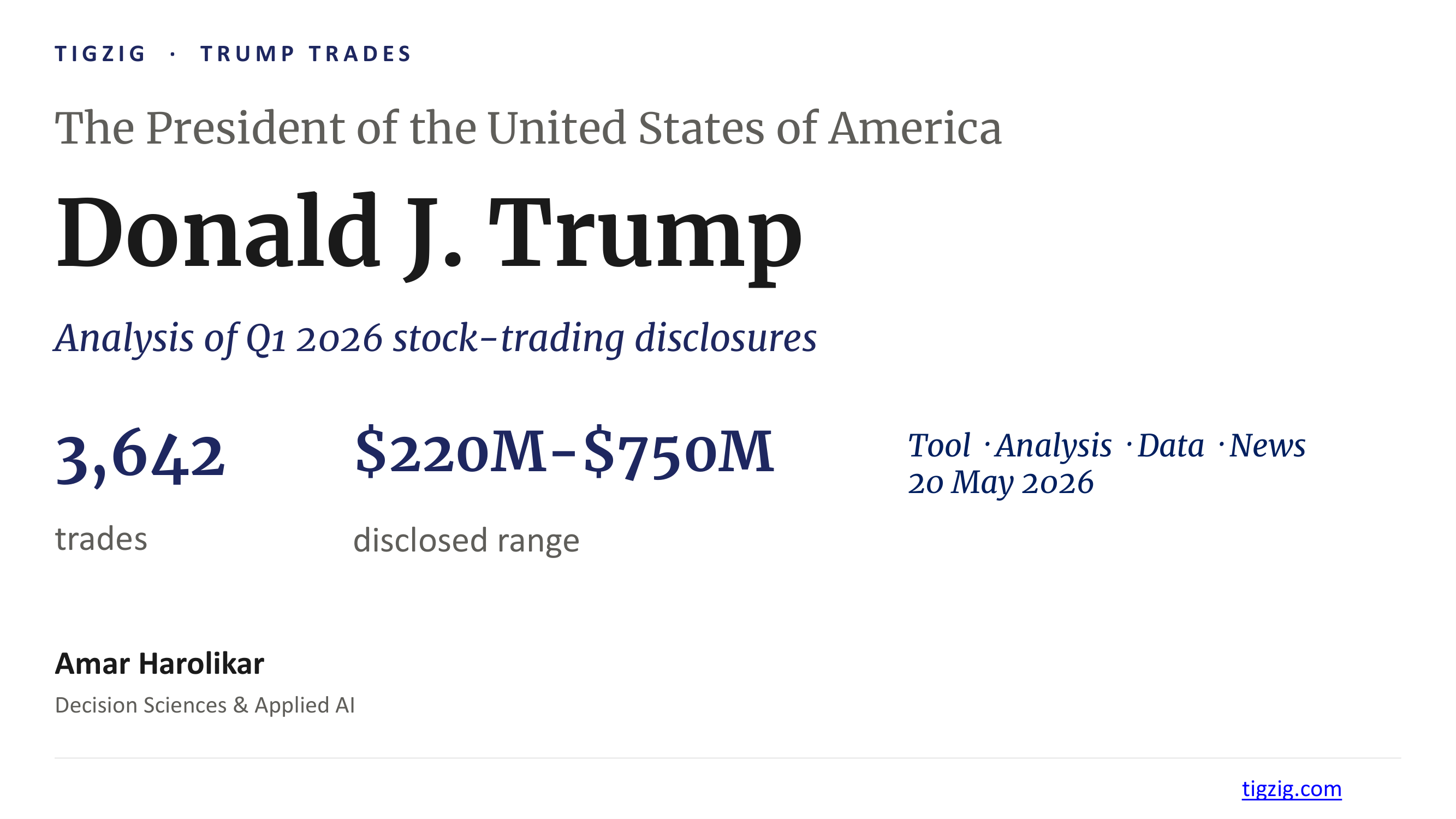
Trump Trades. From Mostly Bonds to 3,642 Equity Trades in One Filing. Free Tool to Search Every Transaction.
9 months of mostly bonds in President Trump's OGE filings broken by one filing on 14 May 2026 carrying 3,642 equity trades, $220M to $750M. Heavy activity in Nvidia, Apple, Microsoft, Amazon, Meta, Oracle. 15 filings since Aug 2025 - earlier 14 combined had 1,726 trades almost all bonds. Built a free interactive tool on top of the OGE PDFs - every transaction searchable across 1,058 tickers, click any company to see trade timeline overlaid on price chart, CSV download. Short analysis deck included on most active tickers, top buys, top sells, and policy overlaps press has flagged.
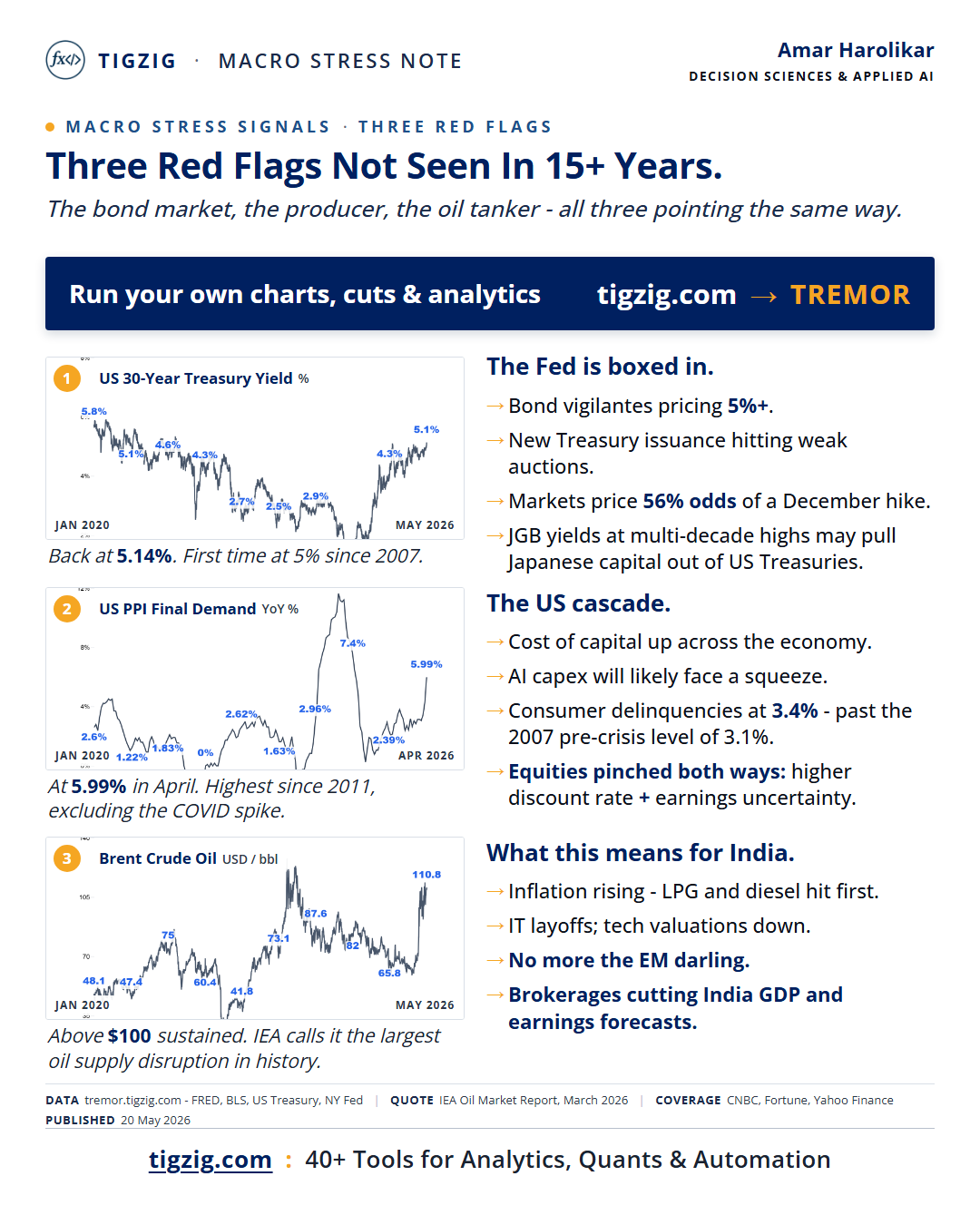
Three Red Flags Hit Together. 30Y at 5.14%, PPI at 5.99%, Brent Above $100. Setup Worse Than 2000 or 2007.
Three macro red flags hit at the same time, each a major disruptor on its own: US 30-year Treasury yield 5.14% (first since 2007), US Producer prices 5.99% (15-year high ex-COVID), Brent above $100 (IEA calls it the largest oil supply disruption in history). Alongside: S&P 7,400 with CAPE 39.6 (2nd-highest in 145 years), auto loan losses past 2007 GFC peak, unemployment near Q3 2007 levels, Mag 7 ~35% of S&P (NVIDIA alone 8.9%). The last time these general patterns showed up: 2000 and 2007. 2026 is looking worse.
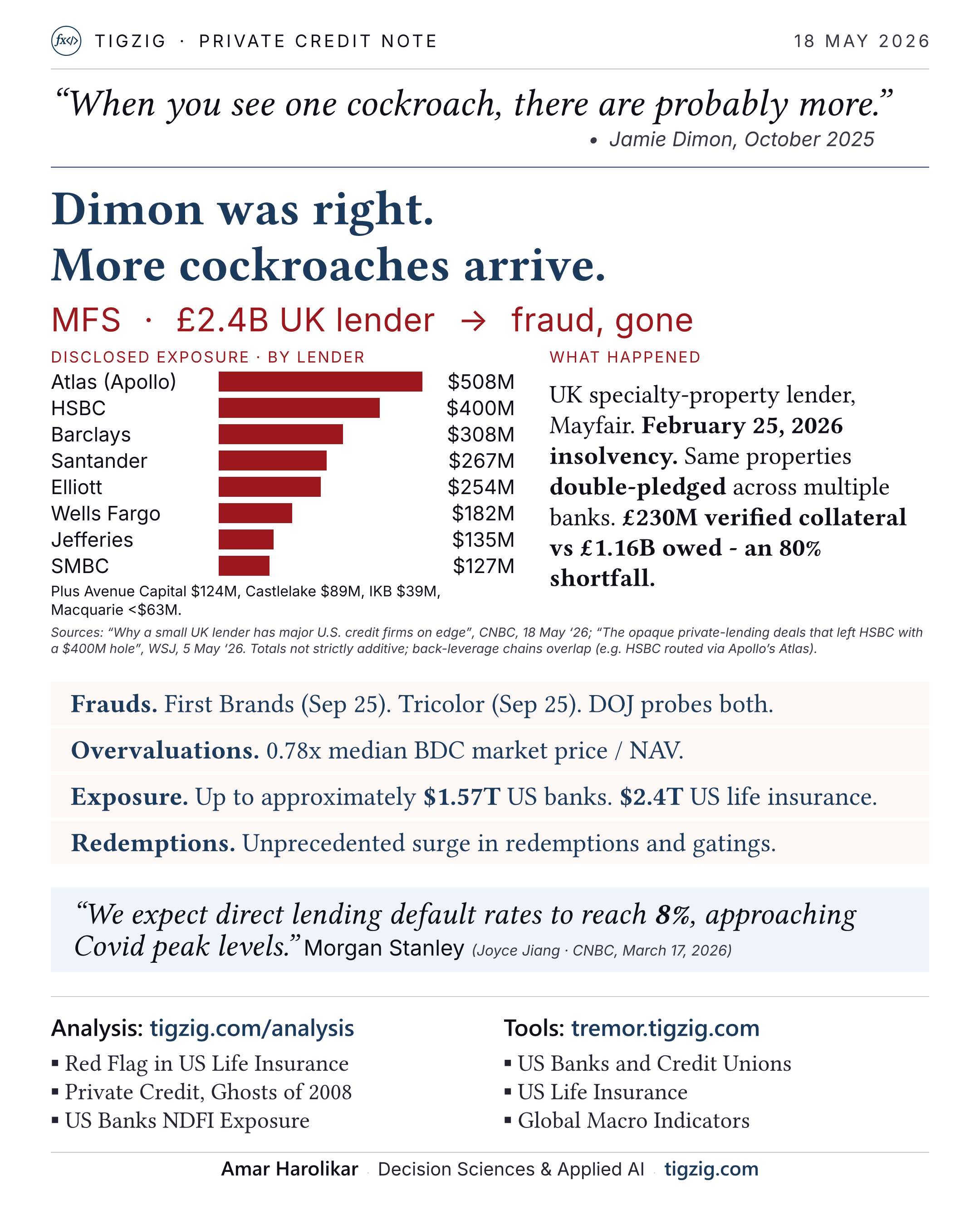
Dimon Was Right. More Cockroaches Arrive. UK Lender MFS Collapses - $2.5B Across 12+ Global Banks.
UK lender MFS collapsed in February with $2.5B exposure across 12+ global banks - Barclays $308M, HSBC $400M, Atlas/Apollo $508M, Santander $267M, Elliott $254M, Wells Fargo $182M. £2.4B loan book, fraud and double-pledging allegations. £230M verified collateral against £1.16B owed (80% shortfall). Affiliated lending chain: HSBC > Apollo Atlas > Zircon Bridging > MFS.
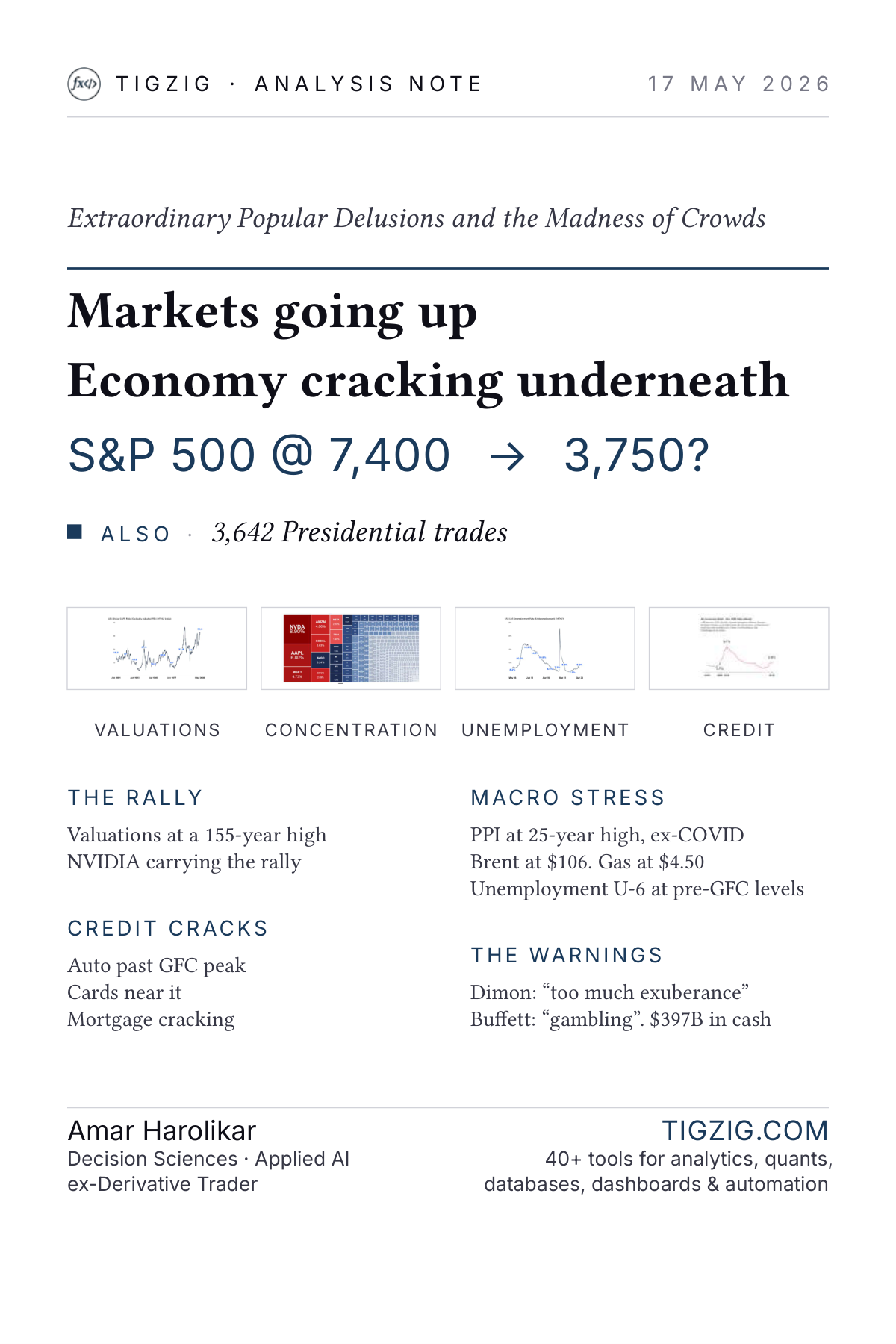
S&P at 7,400. Irrational Exuberance. The Last Two Times This Setup Held, the Index Halved.
S&P 500 at 7,400 with Irrational Exuberance. Last two times setup held: 2000 dot com -49% in 30 months, 2007 subprime -57% in 17 months. Apply pattern math, S&P lands 3,200-3,800. CAPE 39.6 (2nd time in 145 years), auto delinquencies past GFC peak, U-6 back to pre-GFC, PPI 25-year high ex-COVID, Brent $106. Dimon: too much exuberance. Buffett on $397B cash.
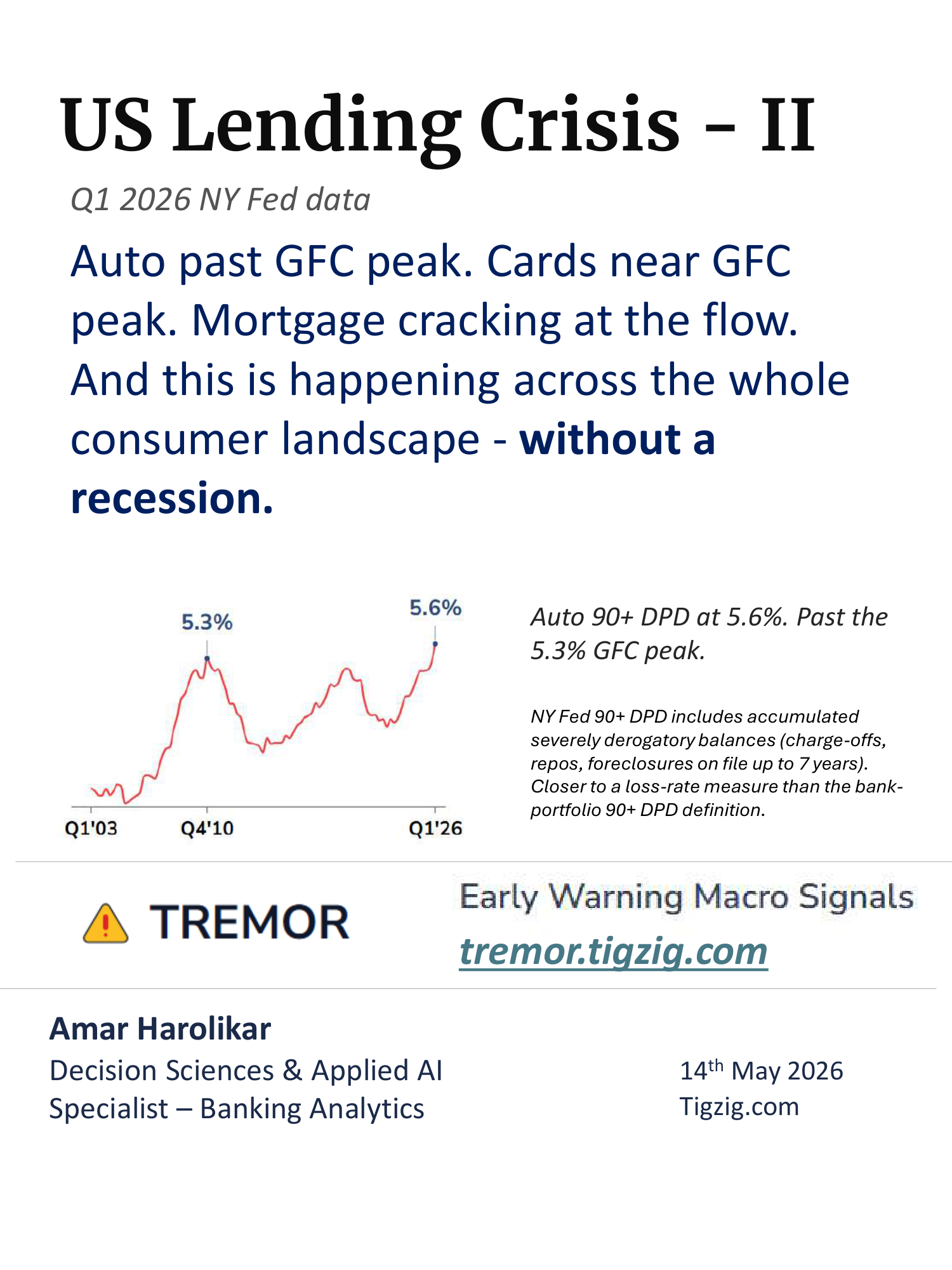
US Consumer Lending Is Already at Crisis-Level Numbers - Without a Recession. NY Fed Q1 2026 Data.
NY Fed Q1 2026 release. Auto delinquencies past GFC peak. Cards near it. Mortgage stock calm but flow rate cracking. HELOC usage and delinquencies rising. Home prices down 9% from 2022 peak. U-6 unemployment back to pre-GFC 2007 levels. Underwater mortgages up in 45 states YoY. Crisis numbers without a recession.
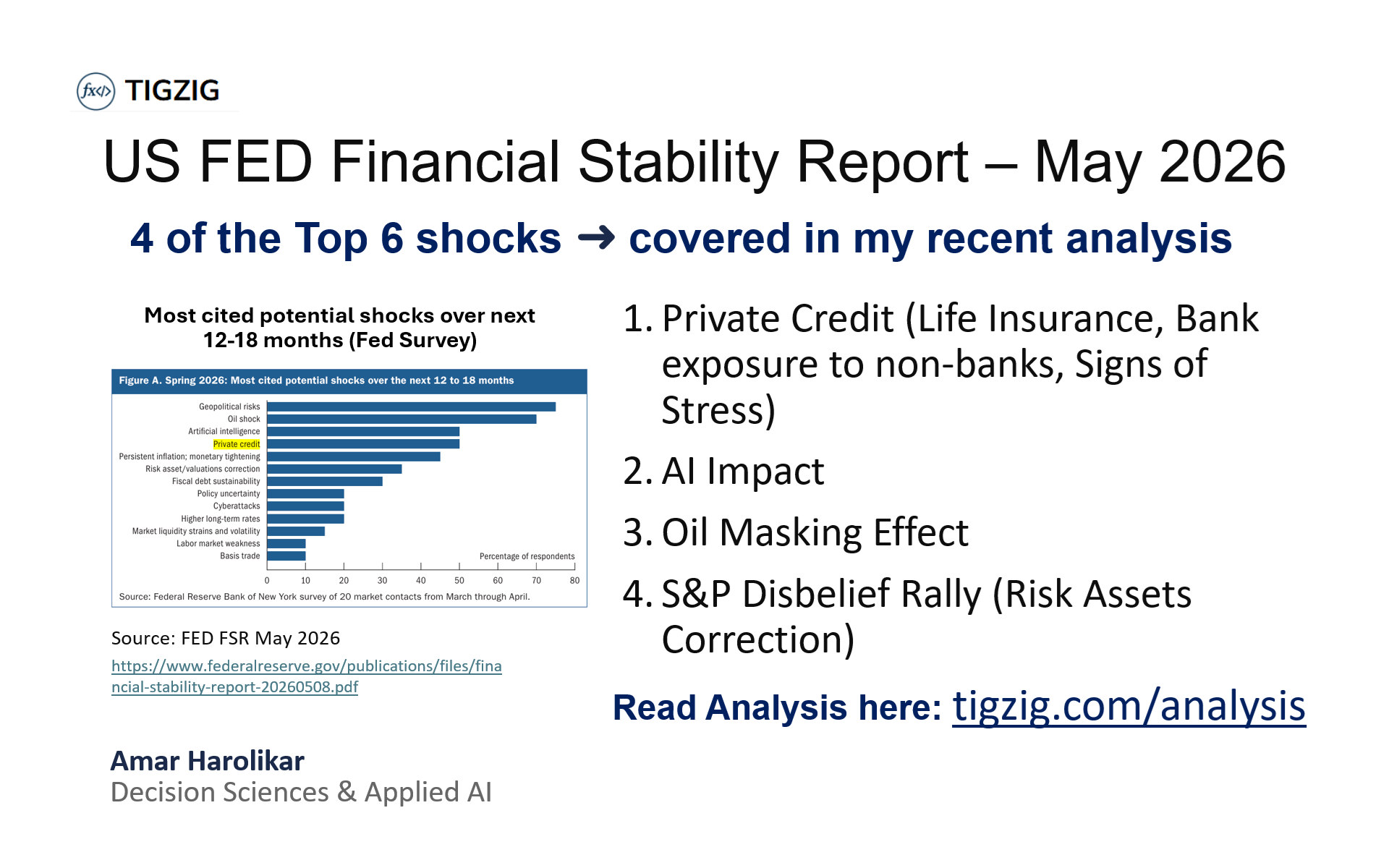
US Fed Financial Stability Report May 2026. Same Stress Points - Now in Fed Own Survey.
US Fed FSR May 2026 covers 4 of the top 6 shocks already in tigzig.com/analysis - private credit (life insurance exposure, bank lending to non-banks), AI impact (labor displacement), oil shock (spot-futures divergence), risk asset correction (S&P disbelief rally). Plus consumer/auto lending stress and stagflation-lite.

Red Flag in US Life Insurance. $2.4T (7.5% of GDP) in Private Credit and Offshore Reinsurance.
US Life Insurers have $2.4T (7.5% of US GDP) in private credit and offshore reinsurance. $1.2T in Fed Unidentified Misc Assets, $1.2T offshore reinsurance memo. Both nearly doubled in 5 years. PE-affiliated loop - same firms own insurers, credit funds and offshore reinsurers. Doom loop risk if retirees surrender annuities en masse.
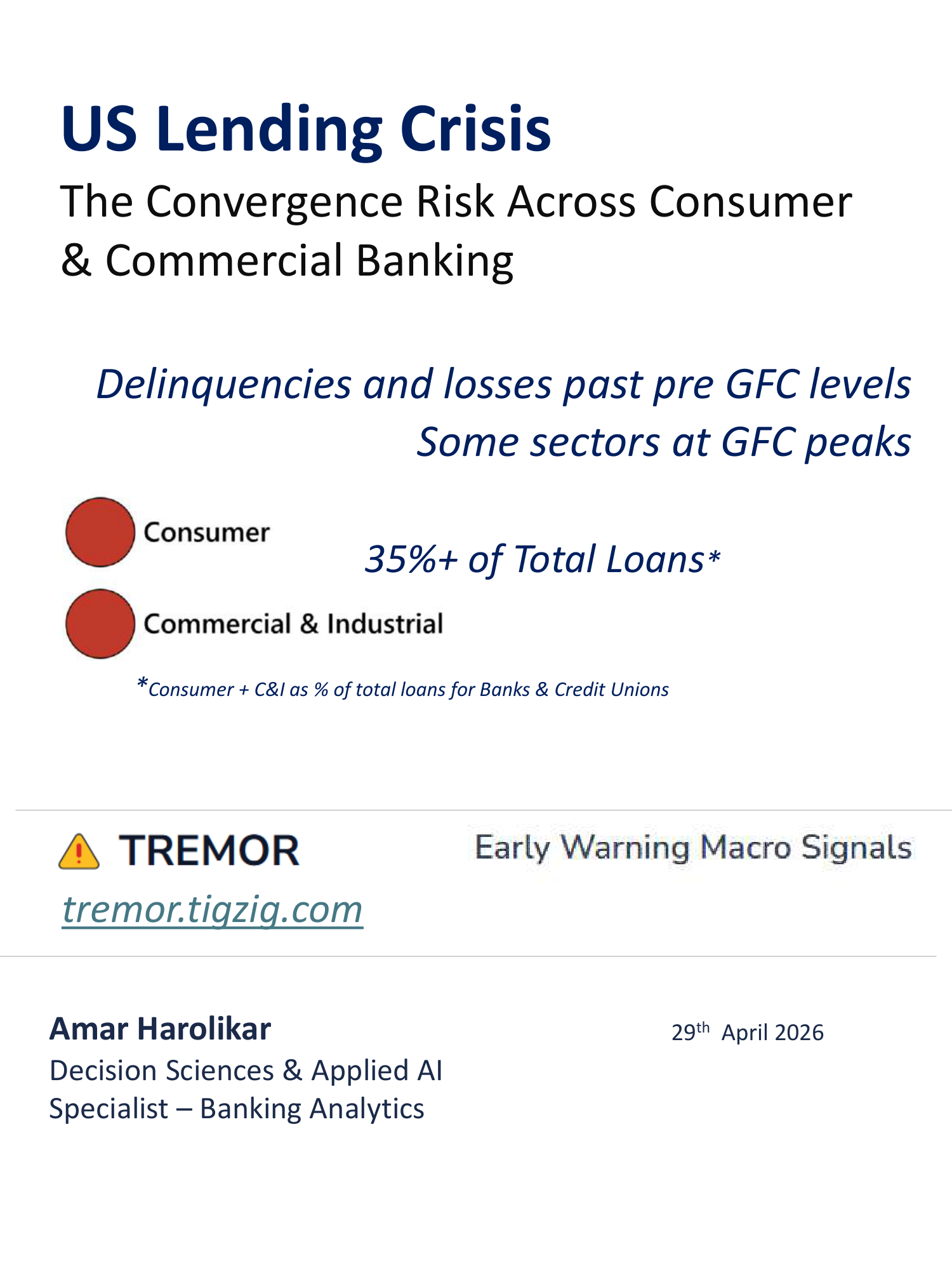
The Convergence Risk. Credit Stress Already Past 2007 Pre-Crisis. Five Aggravators Stacking On Top.
Multiple credit stress signals at the same time across US banks, credit unions, consumer debt. Past 2007 pre-crisis on most metrics. Auto loans already at GFC peak. 5 aggravators on top - AI labor shock, U-1 above 2007, GDP at 0.5%, Brent $100+, private credit stress with $2.5T+ exposure. Warnings from Jamie Dimon and Sarah Breeden.
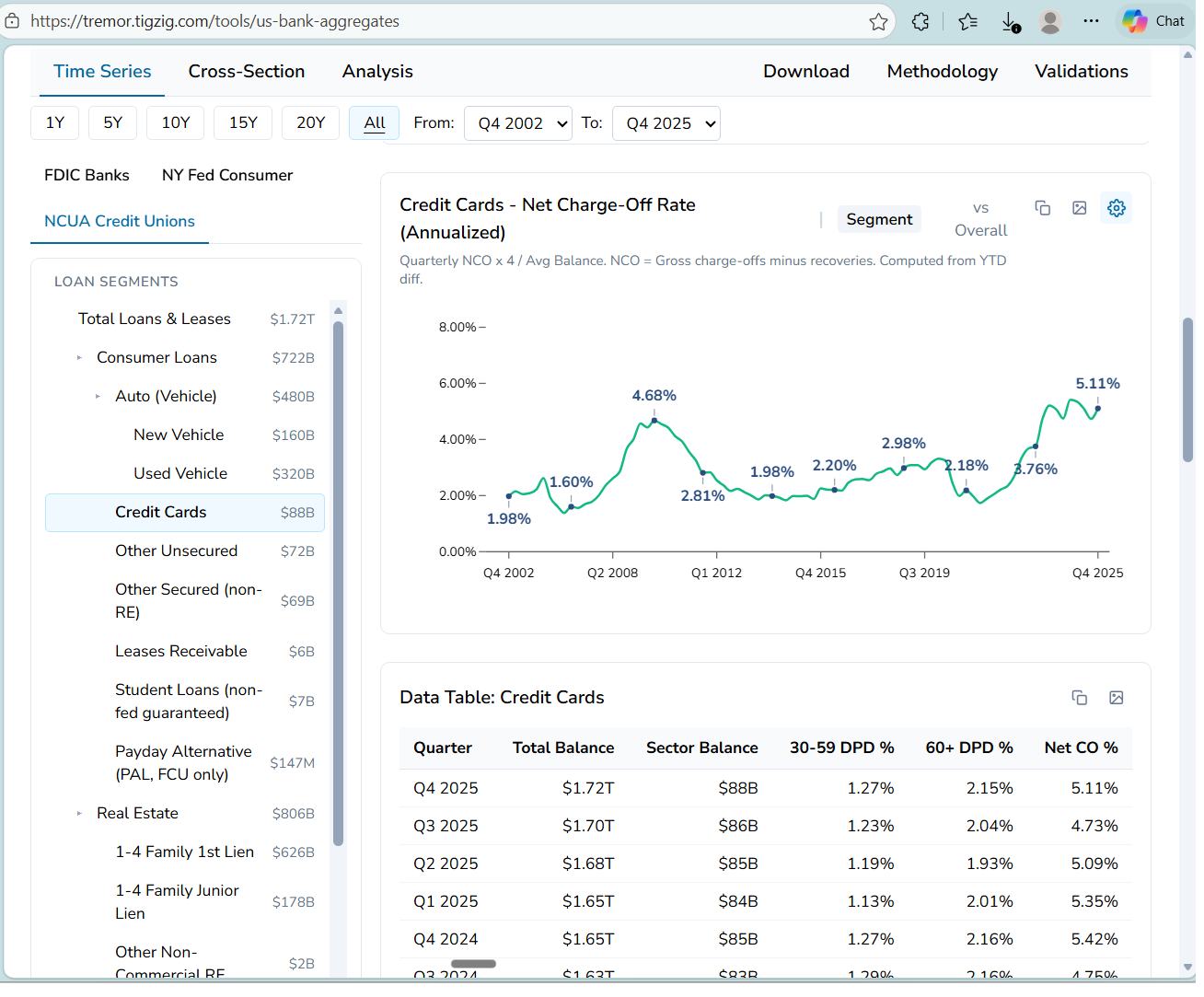
US Credit Unions on TREMOR. Card Charge-Offs at 5.11% - Already Past the 2009 GFC Peak.
US Credit Unions analytics on TREMOR. 23 years, 86 quarters, $1.72T loans across 4,287 federally-insured credit unions from NCUA quarterly FPR. Card NCO at 5.11% past 4.68% GFC peak. Consumer NCO at 1.82% vs 0.99% pre-crisis. 18 segments, 30-59 DPD, 60+ DPD, NCO. CSV download with 74-field reference.
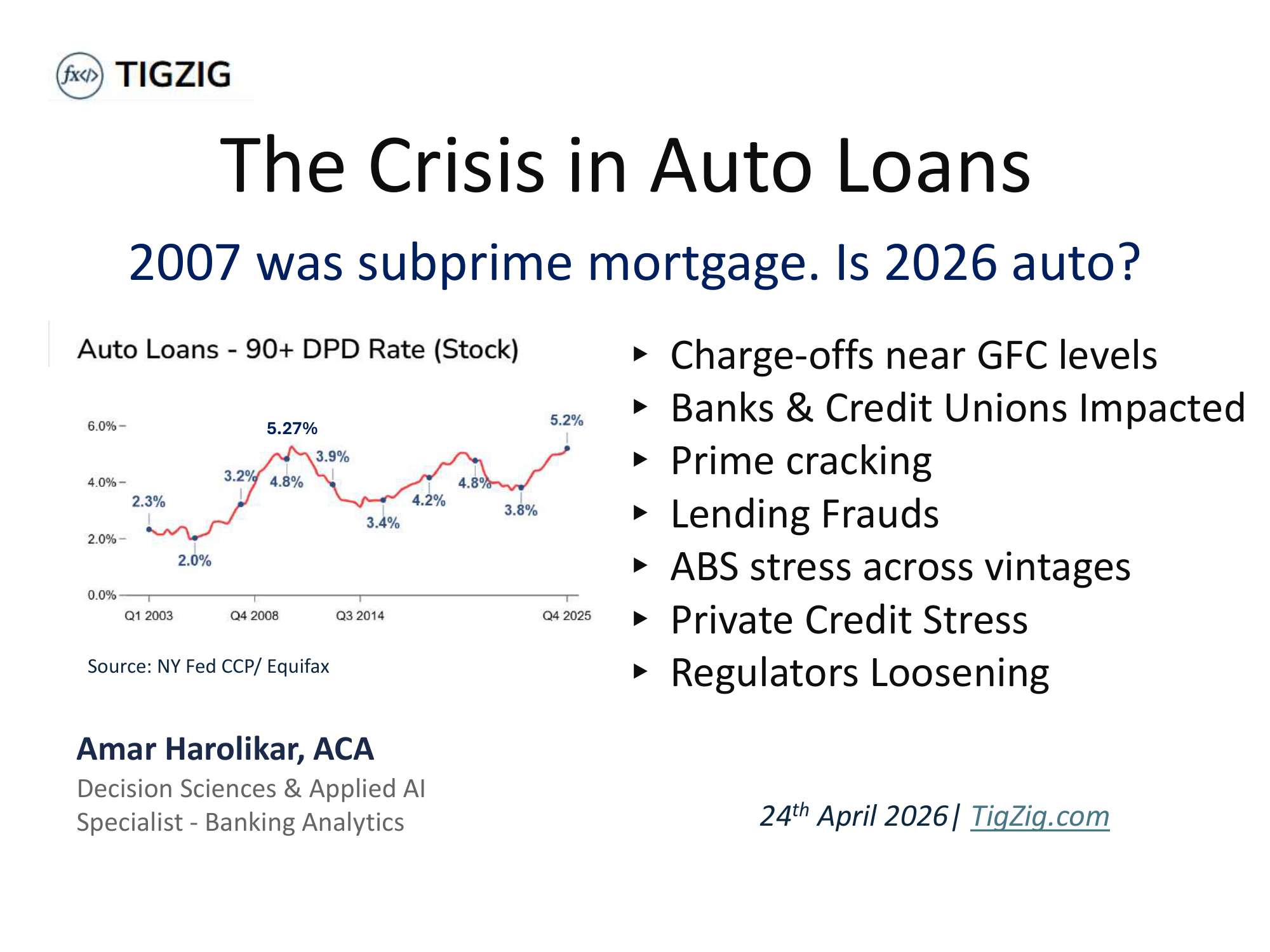
The Crisis in Auto Loans. 2007 was Sub-Prime Mortgage. Is 2026 Auto?
NY Fed Auto 90+DPD at 5.21% vs 5.27% at GFC peak. Bank auto NCO at 2x 2011 baseline. Credit union NCO at 0.95% record high. S&P ABS subprime NCO ~10%. Tricolor fraud $800M. First Brands fraud $2.3B. $1.67T direct exposure plus $350B in ABS. FDIC SDI, NY Fed CCP, NCUA, S&P Global, FFIEC analysis.
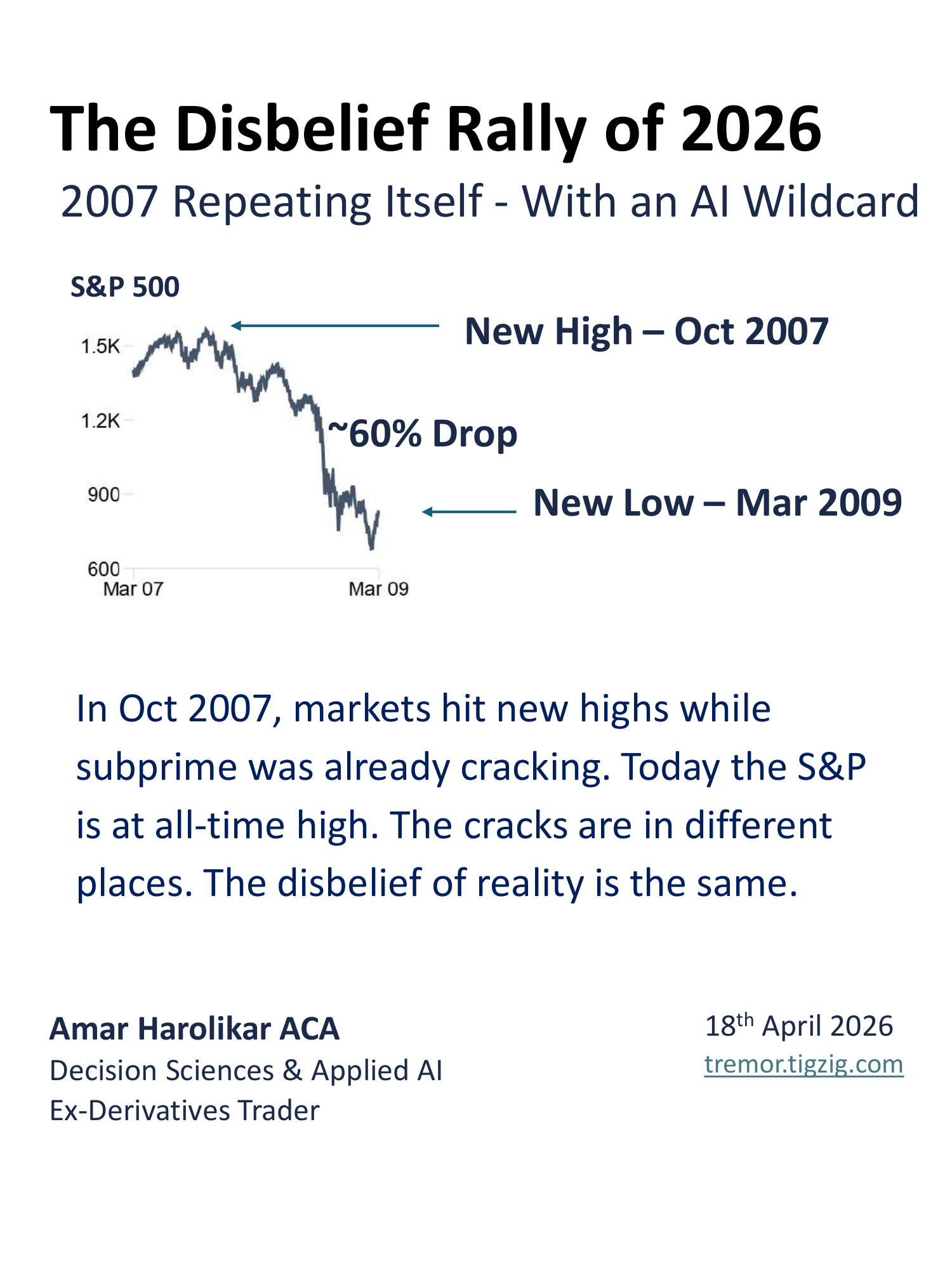
S&P at All-Time High. Under the Hood, Things Are Cracking. Just Like October 2007.
S&P at ATH while private credit at 2x 2007 subprime showing stress. Credit card and auto delinquencies above 2007 pre-crisis. Bank charge-offs higher than 2007. AI displacing workers at unprecedented pace inside a stress cycle. Tracking across FFIEC, FDIC, NY Fed, IEA, Challenger, Anthropic Economic Index.
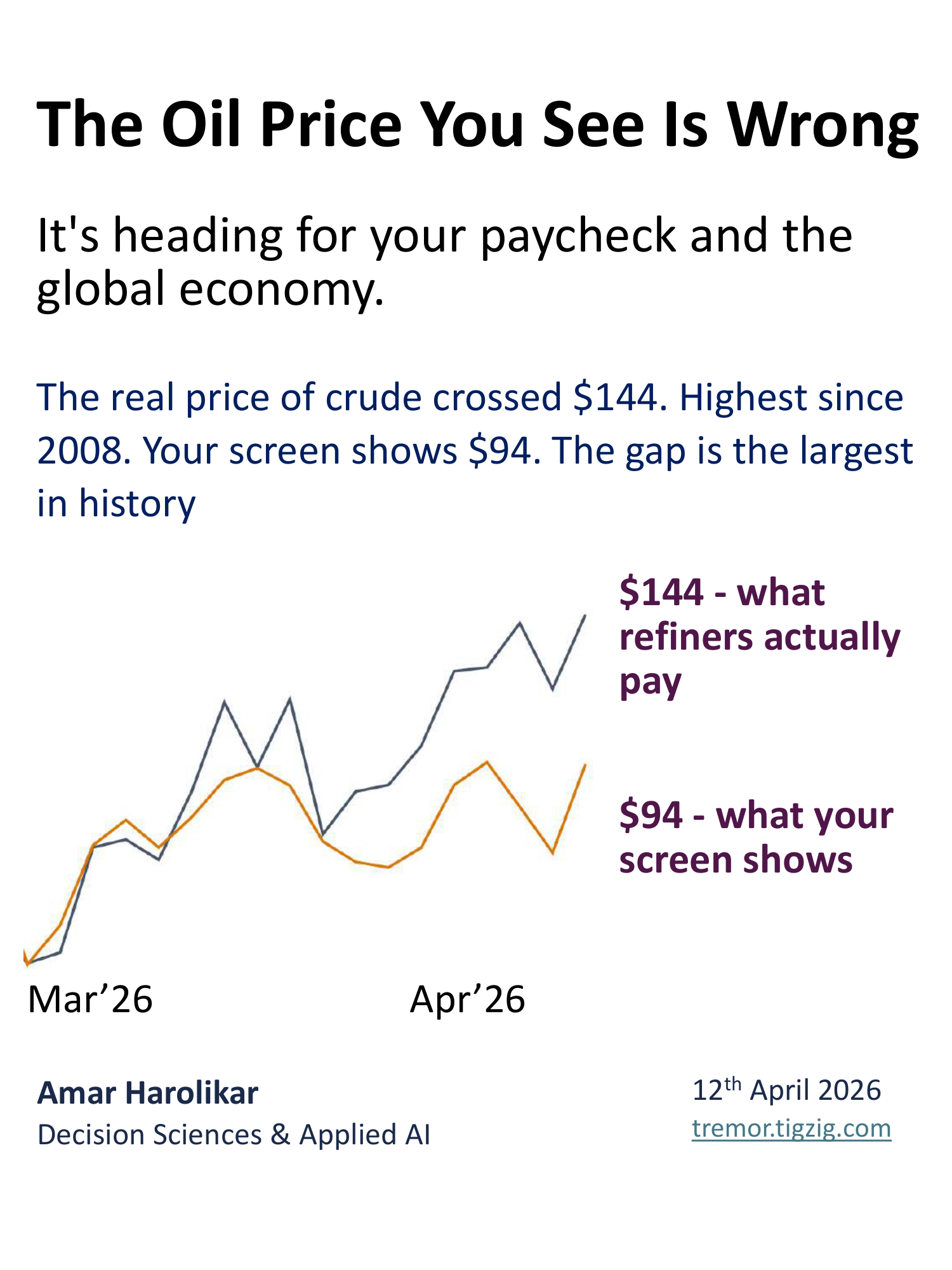
The Masking Effect in Oil Markets - The Price You See on Screens Is Hiding a $50 Supply Shock
Largest spot-futures divergence in oil market history. Brent futures at $94, physical crude at $144. Analysis of 9,864 trading days since 1987. 40 bids vs 4 offers in North Sea. Diesel near $200/bbl. US gasoline inventories at 16-year lows. Hormuz shut 40 days, Kuwait says 3-4 months to restore.
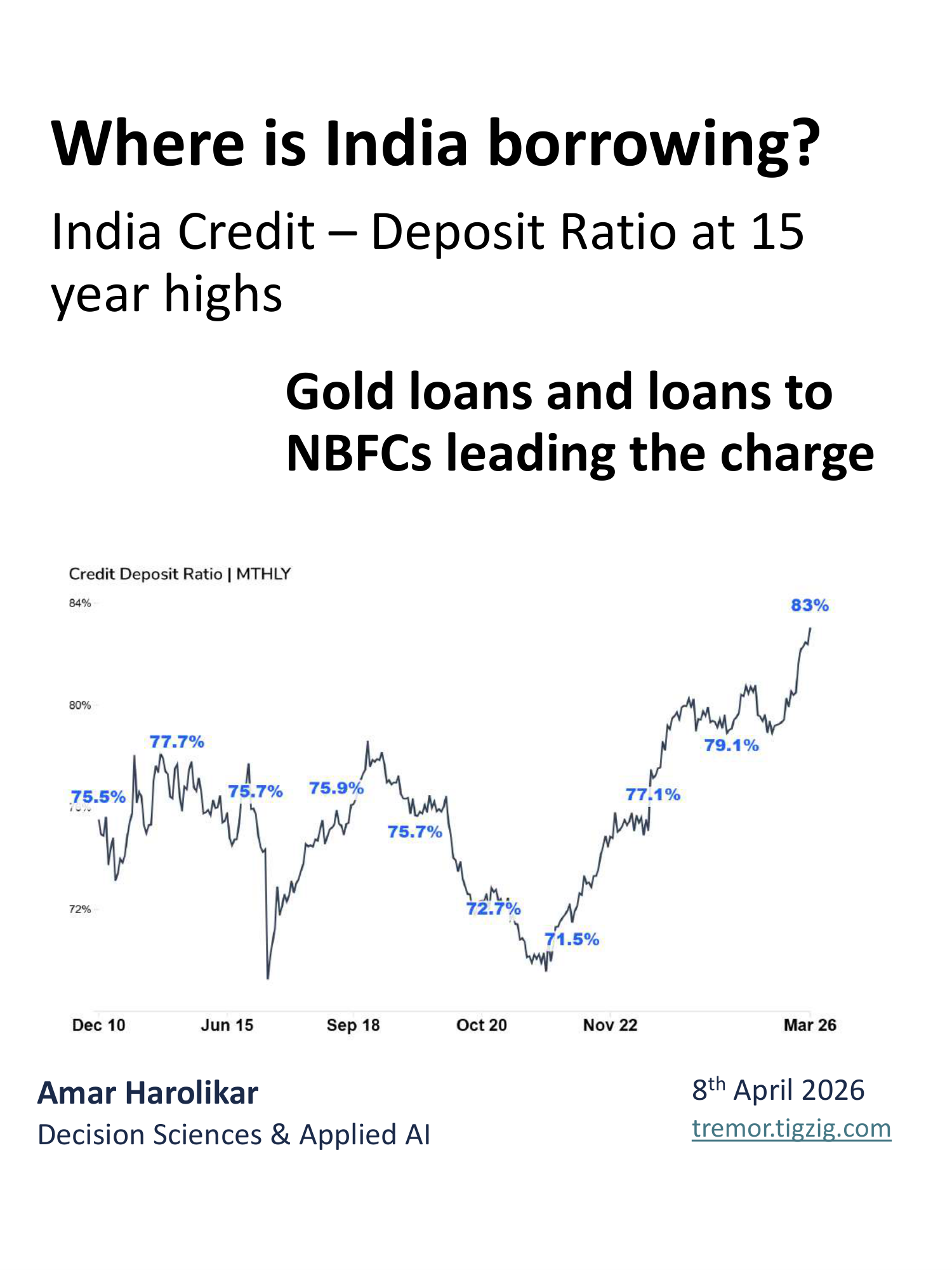
India's Credit-Deposit Ratio Just Hit 83%. A 15-Year High. Gold Loans Up 4x in Two Years.
India credit-deposit ratio at 83%, 15-year high. Gold loans up 4x in two years. NBFC loans up 21% in 9 months. Six sectors growing at 2x overall rate pulling one-third of new credit. Credit grew 12.3% vs deposits 9%. Housing growth slowed. RBI sectoral data analysis.
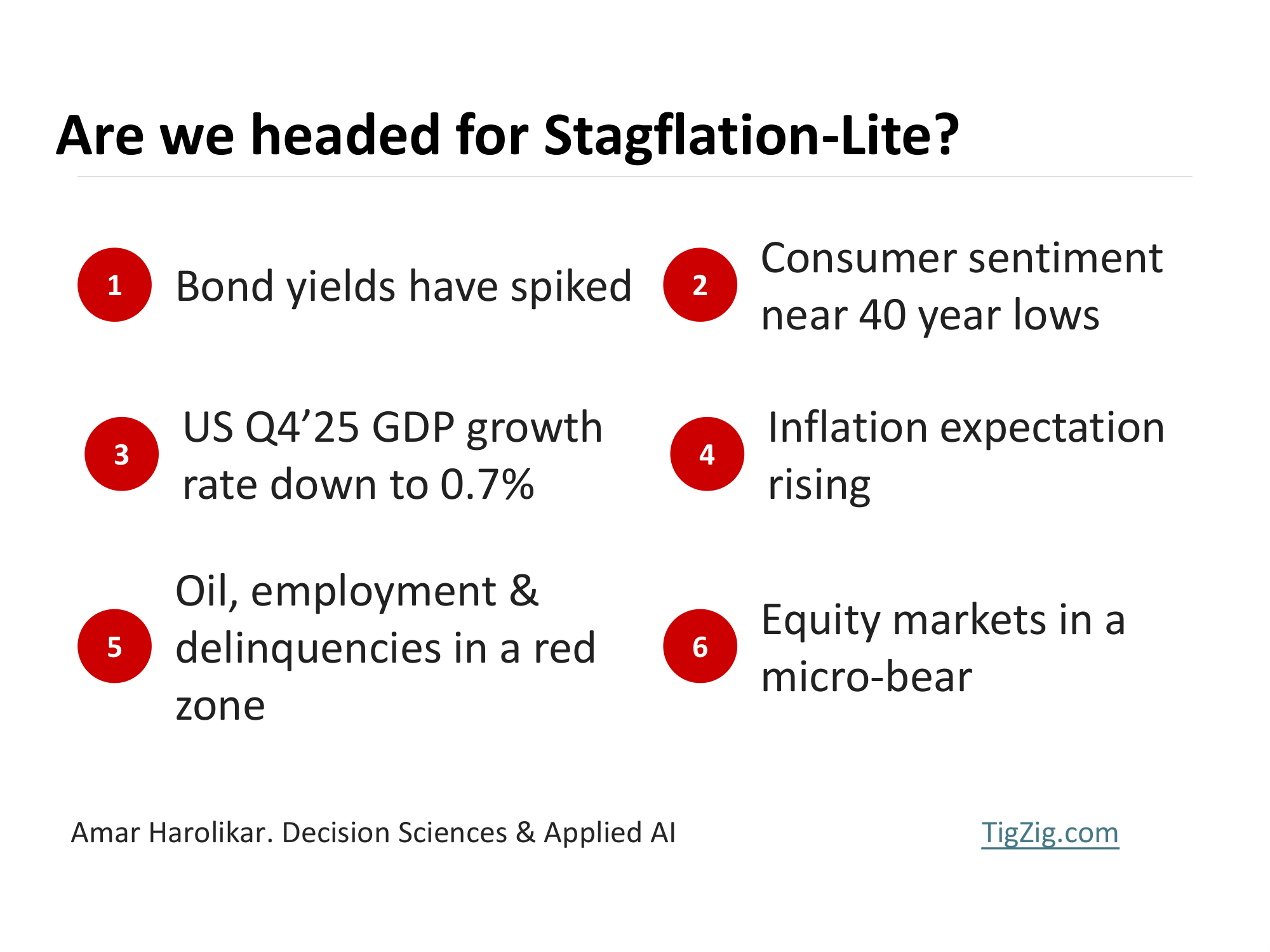
Are We Headed for Stagflation-Lite
Stagflation-Lite signals intensifying. Fed trapped between inflation and weak jobs. US 10Y at 4.4%, PPI at 3.4% with oil shock not yet in data, GDP at 0.7%, consumer sentiment 7th lowest in 40 years, Moody recession odds at 48.6%. Bond markets pricing in high inflation globally.
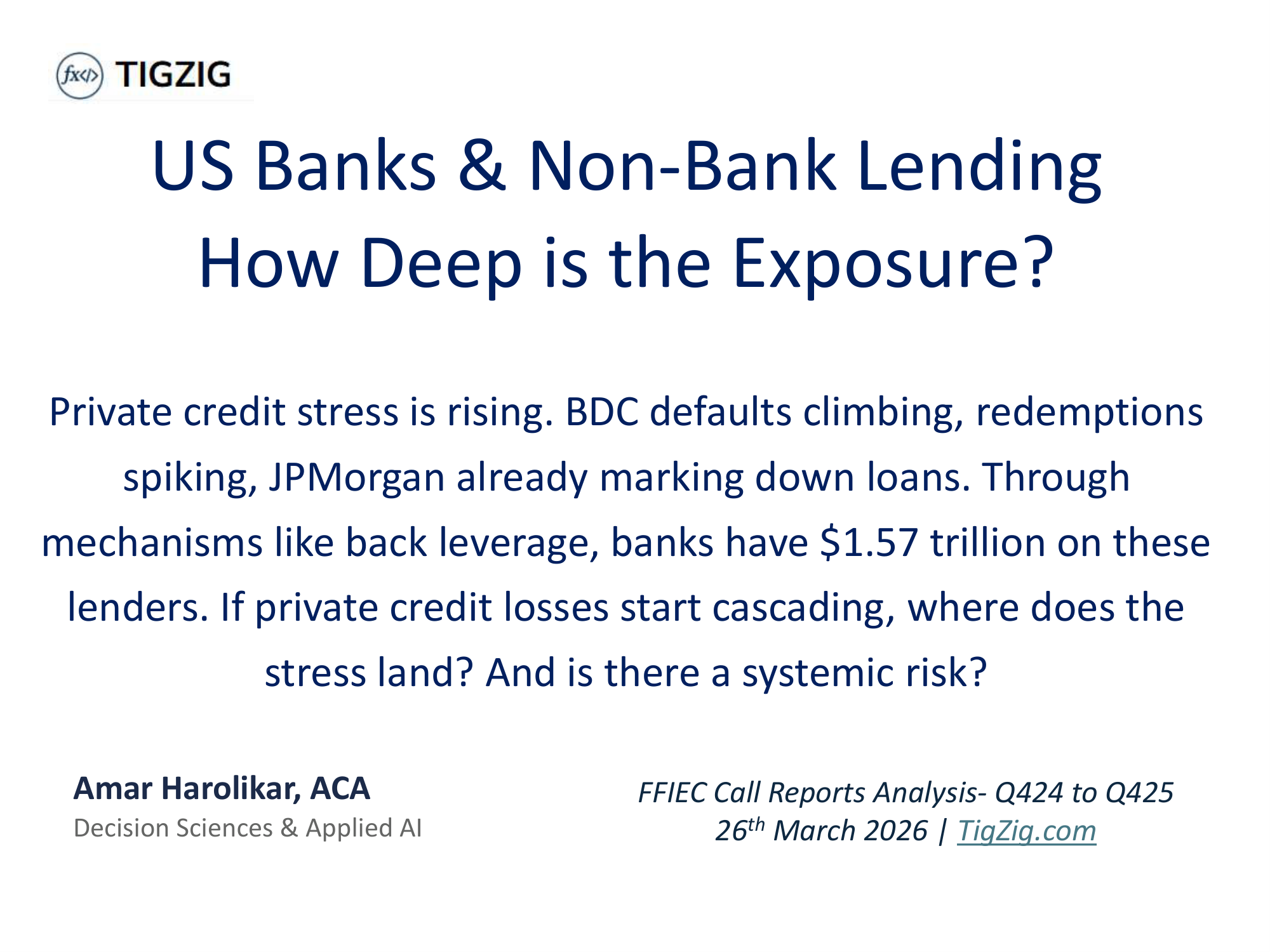
US Banks & Non-Bank Lending - How Deep is the Exposure? Is there a Systemic Risk?
US banks hold $1.57 trillion in loans to non-bank lenders facing redemptions and defaults. 41 banks have this single portfolio exceeding 100% of core capital. 62 banks have loan loss reserves covering less than 10% of exposure. Analysis from FFIEC Call Reports for 629 banks across 5 quarters, cross-validated against FDIC, FRED and S&P Global.
Private Credit - The $2.7 Trillion Shadow Lending Market Is Showing Cracks
Private credit showing cracks that remind Wall Street of 2008. Jamie Dimon and Lloyd Blankfein flagging risks. 40% of borrowers have negative cash flow. Blackstone scrambled to meet $3.8B in redemptions. Management companies down 30-50% in 6 months.
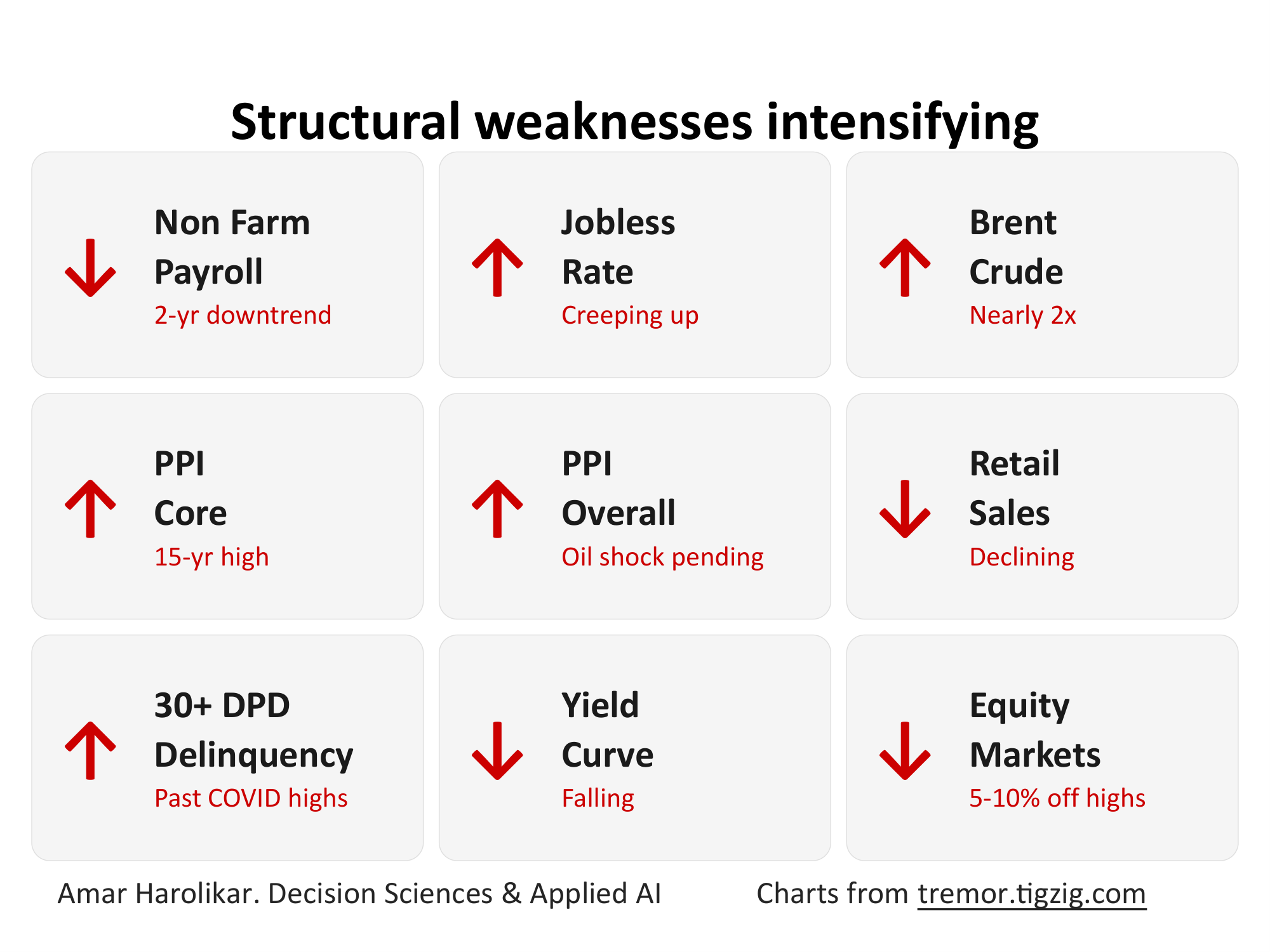
Structural Weakness Intensifying
3 major US macro data points in 3 days all pointing the same direction. Feb payrolls minus 92K against expectations of 59K rise. PPI Core at 3.87%. Fed held at 3.5-3.75%. Brent crude nearly doubled in 3 months. Delinquencies past COVID highs. Multiple macro signals flashing stress simultaneously.
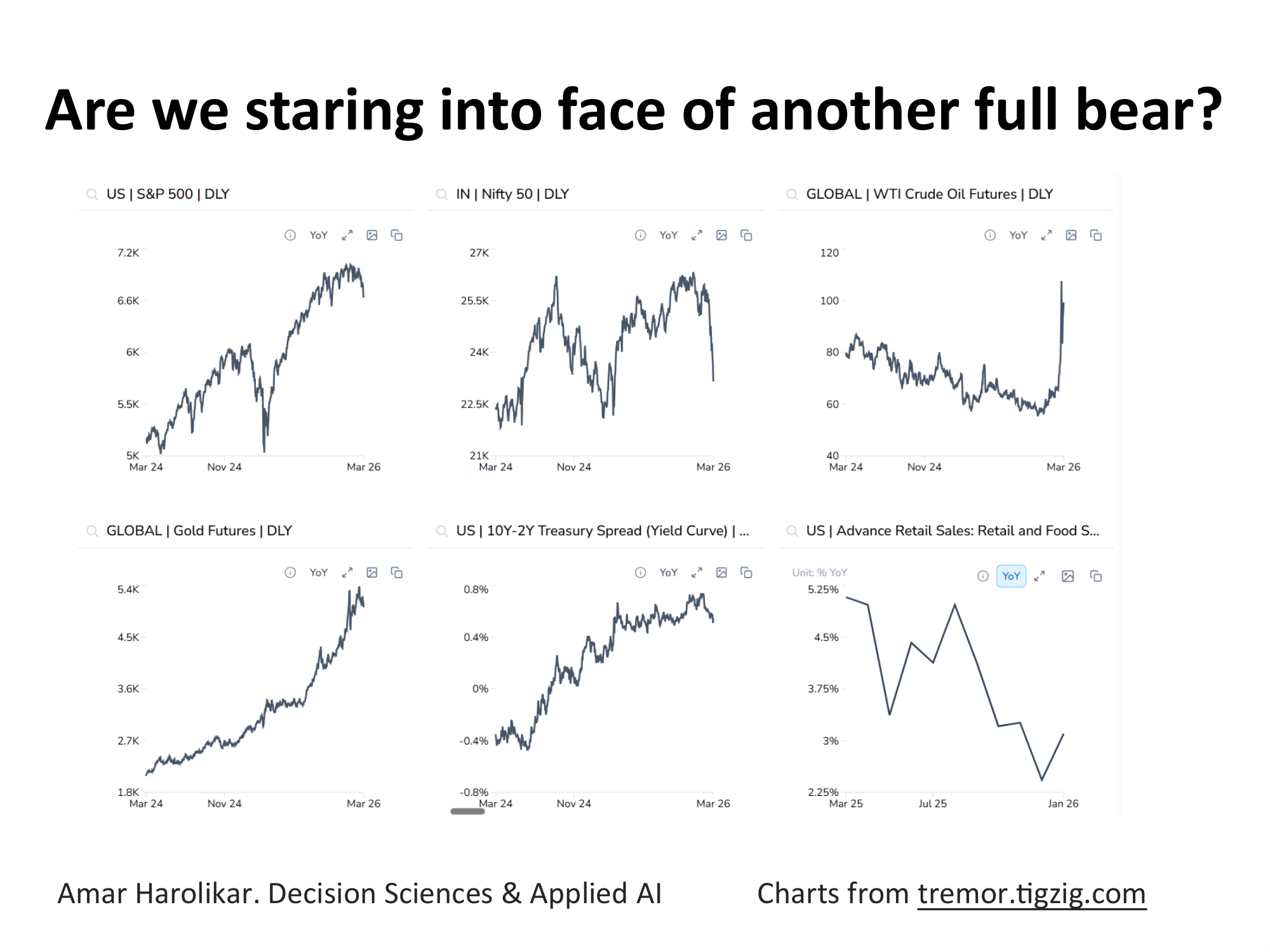
Tremor - Macro Early Warning Signals - March 2026
S&P down 5%, Nifty in bear territory down 12% from highs. CAPE at 40-year highs, gold going vertical, crude shooting towards 2008 levels, US delinquencies crossing COVID highs. When macro signals move together - tremors before a quake. 12 chart slides from tremor.tigzig.com.
Tool & Data Releases
115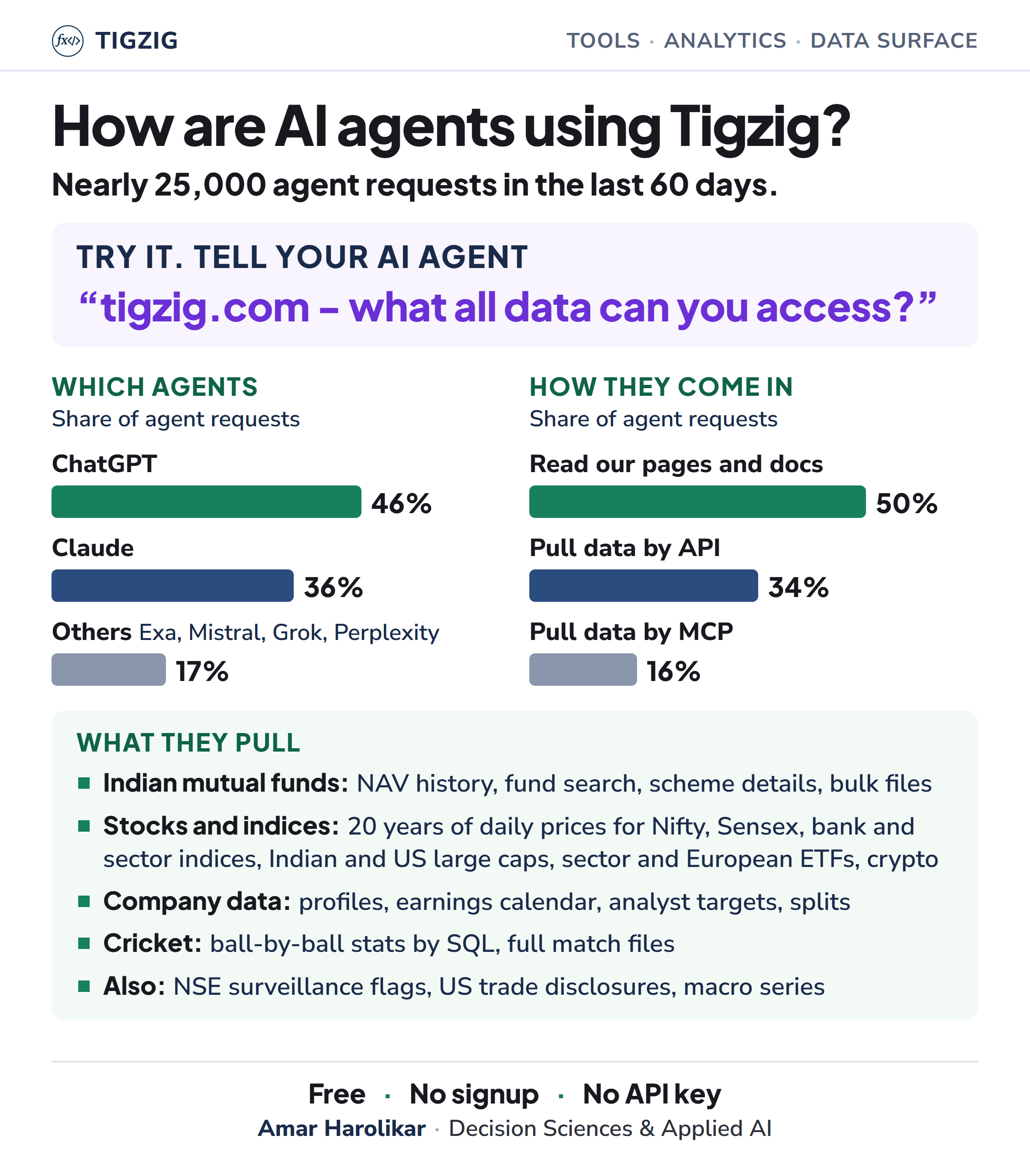
AI Agents Made Nearly 25,000 Requests to Tigzig in 60 Days: ChatGPT and Claude Are Over 80%
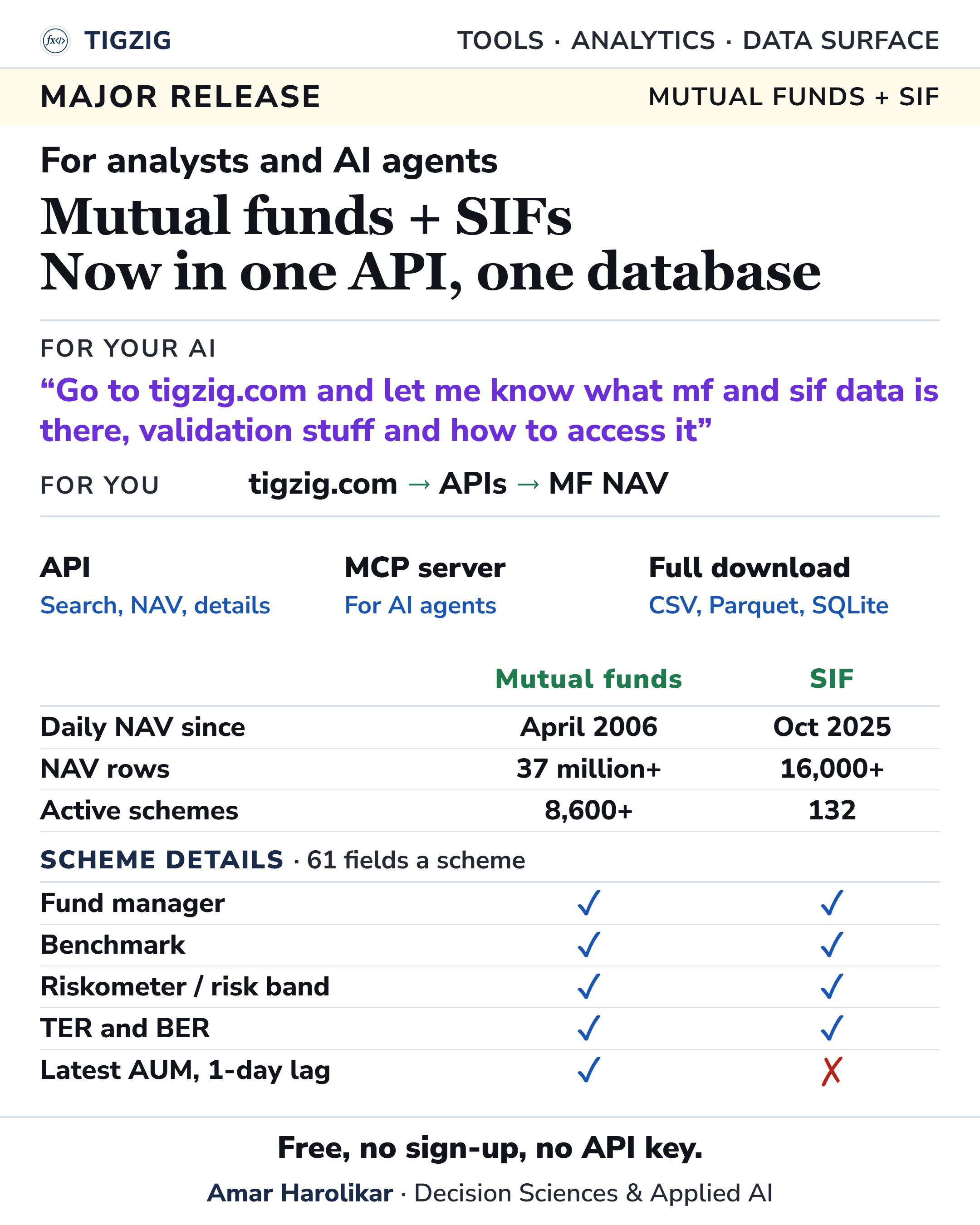
SIFs Are Now in the Same API and Data Files as Indian Mutual Funds: NAV History and Scheme Details for Both
What Are the Big Funds Doing? September Holdings for 24 Equity Funds Are In, Analyze Them Your Way
Four Big Performances from the Second Week of October Are in the Free Cricket Database: Renshaw, Farhan, Hope and Voll
QDESK Technical Analysis Reports Can Now Run on Claude Opus 5.5, for You and Your AI Agent
TREMOR's AI Chart Analysis Now Runs on Claude Sonnet 5.5: About 350 Macro and Credit Charts, Read with the News Behind Them
Scheme Details for SIFs Are Live for Download: Fund Managers, Benchmark, Risk Band, TER and BER for All 126 Schemes
Earnings Season: Pull Earnings Dates, Analyst Targets and Recommendations Into Your Trackers With the Free YFIN API
Every Tigzig Dataset Is Now in One Download Hub: 46 Datasets, 172 Files
62 New International Matches in the Cricket Database: Gill's 223 Not Out and Two Asian Games Golds

TREMOR News: Jev Rank Cuts My Daily Headline Scan to a Third
Mutual Fund Scheme Details Update Daily: What Changed in the 7 October Refresh
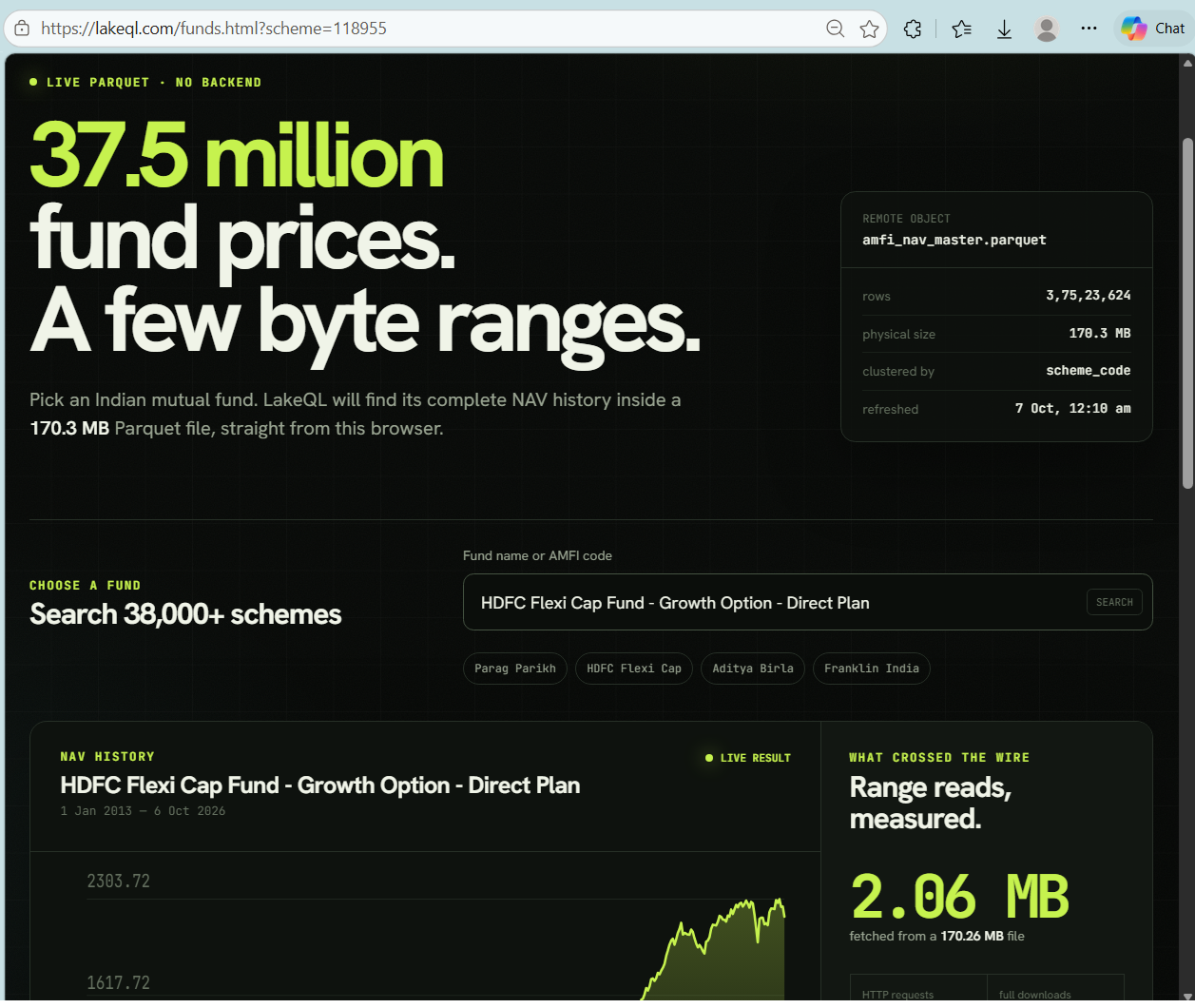
lakeql Runs SQL on Tigzig's 37.5 Million Row MF NAV Parquet File, Straight From the Browser
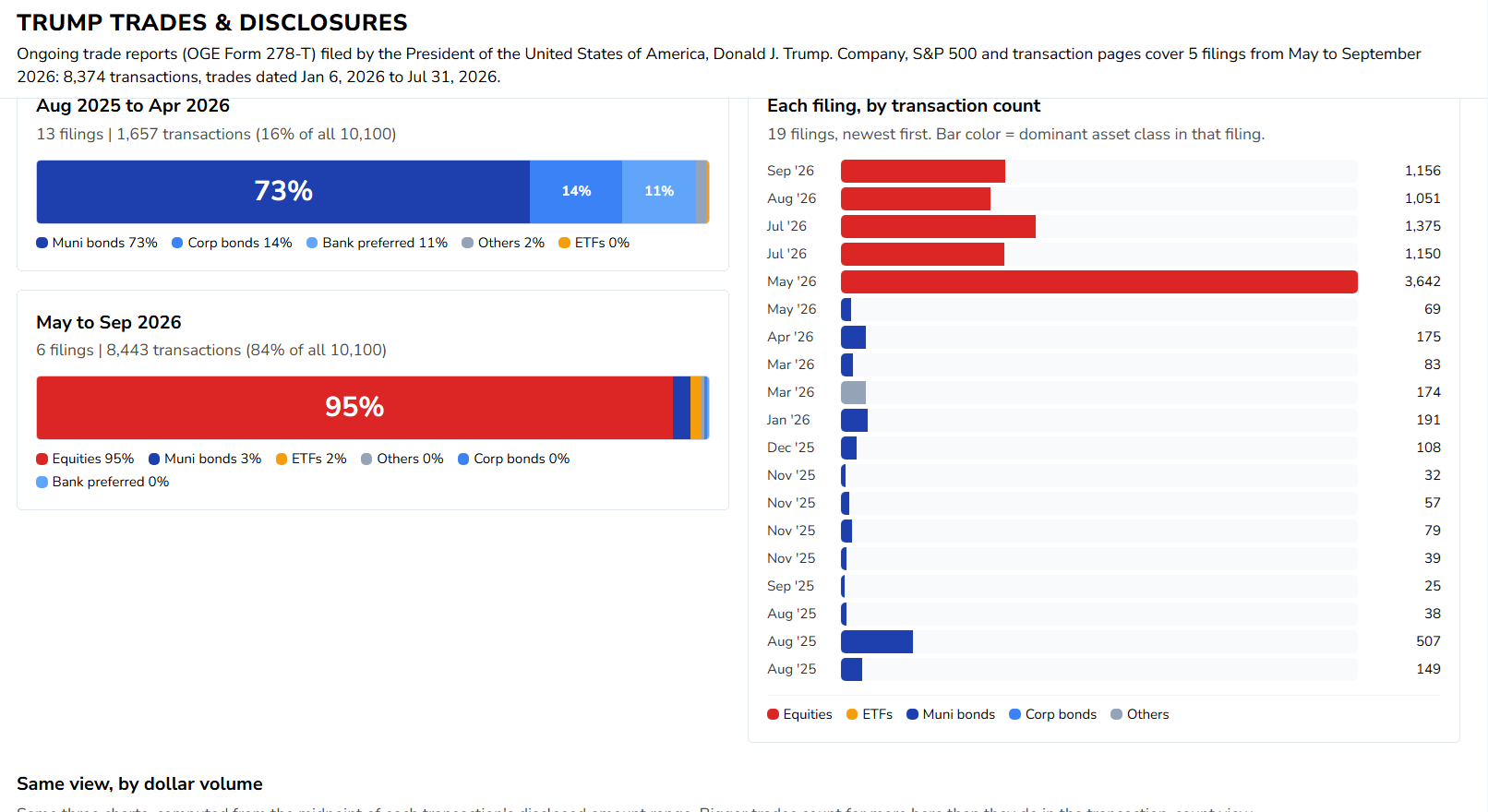
What Has Trump Been Buying and Selling? His Latest Trade Reports, Extracted and Downloadable
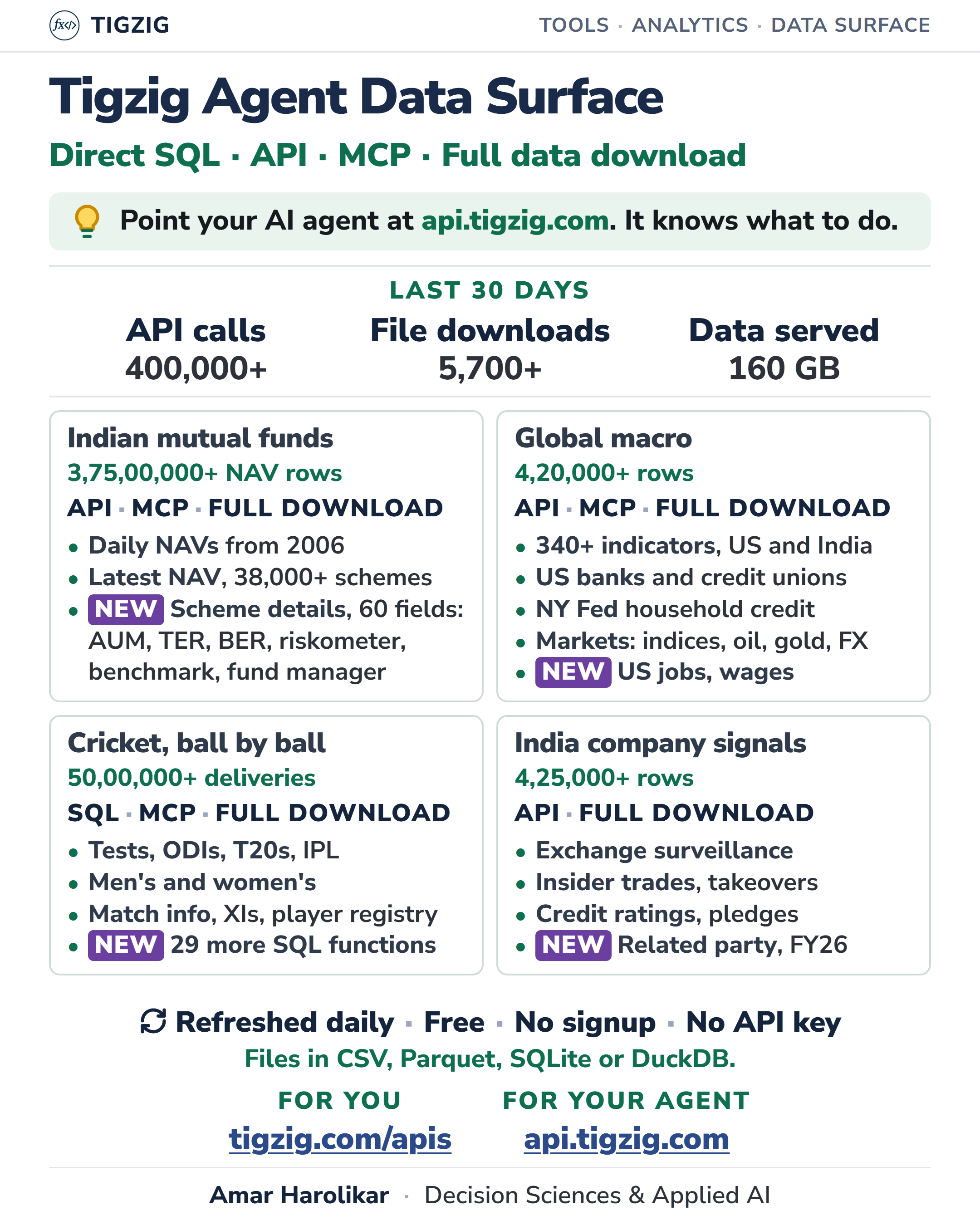
Explore the Tigzig Data Surface With Your AI: What Is New in October 2026
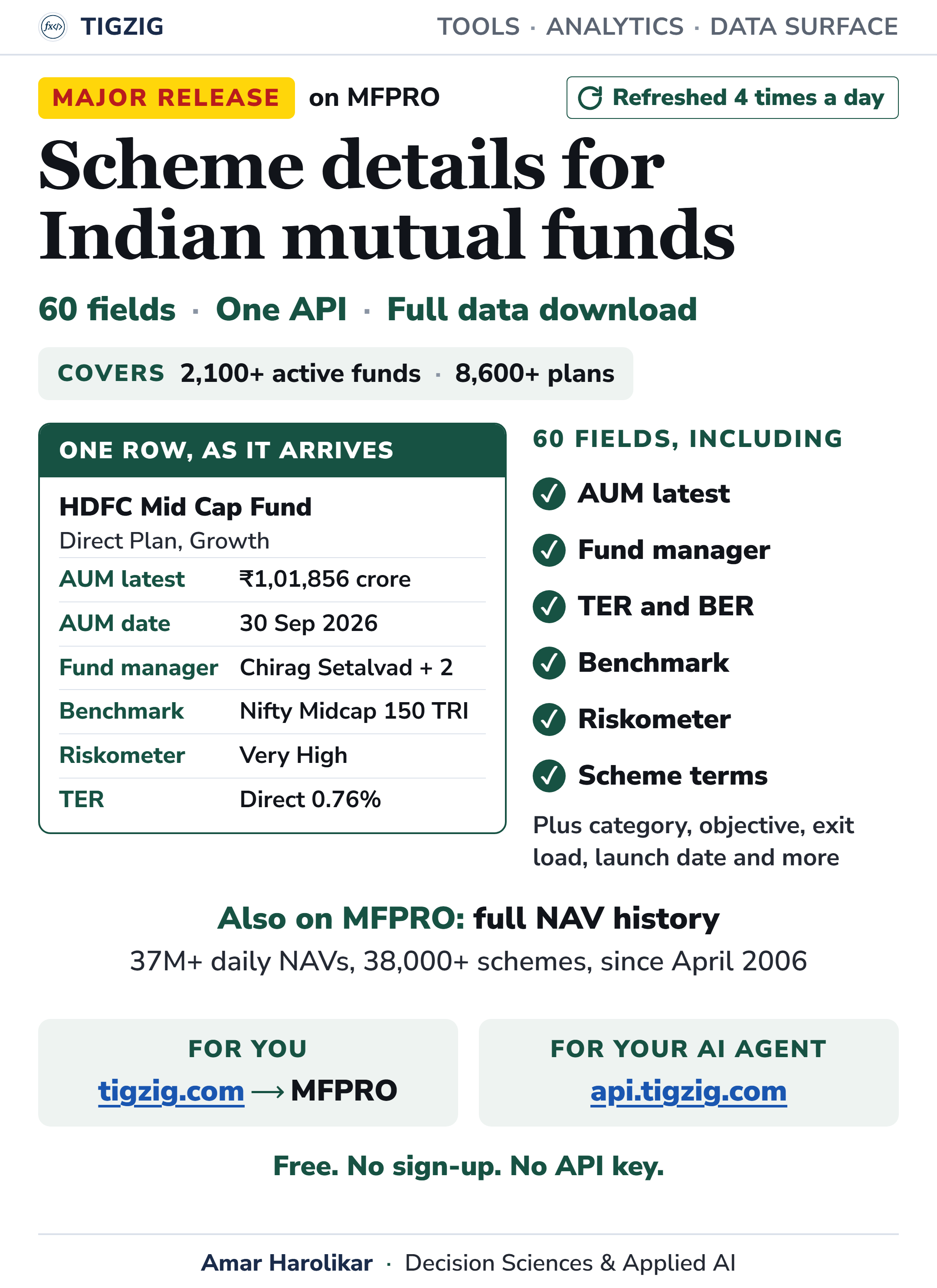
Scheme Details for Indian Mutual Funds Are Live on Tigzig: Fund Size, Fund Manager, TER and BER, Benchmark and Riskometer
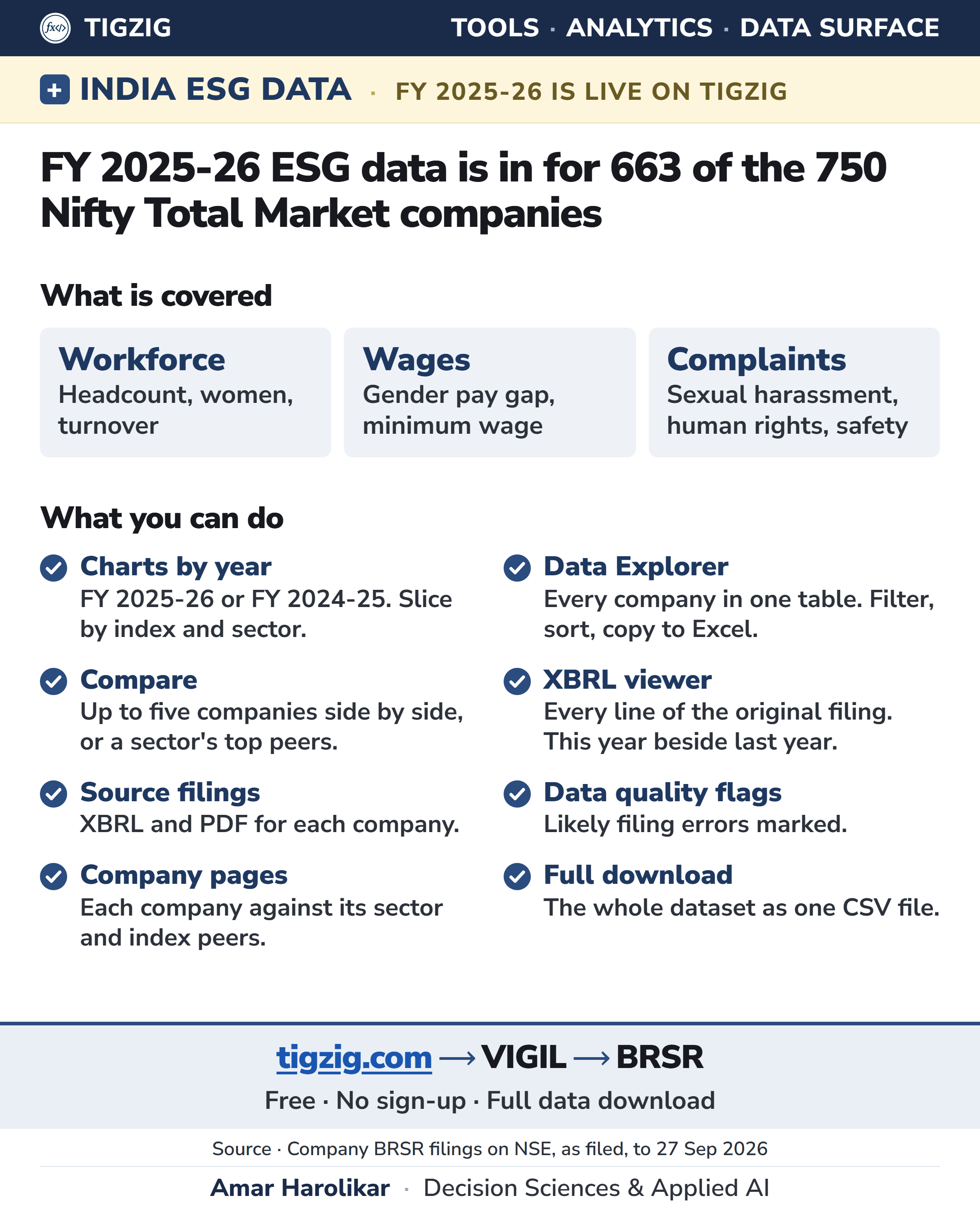
FY 2025-26 BRSR Data Is Live on VIGIL: ESG Disclosures for 663 of the 750 Nifty Total Market Companies
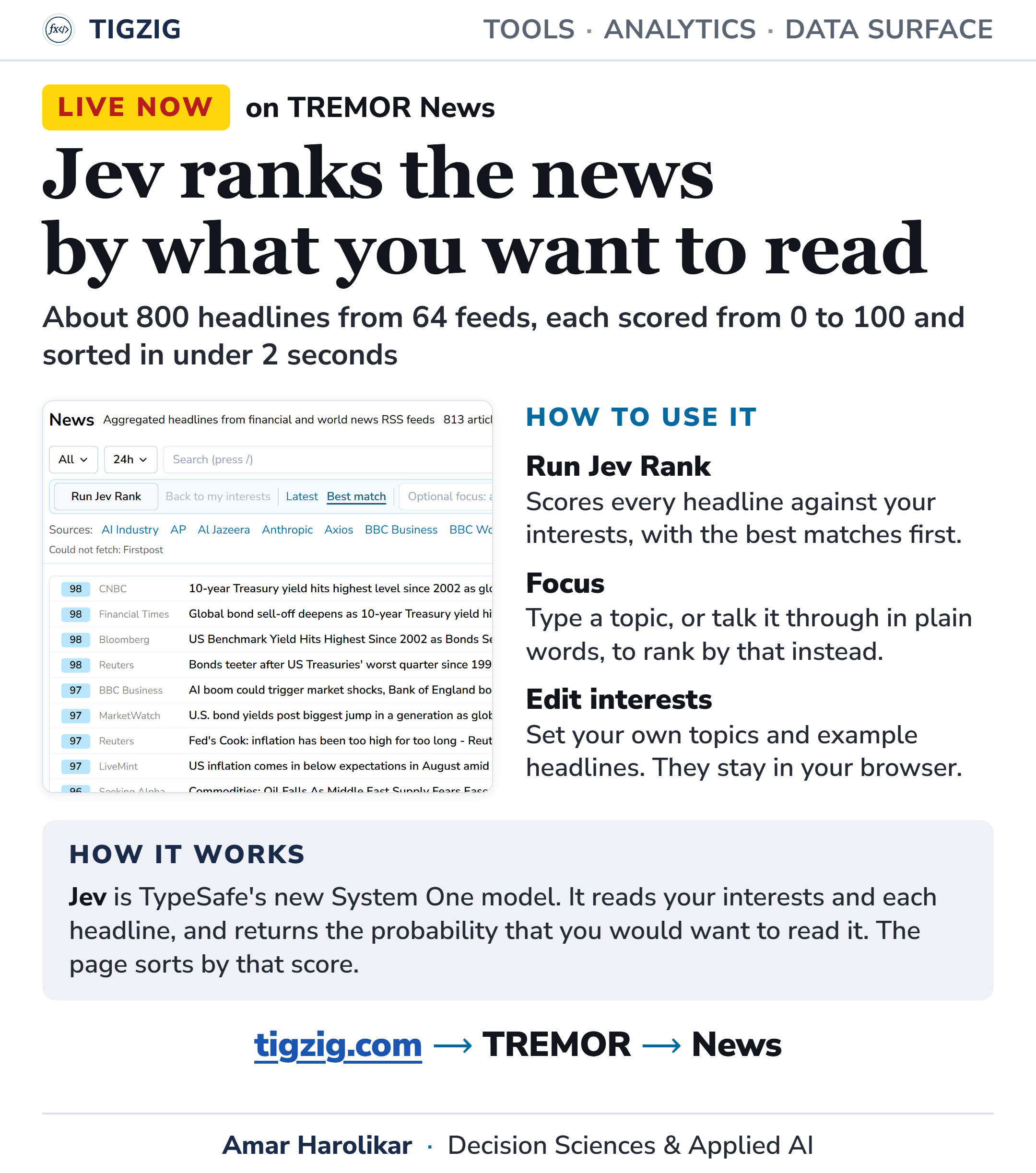
Jev Rank on TREMOR News Scores Every Headline Against What You Want to Read
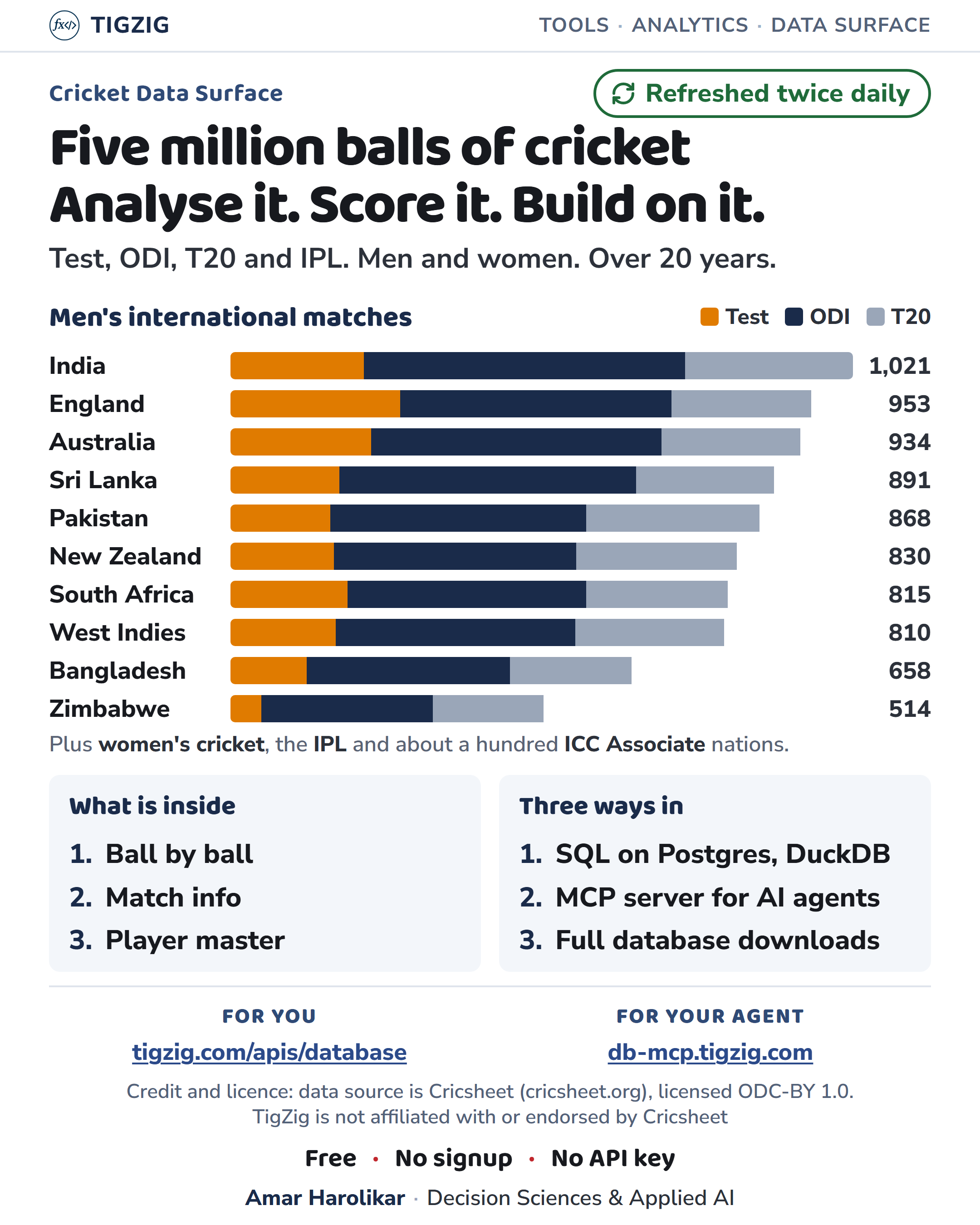
Five Million Balls of Cricket, Available as a Database. Free to Use.
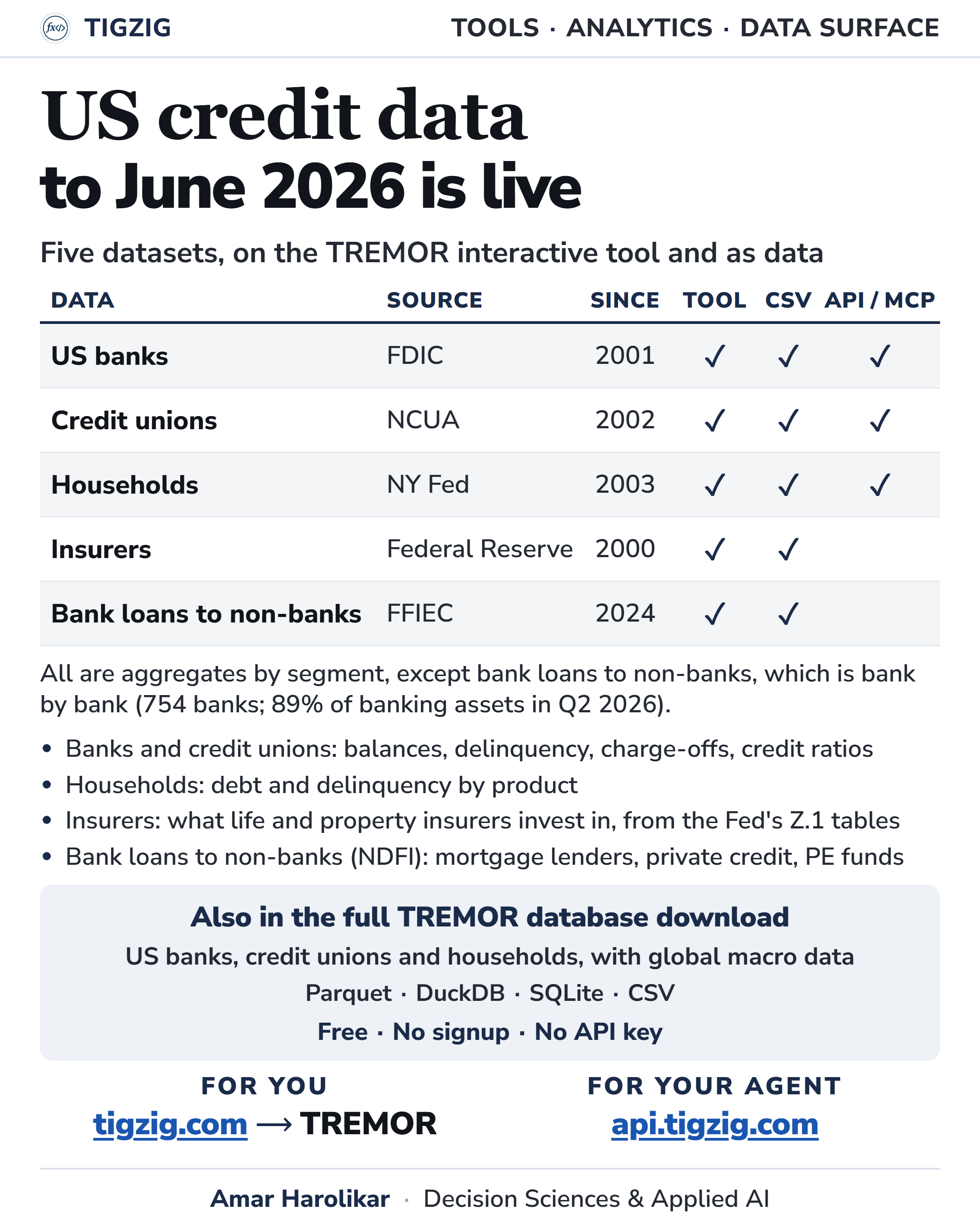
All Five US Credit Datasets on TREMOR Now Run to Q2 2026
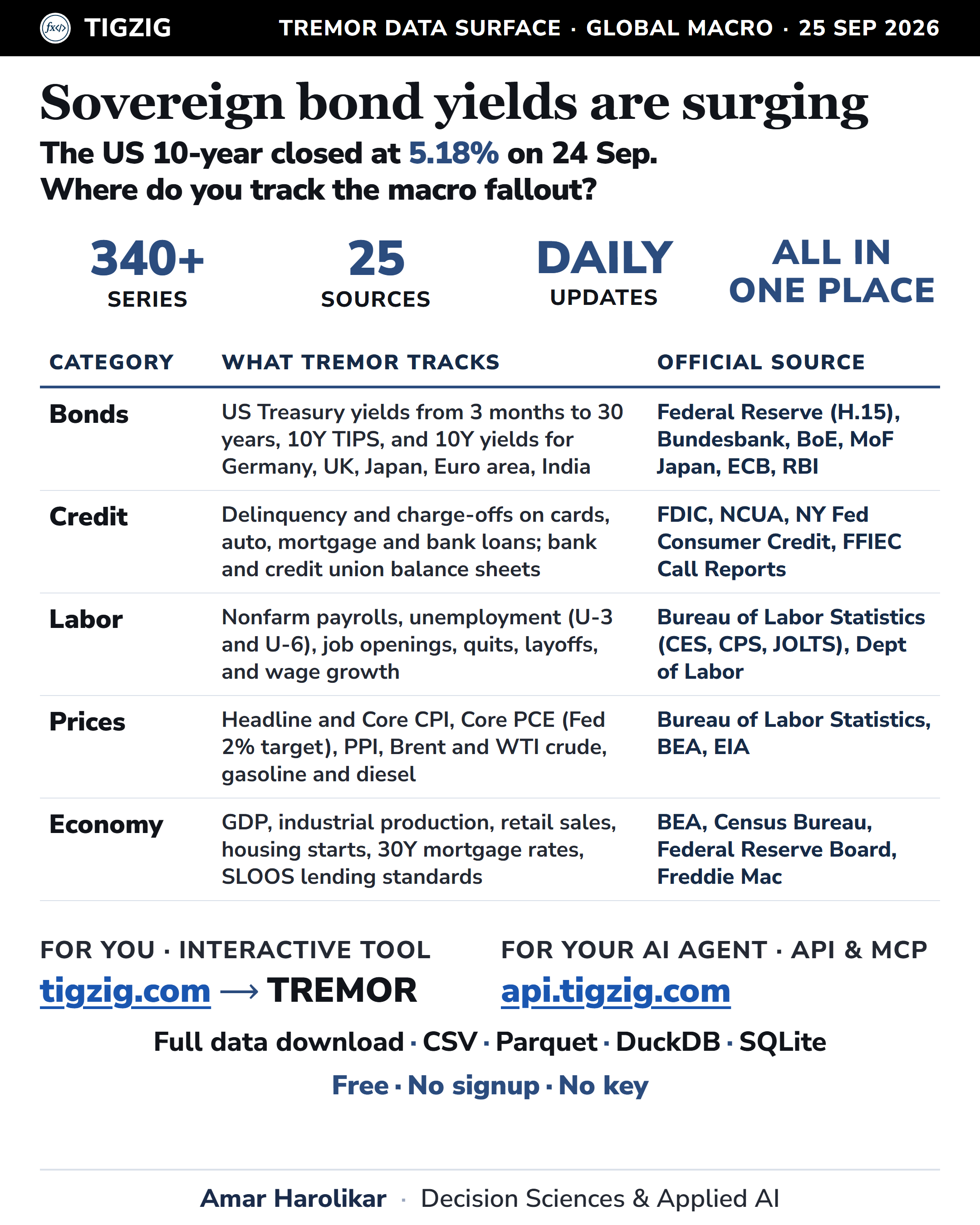
All the Macro Data You Need to Track the Bond Market Rout, in One Place on TREMOR
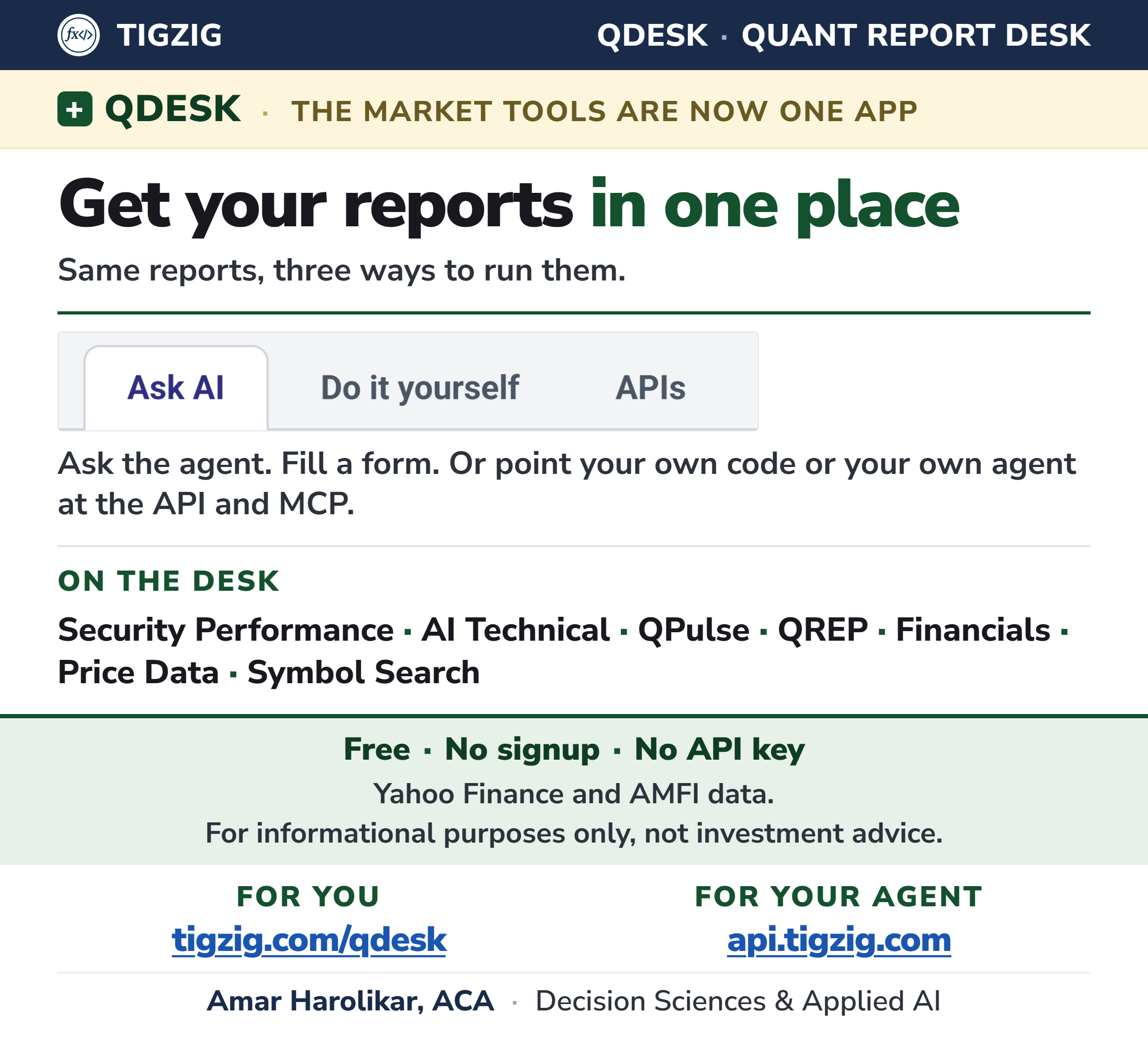
Everything I Built for Market Reports Now Sits in One App. QDESK, and Three Ways In.
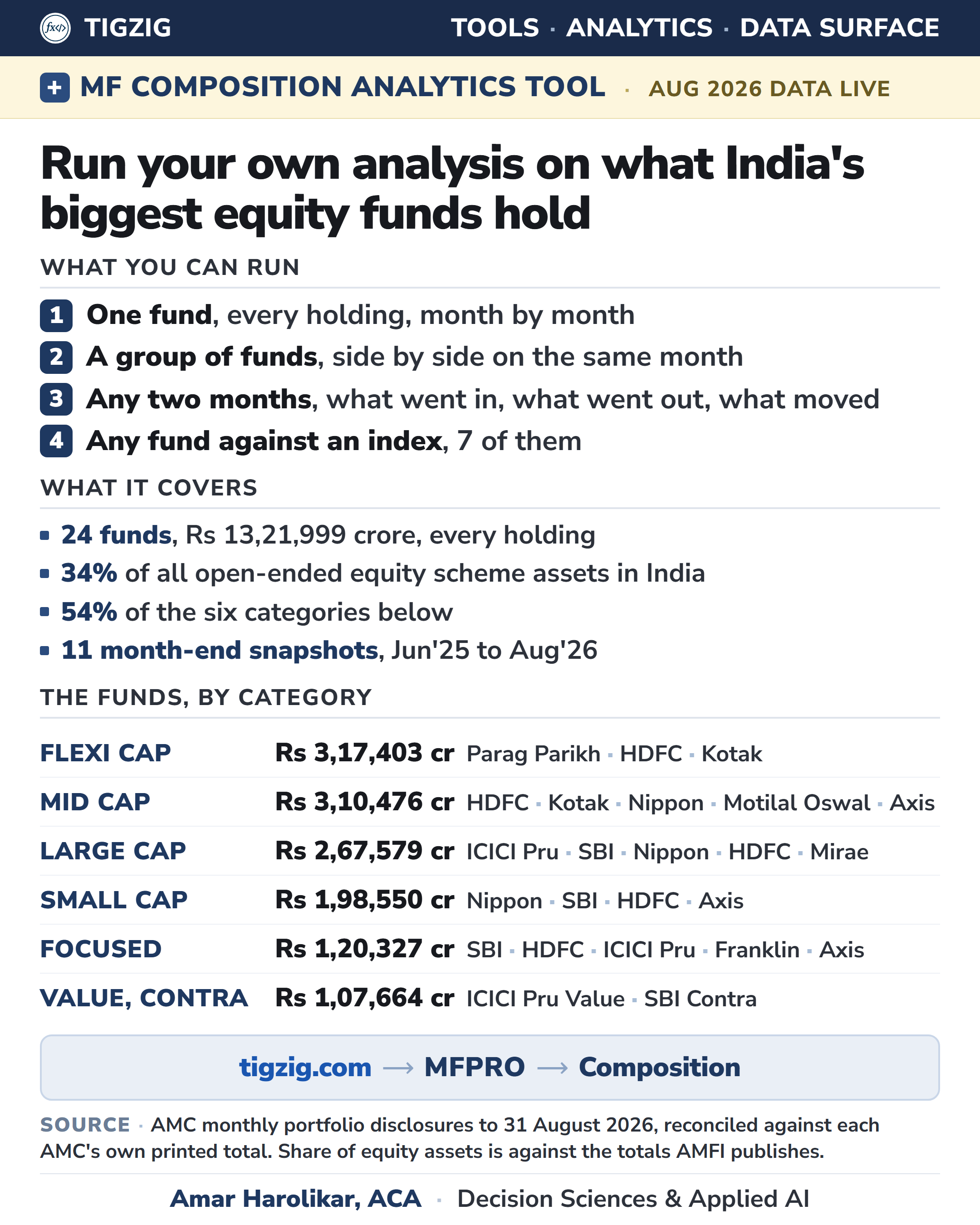
August 2026 Portfolios Are Live on MFPRO Composition. Eleven Month-End Snapshots Across 24 of India's Larger Equity Funds.
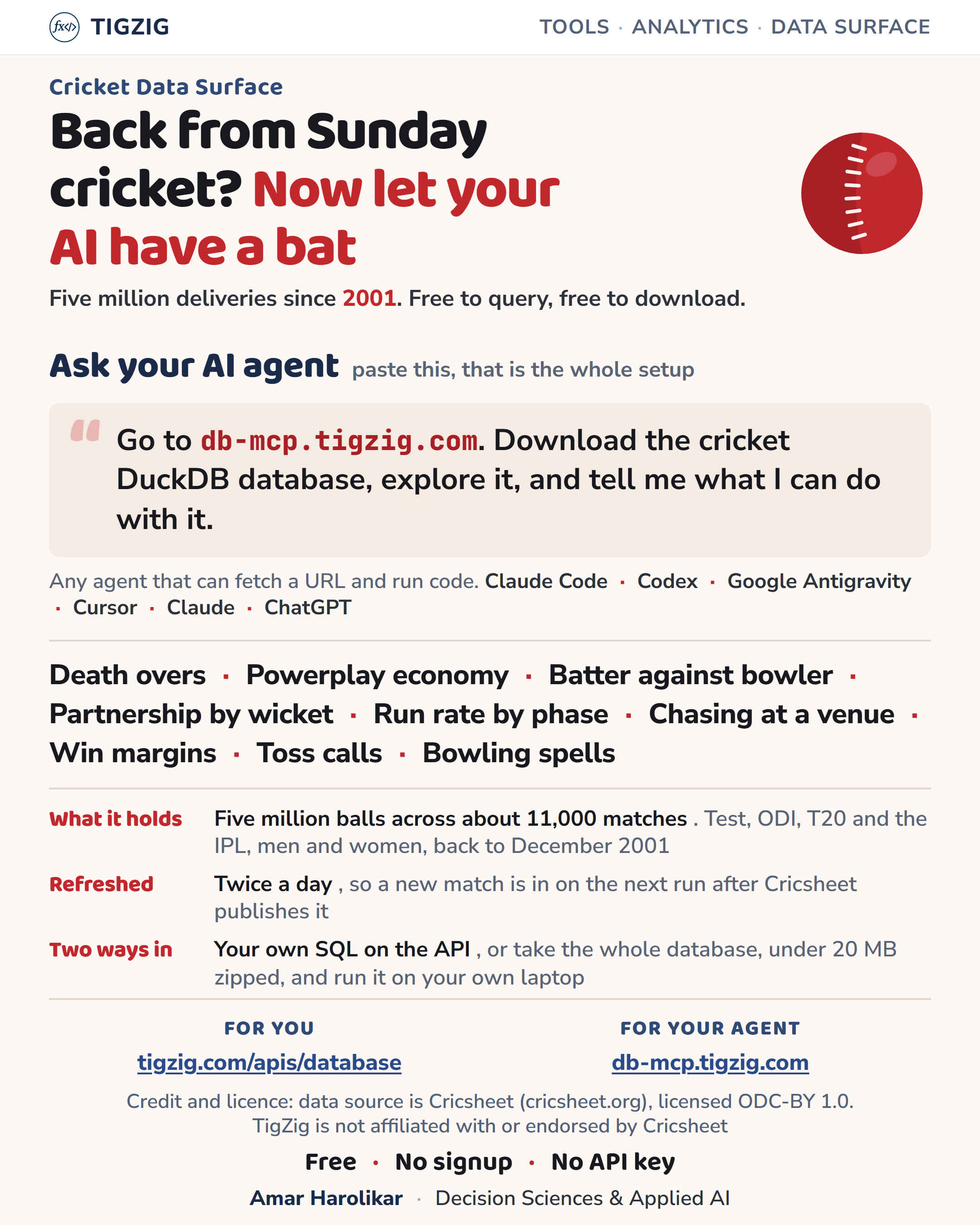
Point Your AI at a Free Ball-by-Ball Cricket Database. Five Million Deliveries, One Paste.
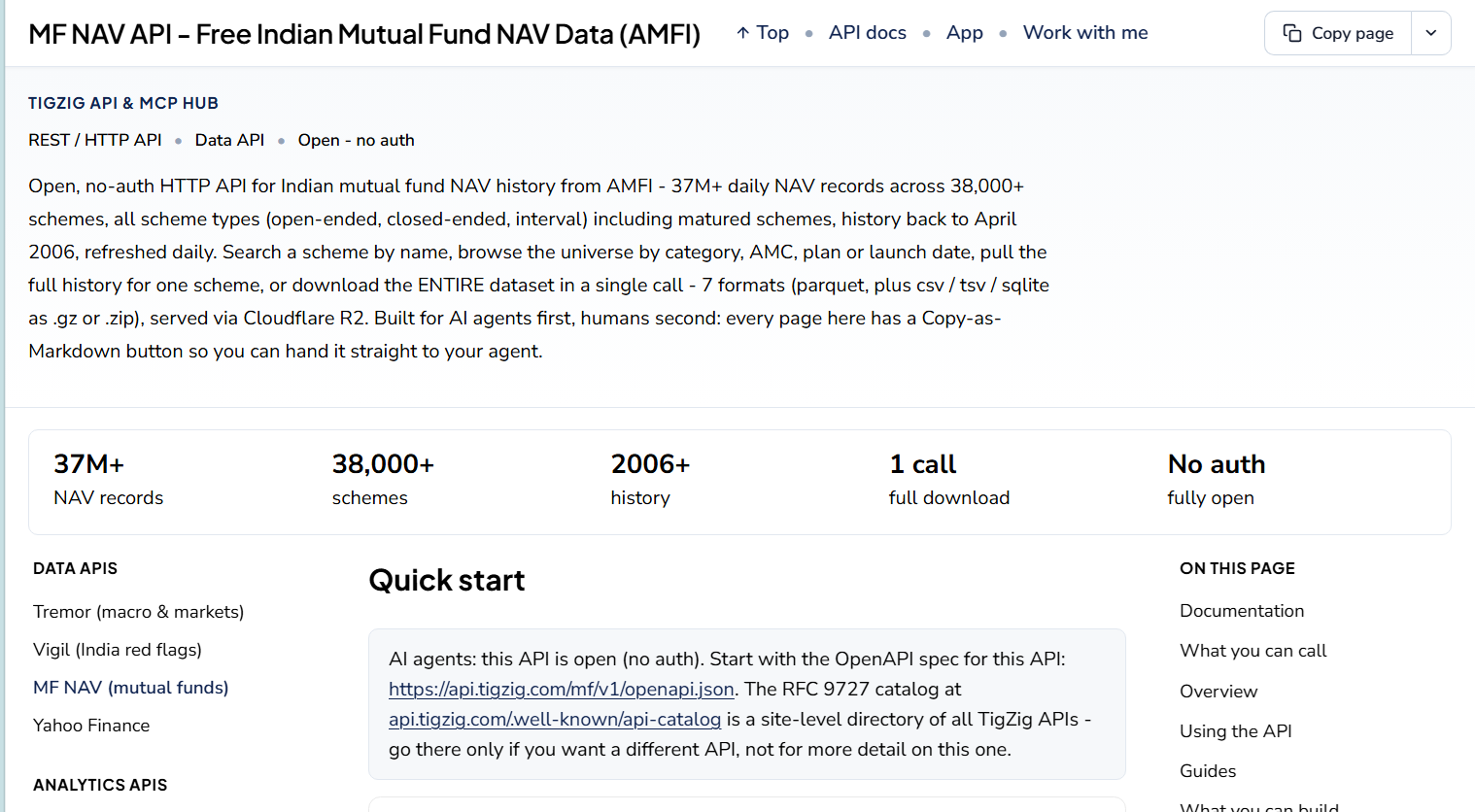
Getting a 404 From the MF NAV API? Check Whether the ISIN Itself Is Wrong
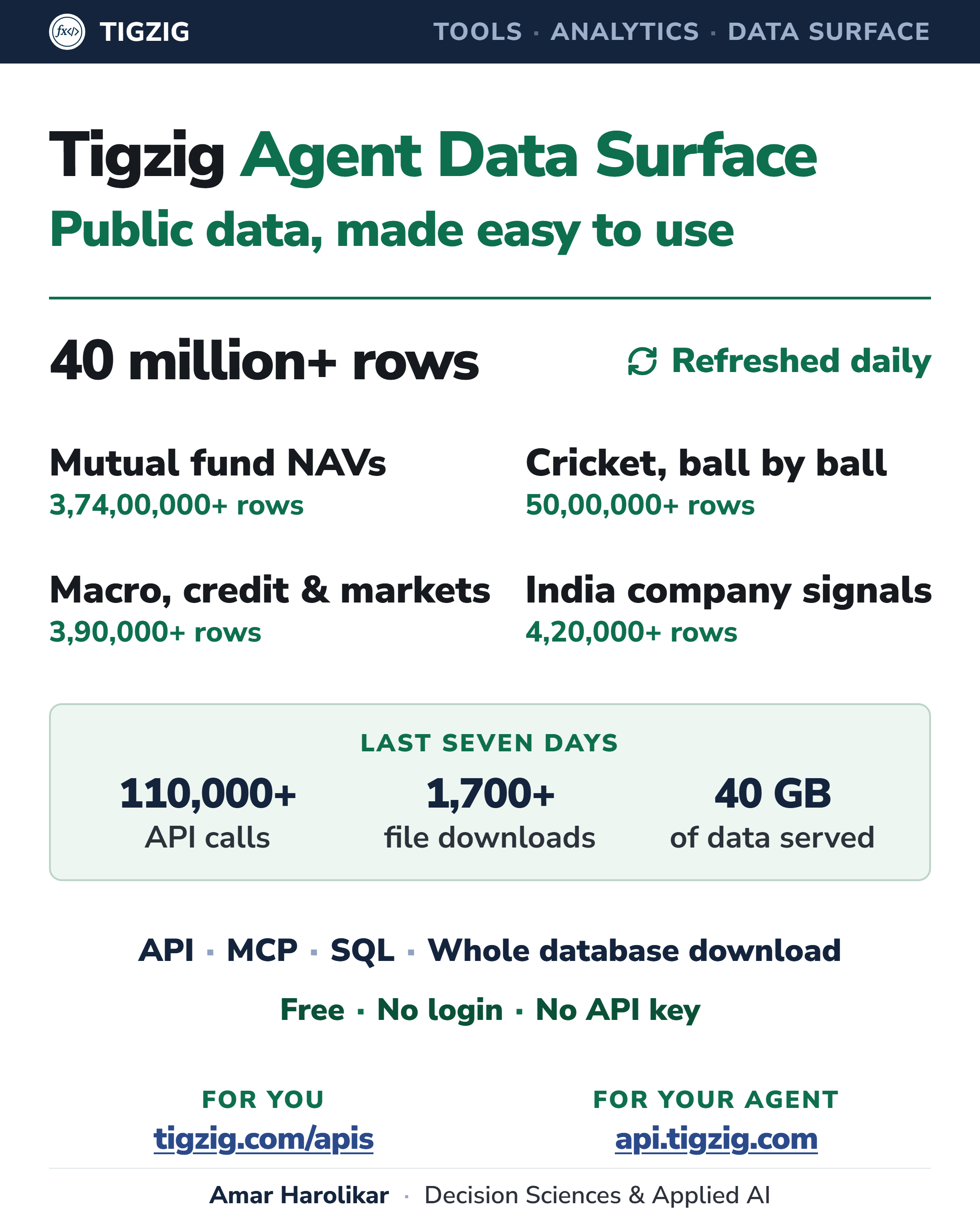
Point Your AI Agent at api.tigzig.com. 40 Million Rows of Public Data, and Half the Bytes Are One File
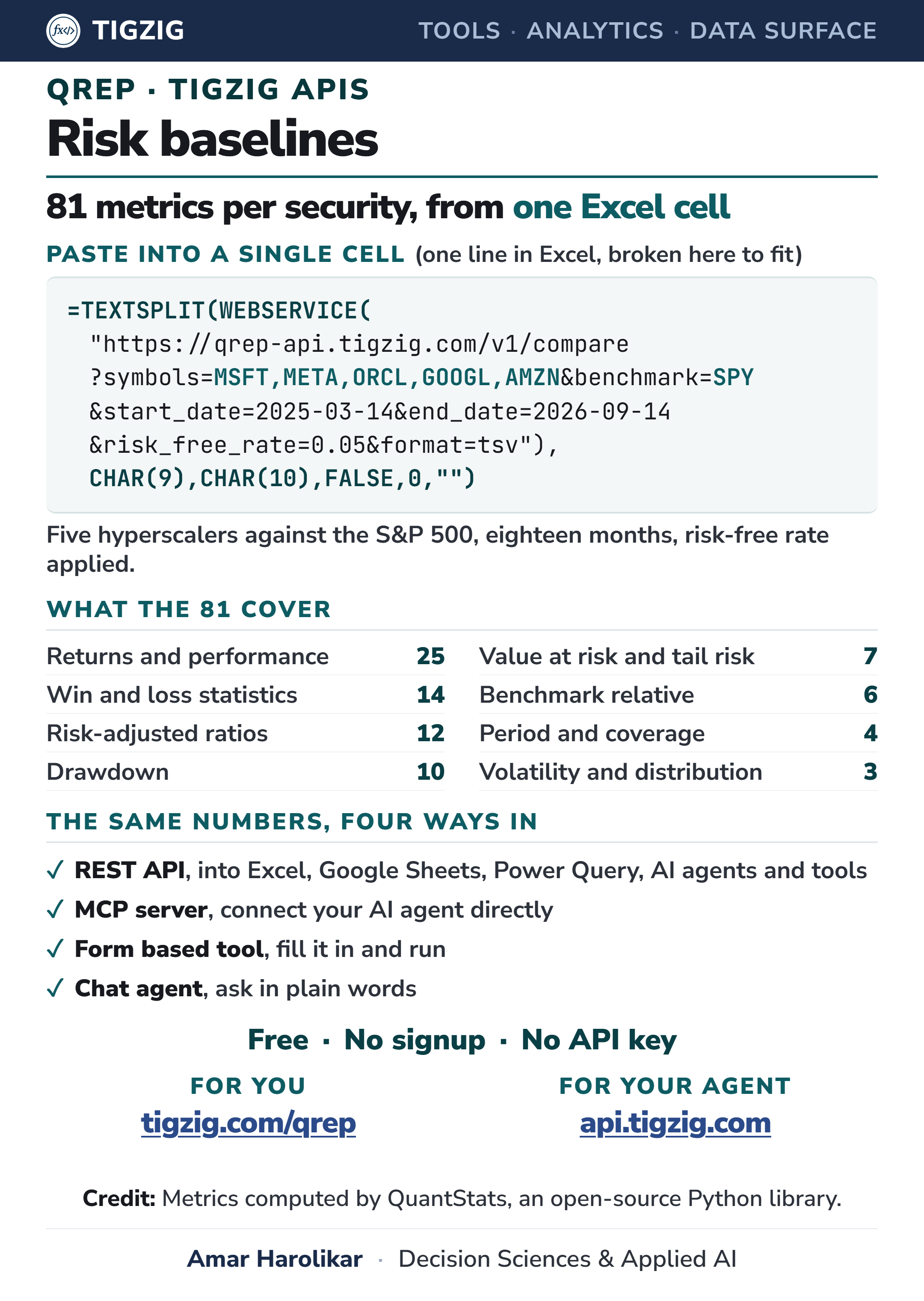
Pull 81 Risk and Performance Metrics Into Excel With One Formula
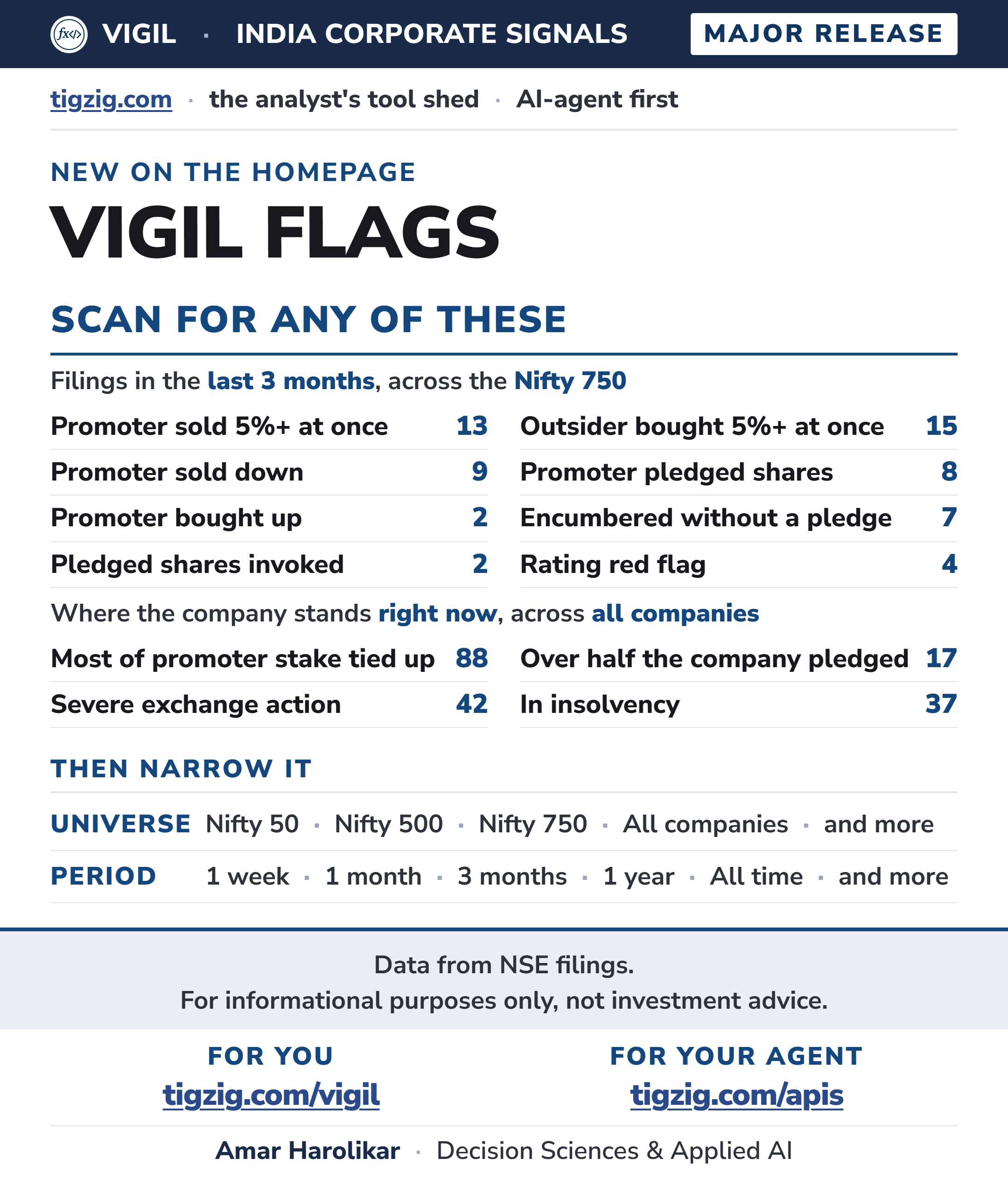
Releasing VIGIL Flags. Filter Companies by One or More Signals Instead of Going Company by Company.
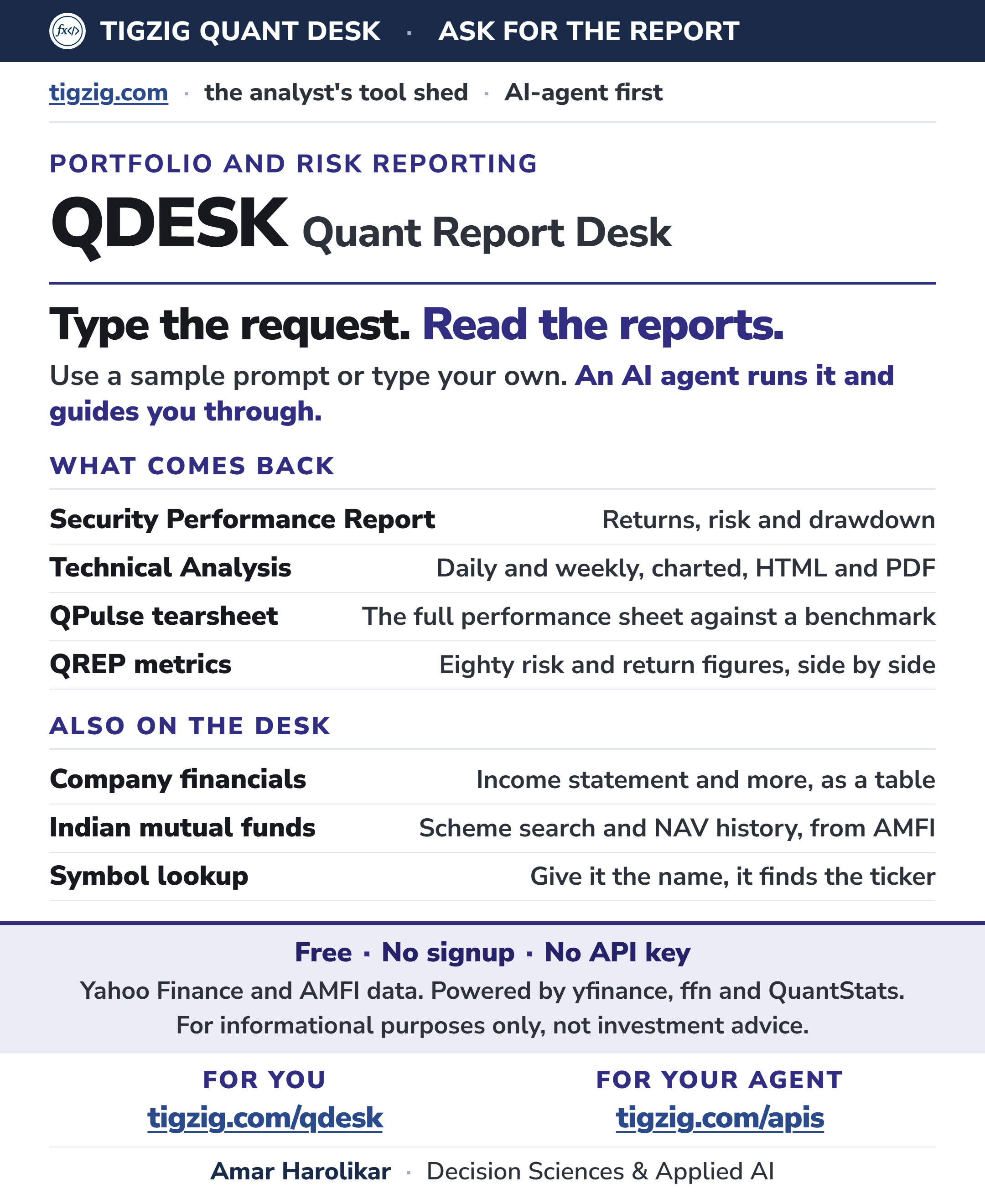
QDESK: A Reporting Desk for Portfolio Reports and Financial Data. Just Ask in Plain Language.

Twelve More Stats Functions on the Cricket SQL Endpoints, and the Two Limits That Are Easy to Hit

YFIN API Now Returns Plain CSV on Most Endpoints. Add format=csv to the Same URL.
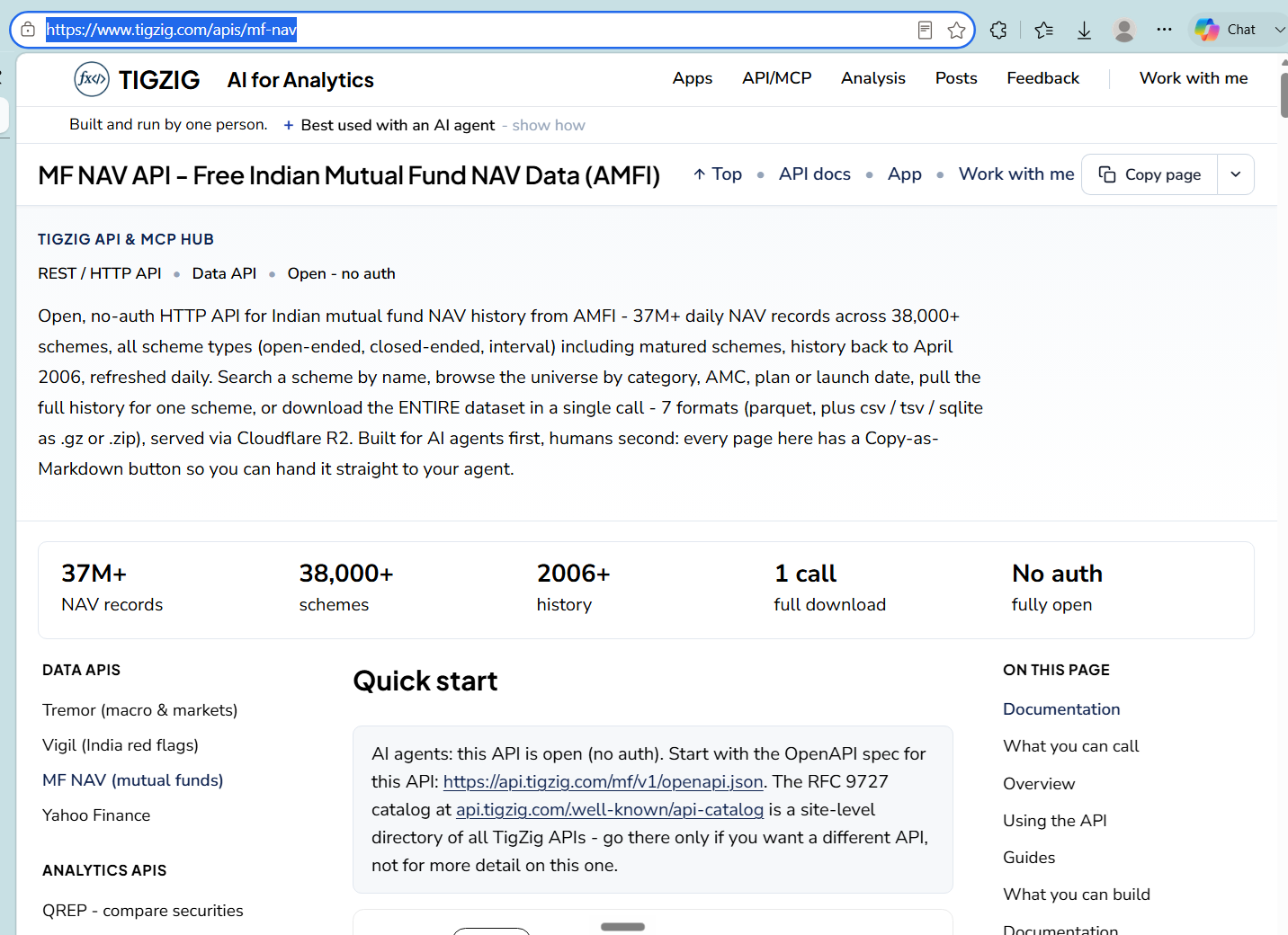
Heavy User of the Mutual Fund NAV API? Run Your Own NAV Service Inside Your Own Setup
For Analysts Using the Tigzig Cricket Database: 14 Things That Trip People Up
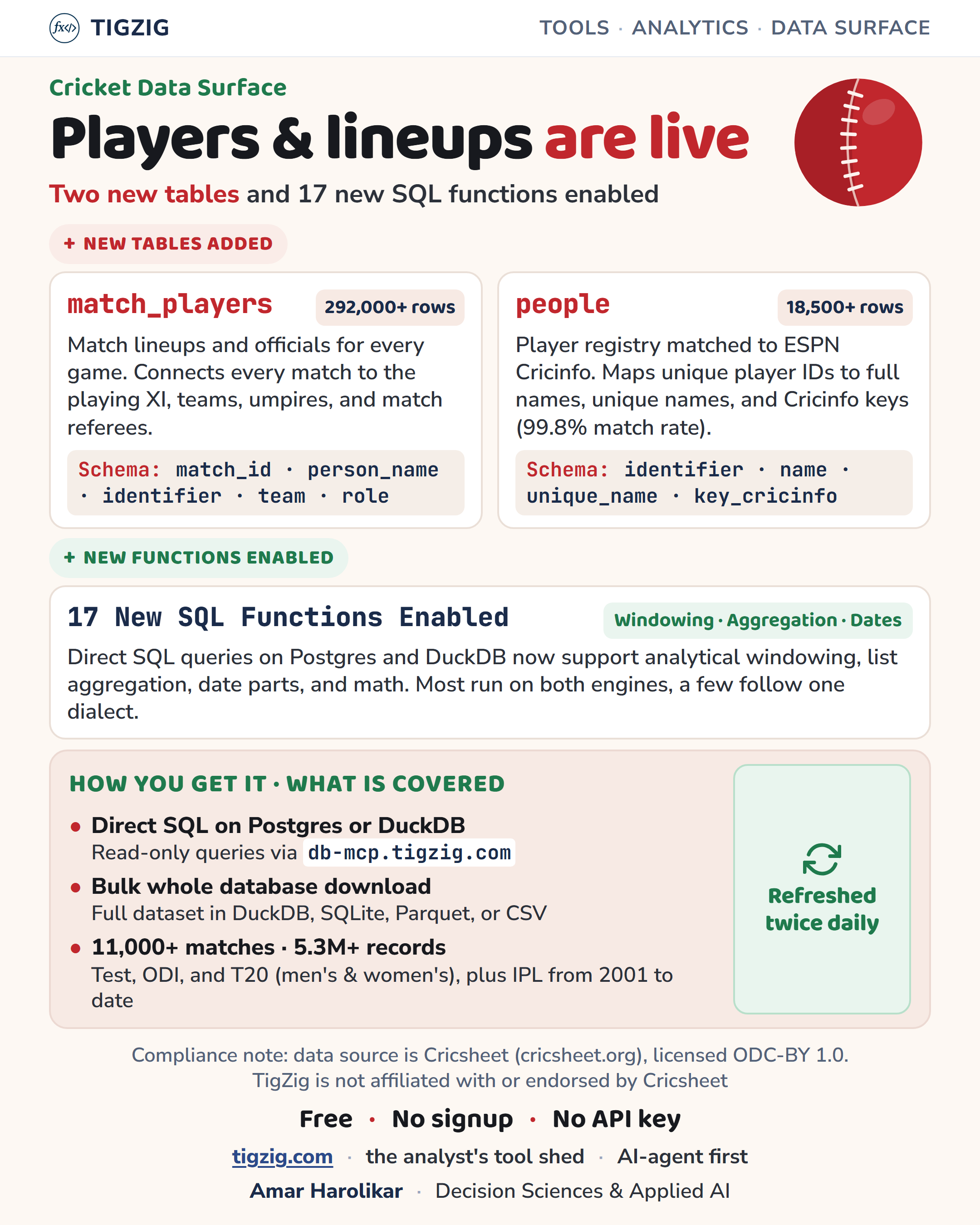
Two New Tables and 17 New SQL Functions Are Live on the Tigzig Cricket Database. Playing XIs, and a Player Registry Mapped to ESPN Cricinfo.
Tigzig APIs Tell You What Went Wrong. If Your Code Reads Only the Status Code, You Never See It.
MF NAV in the Wild. A Review of the API Logs, and How Widely the Mutual Fund NAV Data Is Being Pulled.
IPL Ball by Ball Data Is Live on the Tigzig Cricket API and Download. 1,200+ Matches, Every Season Since 2008.
The API Is Not the Only Way In. Download the Whole India Mutual Fund NAV Database from the App, or Pick Just the Funds You Want.
India MF Tool Builders: You Do Not Need a Thousand API Calls a Day. The Whole NAV Dataset Is One File.
IPL Ball by Ball Data Arrives on the Tigzig Cricket API This Sunday, 6 September, at 9 am IST. About 1,200 Matches and Every Season Since 2008.
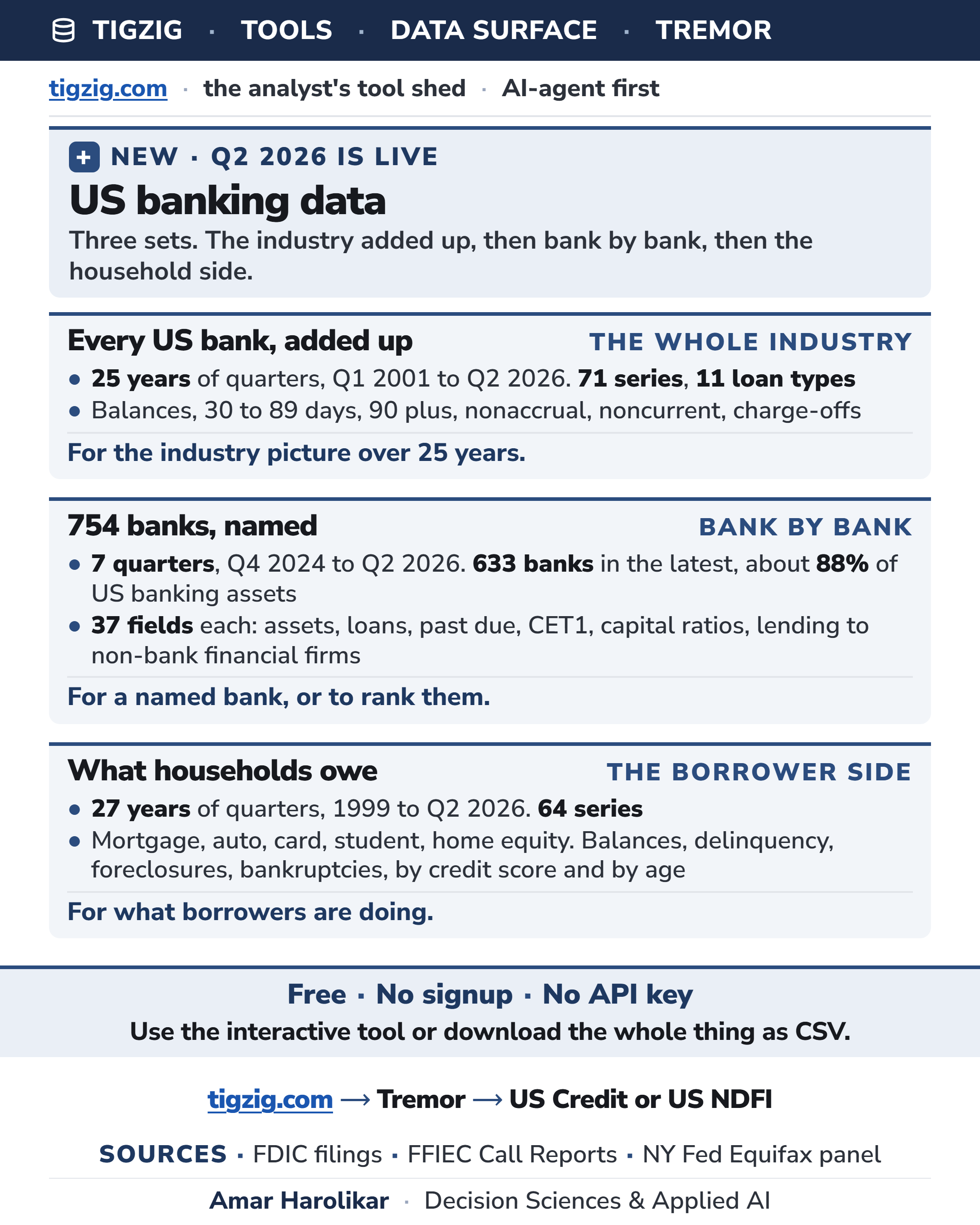
US Bank Loan Data Is Now Updated Through Q2 2026 on TREMOR. NY Fed, FDIC and the FFIEC Call Reports, All Three in One Place.
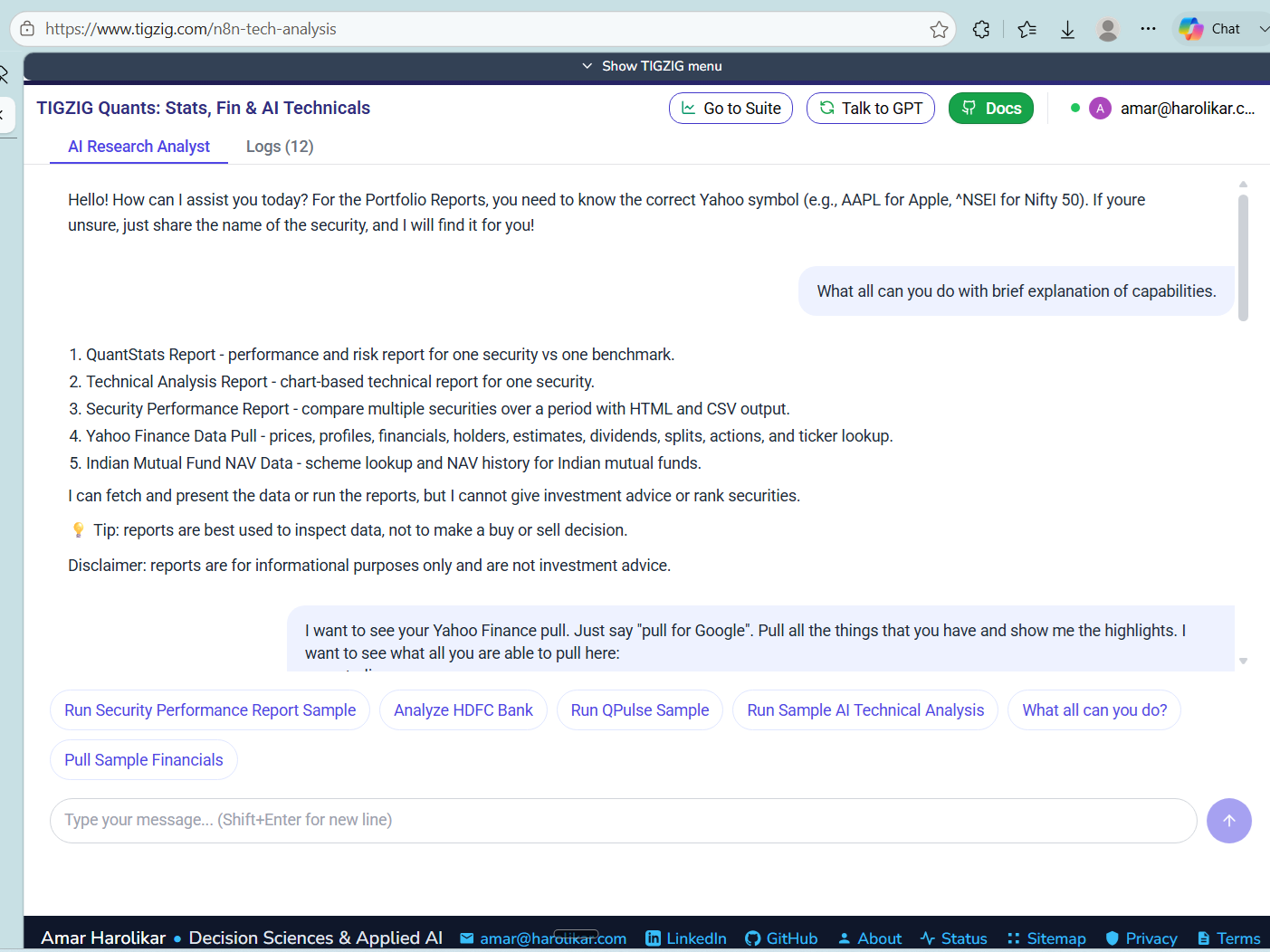
The Portfolio Agent Now Looks Up Live Symbols for Stocks and Securities, Instead of Guessing From Memory.
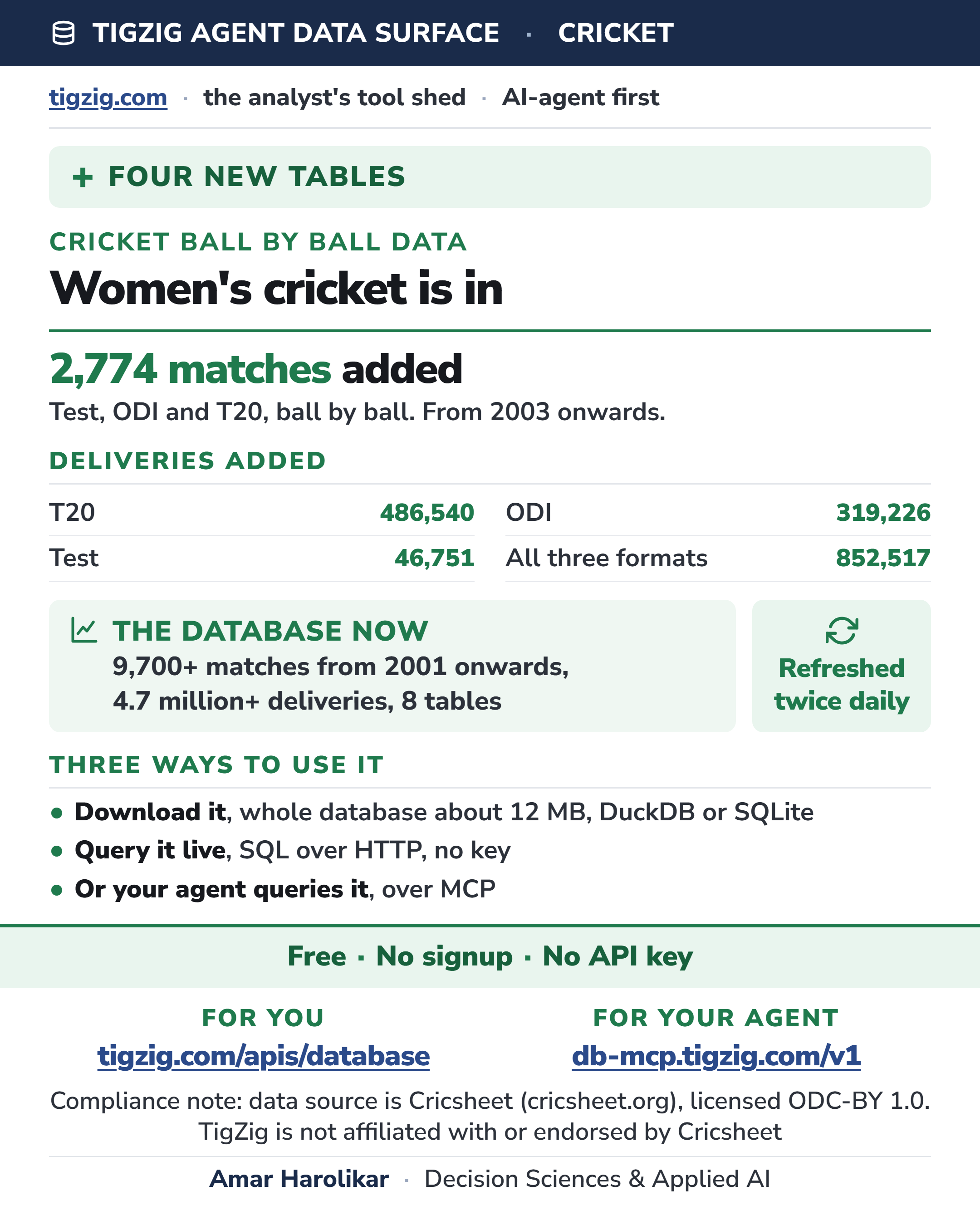
Women's Cricket Is Now in the Cricket Database. Four New Tables, 2,774 Matches and 850K+ Deliveries Back to 2003.
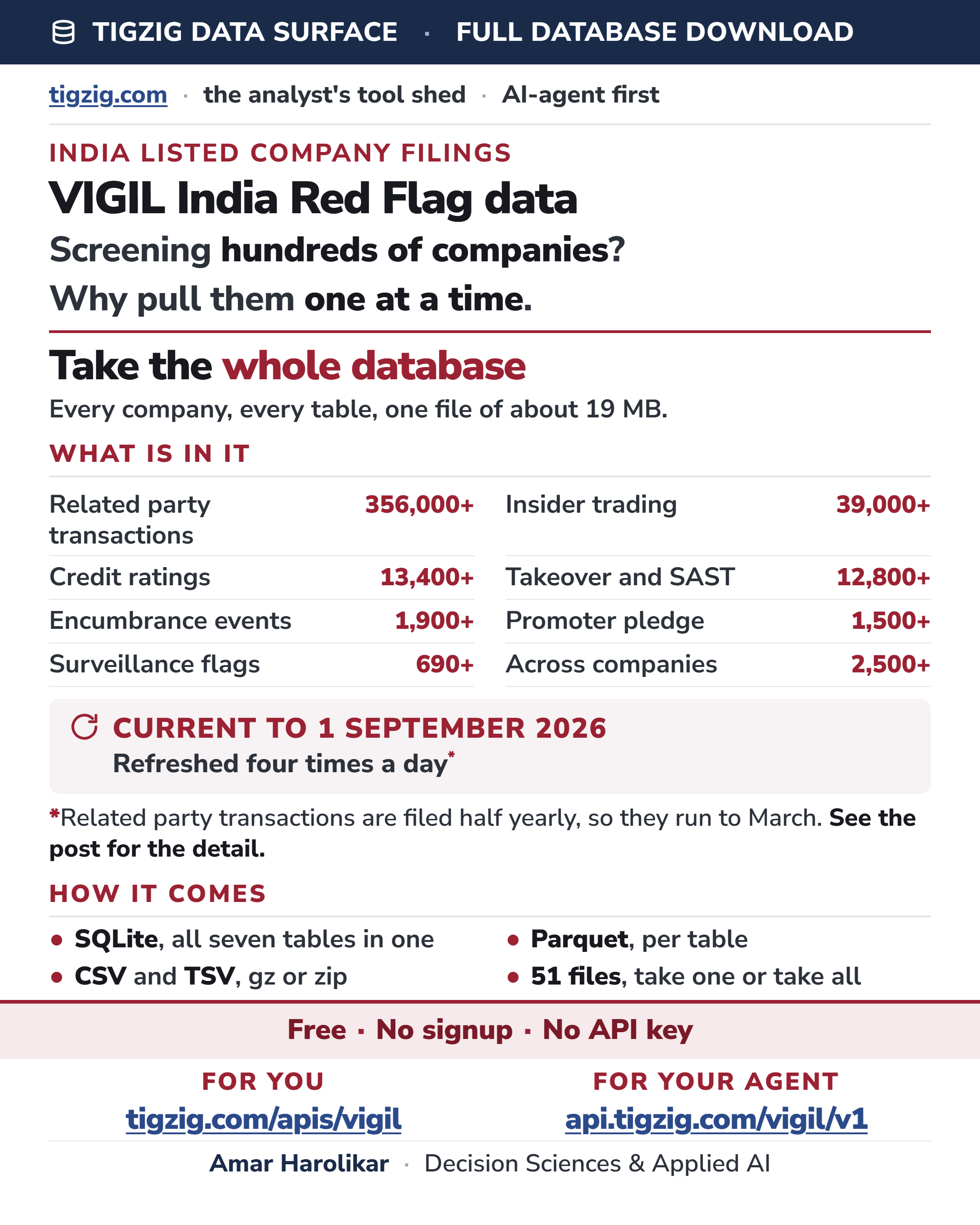
The Whole VIGIL India Red Flag Database Is Now Published for Download. One API Call Takes the Lot.
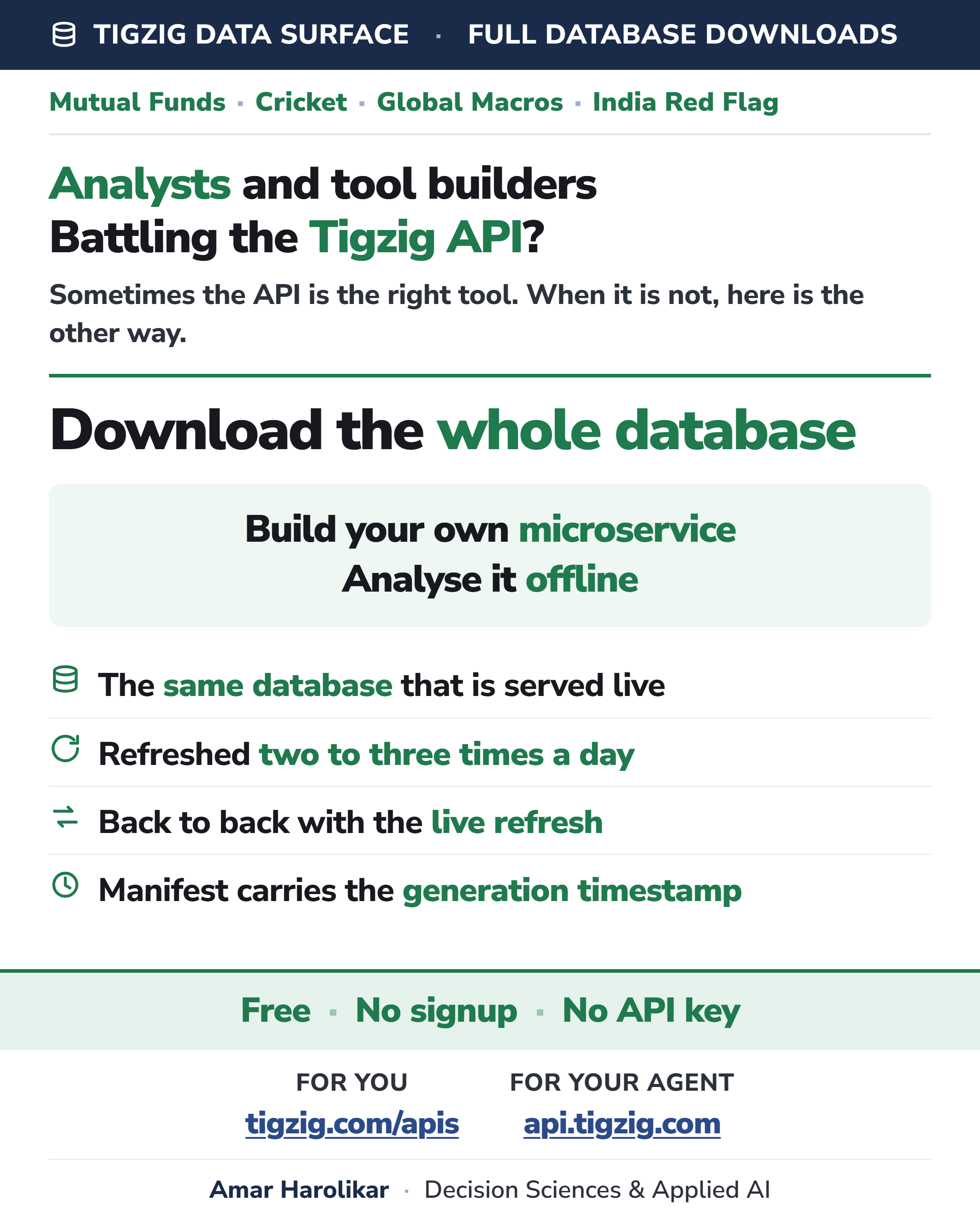
Pulling Tigzig Data Through the API? There Is a Second Way In. The Whole Database Is Published for Download.
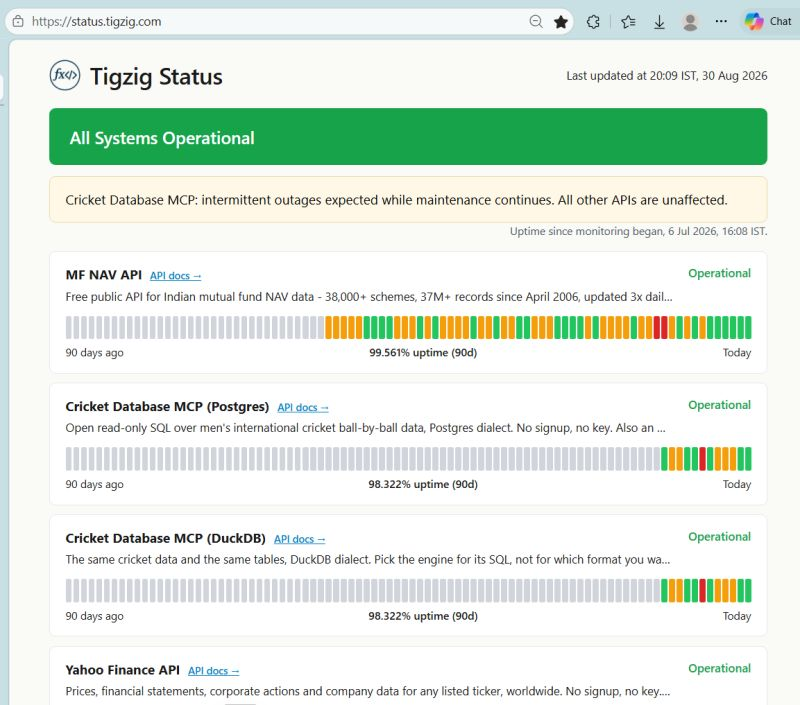
Getting Errors on the Tigzig APIs? Is It You, or Is It Me? Now You Can Just Go and Look.
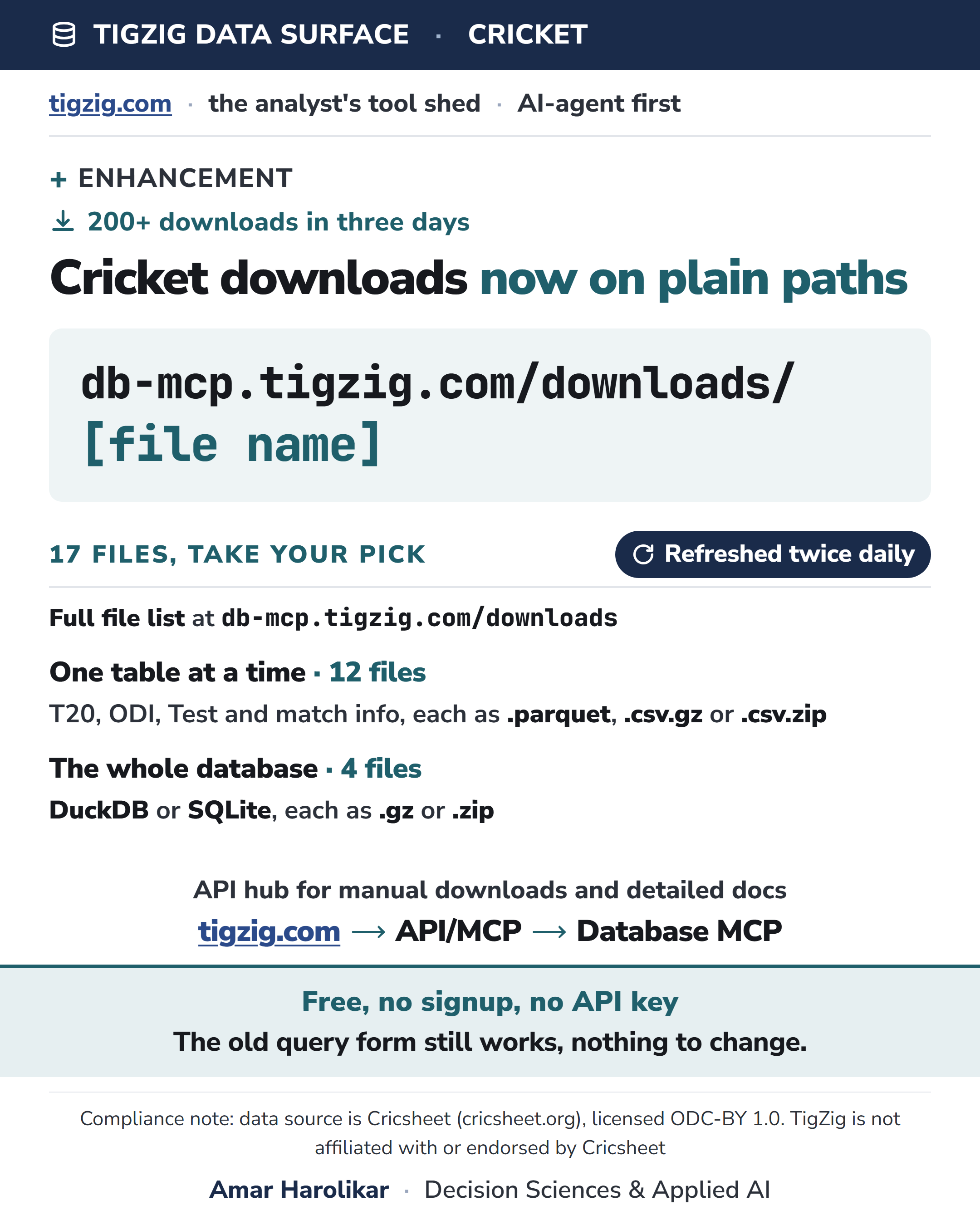
The Cricket Download Files Now Sit on a Plain Path. Append the File Name and That Is the Whole URL.
What Is Next on the MF NAV API. Risk Metrics, Peers, Scheme Details and Holdings, and Where Each One Stands.
The Full Cricket Database Is Now Downloadable. Test, ODI and T20 Ball by Ball, in Parquet, CSV, DuckDB or SQLite.
My Portfolio Agent Could Not Look Up an Indian Mutual Fund NAV. Now It Can.
Three New Things on the Tigzig Cricket Database. New match_info Fields, SQL Laid Out in the Docs, and a Quicker Postgres.
Full Data Download of the Cricket Database, Coming This Week. T20, ODI and Test, Ball by Ball.
Three Upgrades on the India Mutual Fund NAV API. Easier to Pull, Whatever You Already Use.
Reading Macro Charts on TREMOR? Send Them to the AI Agent Sitting There and Get a Read With the Latest News.
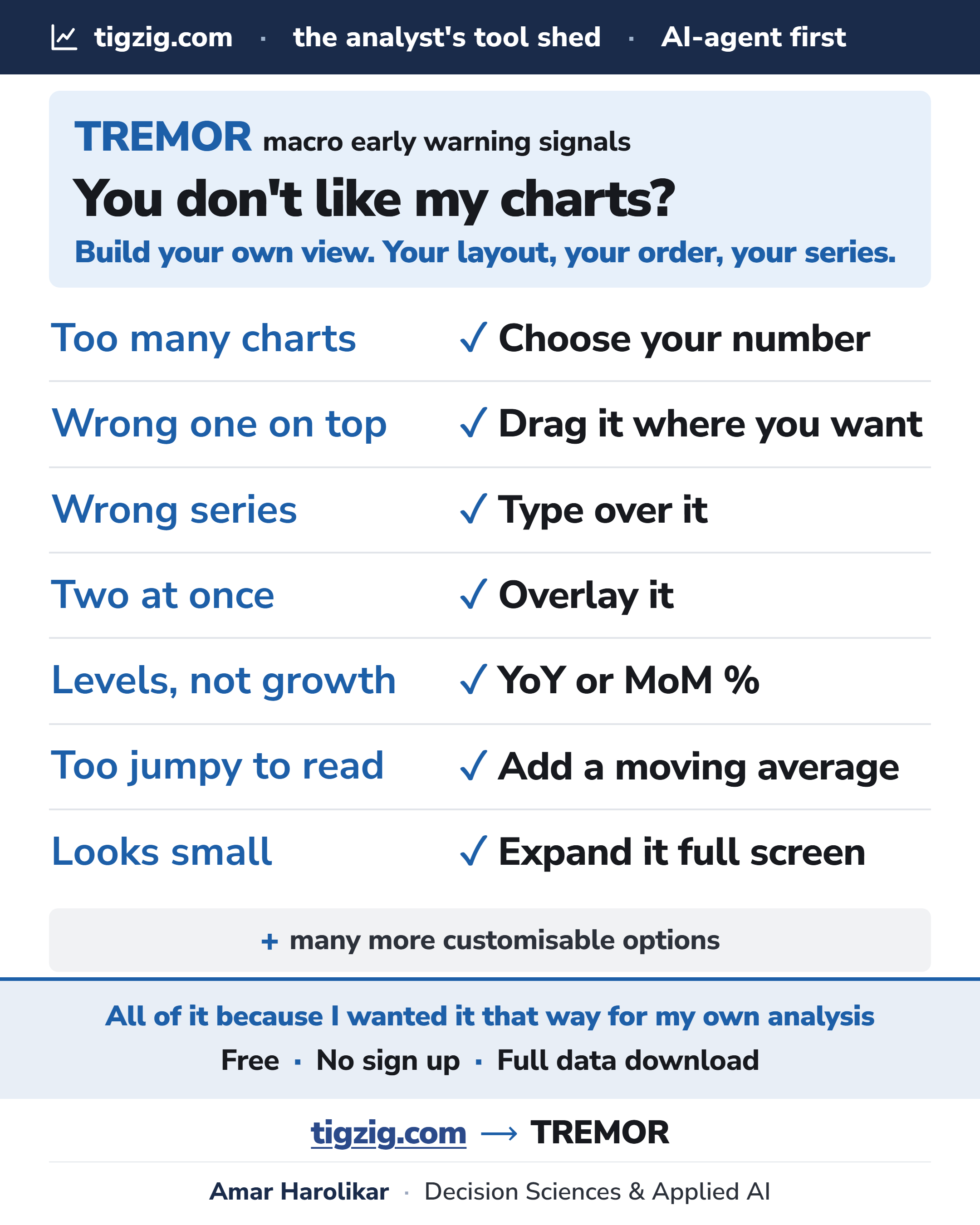
TREMOR Opened With Sixteen Charts in a Fixed Grid. That Was My View. Now You Can Change All of It.
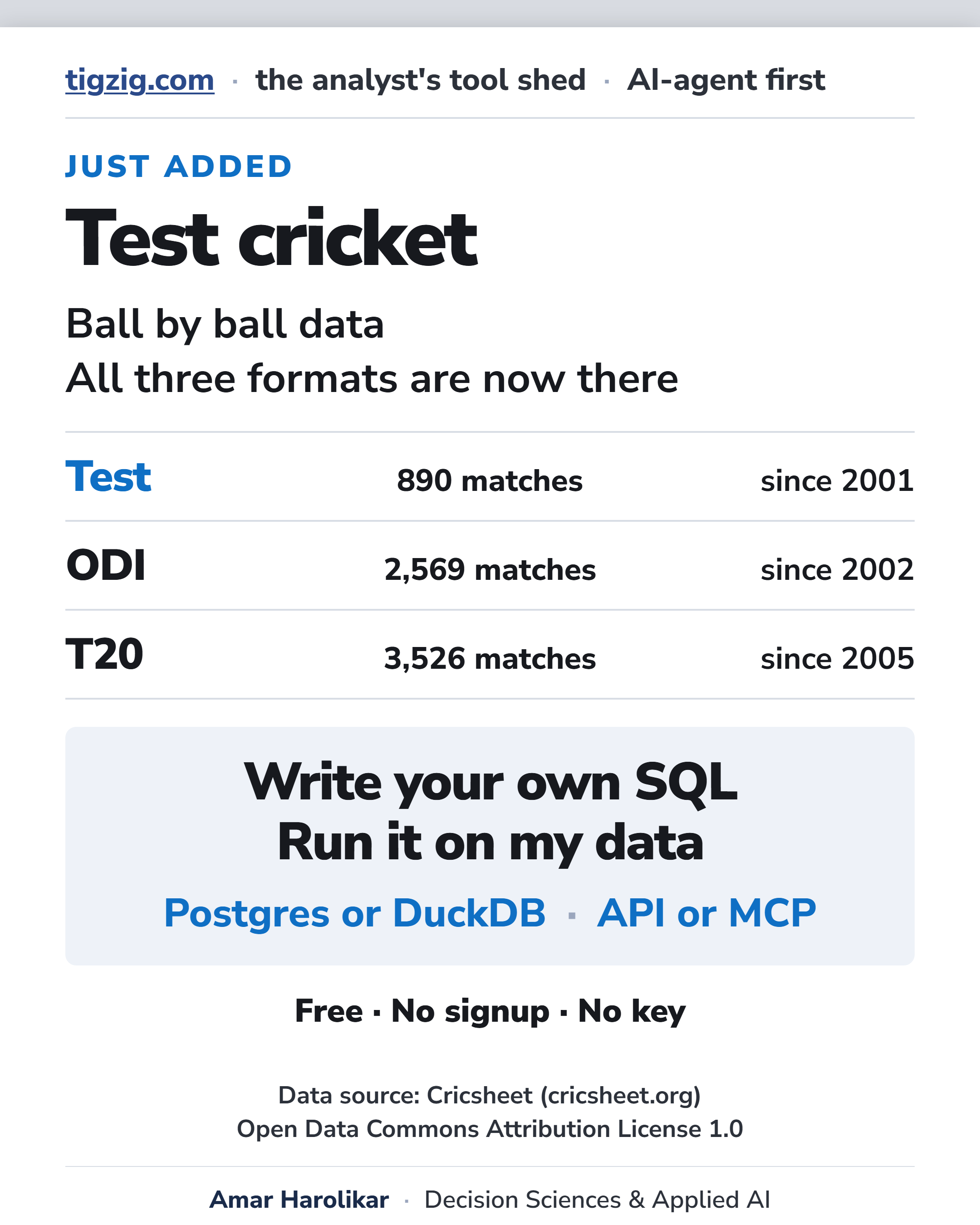
Test Cricket Is Now Live in the Tigzig Open Cricket Database, Alongside T20 and ODI. 3.8 Million Deliveries.
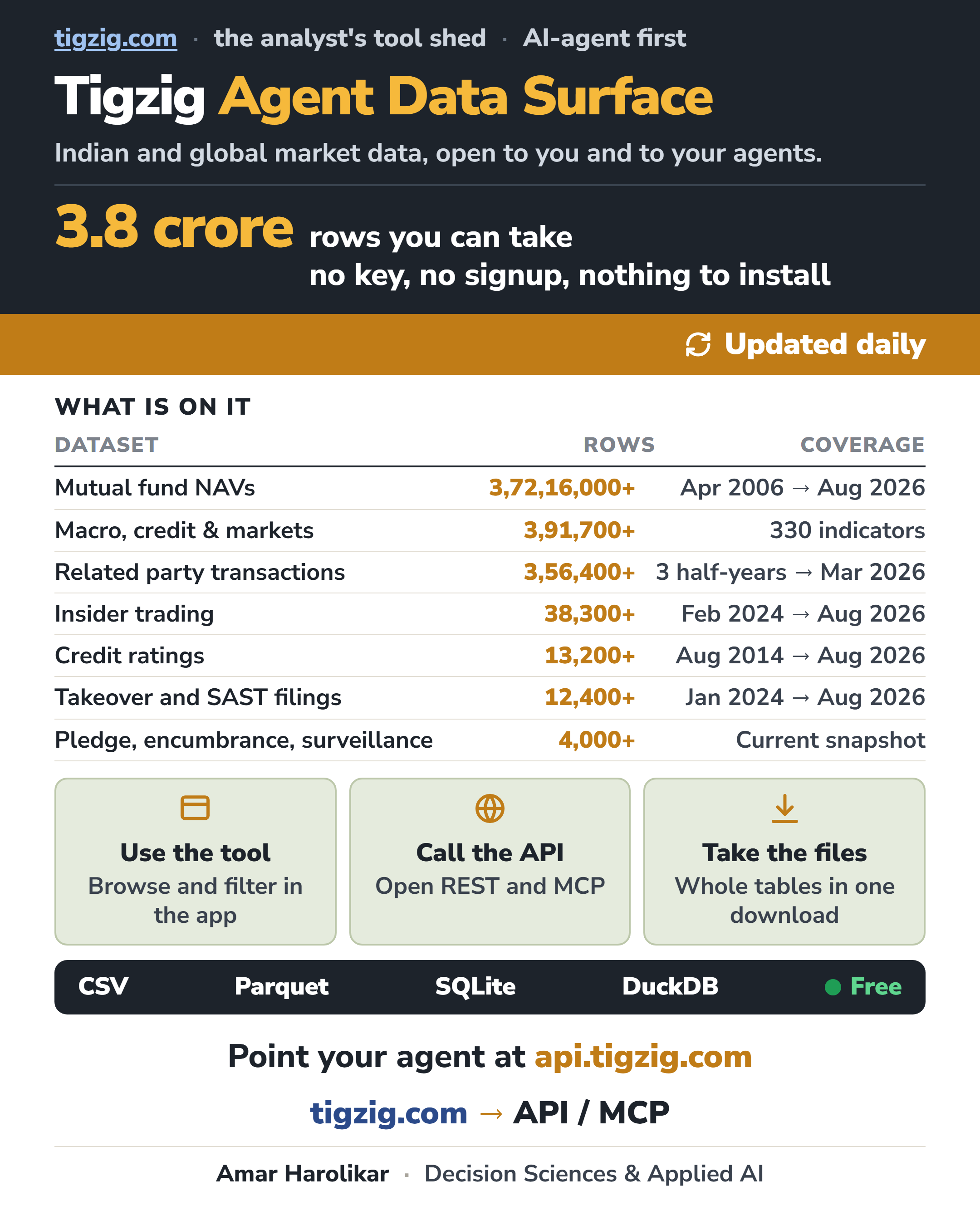
Point Your AI Agent at api.tigzig.com and It Works Out Which Dataset It Needs. 38 Million Rows Across India and the US, Free.
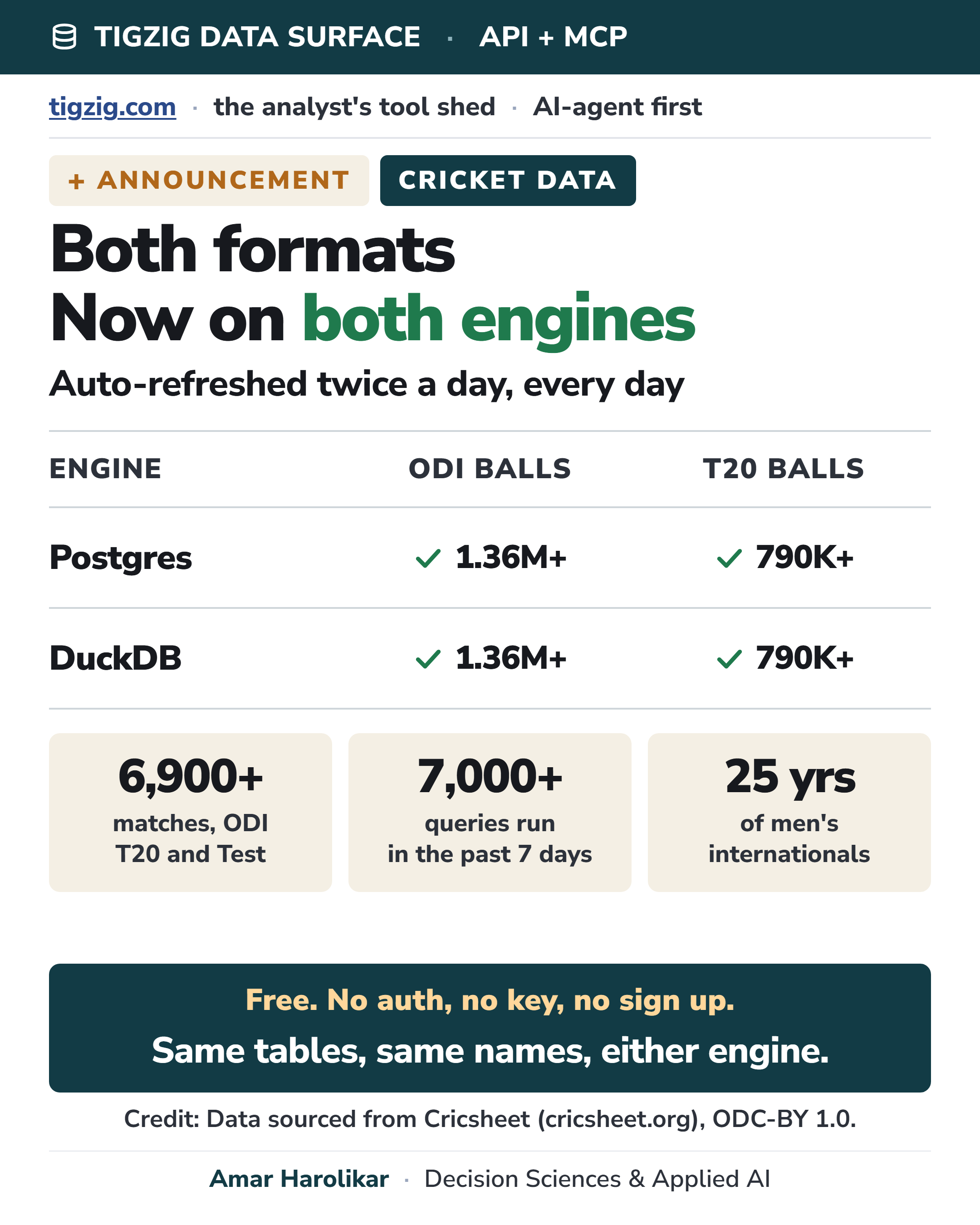
T20 and ODI Ball by Ball Are Now on Both Engines, Postgres and DuckDB. Run Your SQL Directly on My Server.
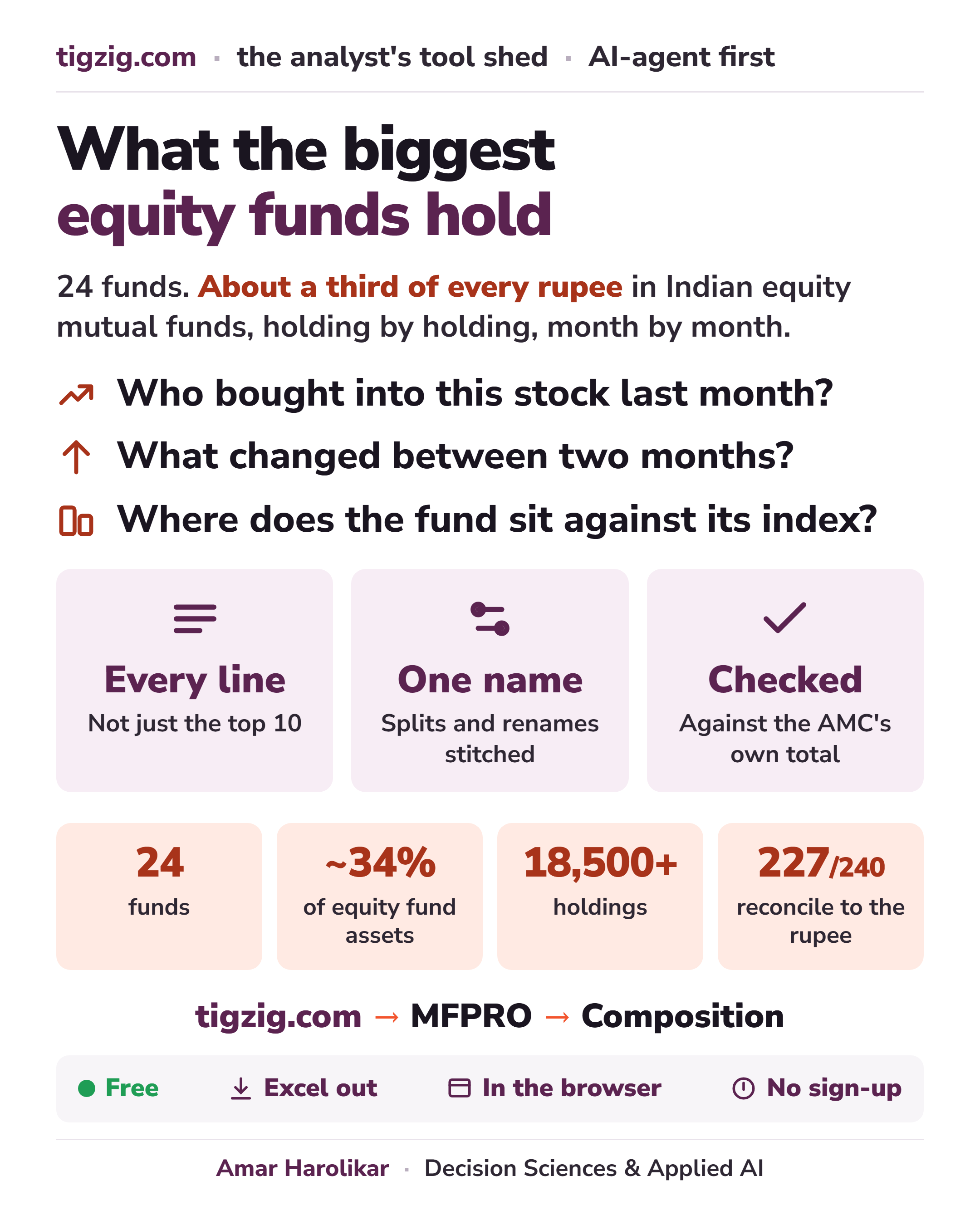
MFPRO Composition Analytics Is Live. Portfolios for 24 of India's Largest Equity Funds, Reconciled Against the AMC's Own Printed Totals.
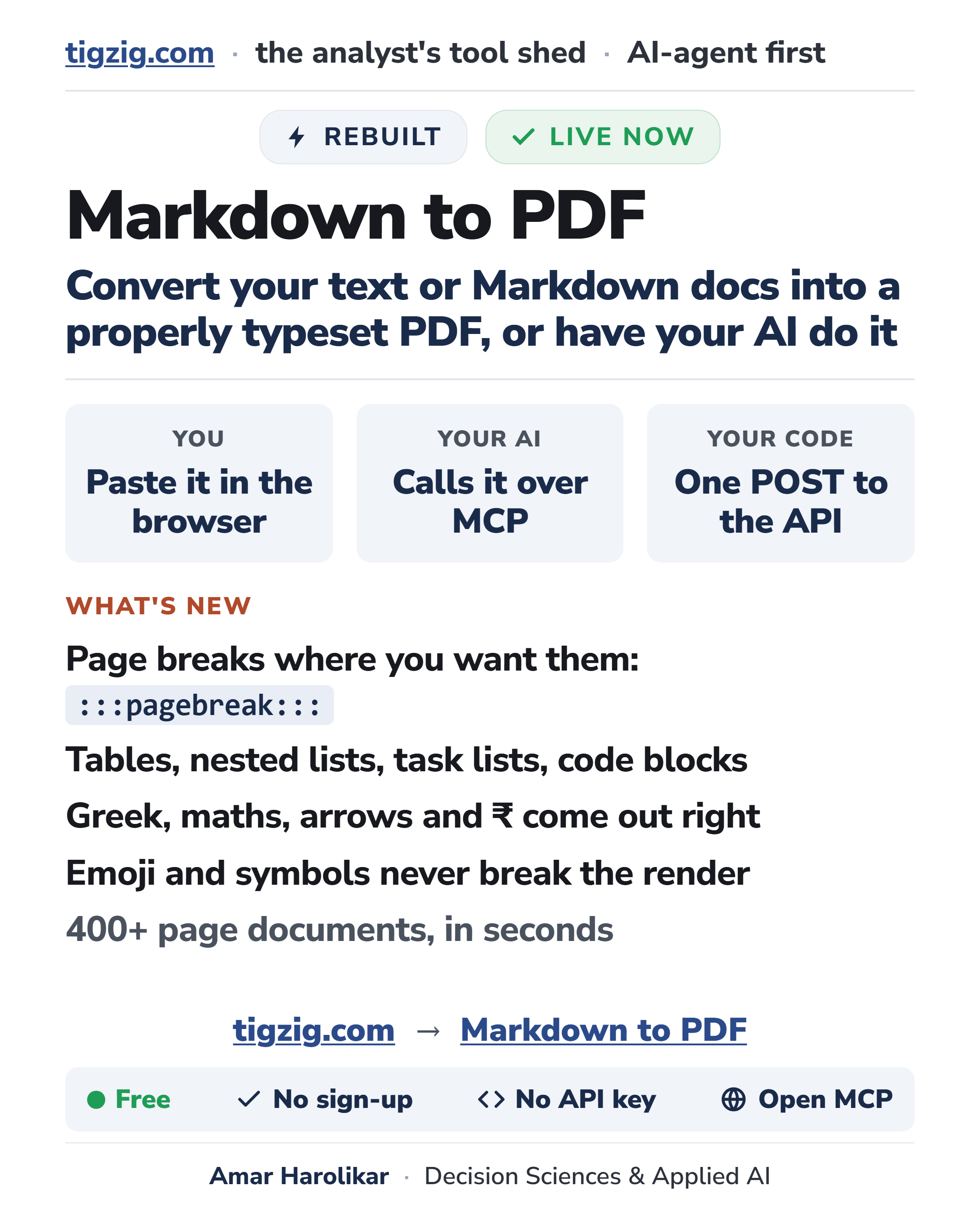
I Rebuilt the Markdown to PDF Converter on tigzig.com. Paste Text, Get a Properly Typeset PDF, or Have Your Agent Do It Over MCP.
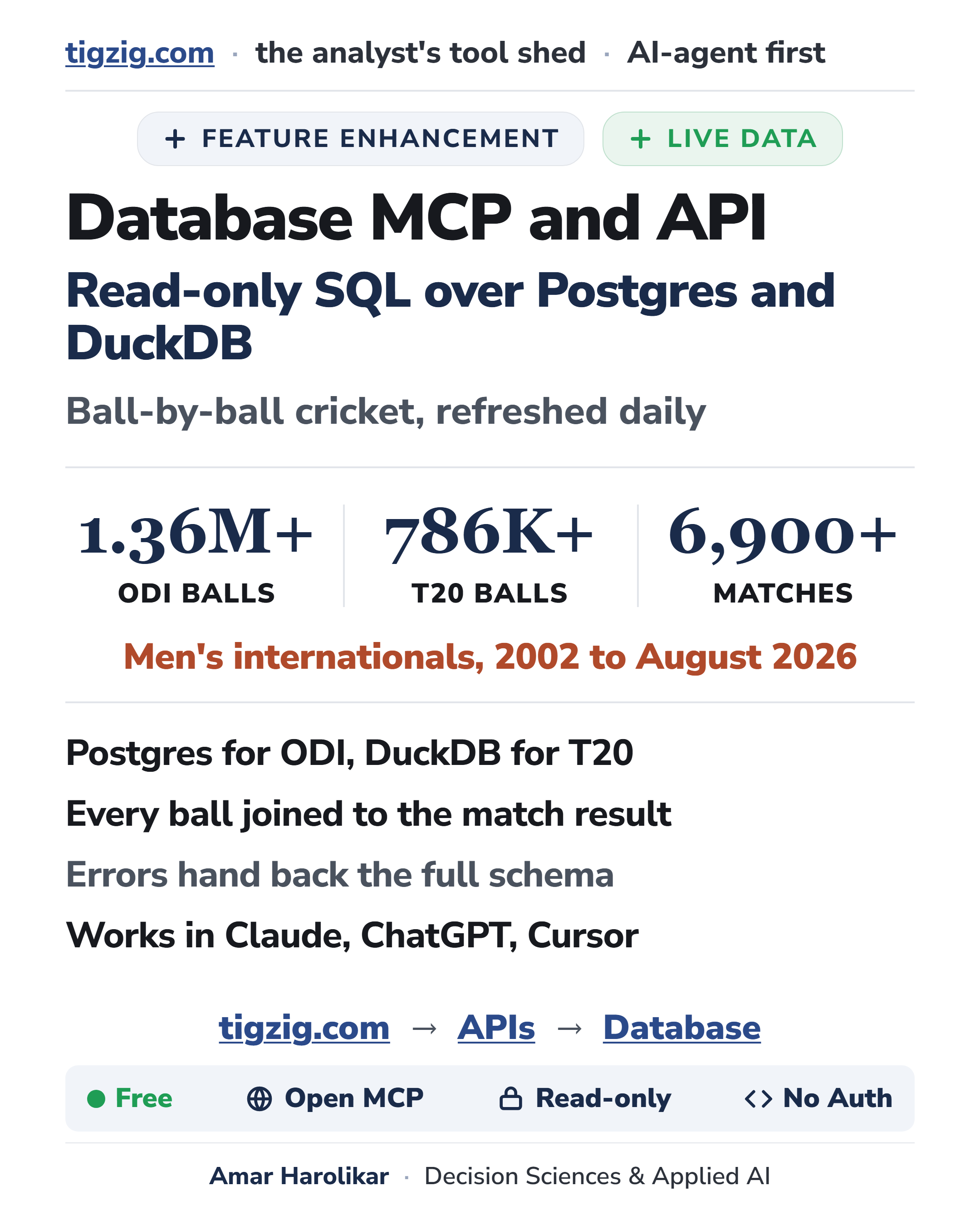
A Database Server With API and MCP You Can Point an AI Agent At, With Ball-by-Ball Cricket Behind It.
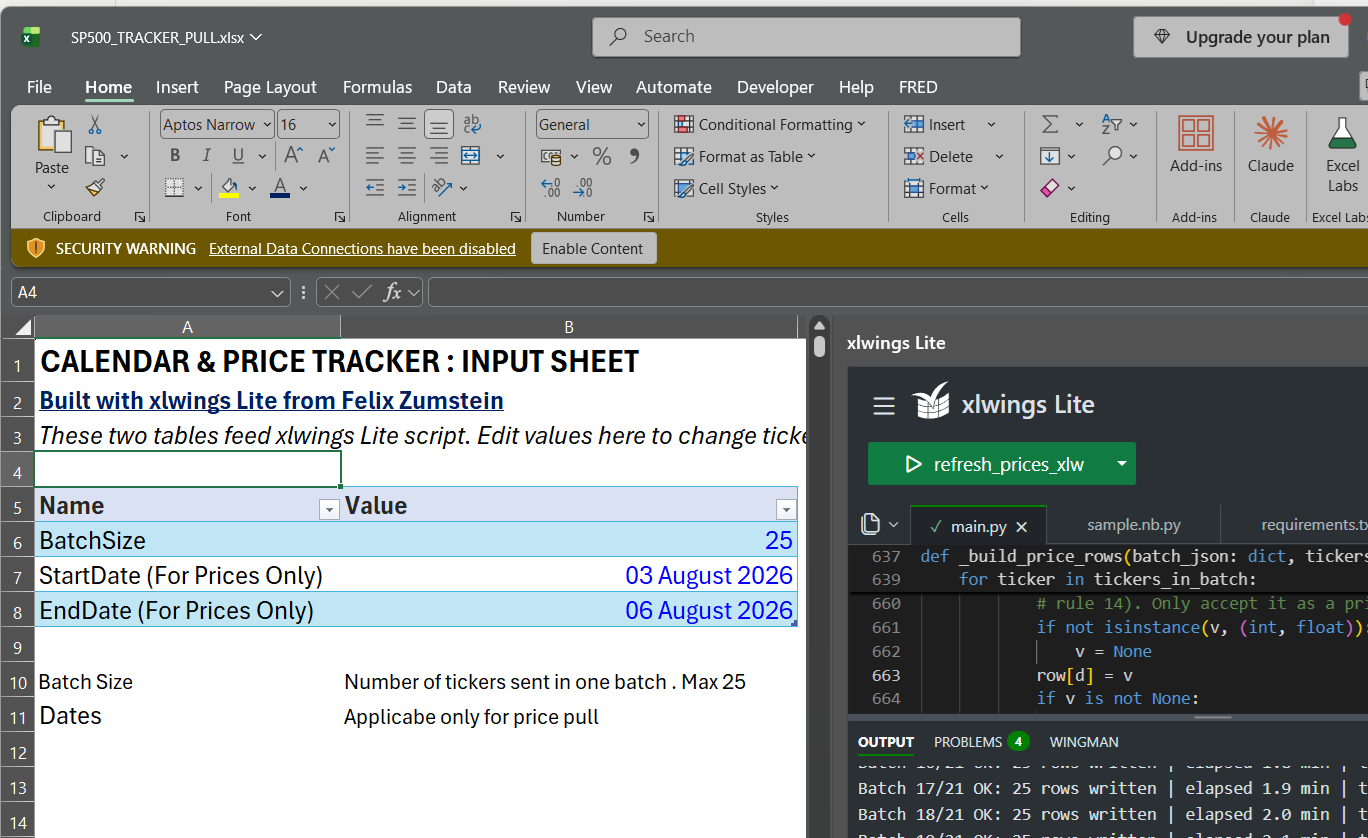
An Excel Tracker for Hundreds of Yahoo Finance Tickers, Built with xlwings Lite. For When WEBSERVICE Keeps Failing.
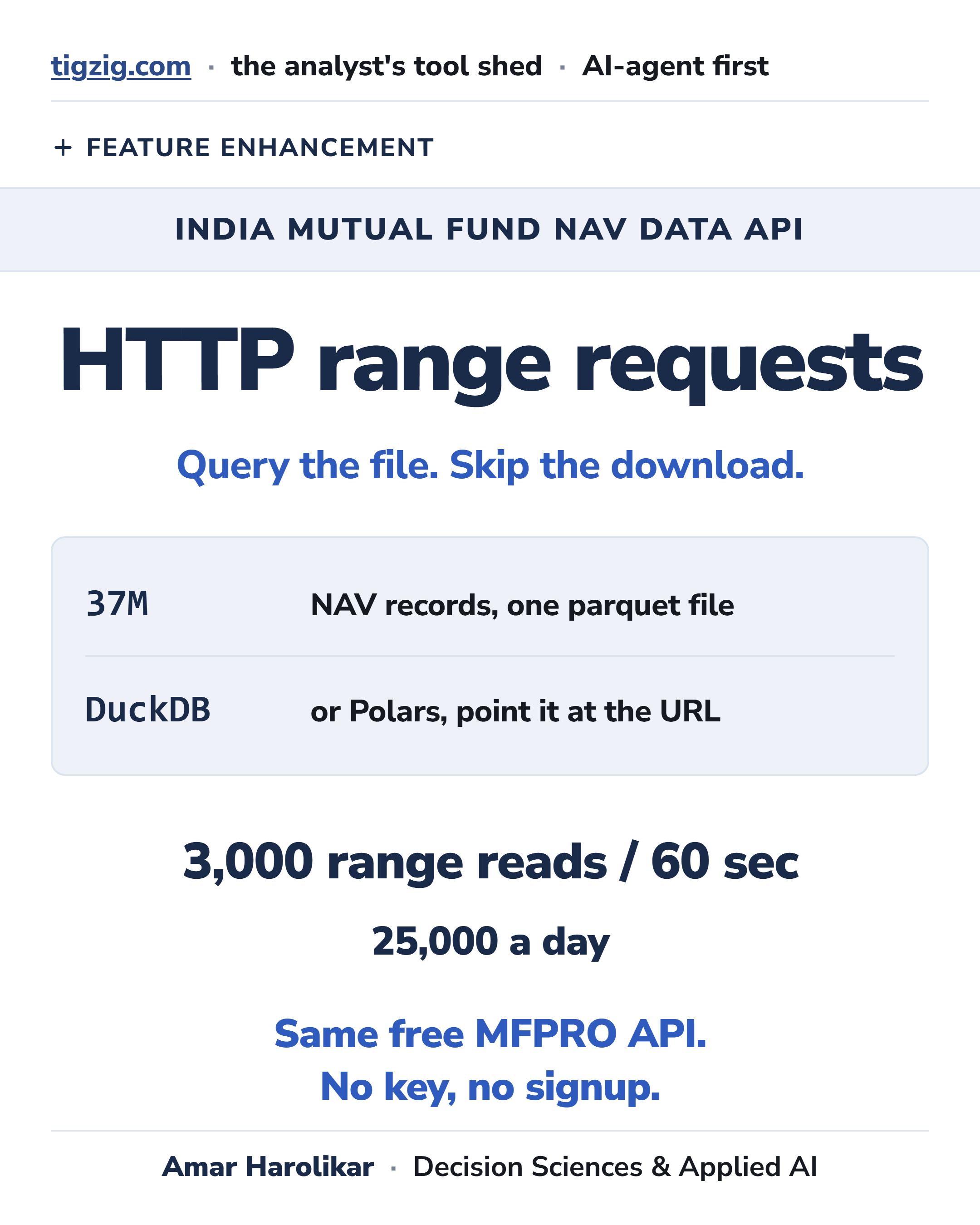
Range Requests on the MFPRO NAV File Are Fixed. DuckDB and Polars Queries No Longer Get Refused Midway.
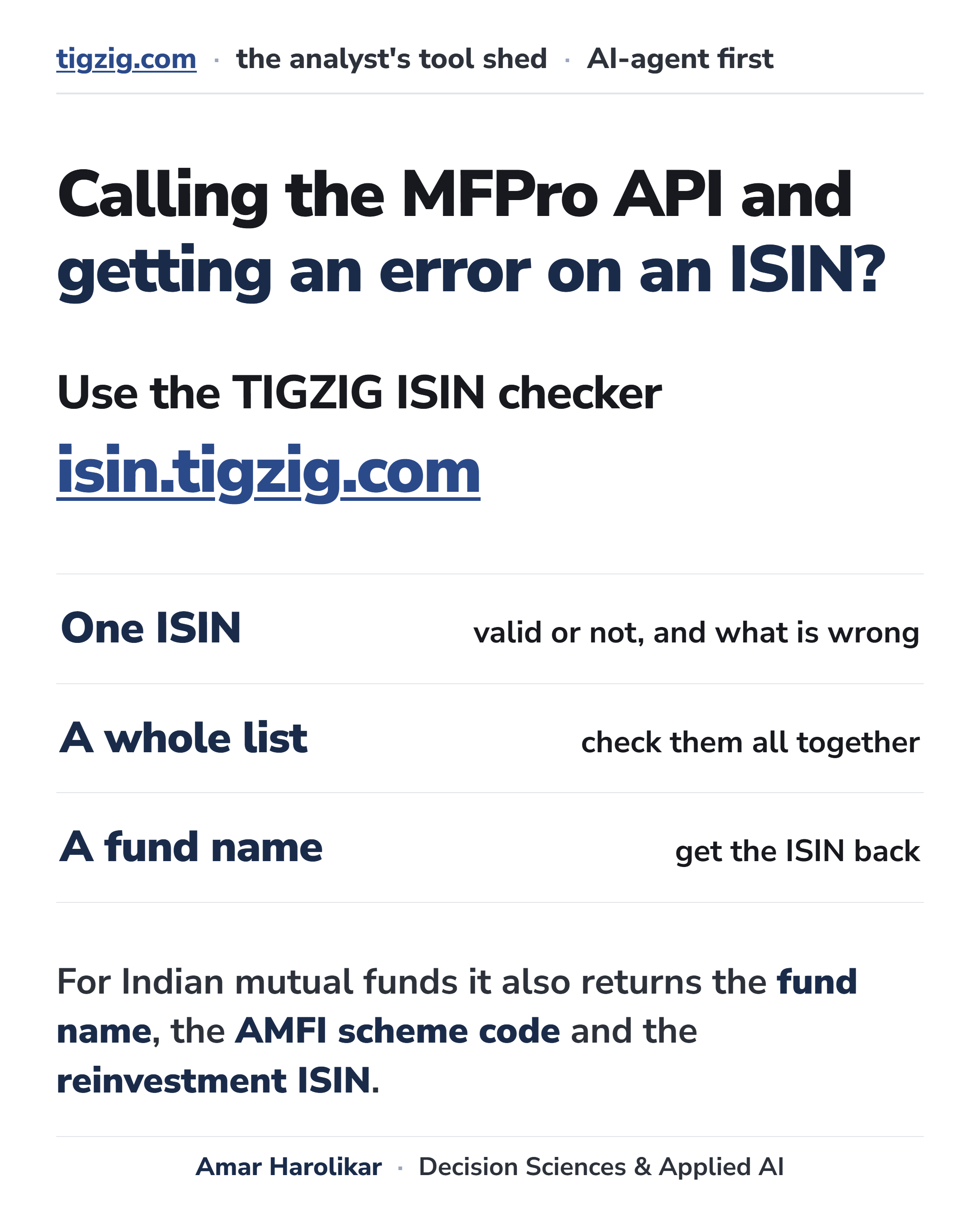
An ISIN Checker for When a Mutual Fund Lookup Fails. And Why One Fund Carries Ten Identifiers.
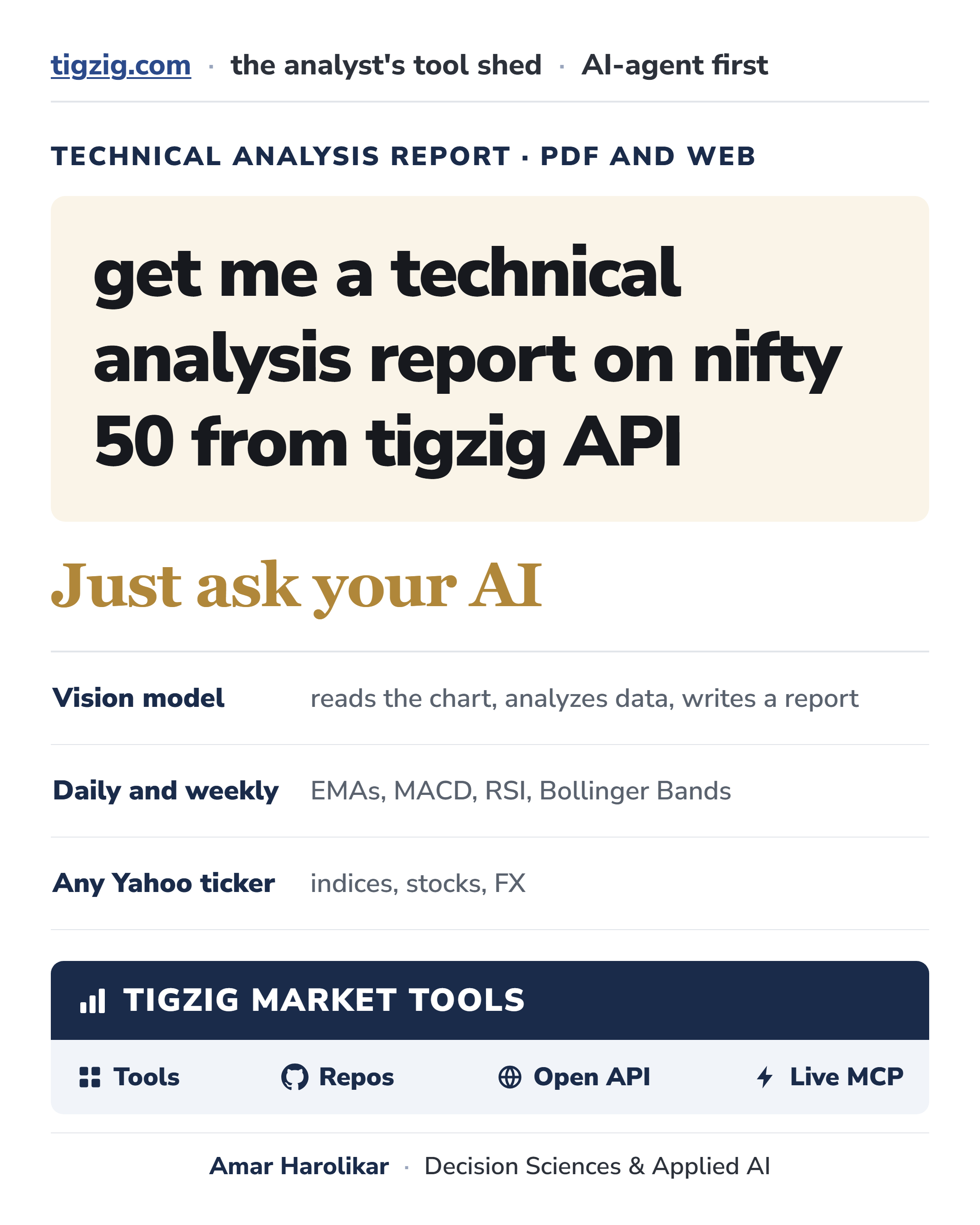
Technical Analysis on Any Ticker Without Visiting My Site. Just Ask Your AI Agent.
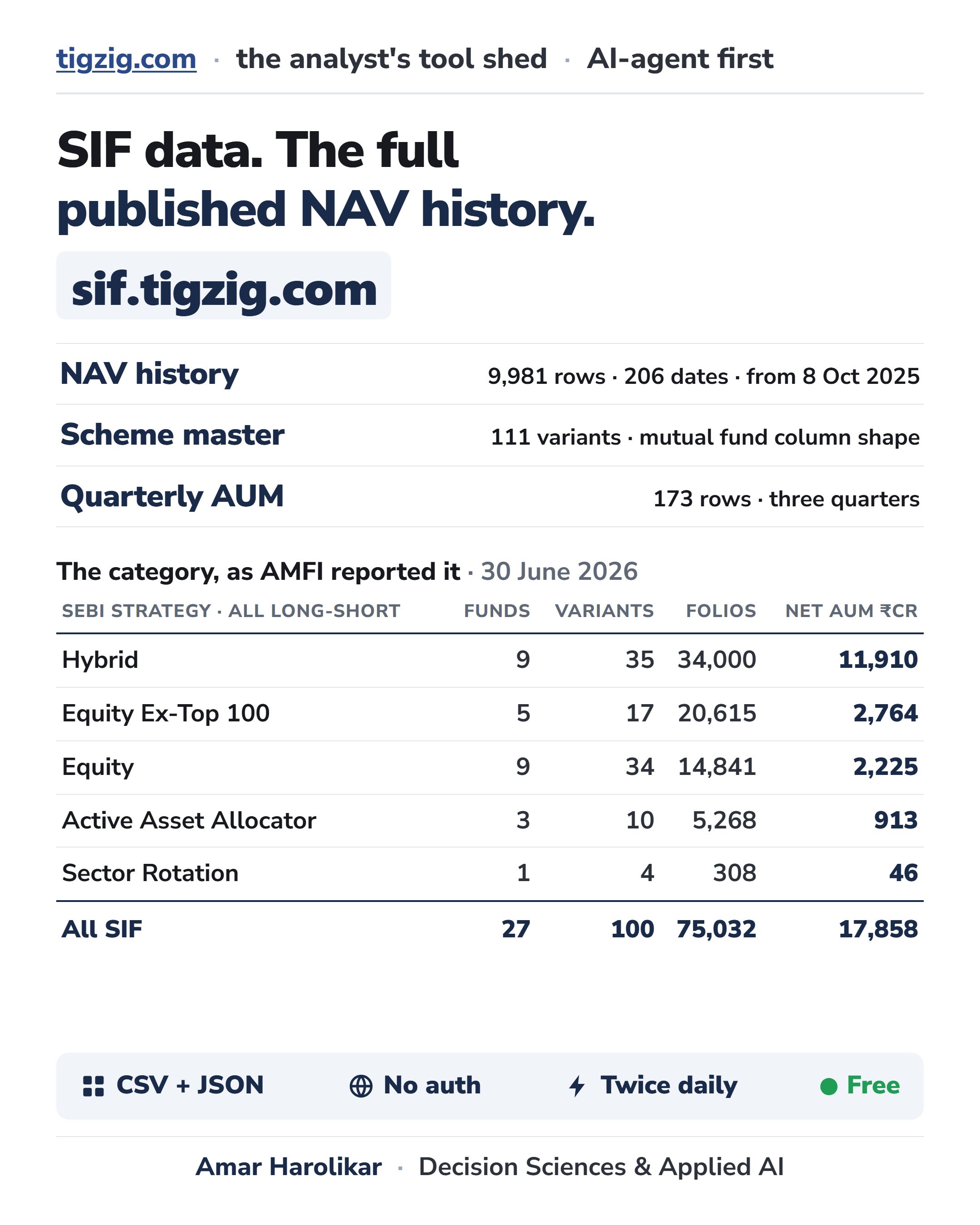
SIF Data Is Live. The Full Published NAV History, the Scheme Master and the Quarterly AUM.
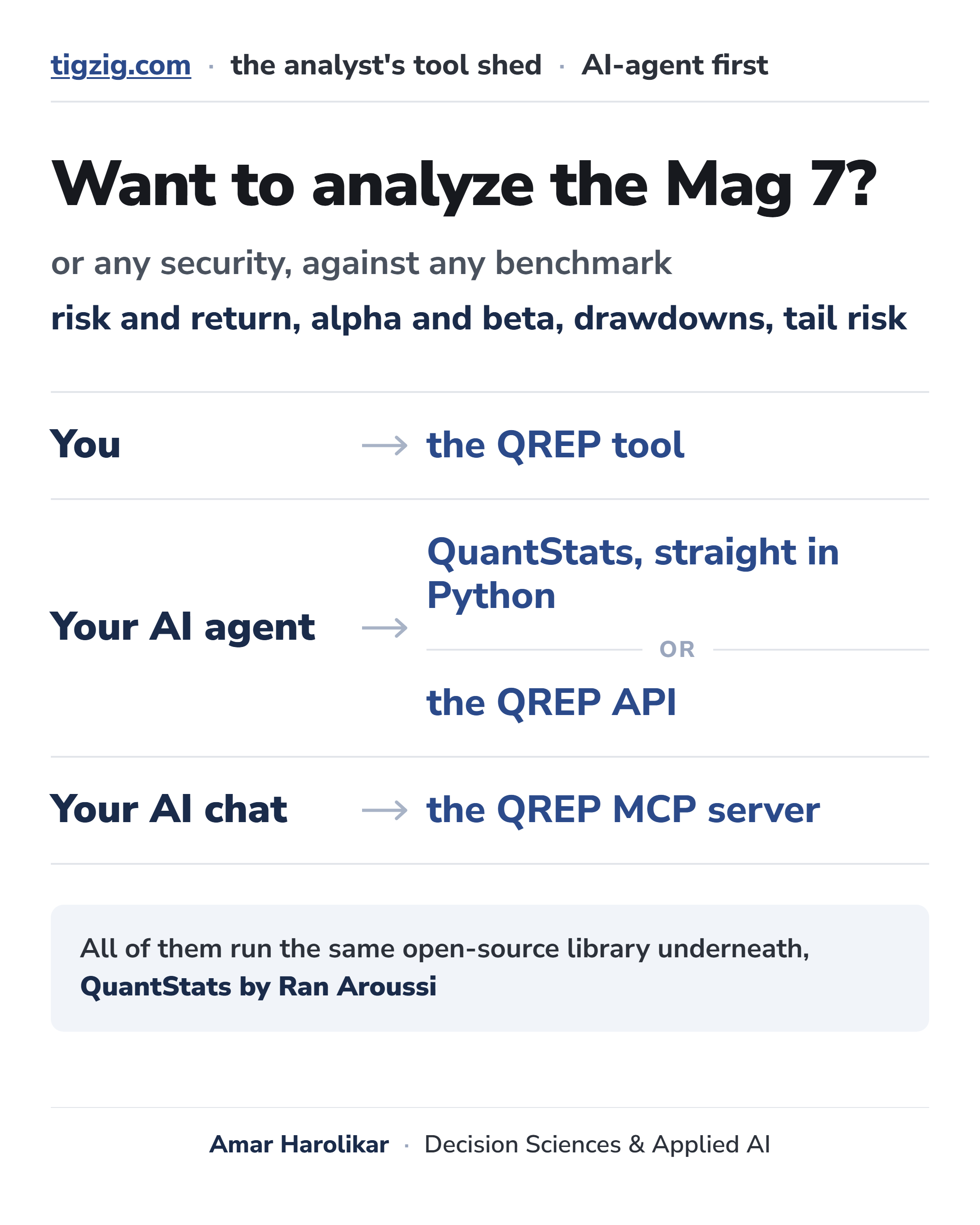
Comparing Securities on Returns, Risk and Drawdowns. Four Routes into QuantStats, Depending on What Your AI Can Do.
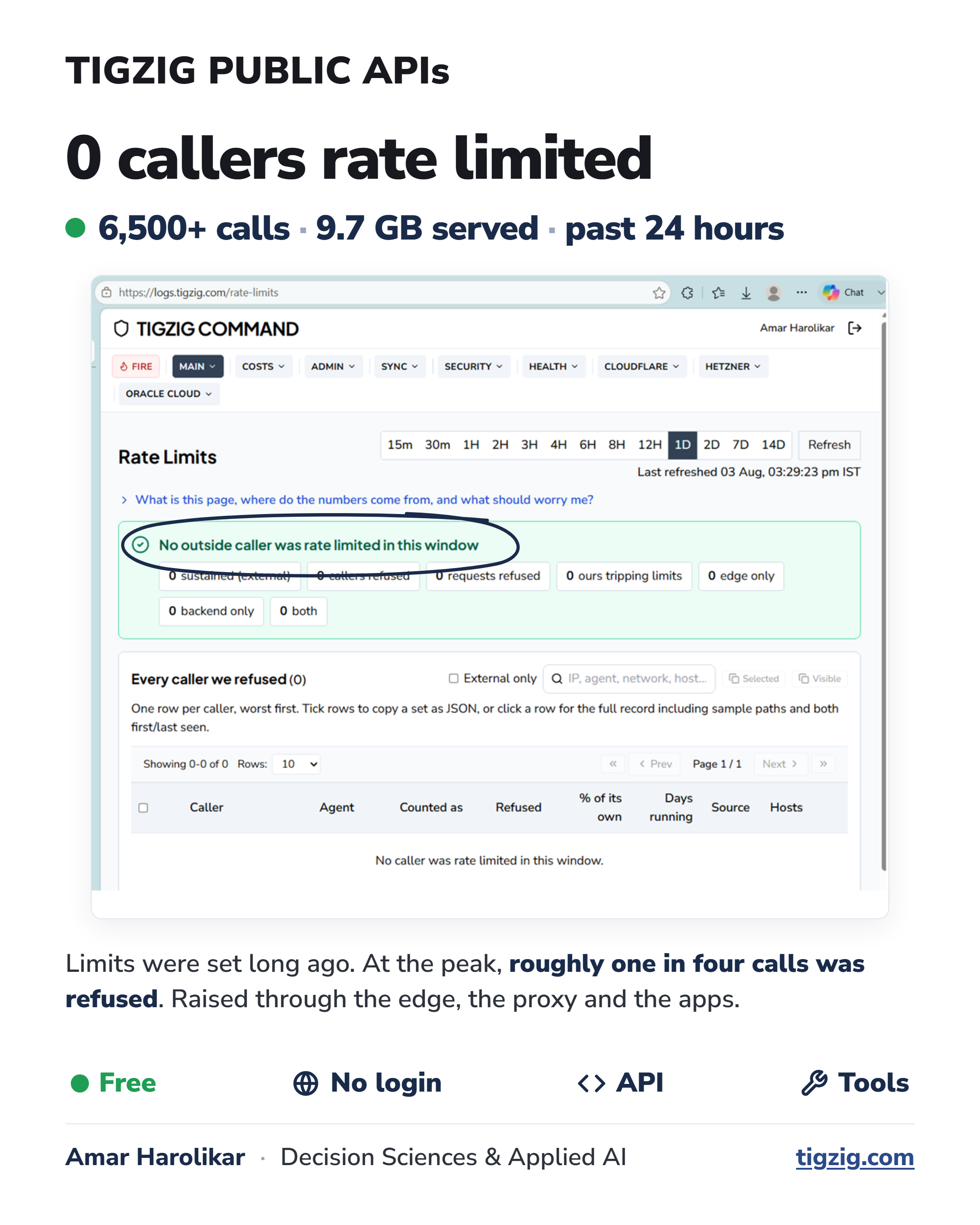
Zero Callers Rate Limited in 24 Hours. 6,500+ Calls and 9.7 GB Served, After the TigZig API Limits Went Up.
TigZig API Rate Limits Raised Substantially, Across the Edge, the Proxy and the Apps. And a 429 Now Tells You What to Do About It.
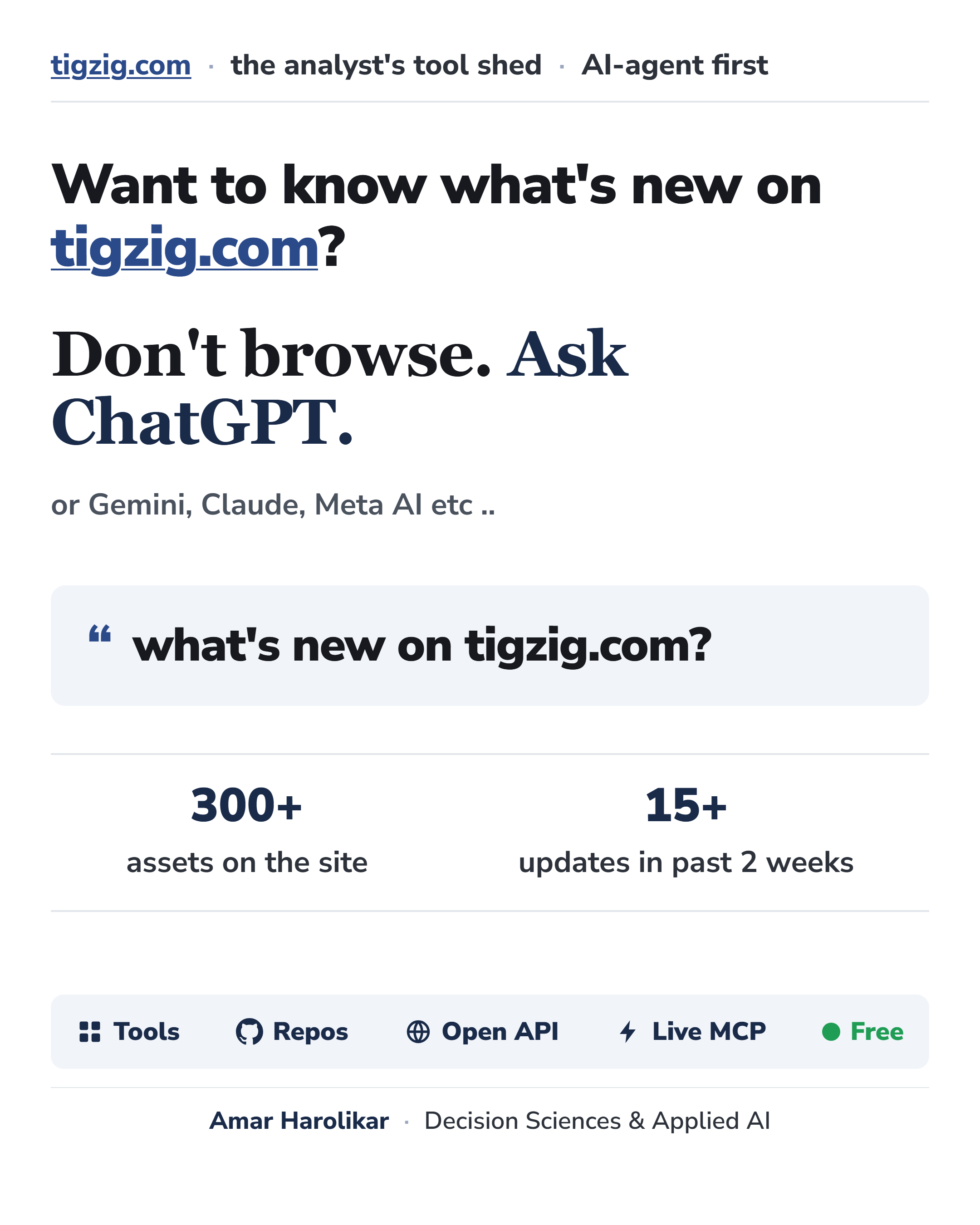
Tigzig is Built AI-Agent First. 300+ Assets, and the Fastest Way In Is to Ask Your AI.
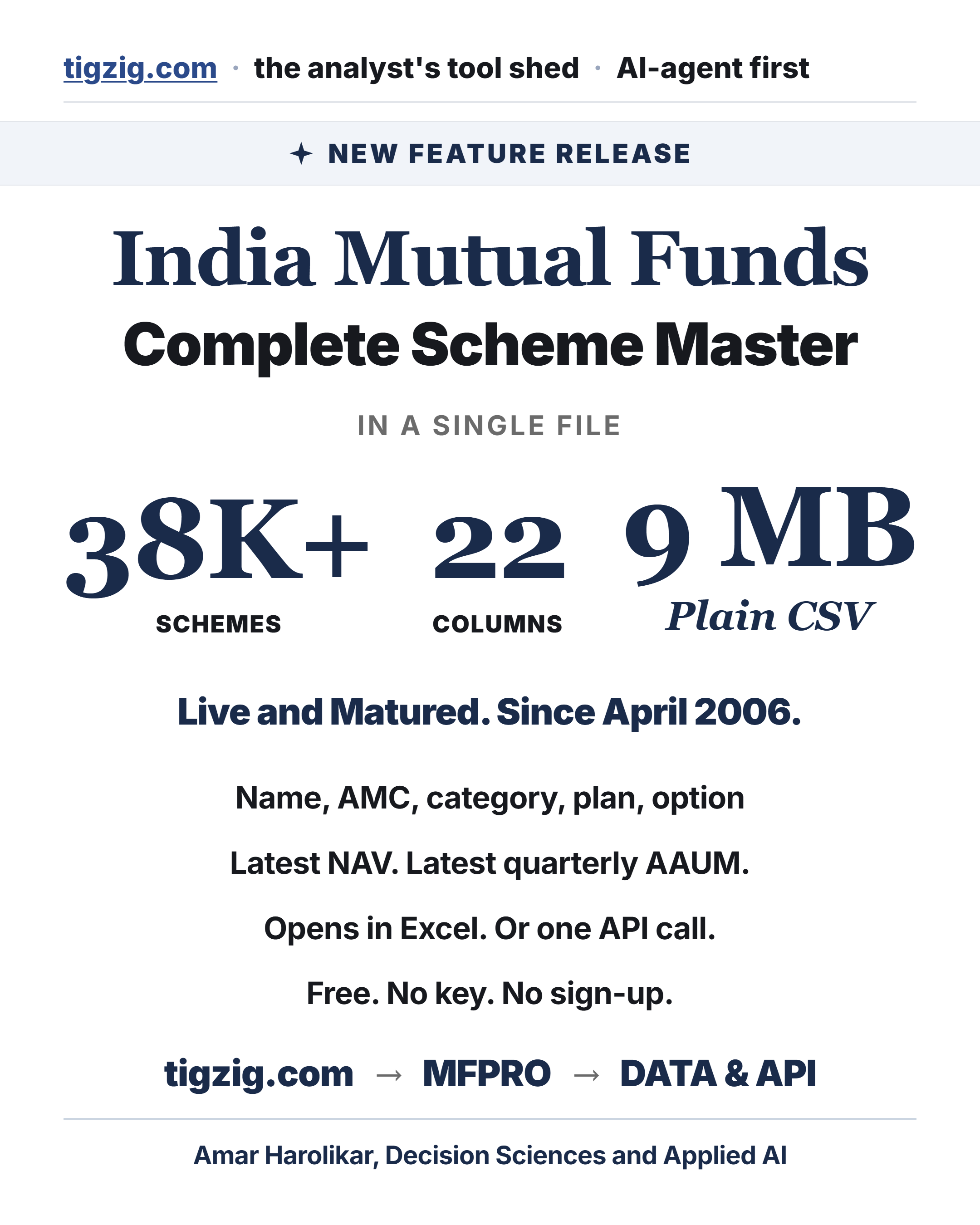
MFPRO Scheme Master: Every India Mutual Fund Scheme in One Small File, Free
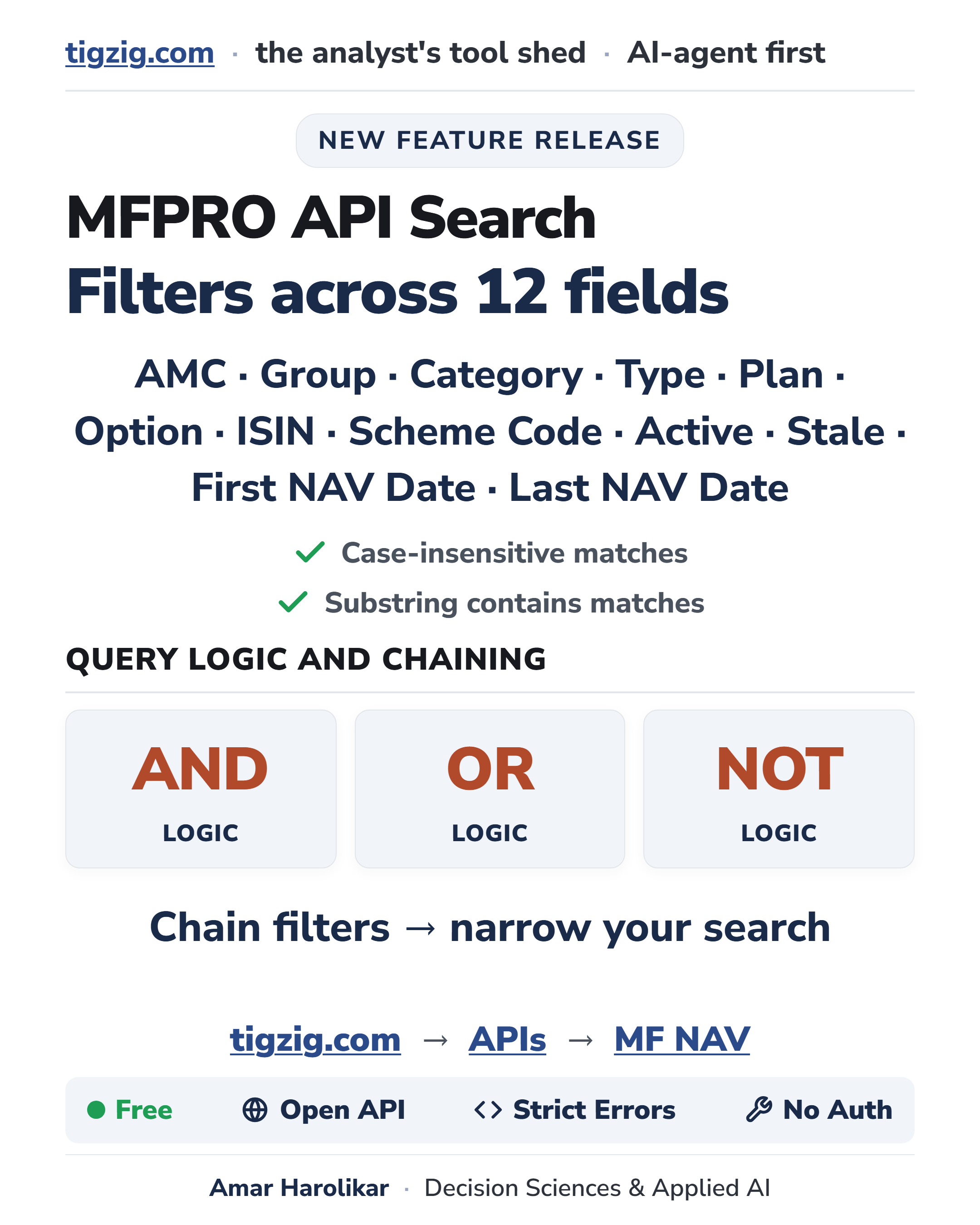
MFPRO Mutual Fund API: Search Now Filters Across 12 Fields on a Scheme
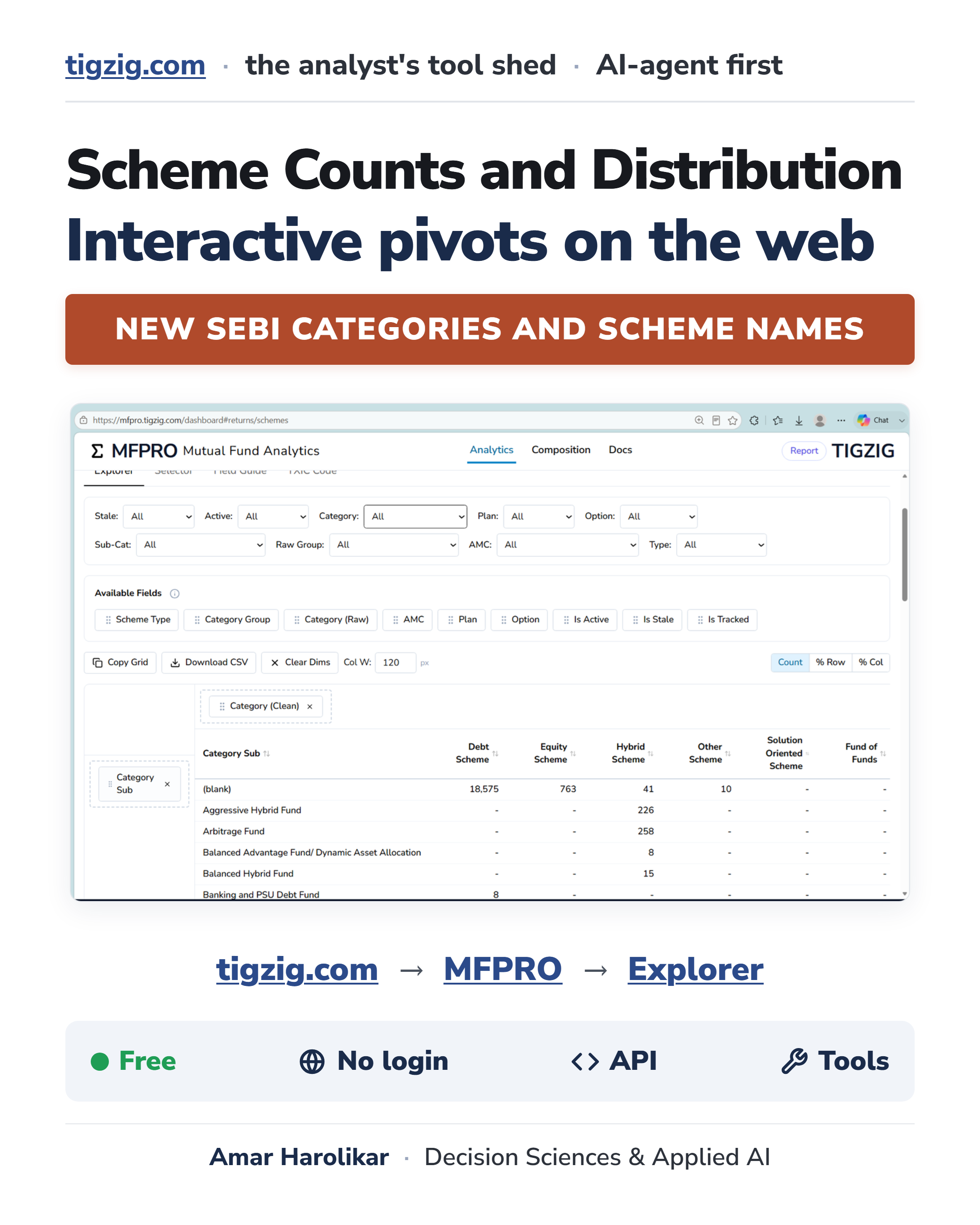
MFPRO Scheme Explorer is Live. Cross-Tab 38,000+ India Mutual Fund Schemes, and Watch the SEBI Re-Categorisation Happen in the Daily Files.
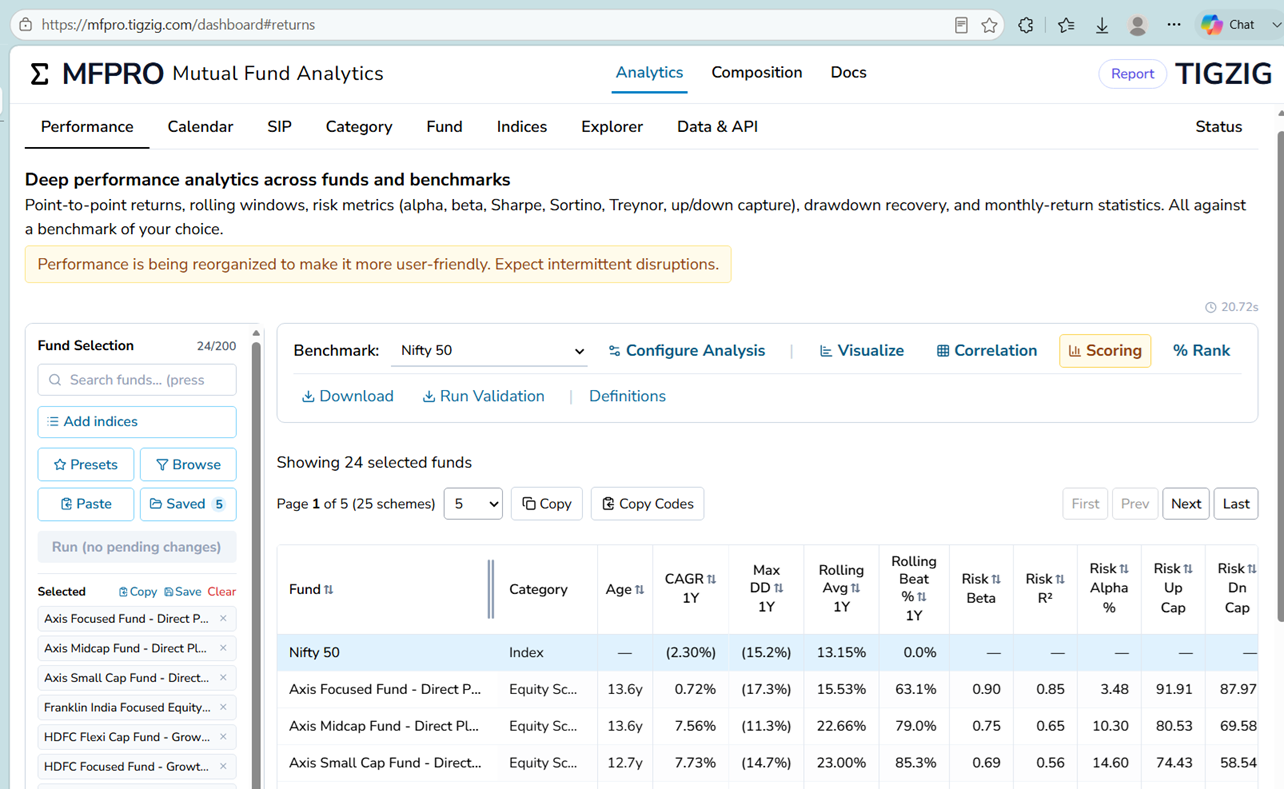
SEBI Has Revised Mutual Fund Categorisation and Introduced a New Fund Type. The Major Changes, and What They Mean for MFPRO Users and Analysts.
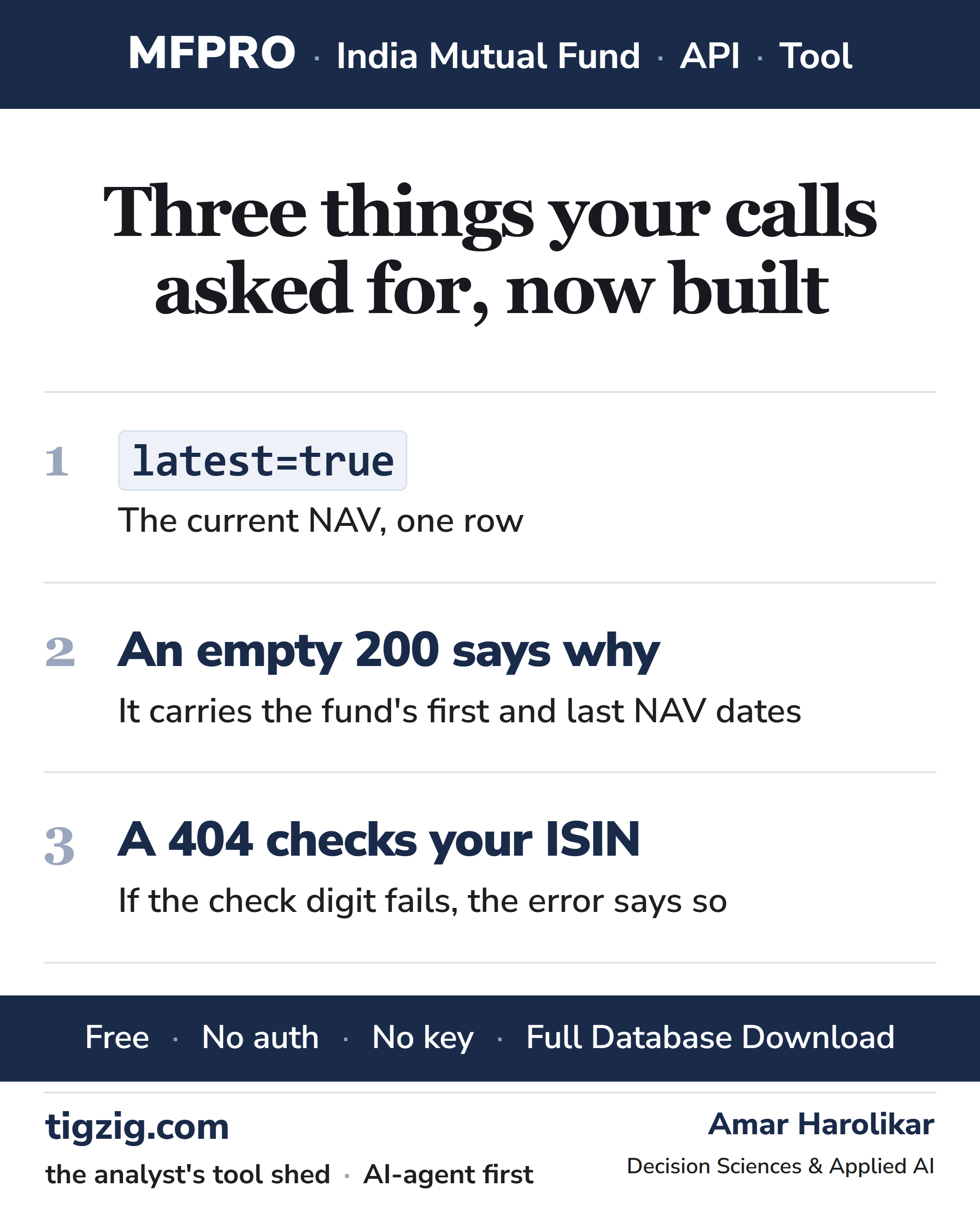
MFPRO Mutual Fund API Update. Three Things Your Calls Asked For, Now Built.
1 in 5 Bulk Downloads Were Silently Truncating. Two Cloudflare Worker Bugs, Found and Fixed. Now Up to 4x Faster.
Yahoo Finance MCP Backend Upgraded. 25 Tickers in One Request, Answers in Seconds, Clear Errors Instead of Slow Failures.
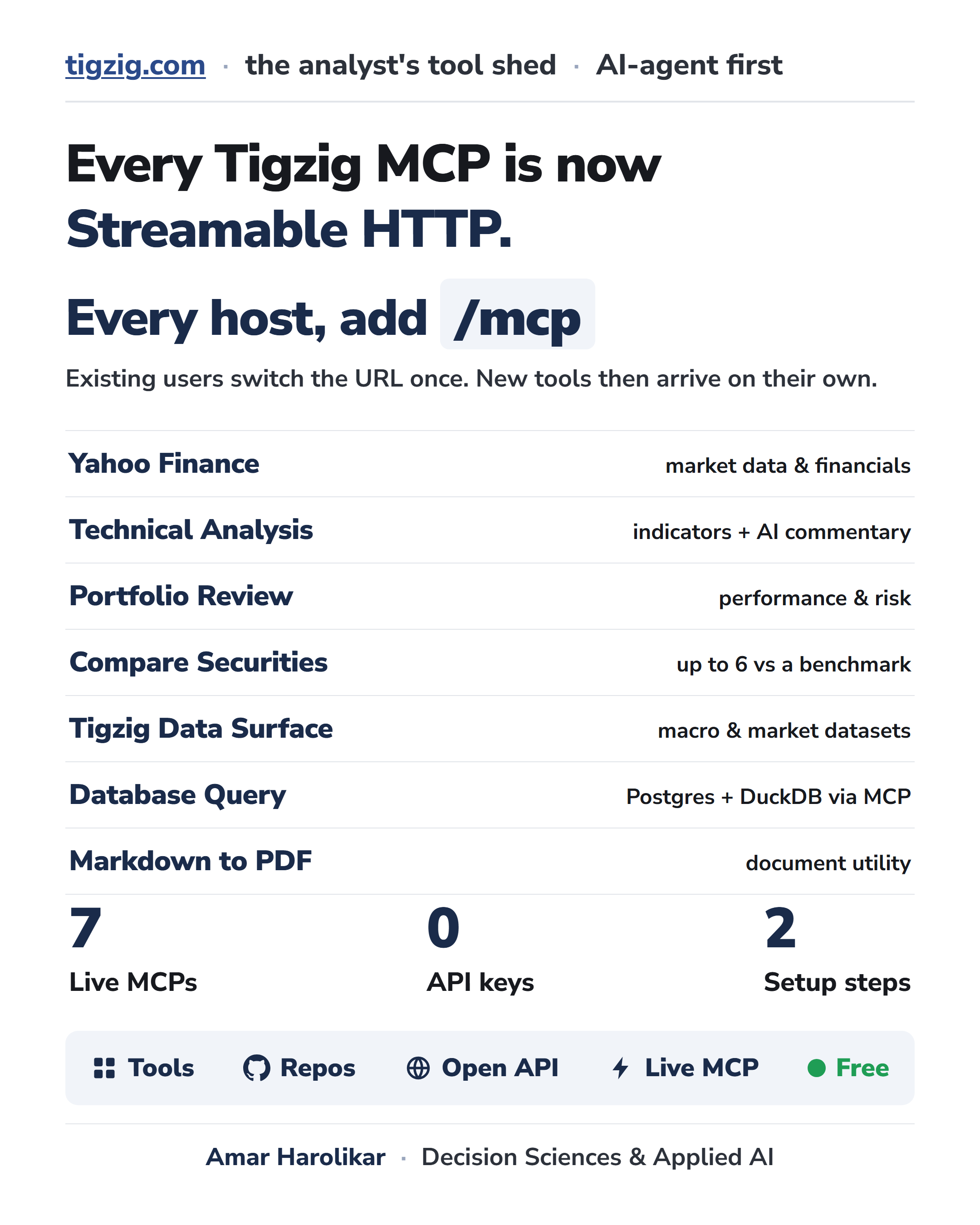
Every Tigzig MCP is now Streamable HTTP. Requesting existing users from LM Studio, ChatGPT, Claude etc to make a one time change if you have not already done so
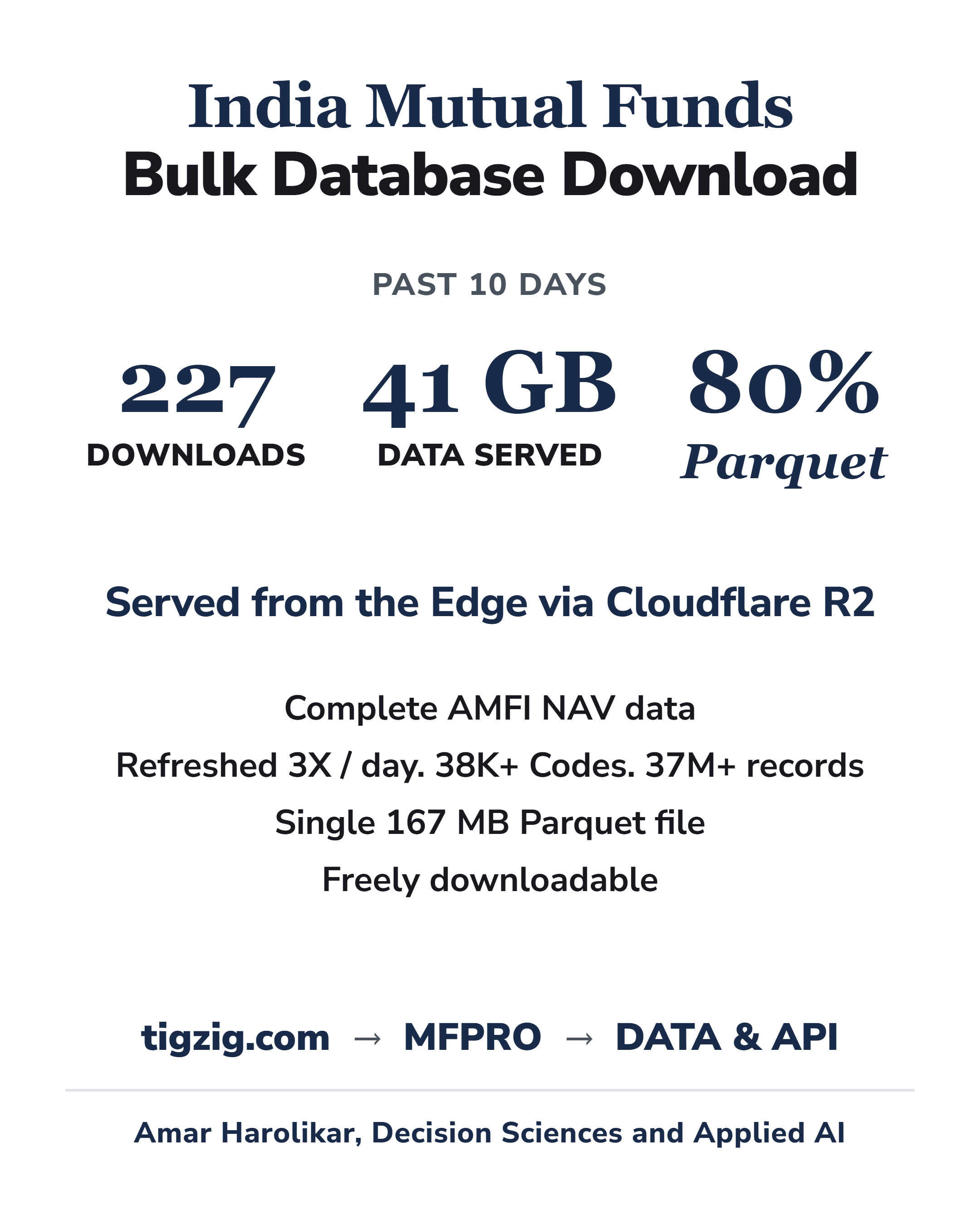
227 Downloads, 41GB in 10 Days. India MF Complete NAV Database - 38K+ Schemes, 37M+ Records, One 167MB Parquet. Free.
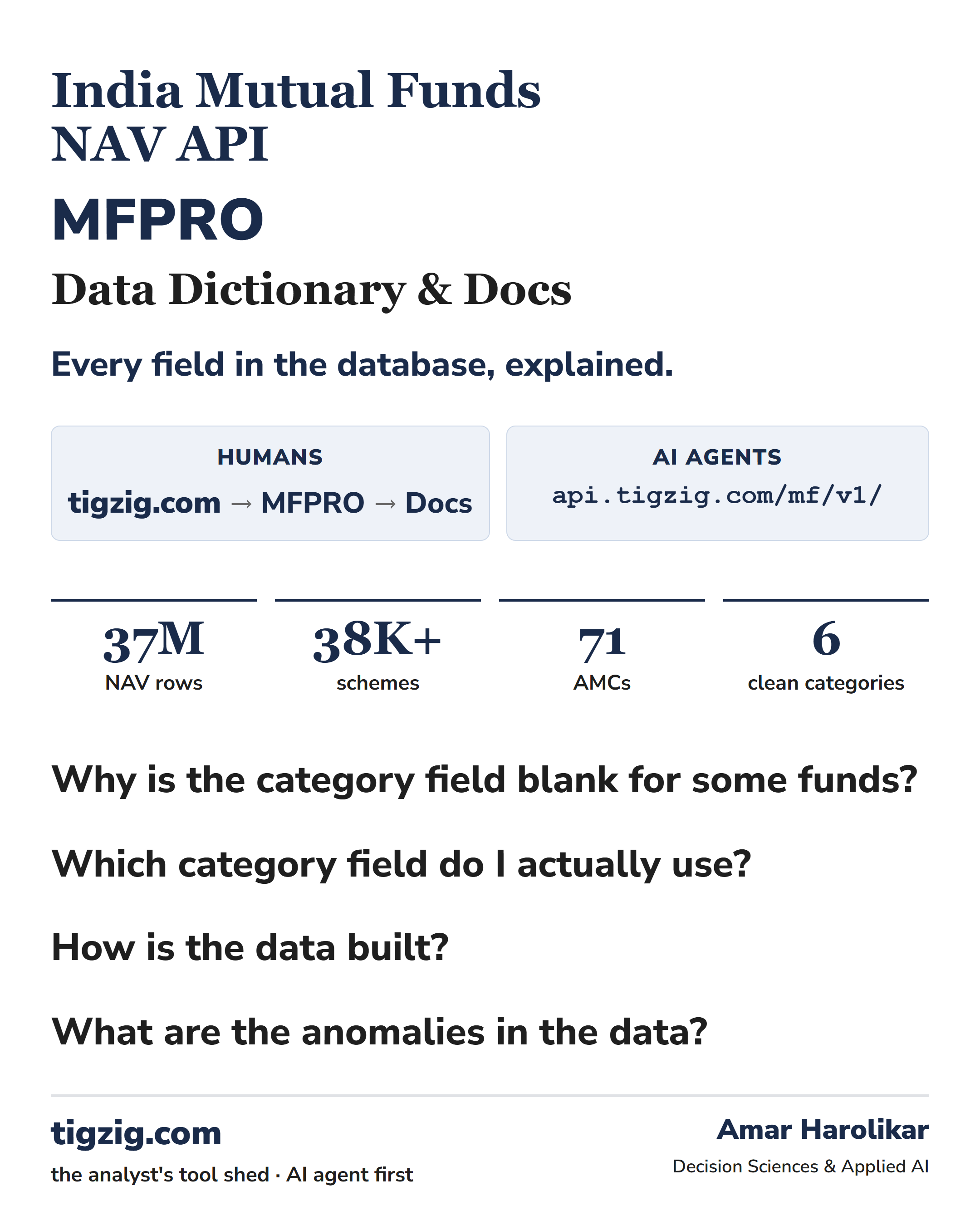
Data Dictionary & Docs Live on MFPRO. Every Field Explained, 21-Metric Methodology, and How the India MF Universe Actually Looks.
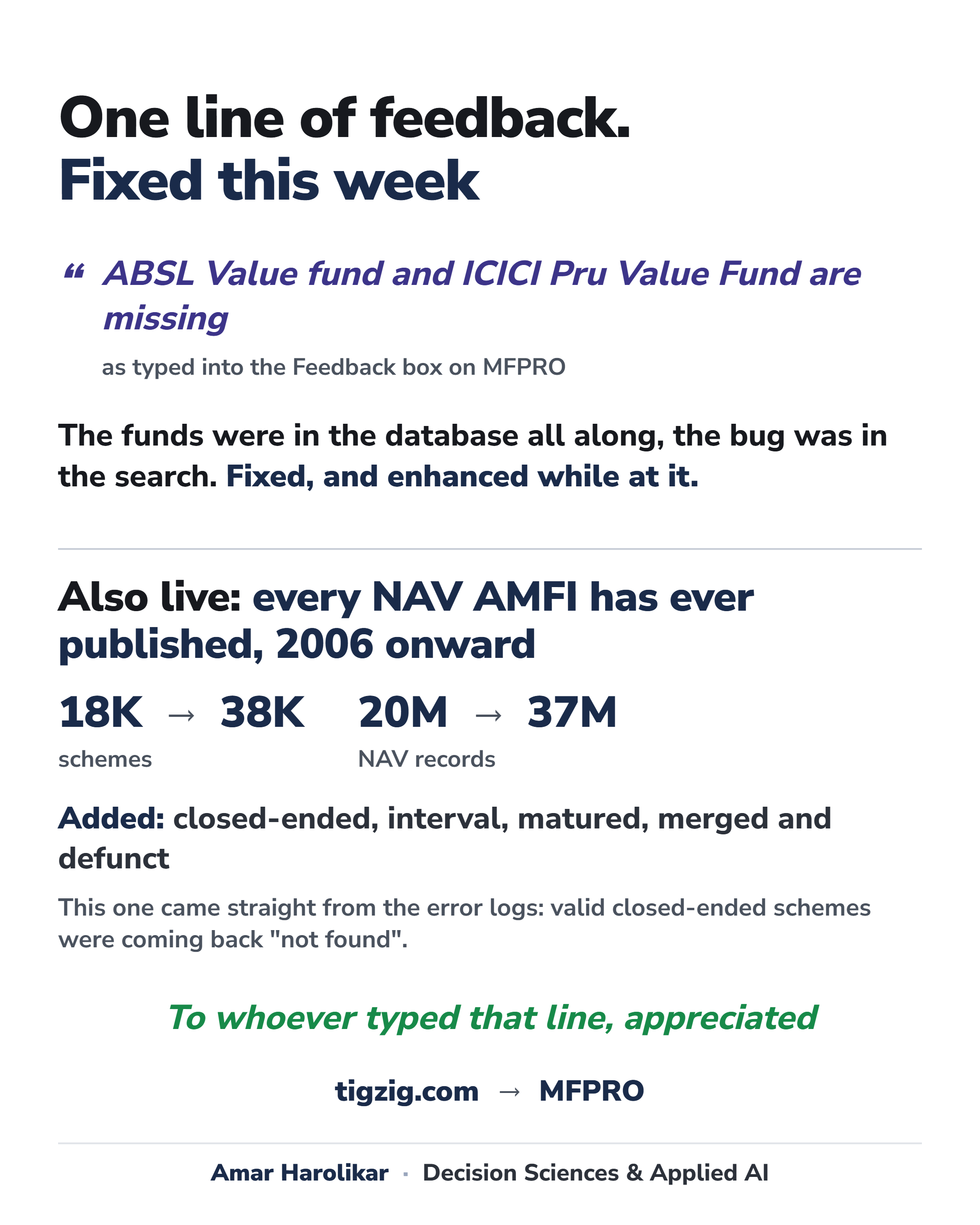
One Line of User Feedback, Fixed Within a Day. MFPRO Search Upgraded + Complete AMFI NAV History, 37M Rows, 2006 Onward.

TigZig is Built Agent First. 300+ Assets on AI for Analytics. Just Ask Your ChatGPT, Gemini or Claude.

Tremor: A Free, No-Auth API for 330+ Macro and Market Indicators, 350K records, Refreshed 3x/Day. Ask your AI to explore.

MFPRO Data & API Screen Live - Download the Whole India MF NAV Database in One Click. No Code, No API.

FRED, 845,000 US Economic Series - Your AI Can Pull Any of Them Directly. No MCP, No Plugin, No Install.

Tigzig APIs - Reading the Logs, Shipping the Fixes. Status Page Live, R2 Downloads, Self-Correcting 4xxs.
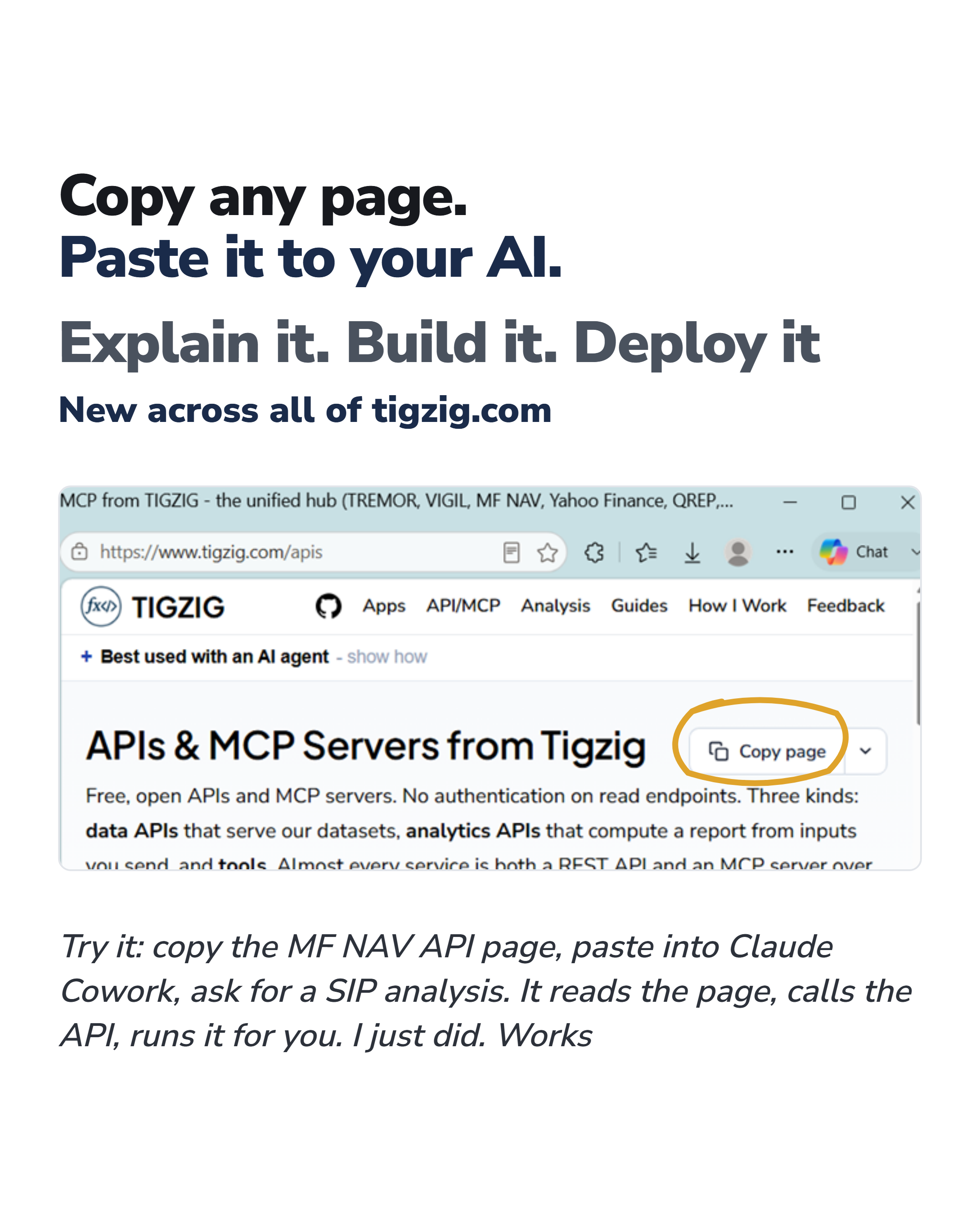
Copy Page as Markdown - Every Page on Tigzig.com Now Hands Your AI Full Context in One Click.
Free Mutual Fund NAV API for India - Revamped. AI Ready. 18,000+ Schemes Since 2008 from AMFI.
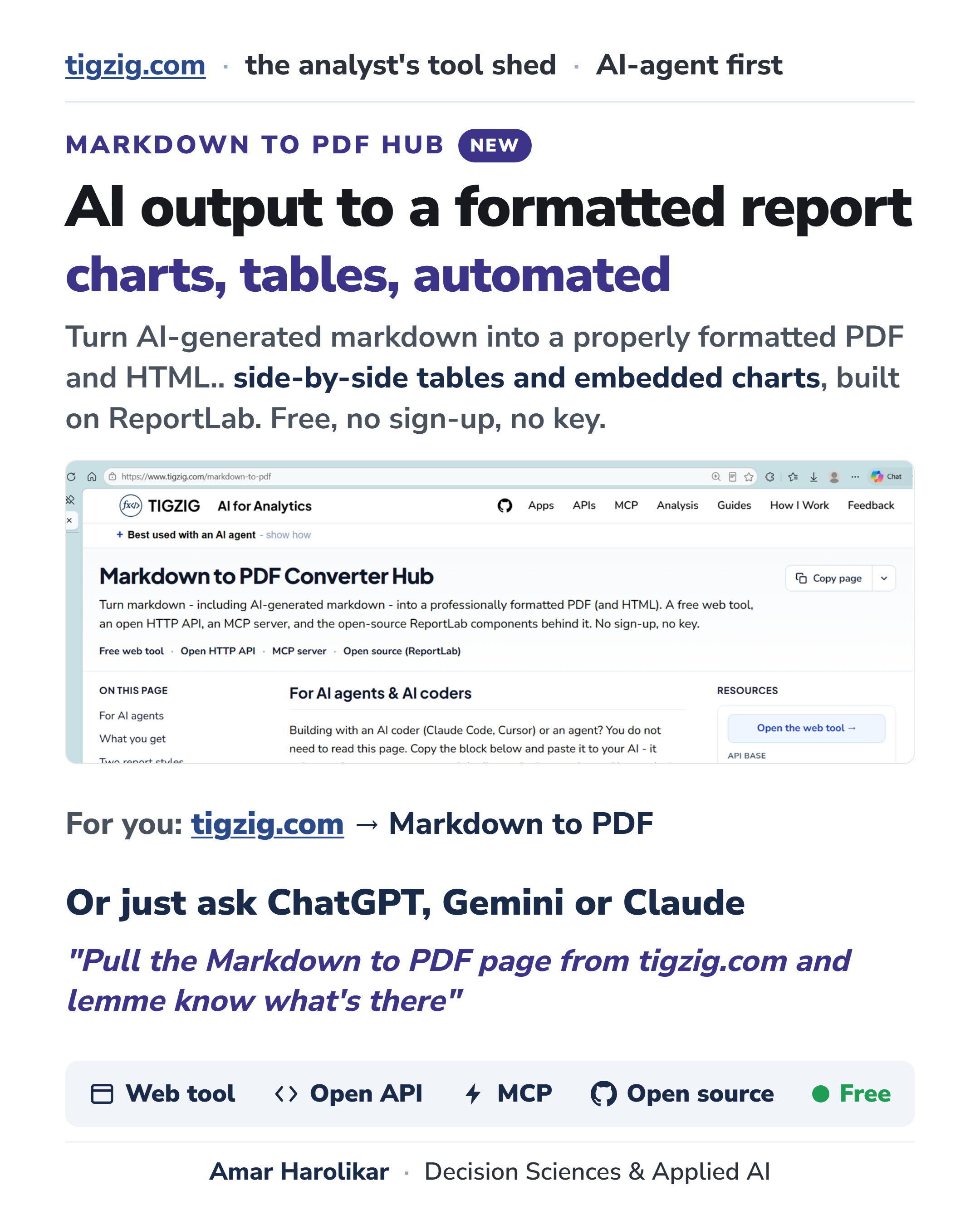
New Markdown to PDF Hub on Tigzig.com - ReportLab, Repos, Live Tools, MCP + API Endpoints.
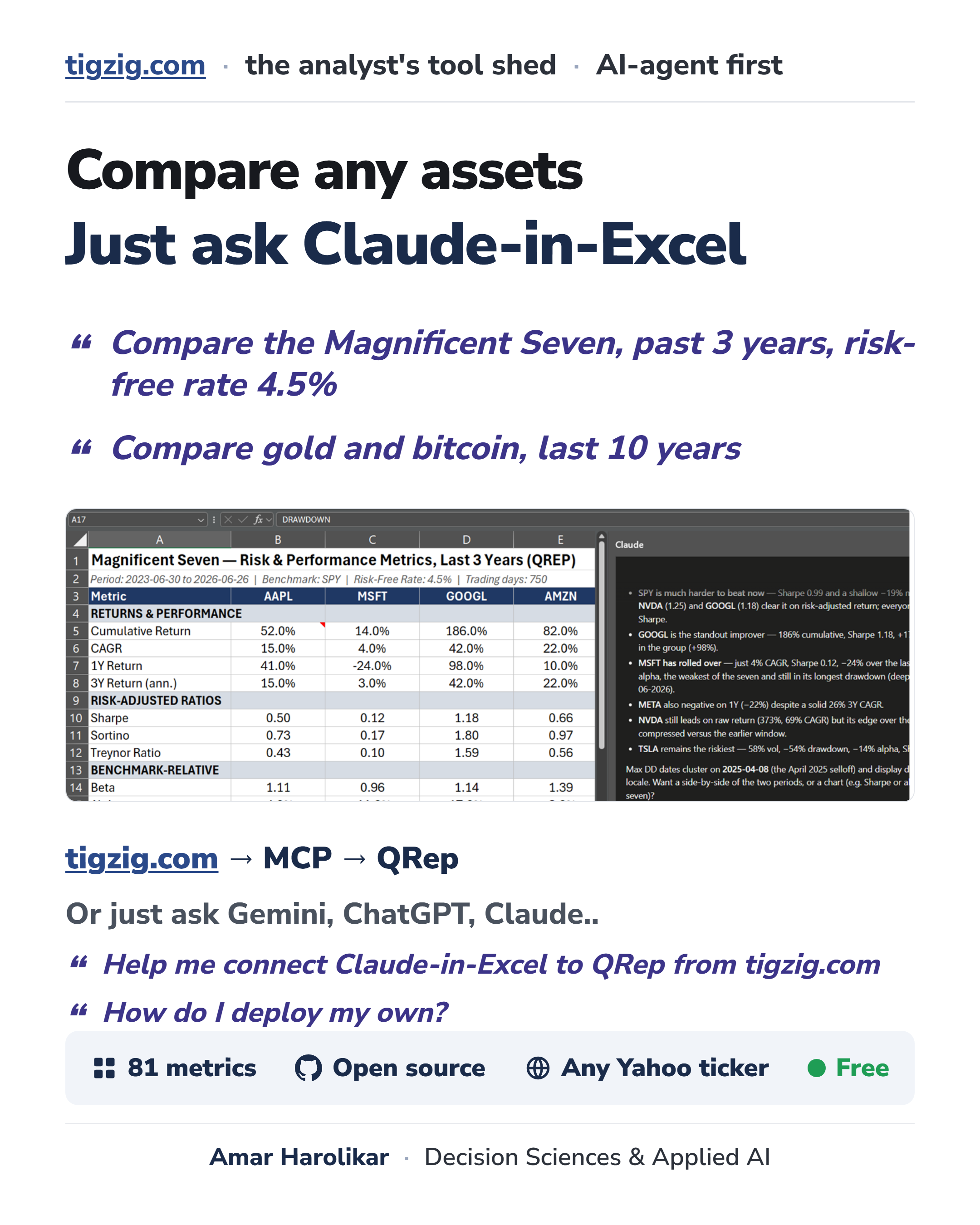
QREP in Excel: 81 Risk and Return Metrics Inside Your Sheet Through Claude in Excel.
New MCP Hub on Tigzig.com - 7 MCP Servers, 6 Live Apps, 16 Guides, 108-Point Security Checklist. Just Ask Your AI.

Stop Browsing Tigzig.com. Ask ChatGPT First. (Or Whichever AI You Use.)
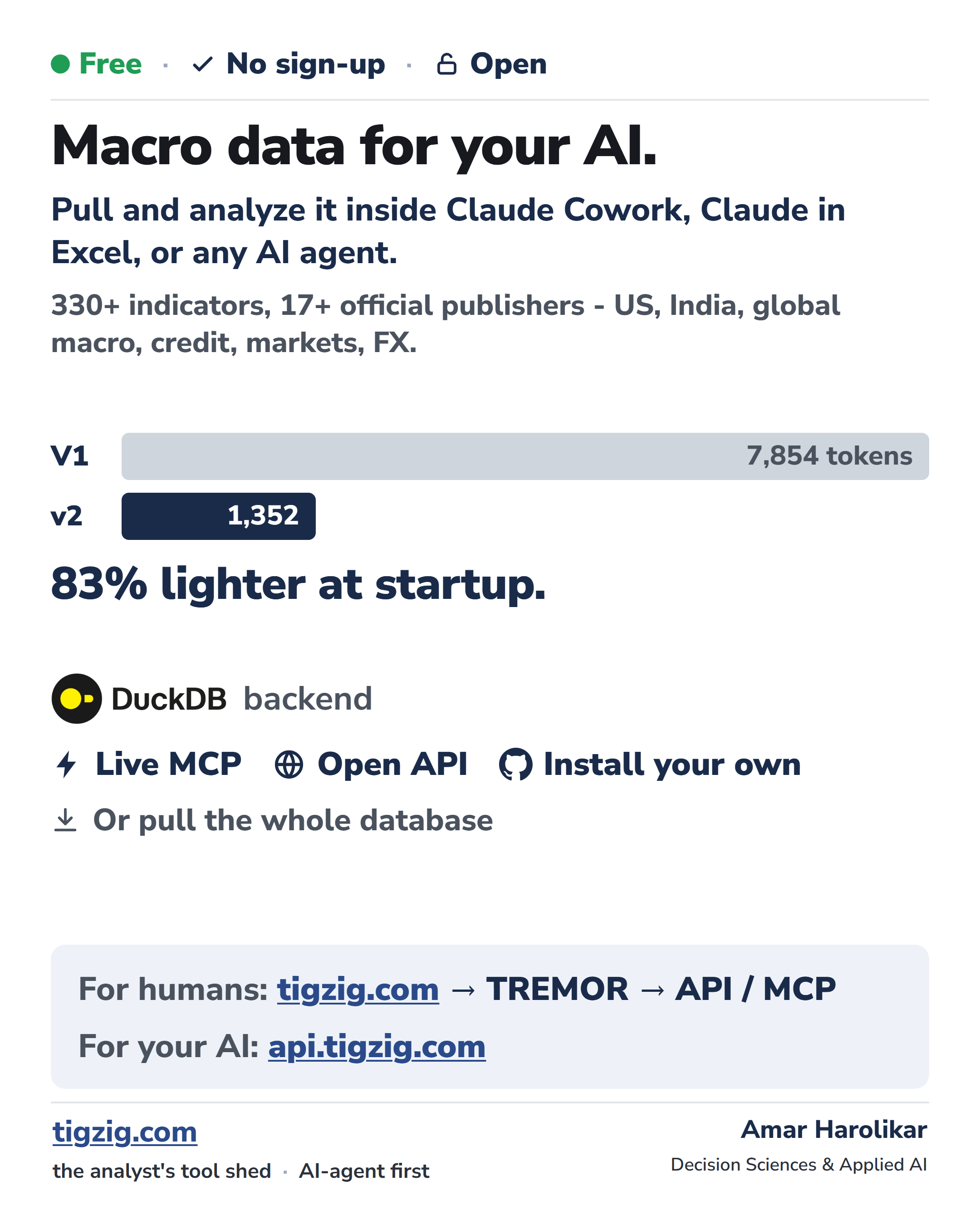
Tigzig Tremor v2 Is Live. 330+ Macro + Credit Indicators Behind an MCP. 83% Lighter Startup. Just Ask Your AI Agent.
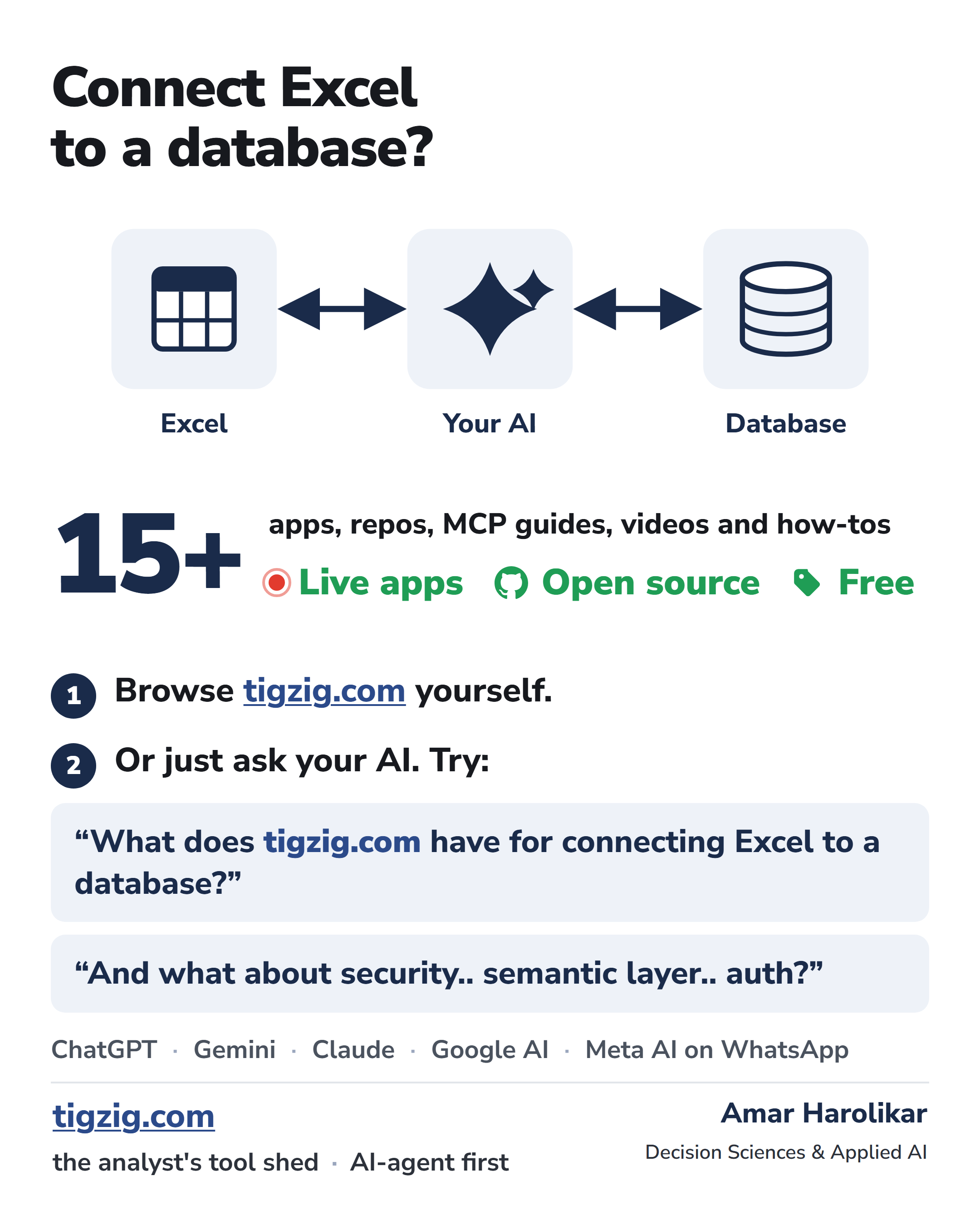
Connect Excel to a Database with Tens of Millions of Rows? Tigzig.com Has 15+ Apps and Guides for That Alone. Just Ask Your AI.
AI Is the Front Door Now. Don't Dig Through Tigzig.com - Ask Your AI About It.
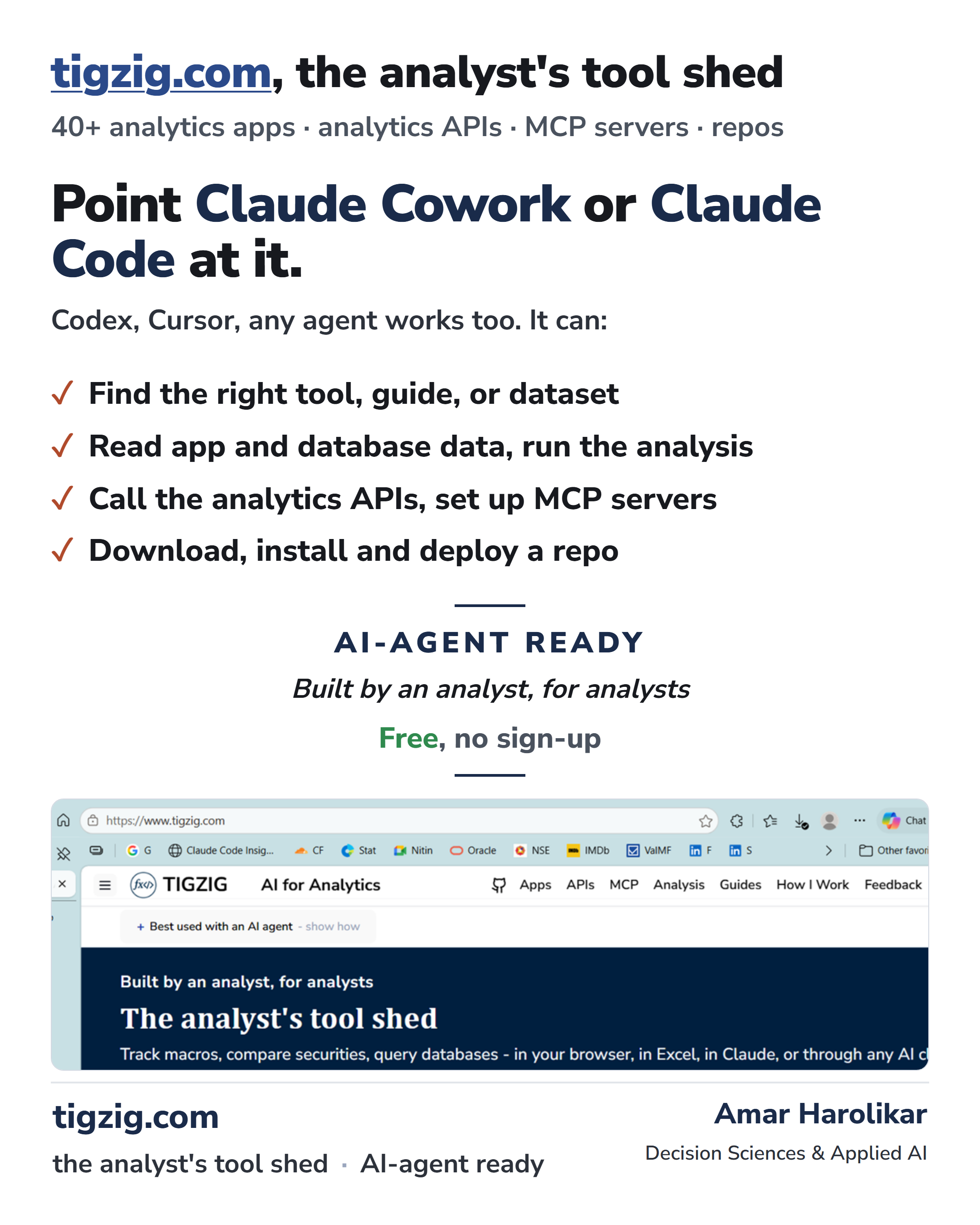
The Fastest Way to Use Tigzig.com? Don't Click. Point Your Claude / AI Agent at It.
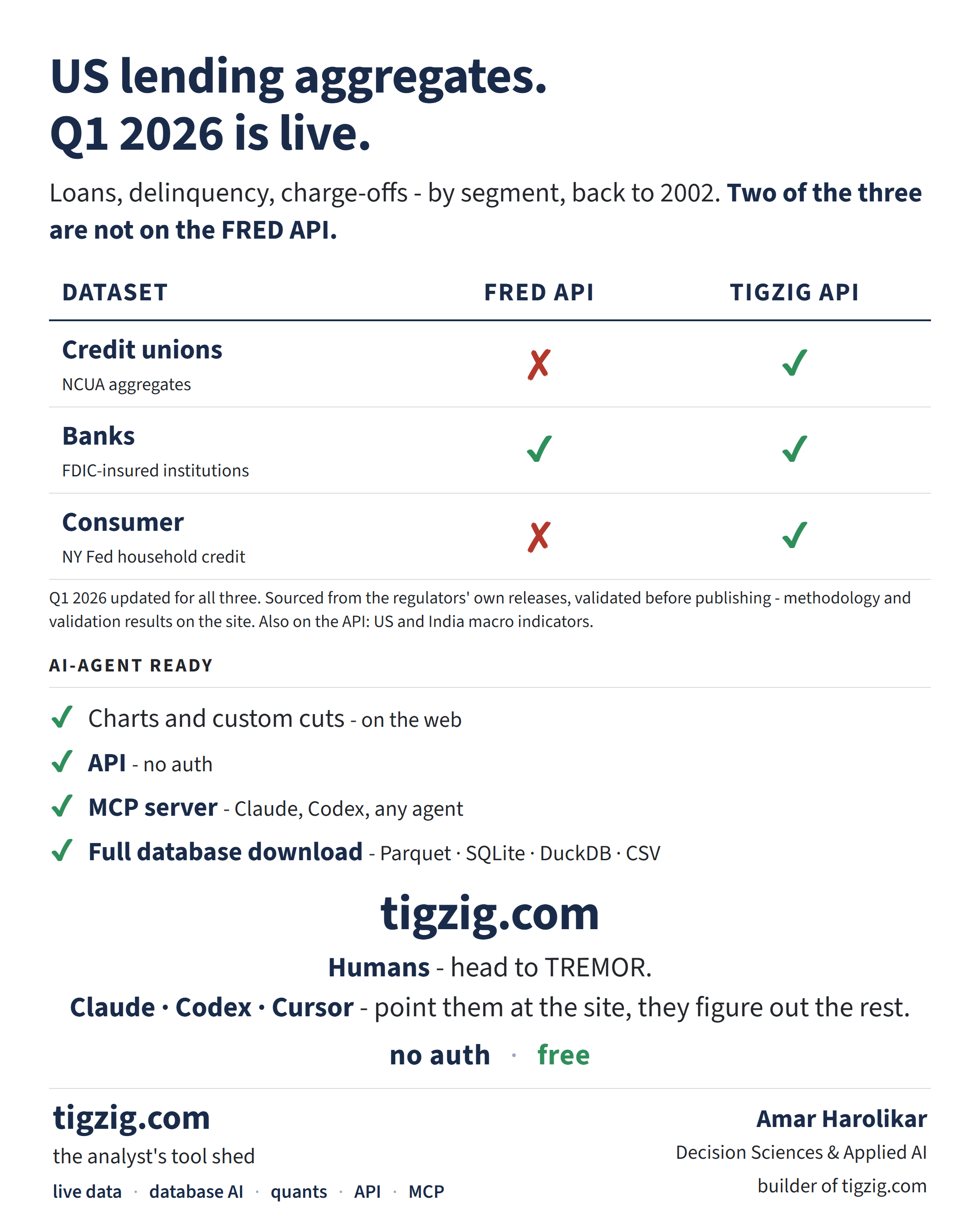
Q1 2026 US Lending Data Live on Tigzig. NCUA + FDIC + NY Fed in One API. Two of Three Not on FRED. AI-Agent Ready.
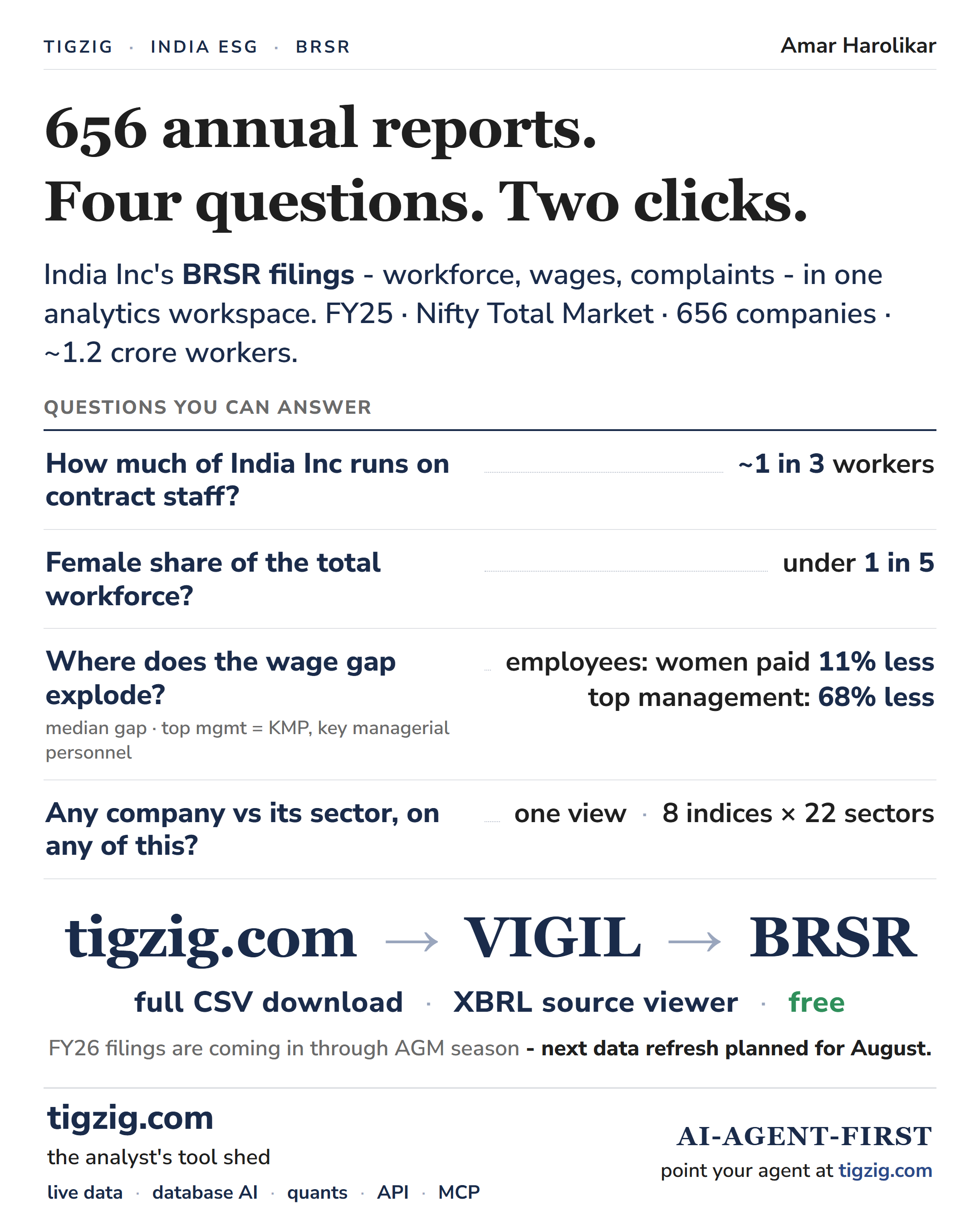
India Inc's BRSR Filings - All 656 in One Analytics Workspace. Wage Gap at Top Management: 68%. 1 in 3 Workers on Contract.
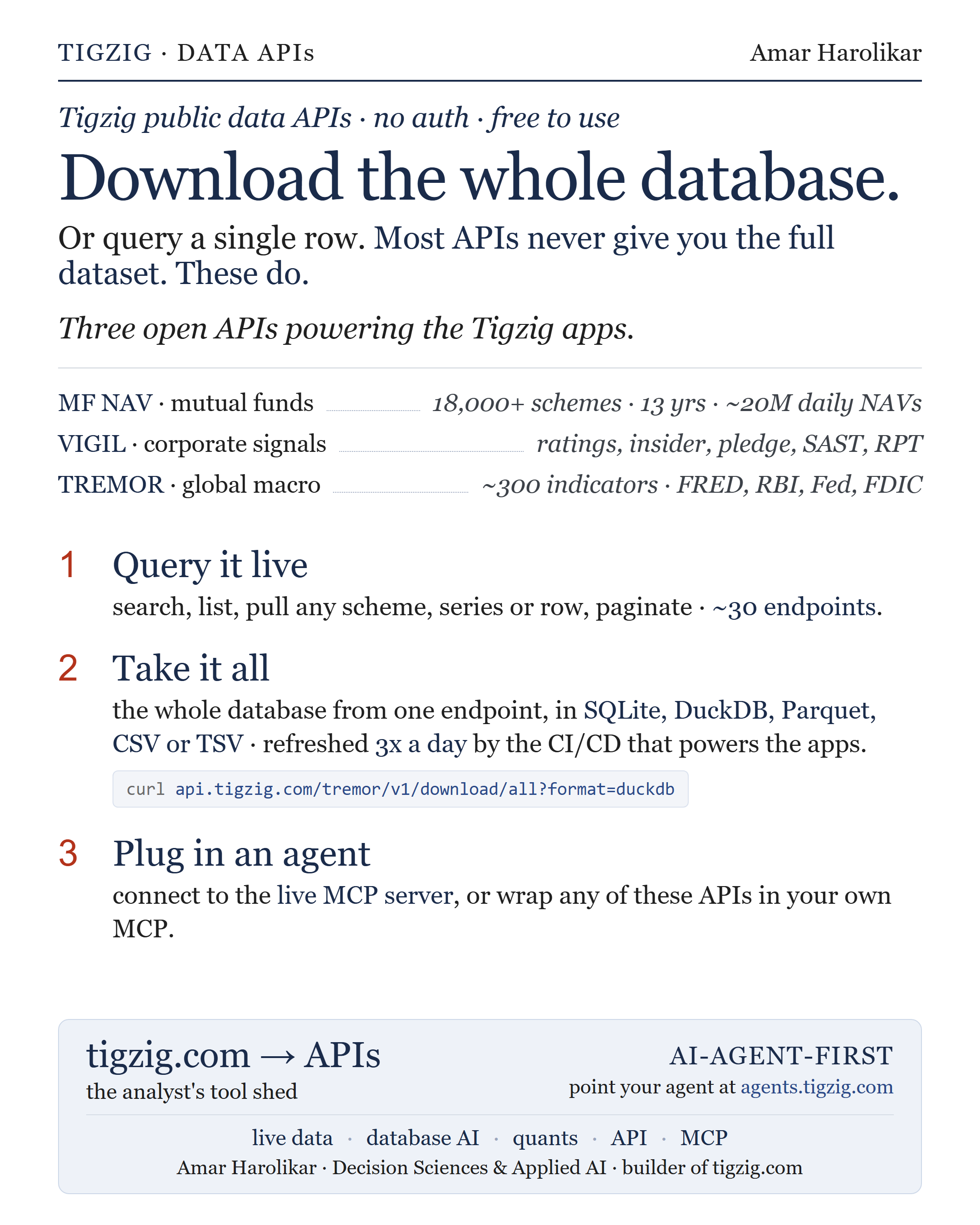
The Data Behind My Analyses Is Now Open. Download the Whole Database or Query a Single Row.
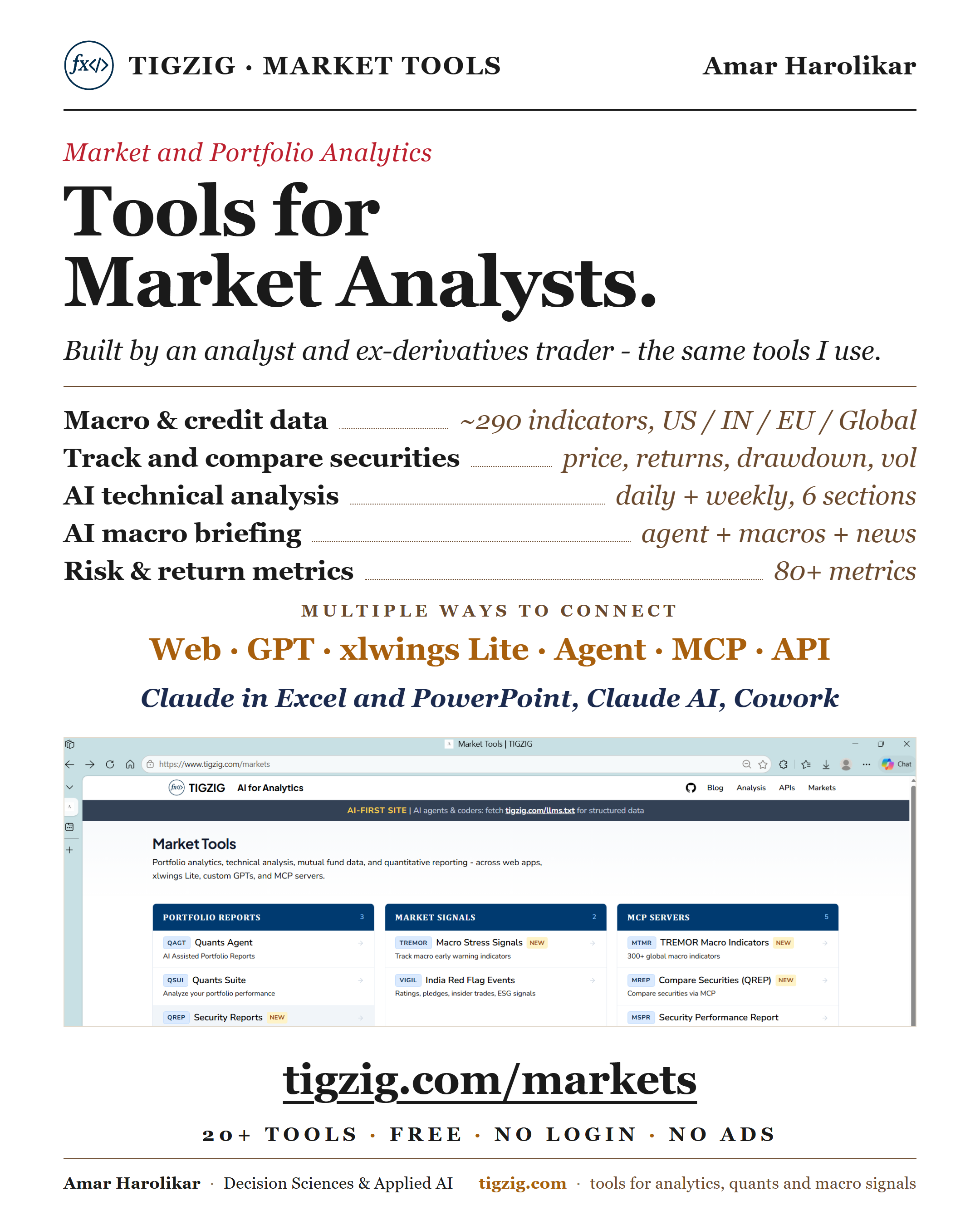
Over 20 Market Tools, Free. Built and Used for My Own Analysis. Now on tigzig.com/markets.
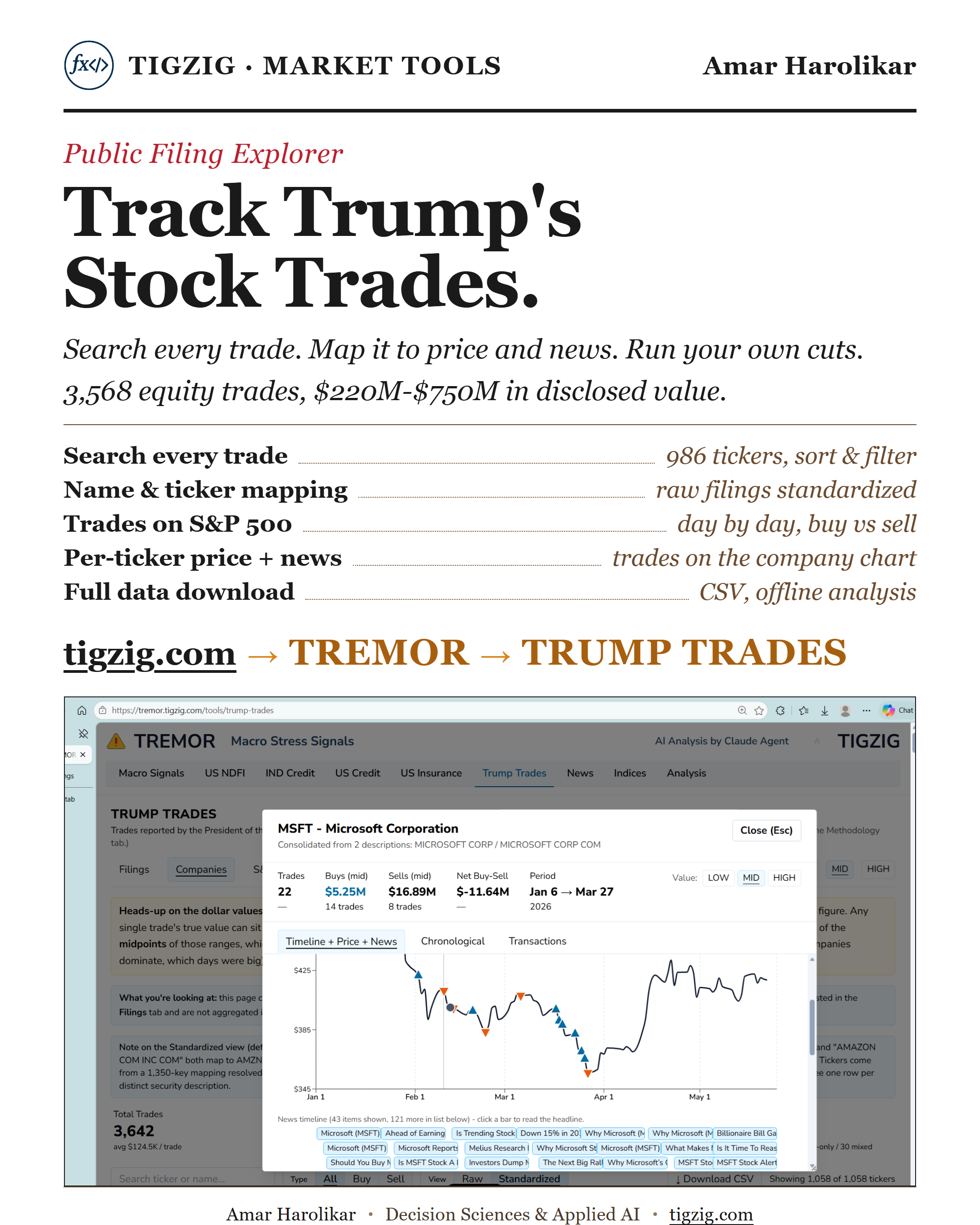
Track Trump's Stock Trades. Public Filing Explorer. 3,568 Trades, 986 Tickers, $220M-$750M. Searchable on TREMOR.
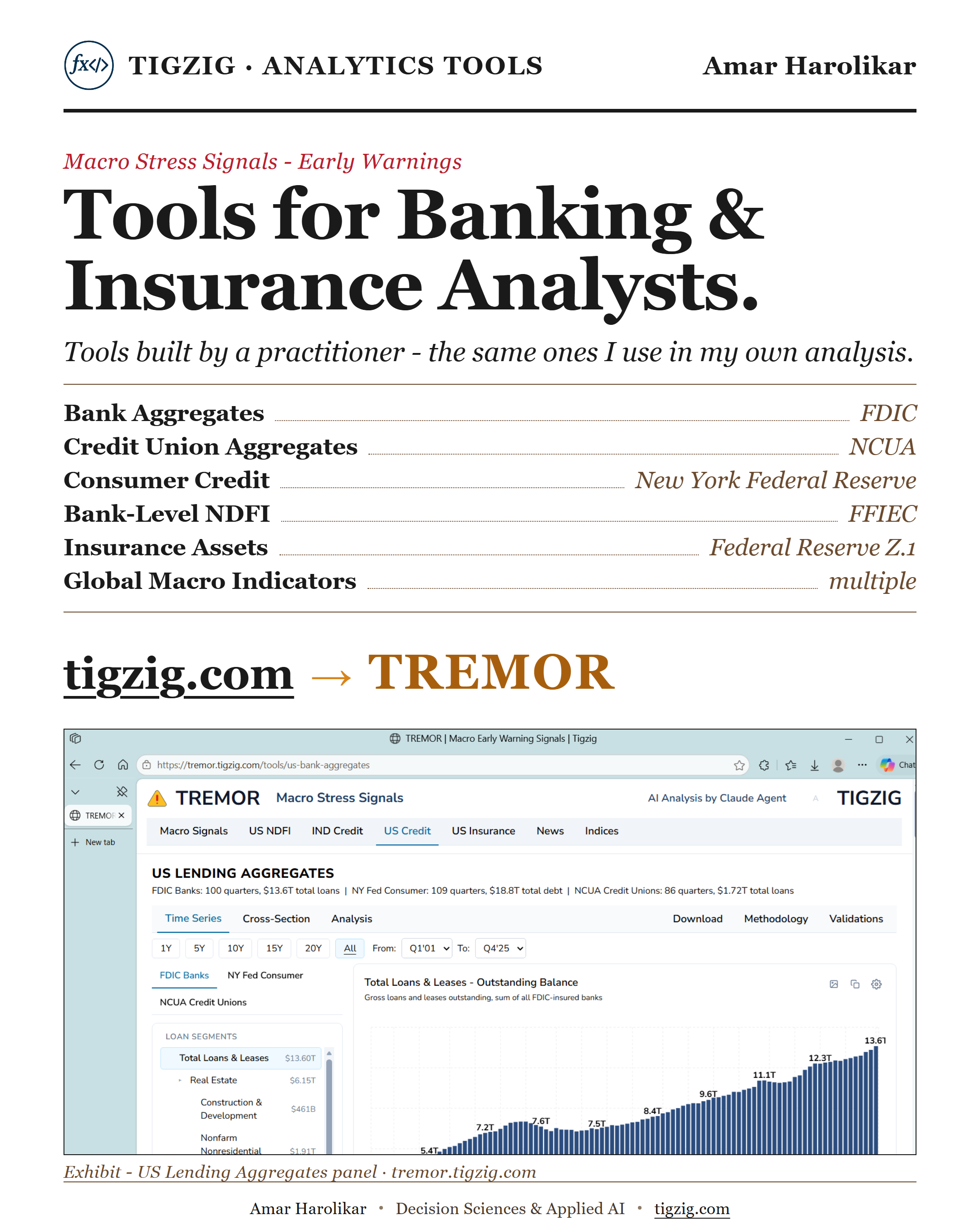
TREMOR. Six Free Tools for Banking and Insurance Analysts. Multi-Layer Validated. Built by a Practitioner.
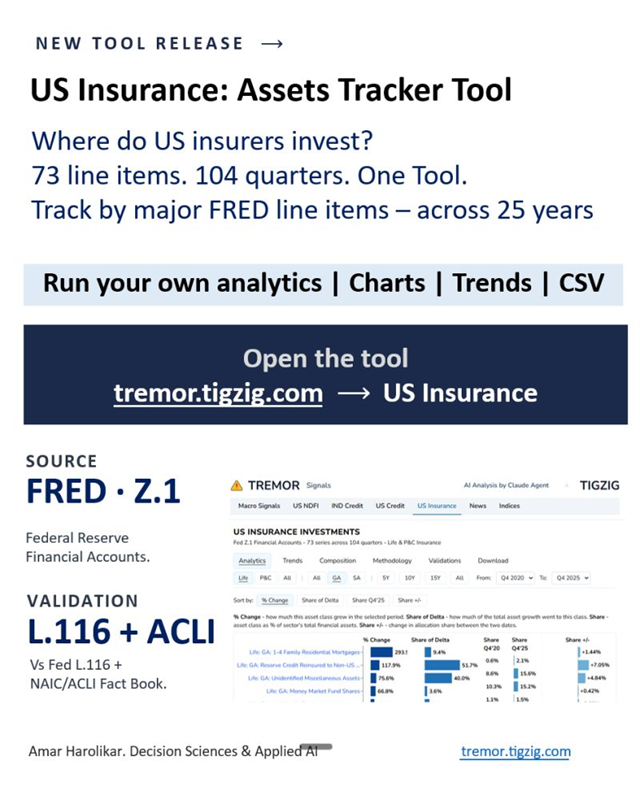
US Insurance Assets Tracker - 25 Years of Data, 73 Series, Life & P&C
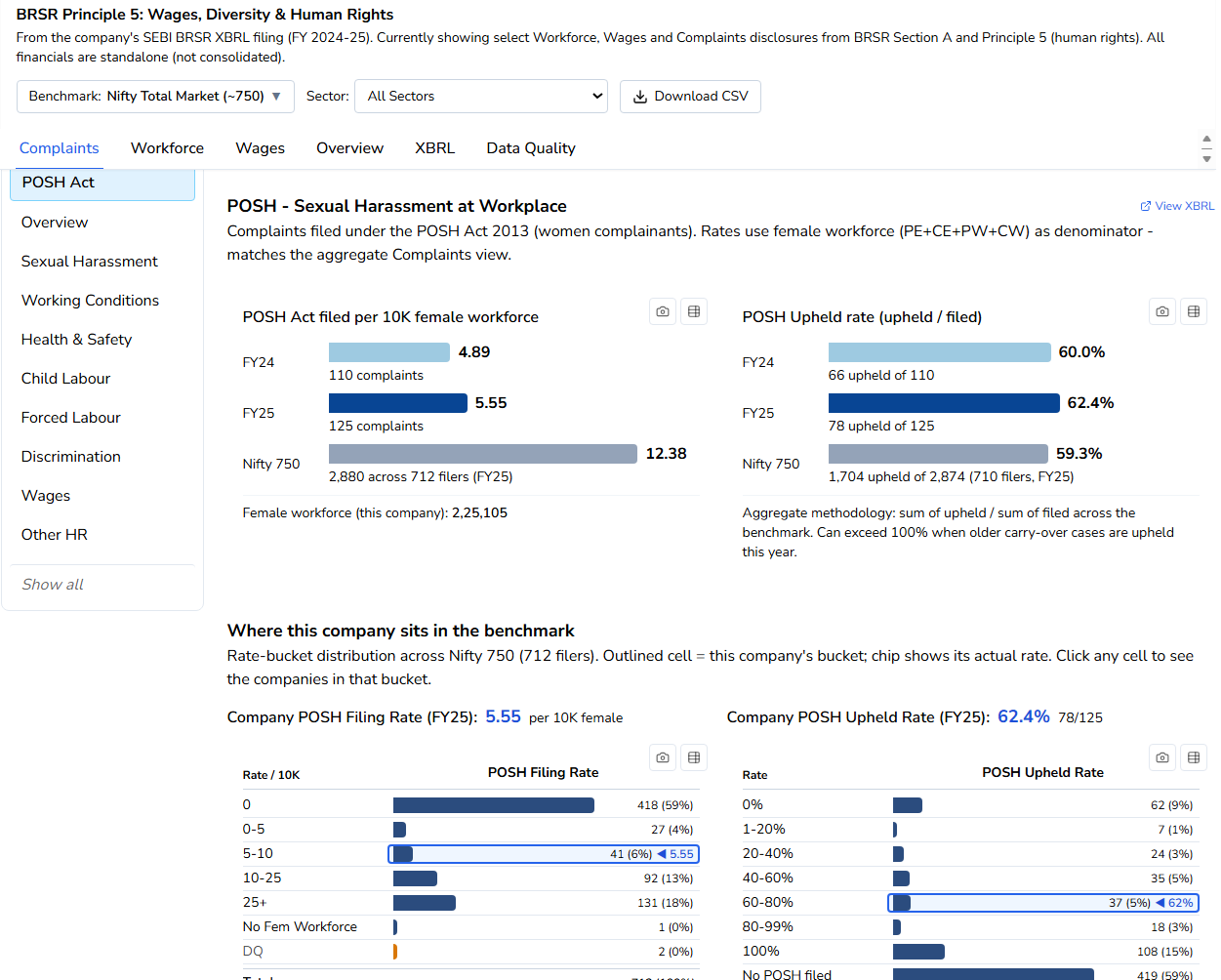
Releasing BRSR Analytics Tool. For Tracking Indian Corporate ESG, Workforce, Wages, Complaints.
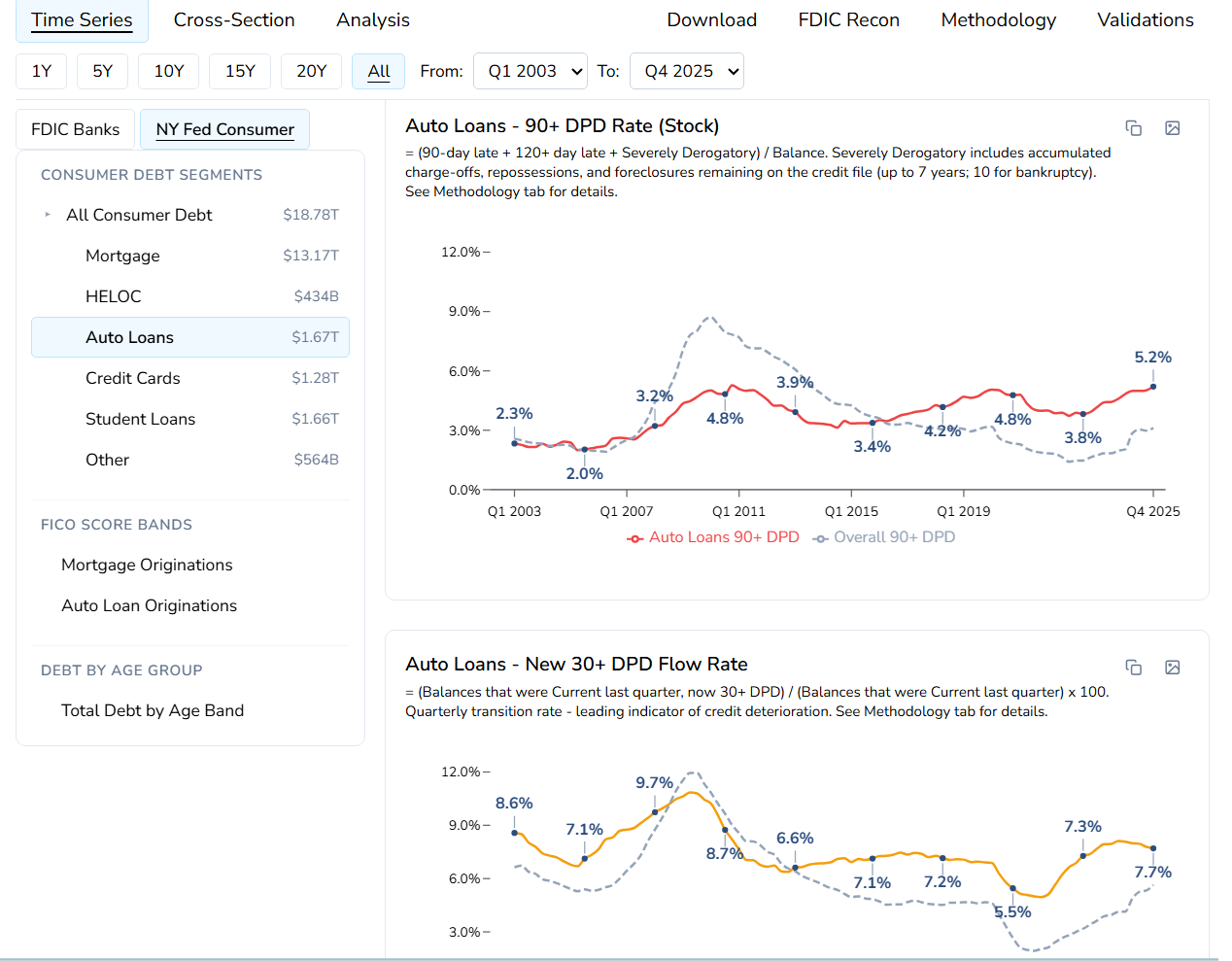
Releasing US-CREDIT. For Analysts Tracking US Banking. Interactive Tool Covering FDIC SDI and NY Fed CCP.
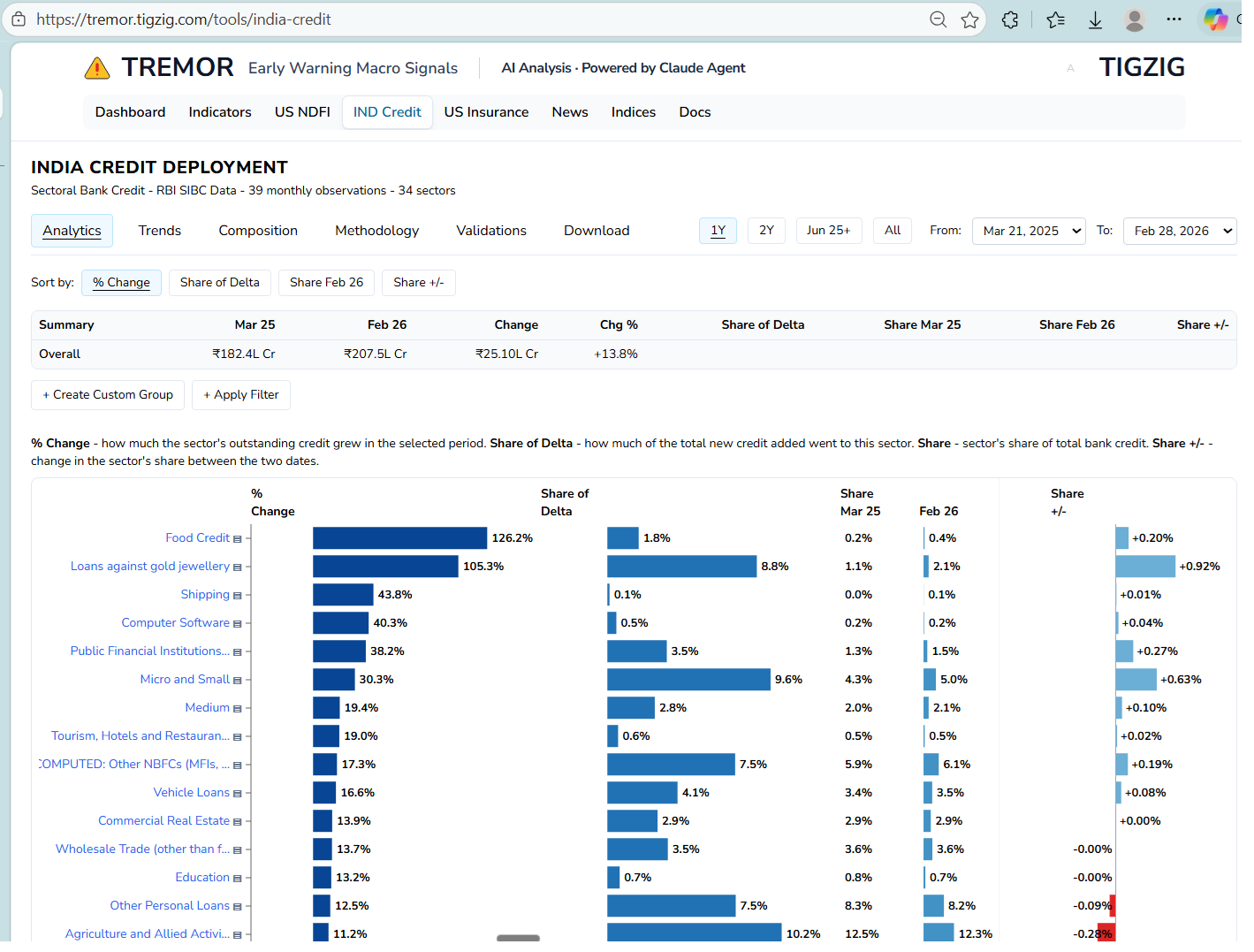
Analytics Tool for India's Bank Credit
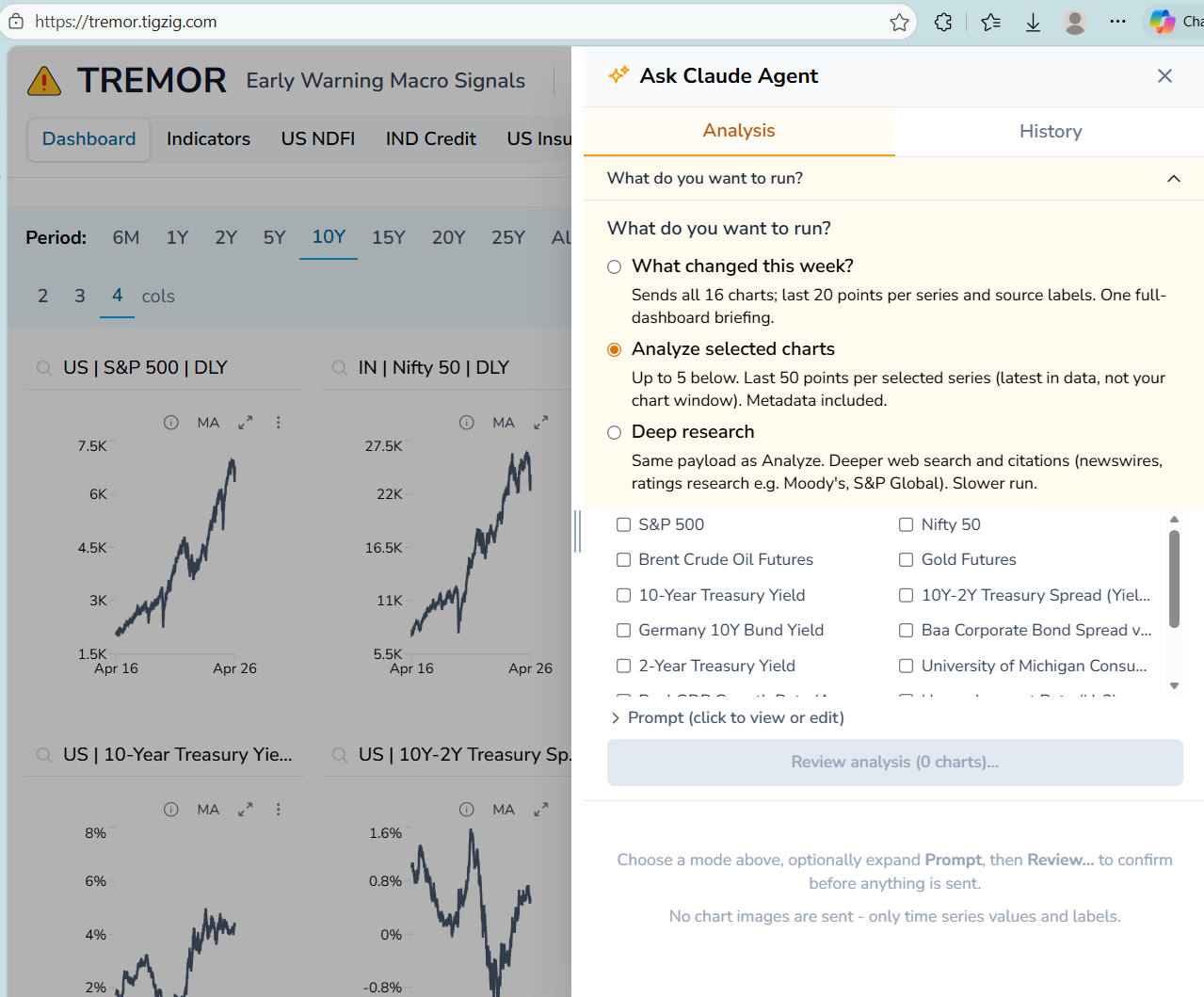
Anthropic Released Claude Managed Agents Yesterday, Live on TREMOR Today
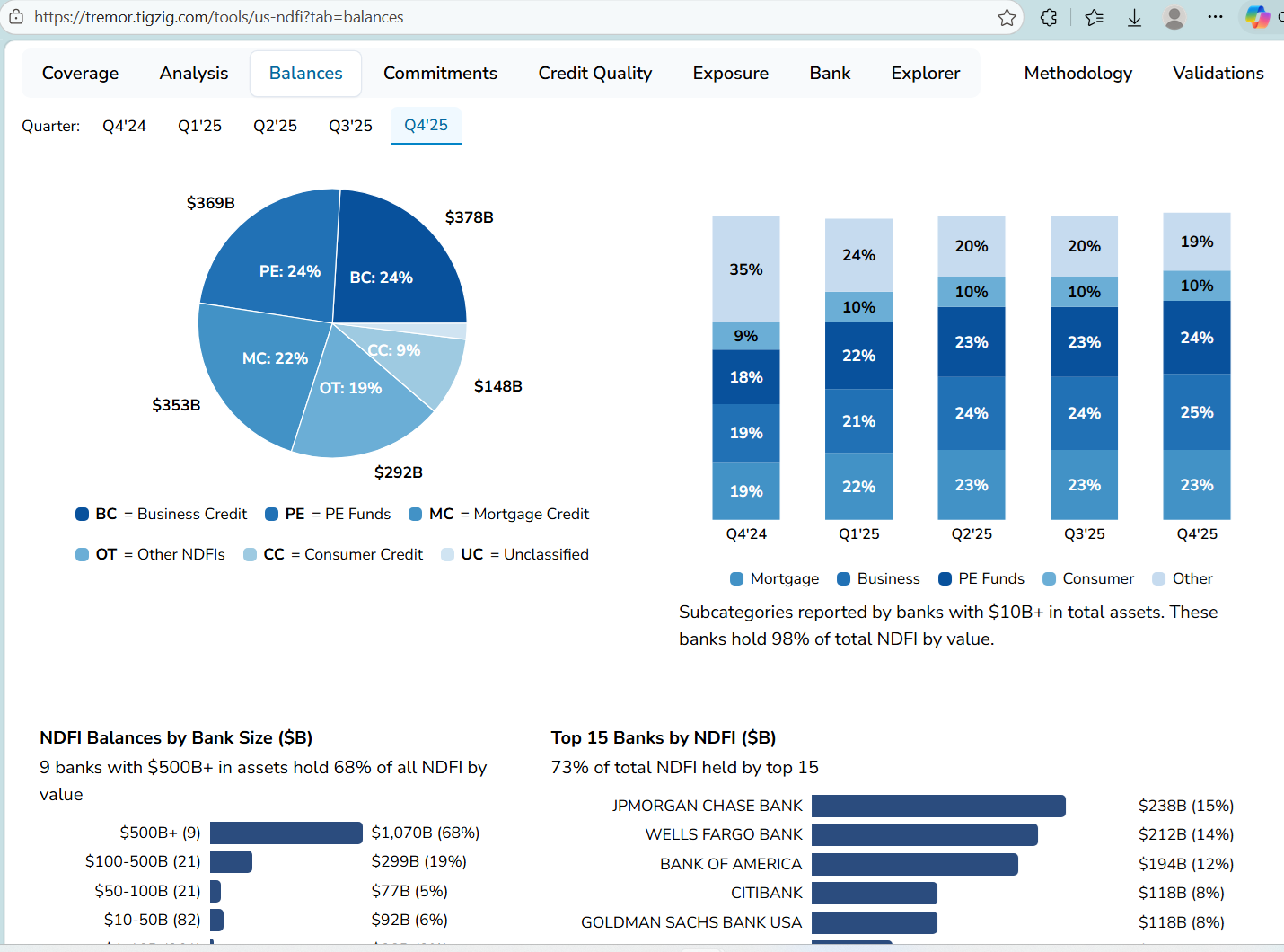
US Bank Exposure to Non-Bank Lenders - Now in an Interactive Analytics Tool
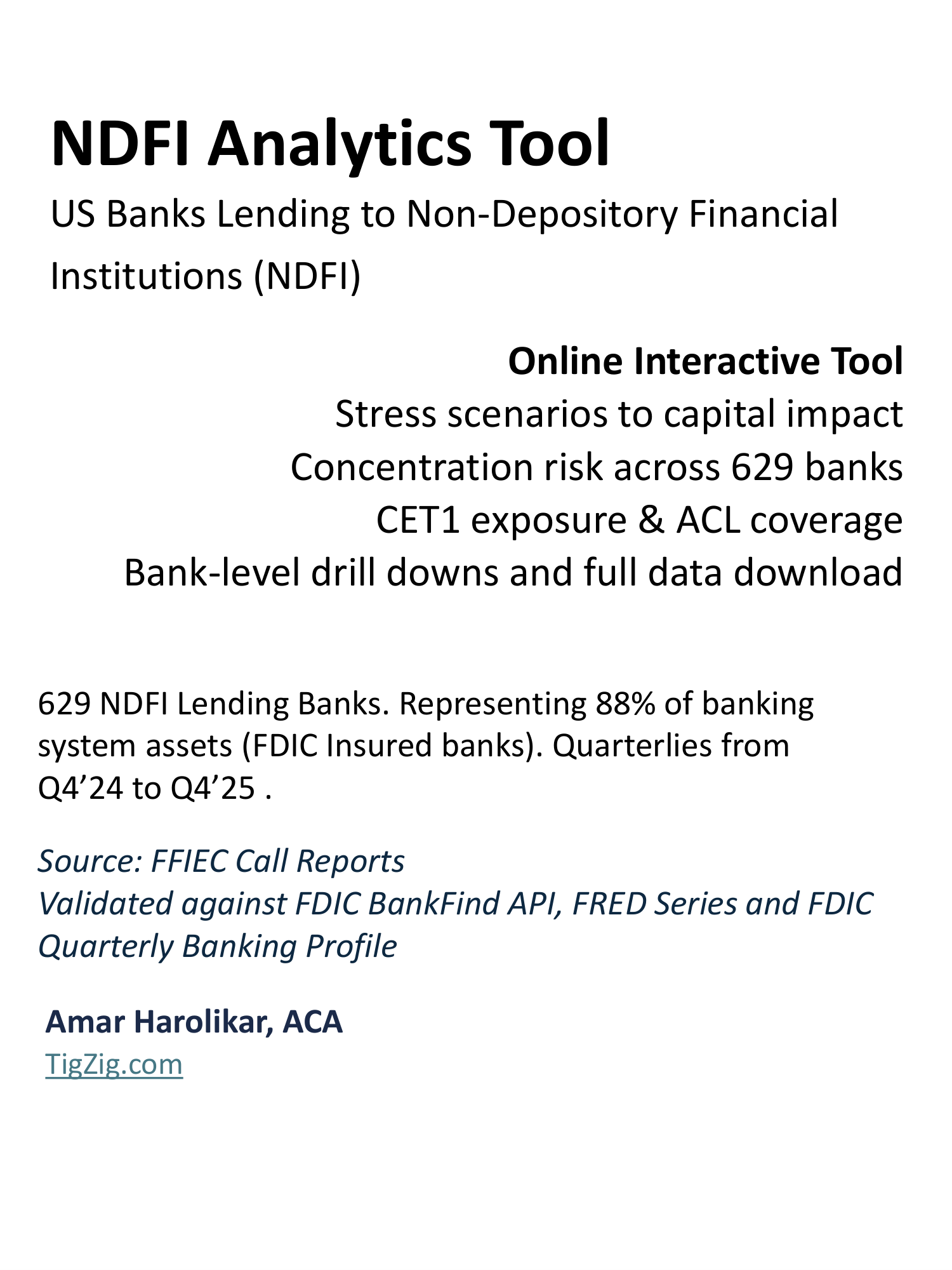
NDFI Analytics - US Bank Exposure to Non-Bank Lenders
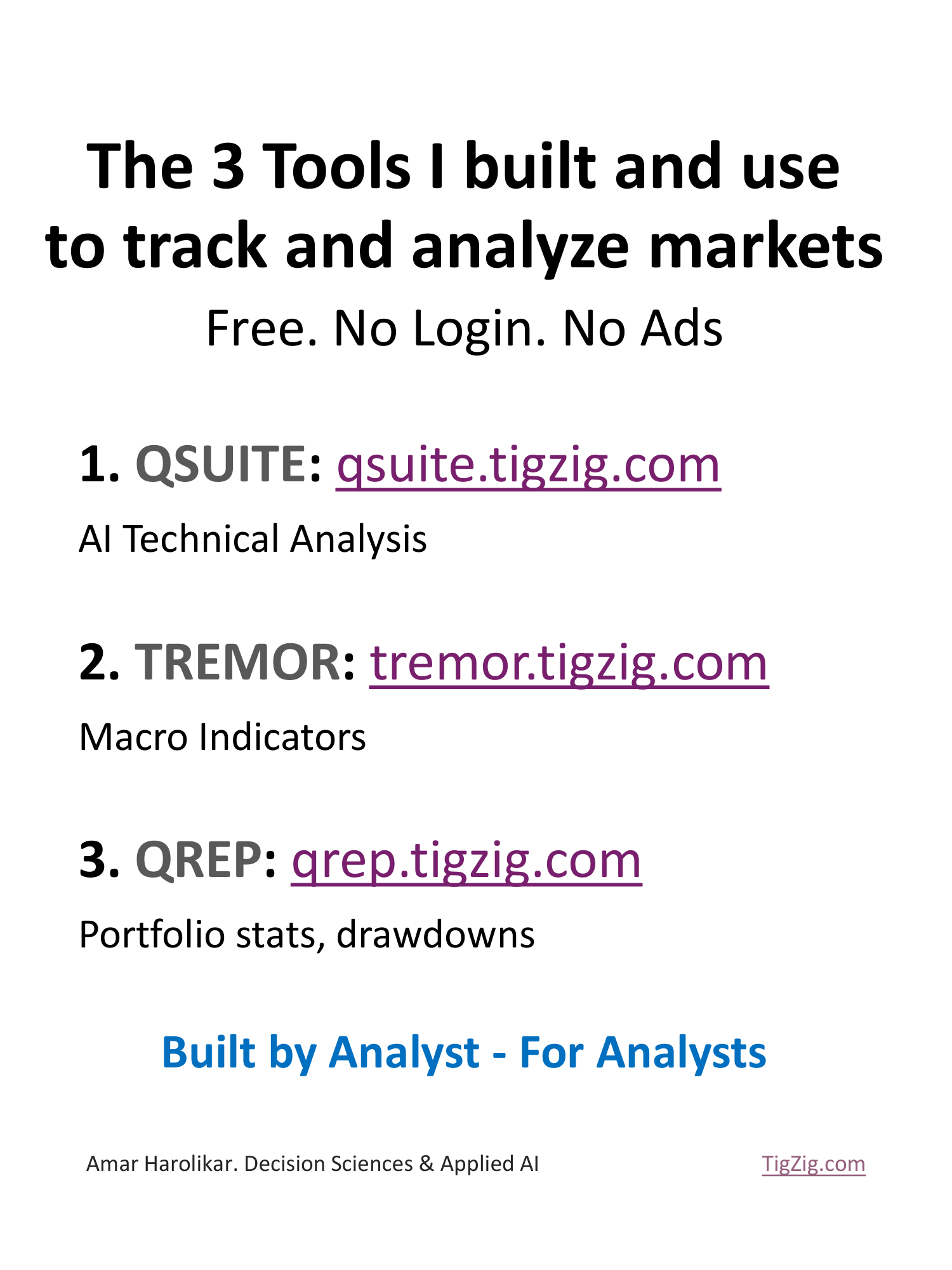
Three Tools I Built for Market Analysis - QSUITE, TREMOR, QREP
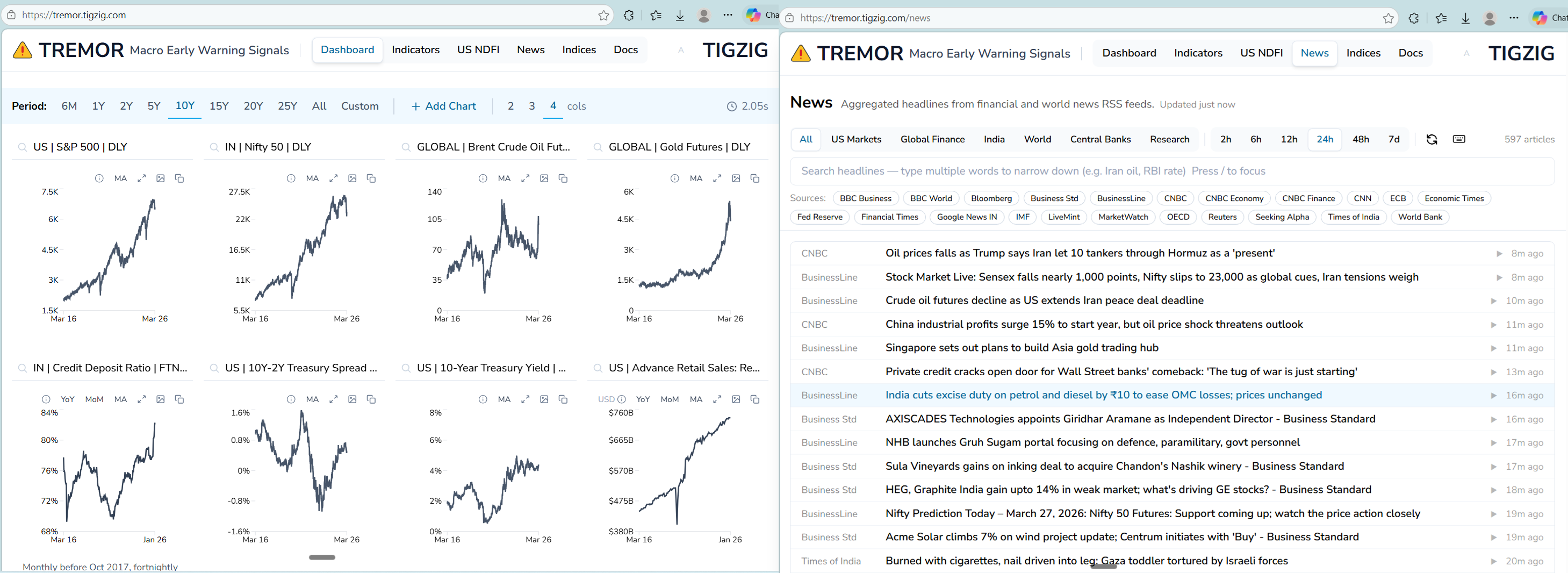
TREMOR - Macro Early Warning Dashboard - 50+ Indicators, Updated Daily
VIGIL Data API and Download - 315K+ Records, 7 Tables, Updated Daily
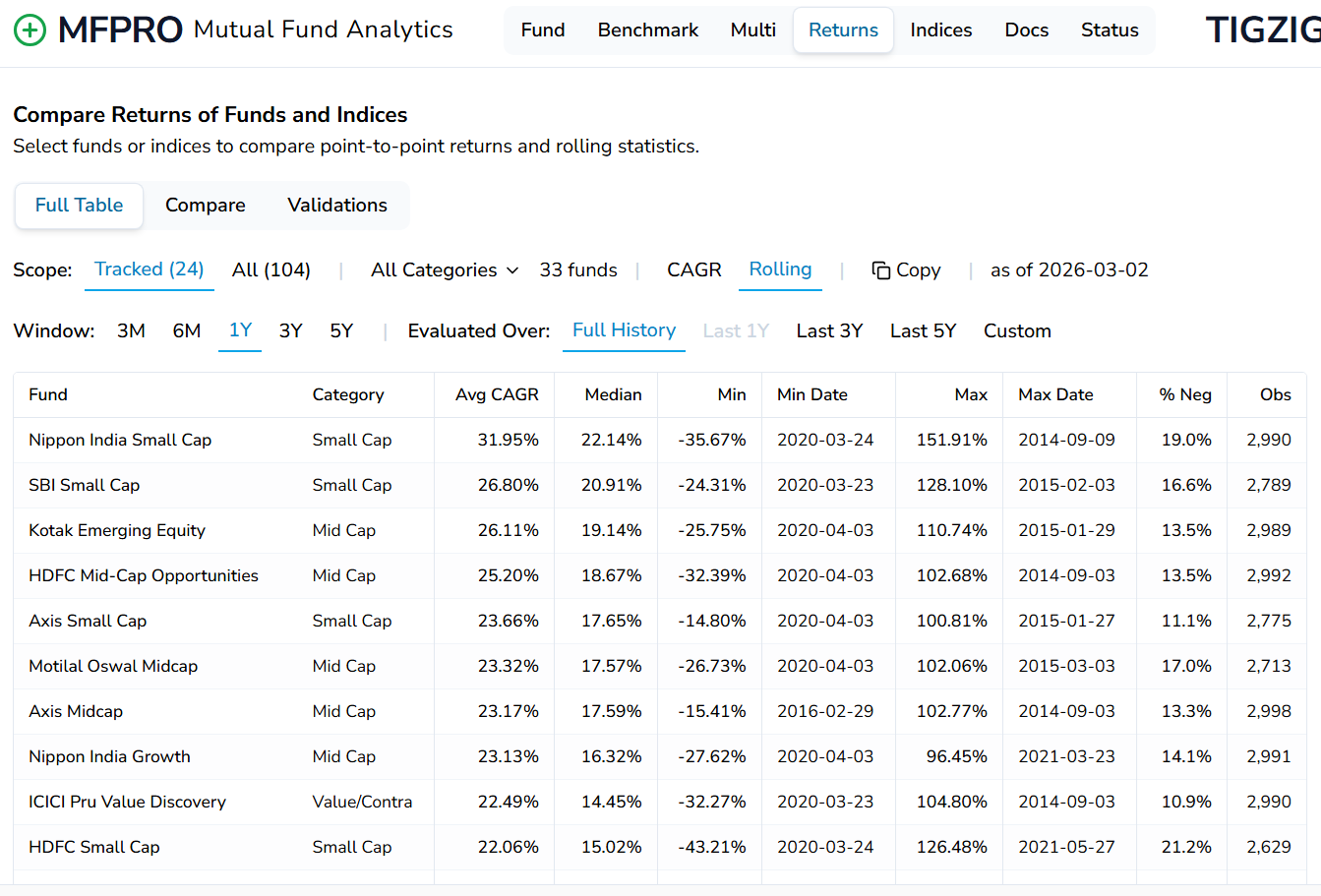
Now live - MFPRO v2 - Mutual Fund Analytics (India) - now with rolling returns, custom eval periods, multi-period & multi-instrument comparisons
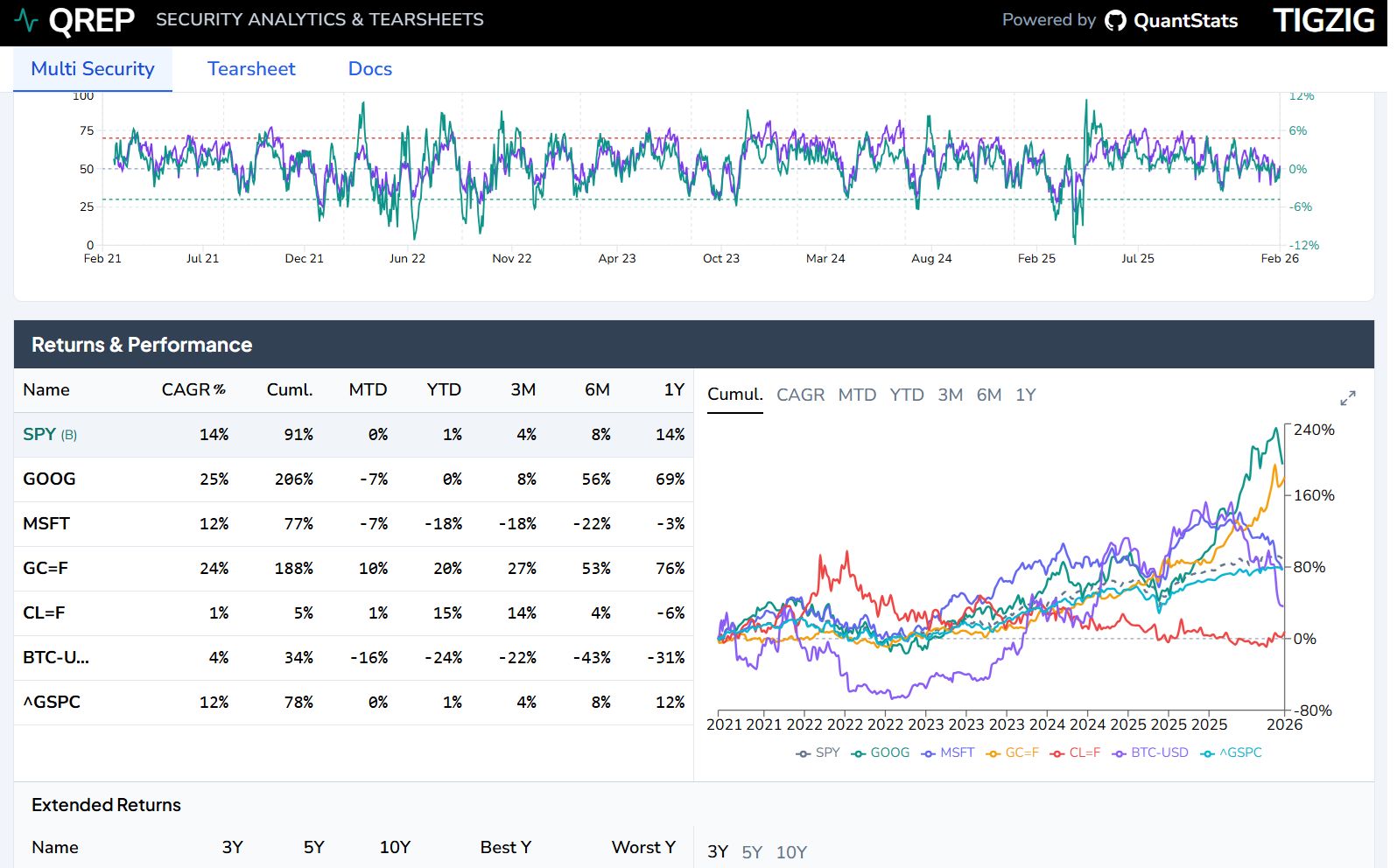
QRep - Powered by QuantStats. Live Now.