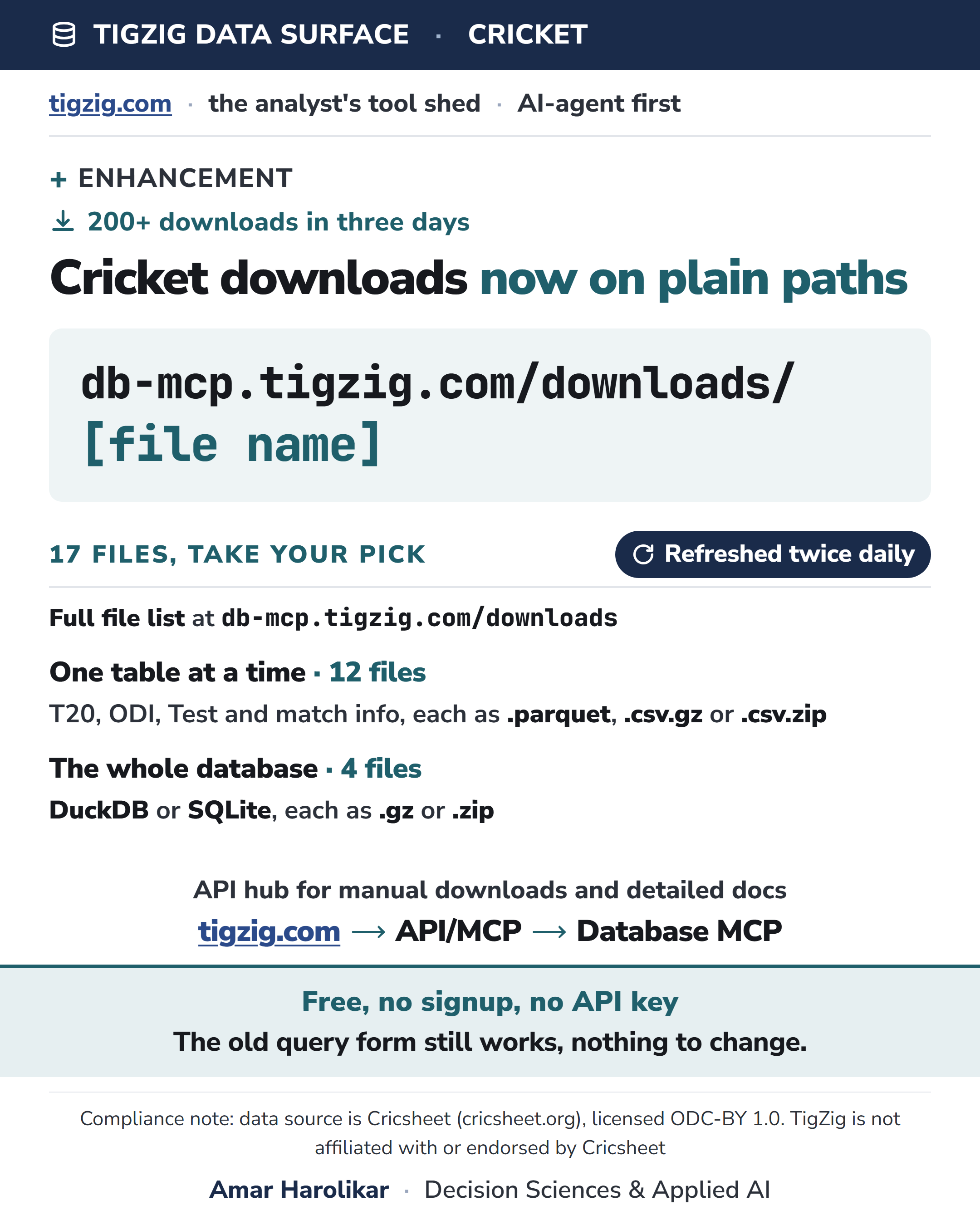
The Cricket Download Files Now Sit on a Plain Path. Append the File Name and That Is the Whole URL.
Published: August 29, 2026
The cricket download files now sit on a plain path, so you append the file name and that is the whole URL. I made the change because the data has done over 200 downloads in three days and people are already scripting against it, and a query parameter is one more thing to get right when all you want is the file.
For example:
db-mcp.tigzig.com/downloads/cricket_all_tables.duckdb.zip
That is the whole DuckDB database, about 9 MB compressed. Ball-by-ball for ODI, T20 and Test, 6,900+ matches, 2001 onwards, all 3.8 million deliveries.
One GET request. If you are working in Python, JavaScript, a notebook or a spreadsheet tool, a single fetch pulls the file down. No key required.
The older query parameter form is unchanged and I am not retiring it, so anything already scripted keeps running. And the direct SQL access to the remote databases, Postgres and DuckDB, continues to be live.
17 files in all. Four tables one at a time as parquet, csv.gz or csv.zip, or the whole database in one file as DuckDB or SQLite. Refreshed twice a day.
File list at: db-mcp.tigzig.com/downloads
If you would rather click than script, the API hub has the manual downloads and the full AI docs link: tigzig.com/apis/database
Compliance note: data source is Cricsheet (cricsheet.org), licensed ODC-BY 1.0. TigZig is not affiliated with or endorsed by Cricsheet.
Where the files actually sit
The real home for the downloads is api.tigzig.com/cricket/v1/download/[file name]. That is where the file actually sits and where the bytes come from.
db-mcp.tigzig.com/downloads/[file name] is the short one I mention above, and it is a convenience redirect that sends you to the address above. curl and wget follow it on their own with no extra flags, and a browser just lands on the file.
The older query parameter form, /cricket/v1/download/[table]?format=parquet, is unchanged and still live, so nothing already written needs touching.
The fields, and how the tables are put together
If you want to go further into what the fields are and how the tables are put together, the API docs are at:
- for you: db-mcp.tigzig.com/v1/redoc
- for your AI: db-mcp.tigzig.com/v1/openapi.json
I have written a short description of each field there, along with what I have run into while working with the data. That is my reading of it though, and for the underlying Cricsheet fields the original documentation is the one to trust: cricsheet.org/format/csv_ashwin
The tables here are derived from that format, reshaped and joined to a match level table, so where my description and theirs differ, theirs is the source of truth.
The cricket dataset linked here is from Cricsheet, published under the Open Data Commons Attribution License 1.0 (ODC-BY). If you redistribute it, keep the attribution and the licence with it.
Working on something similar? How I work covers the rates, the availability and what I take on.