Point Your AI at a Free Ball-by-Ball Cricket Database. Five Million Deliveries, One Paste.
Published: September 20, 2026
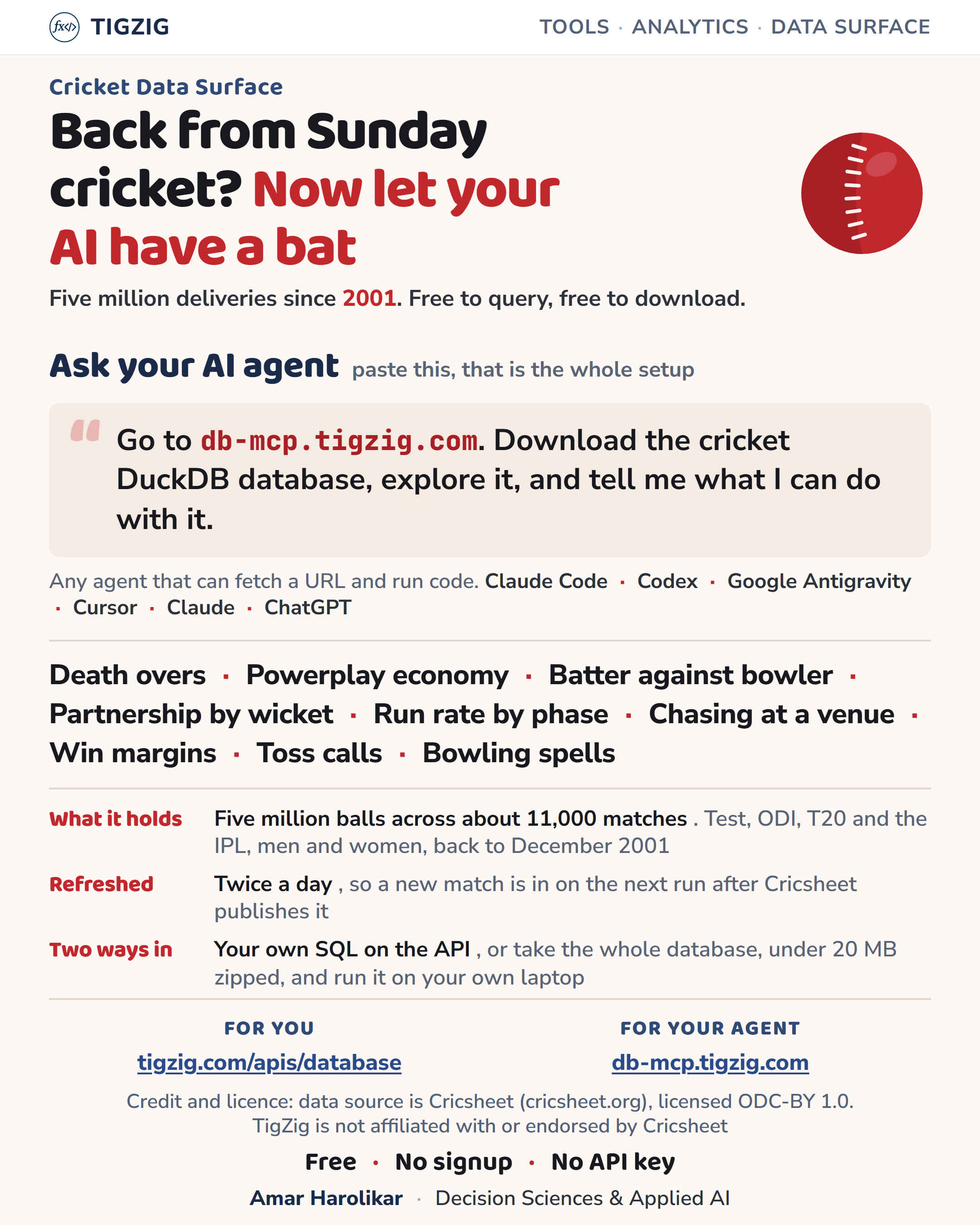
Back from Sunday cricket? There is a free ball by ball database you can point your AI at. It will work out how to get in on its own and do the heavy lifting, and you just steer it the way you would like.
Every delivery bowled in international cricket since December 2001 is in it. Test, ODI and T20, men and women, plus the IPL. About five million balls across roughly 11,000 matches, refreshed twice a day.
Just paste this into whichever agent you use:
Go to db-mcp.tigzig.com. Download the cricket DuckDB database, explore it, and tell me what I can do with it.
That address returns a plain JSON index. The agent reads it and works out the rest on its own, including where the SQL endpoints are and where the files live, so you do not have to explain any of it.
Two ways in
There are two options, and your AI can help you decide based on your specific setup.
- Run your own SQL against my database, DuckDB and Postgres, through the API.
- Take the whole database as a DuckDB file, under 20 MB zipped, and run it on your own laptop against a copy with no SQL constraints and no rate limits.
Deep dive with ball by ball
A scorecard tells you a batter made 48. With ball by ball you get which over they took a chance in, who was bowling at the time, how the run rate moved either side of it, and what that same pair did the last three times they met.
Free, no signup, no API key.
For you: tigzig.com/apis/database
For your AI: db-mcp.tigzig.com
The SQL is rarely the hard part
SQL is just one part, and the AI will do the heavy lifting for you. To get the right analytics out, the constraint is different. It is knowing the game well enough to ask the right questions, validating results to find out what your AI missed, and knowing where this particular data bites.
Three that cost people real time. A wide and a no ball are not legal deliveries, so a balls faced count that includes them comes out wrong. A run out is not the bowler's wicket. The extras columns are blank where nothing was conceded, so a sum that treats them as zero comes up short. None of these throw an error. You get a number back and it looks perfectly reasonable.
Here are some guides that could be of help. These came out of reading the API logs, so they are what people hit in practice.
- Fourteen things that trip people up on this database: cricket-database-14-things-that-trip-people-up-sep2026
- The stats functions you can use, and the two limits that are easy to hit: cricket-sql-stats-functions-and-limits-sep2026
- When an error keeps repeating, the response body usually names the fix: api-error-hints-aug2026
Which AI can do this, and the mechanics
On which AI can do this, the test is simple. It needs to fetch a URL and run code, either on your machine or in a sandbox. Just check with your AI directly.
The full coding agents are safe. Claude Code, Codex and Google Antigravity will do it without any fuss.
The desktop and chat apps are where it keeps moving. Some have a sandbox now that did not have one a few months ago, and the product tiers split and recombine often enough that anything I write here has a short shelf life. Check what your own tool can do today, or ask it directly and it will tell you.
For the mechanics. The API takes read only SQL on two engines, Postgres and DuckDB, with the same tables on both, and gives you json, csv or tsv back. There is an MCP server on the same host for clients that take connectors. Every table is also published as a file, and the whole database as a single DuckDB or SQLite file.
Four tables. ball_by_ball is one row per delivery. match_info is one row per match with venue, toss, result and officials. match_players is the lineups and the officials. people is the player registry with cross reference ids, so you can join to other cricket sources without matching on names.
Spec for an agent: db-mcp.tigzig.com/v1/openapi.json
Credit and compliance
Data source is Cricsheet (cricsheet.org), licensed ODC-BY 1.0. TigZig is not affiliated with or endorsed by Cricsheet.
Working on something similar? How I work covers the rates, the availability and what I take on.