Hormuz Is Quietly Opening. The First Good News in 100 Days. And It Is Running in Two Lanes.
Published: June 5, 2026
Quick note.. nobody has the full picture here. This is a live war, and what we have is frontline reporting, not an official documentation, with the news reports themselves often unsure how the strait actually works right now. So take the specifics as the best read available, not the last word. Compiled from Reuters, CNBC, Fortune, Lloyd's List, Energy Aspects and others (below), plus my own read of what it adds up to.
A trickle of tankers is getting out of the Strait of Hormuz again. After more than three months of a shut chokepoint, that is solid news.. the first real relief in this whole mess, and I am not going to undersell it. But how they are getting out is the interesting bit. There is not one quiet arrangement here. There are two. One lane Iran controls and charges for. One lane the US Navy quietly watches over, off near the Oman coast. And neither side will quite say out loud how any of it works. So the strait is effectively opening, yes. But even a fully open strait does not mean the oil problem is solved. A reopening is where the slow pain starts. The old pain does not end with it.
What the ships are doing
Over the last few weeks more ships have slipped out of the Gulf, a lot of them with their tracking signals switched off. Per Reuters, the trickle has gathered pace. On the face of it only about three tankers a day have crossed in and out since the war began.. roughly a tenth of normal. But the oil sitting on tankers behind the strait has been falling, from a peak of 184 million barrels in late March to around 148 million now (Kpler), so more is leaving than the headline count shows. Vortexa reckons about 65% of the laden tankers that did get out in May went dark to do it.
For background, this goes back to the 2026 Iran war that started on 28 February. Iran shut the strait in retaliation.. the strait that normally carries about a fifth of the world's oil and gas.. and somewhere around 2,000 ships ended up trapped in the Gulf. So crude is now getting out of a chokepoint that was, for all practical purposes, closed.
Two lanes, and neither side spells it out
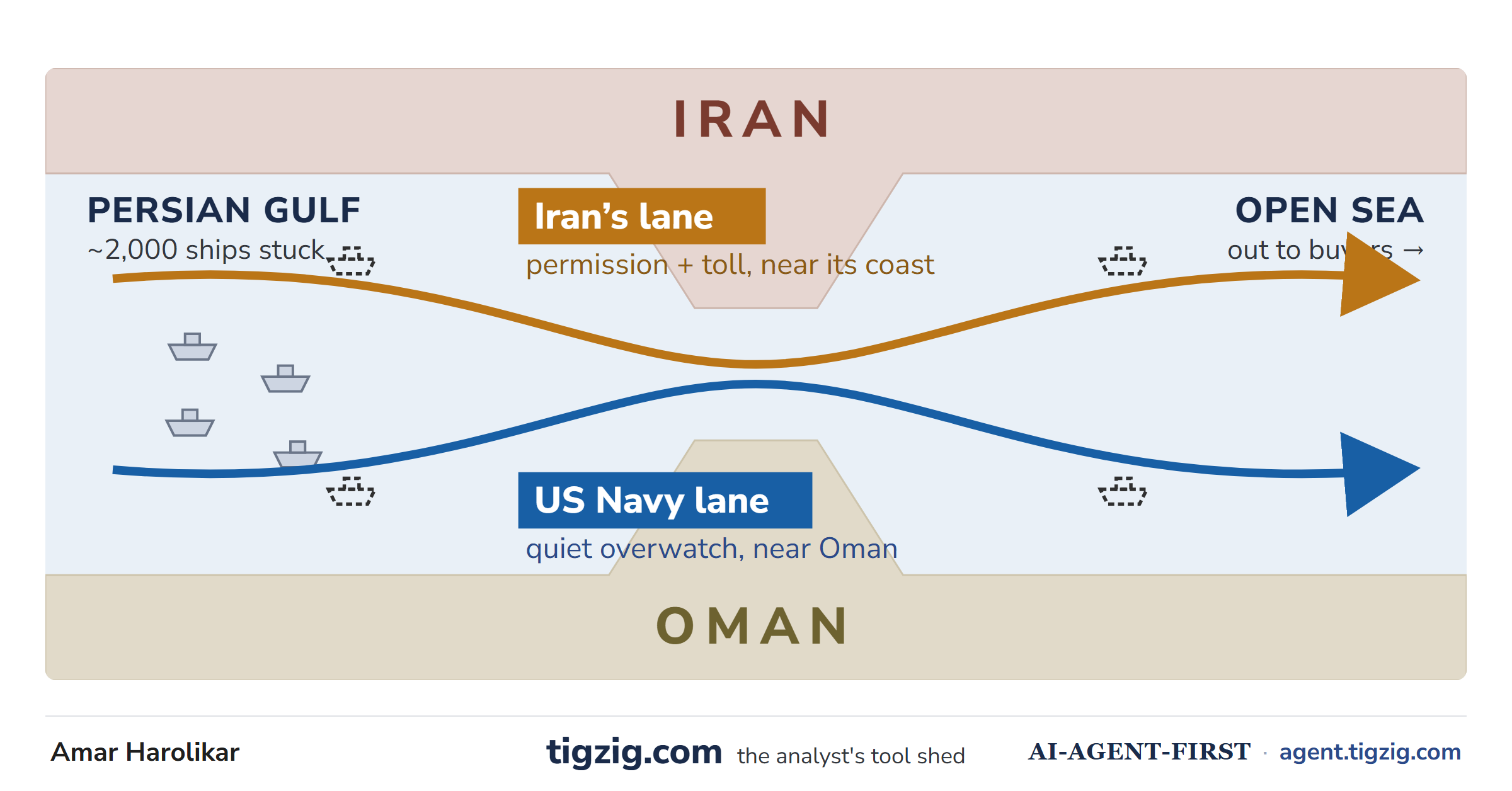
What is going on is this. The ships are not all getting out the same way. They are leaving through two separate lanes.
One is Iran's. The Revolutionary Guard set up a route close to the Iranian coast soon after the war started. You get permission, you pay a toll, you go. Cross without permission and they go after you. Most of the traffic has gone this way.. CSIS found that of the vessels that made it through since early March, over half were run by companies from just four countries, with China right at the top. Energy Aspects sees the same shape.. most ships are hugging the northern corridor near Iran, which points to Iranian approval.
The other lane is the Americans'. To get around Iran's route, the US Navy cleared mines and opened a second channel near Oman's coast, away from the Iranian guns. Over about three weeks, US Central Command guided roughly 70 ships in and out, sources told the New York Times. Officially, the US says it is not escorting anyone.. it is only communicating and coordinating with ships that want to cross. Richard Meade at Lloyd's List put it carefully.. "transit decisions remain solely with ship operators." Read between the lines and the Navy is telling ships it will knock down incoming threats, and telling them when to switch their signals off.
And about those switched-off transponders, because the obvious read is wrong. Going dark is not about hiding a supertanker from a navy. You cannot.. these things are hundreds of metres long and every radar and satellite in the area picks them up. On Iran's side, ships go dark to stay off the Western sanctions record, the same trick Iran's own shadow fleet has used for years. On the US side, they go dark so they are not broadcasting their exact position to Iran while they run the Oman channel, leaning on US radar instead. Either way it comes down to who is allowed to see you on paper.
And the two lanes put you in a bind. Use Iran's lane and you risk US sanctions.. Washington has already sanctioned Iran's new Persian Gulf Strait Authority and says any deal with Iran to cross is off limits. Use the US lane and you risk an Iranian attack.. fast boats have buzzed convoys, and the US has been shooting down drones aimed at ships. Per Kpler, of the roughly 895 ships that crossed between early March and mid-May, just over half took Iran's route and about 40% went by a route nobody can quite place. That 40% is the story.
Open doesn't mean that oil is gushing through
Best case... say the fighting stops, a deal gets signed, the strait reopens properly. Even then the oil does not come back at the speed of a press conference. The plumbing has been pulled apart and it has to be put back together.
Producers shut in something like 11 million barrels a day of output during the war, and they will not switch all of that back on until they trust the exports can actually move. Empty tankers have to sail back into a region they spent months avoiding. Insurance is still priced for a war zone, which makes a lot of routes uneconomic. And some of the damage was physical.. this was a real war, infrastructure got hit, people got killed.
Energy Aspects, the independent oil research shop, put it plainly in a note dated 2 June. Their own data shows fewer than 50 laden non-Iranian tankers got through in all of May. Their bottom line:
"Oil flow recovery will be slow, uneven and possibly incomplete."
They are even watching Gulf producers build new pipelines to go around Hormuz altogether.. the sort of thing you only do once you have stopped believing the old normal is coming back.
Where that leaves it
The worst case, the strait staying shut for good, is receding. That is the first decent news in a hundred-odd days and I am not going to pretend otherwise. The US and Iran are in the final stretch of a memorandum that would, over an interim 30 to 60 days, have both sides ease their blockades and let more ships through (Energy Aspects, CBS).
But look at what that deal actually is. Reuters, talking to people close to it, describes an interim bargain that leaves Iran battered but not broken, with the strait, in the words of one regional analyst, basically under Iranian control however the fees end up dressed. Which tells you the US lane is a workaround, not a fix. The thing that would actually fix this is one open waterway anyone can use without a toll from Tehran or a quiet nod from the US Navy. That has not happened. Right now it is two contested lanes, a trickle through each, and a ceasefire that got tested again this week when drones and missiles started flying around the Gulf.
So.. opening, yes. And that is real. Solved, no. The pain is mostly still ahead, but at a lower peak than the worst case we were staring at back in April.
Macro tools and prior analysis
- TREMOR - my macro early-warning to track charts and news tigzig.com -> TREMOR
- The April companion piece - The Masking Effect in Oil Markets
tigzig.com - the analyst's tool shed.
AI-agent-first .. point your agent at agent.tigzig.com
Sources
- CNBC - Ships in Persian Gulf quietly coordinate with U.S. Navy to exit Hormuz (4 Jun 2026)
- Fortune - The Strait of Hormuz is splitting into U.S. and Iranian lanes (1 Jun 2026)
- Lloyd's List - Stranded ships start to move as quiet US overwatch spurs Hormuz exits
- Reuters - More oil escapes Hormuz, keeping traders guessing (4 Jun 2026)
- Reuters - Crude tankers exit Strait of Hormuz with trackers switched off (10 May 2026)
- Reuters - War may end in interim deal that leaves Iran battered, unbowed (3 Jun 2026)
- Energy Aspects - Why the Strait of Hormuz won't reopen overnight (2 Jun 2026)
- CSIS - The Strait of Hormuz in 8 charts (22 Apr 2026)
- OilPrice (citing Reuters, Kpler, LSEG) - Oil tankers go dark to exit the Strait of Hormuz
- Al Jazeera - US-Iran ceasefire deal: what are the terms (8 Apr 2026)
- CBS News - Possible US-Iran agreement on Hormuz and ceasefire extension (Jun 2026)
Working on something similar? How I work covers the rates, the availability and what I take on.