Mutual Fund Daily AUM Is Now a Free Download: 2,200+ Funds Since 2019
Published: November 22, 2026
A fund's AUM moves with the market and with money coming in or going out. Take out the part its NAV explains and you get a rough estimate of net new money. Daily AUM for 2,200+ funds since 2019 is now one free file.
Caveat: estimating net flows is a tricky business
The market and investor money are the two big reasons, but there are others. A dividend payout takes money out of the fund. A scheme merger adds another fund's assets. A fund launch or a closed-end fund maturing shows as one large move. A unit split drops the NAV while the AUM stays the same. An ETF investor buys on the exchange, from another holder or a market maker, and that money does not reach the fund. The ETF's AUM rises only when a market maker or a large investor creates new units with the fund house, in large blocks, so the daily figure can trail the buying and come in lumps. And a fund house's figure can arrive late or repeat the previous day.
Expenses need no separate adjustment, since a fund's NAV is already after its expense ratio. I use the growth plan's NAV, since a payout plan's NAV drops on every payout. Direct and regular plans have different NAVs. One way to handle a fund with both is to weight the two NAV returns by each plan's size. Plan sizes come only as a quarterly average, so that weight is an approximation too.
Adjust for what you can. The method picks up large moves well. Small numbers are within its error, so I would not read much into them. Always run a backtest. Run your method on earlier months and compare it with AMFI's category level net flow, to see how far off you are and whether you are comfortable with that.
Tips for using the data
Daily AUM is for the whole fund, all plans together. Quarterly average AUM is a different number, for each plan, averaged over the quarter. The two should not be compared directly.
On a market holiday most funds have no figure. On a day when only the debt market is closed, most debt funds have none, while equity, liquid and overnight funds do. A total across all funds is low on those days.
Liquid and overnight funds have no daily AUM before 2025, and only on a few days until mid-Jun 2025. A total across all funds, or across a category, is reliable from 20 Jun 2025 only.
AMFI marks some figures with ^, the fund house's most recent figure. Most of these repeat the previous day's value.
A day's AUM usually appears on AMFI's page the next morning. Friday's usually appears on Monday or Tuesday.
Data quality
About 300 of the 2.3 million figures are data quality items. They are marked in the file and explained in the docs. Details in the data points below.
Get it
For your AI
"Download the daily AUM data from tigzig.com along with the methodology and validations, and help me analyze it"
For you
Downloads: tigzig.com ➜ Downloads https://www.tigzig.com/downloads
Live tool: tigzig.com ➜ MFPRO https://www.tigzig.com/mfpro
A few data points
The 300 data quality items. On some days a fund shows its sister fund's figure, a fund house's whole file is off, or rupees are printed under a crore heading. About 290 of these figures are blanked, each with a reason code, and 20 are corrected from rupees to crore.
A blank is never filled from the days around it. AMFI's own figure stays in a separate column on every row, so you can see what was changed.
About 160 large one-day moves, nearly all in overnight funds, are kept and marked. They look like real money moving in and out.
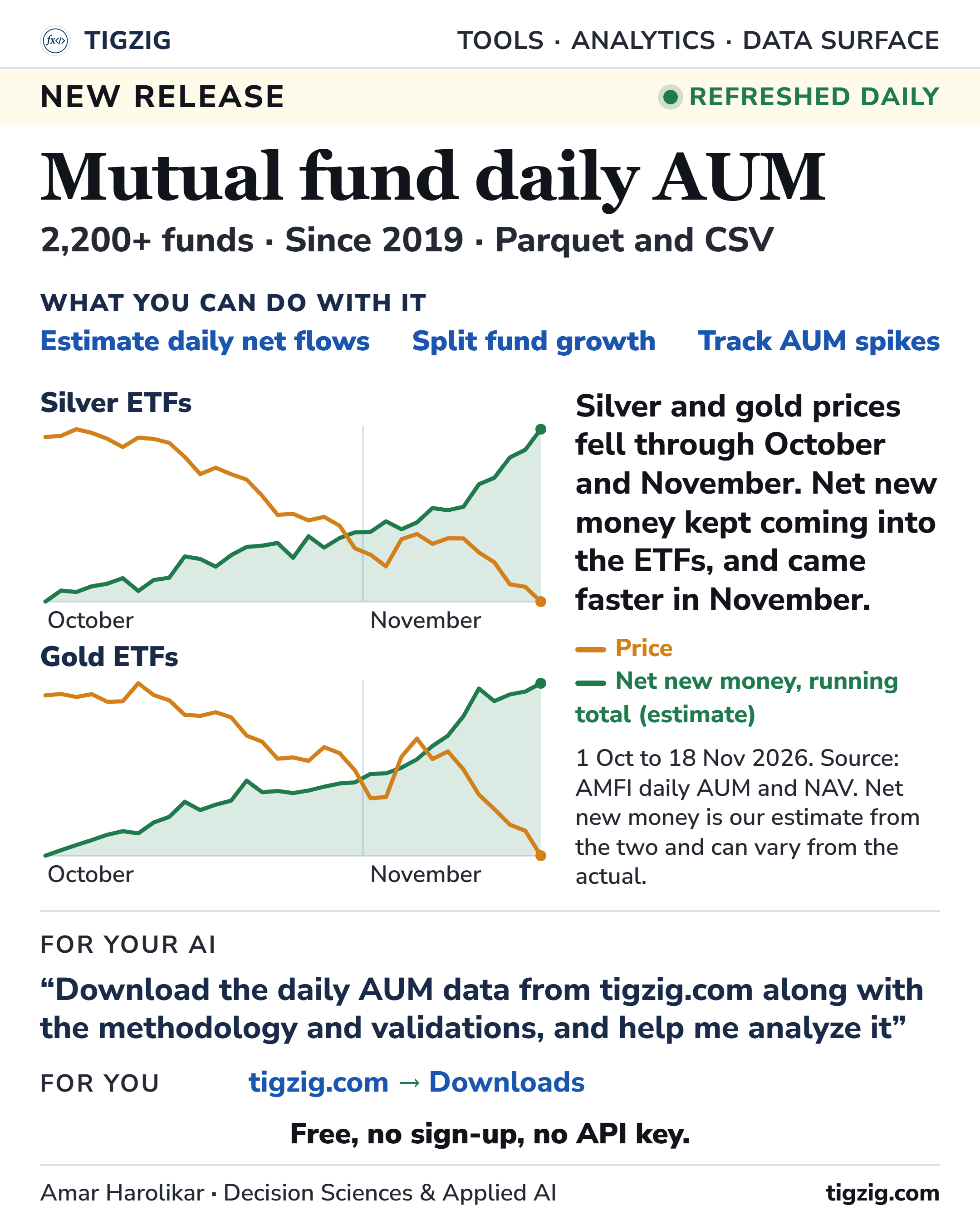
The silver and gold charts use ETFs only. Funds of funds hold the same ETFs, so adding them would count the money twice. The price line is the ETFs' NAV, and the money line is the daily change in AUM less the part the NAV explains, added up from 1 Oct. For October the estimate matches AMFI's monthly net flow for both gold and silver ETFs. November is to the 18th, and AMFI's figure is not out yet.
MFPRO shows the same AUM series as a chart on each fund's page, with the marked days listed beside it. https://www.tigzig.com/mfpro
Working on something similar? How I work covers the rates, the availability and what I take on.