Mutual Fund TER Now Includes Brokerage, Trading Costs and Taxes: A TER Can Look Much Higher While the Fund Costs the Same
Published: October 25, 2026
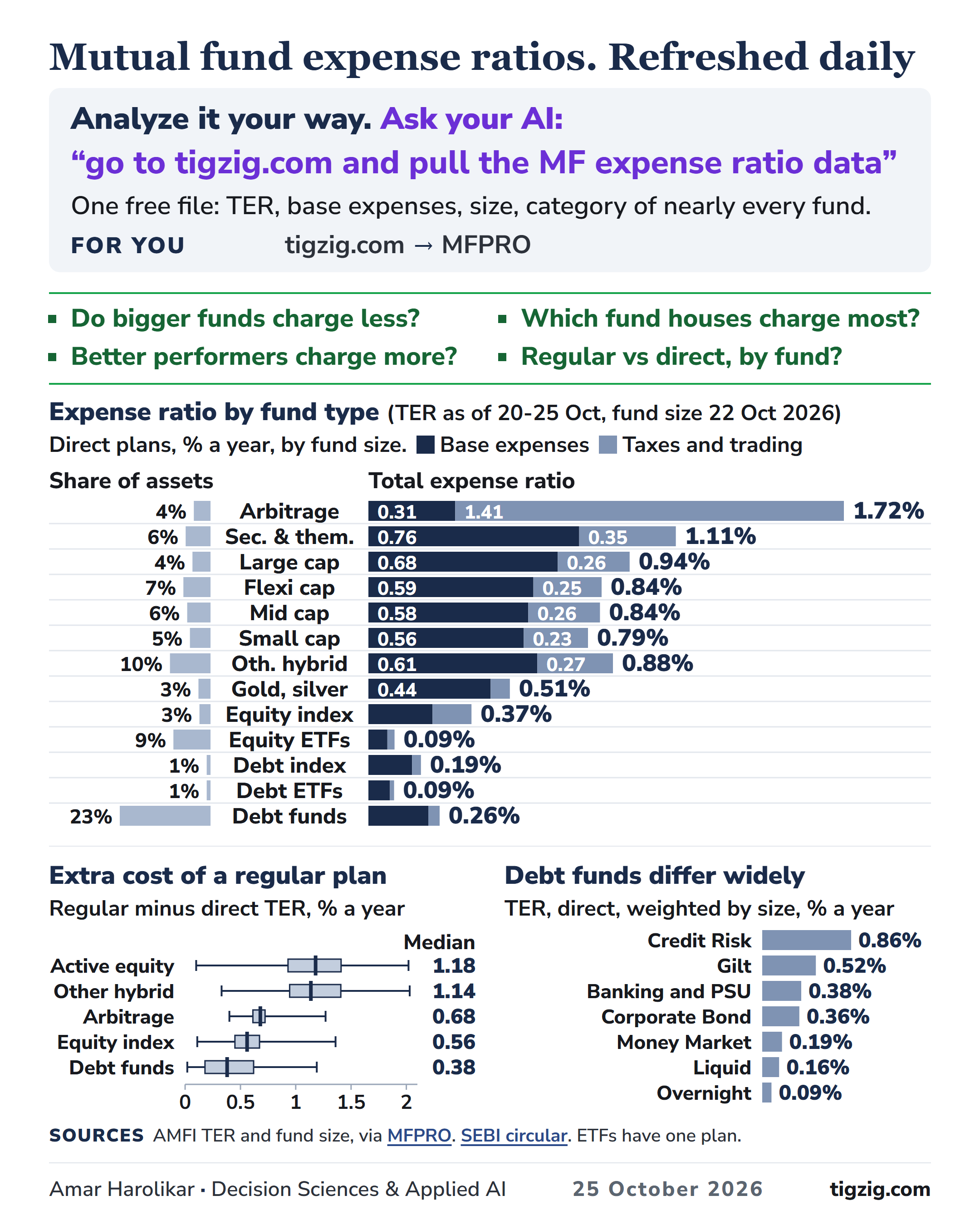
Since 1 April 2026, a fund's TER also shows the brokerage, trading costs and taxes on its own trades. These costs are not new. The fund always paid them, and now they are in the TER. A TER can look much higher while the fund costs (BER - Base Expense Ratio) the same.
The data is in one free file, updated daily from AMFI's filings. It has the TER and BER of both plans for nearly every fund, with fund size, category and scheme details.
Point your AI at it to pull the data and set it up the way you want.
For your AI
"go to tigzig.com and pull the MF expense ratio data"
For you
SIF funds are in the same file, marked in its source column. They also have their own files.
Some more points on expense ratios
Before April, AMFI's daily TER filing showed the base TER, GST on it and a small additional expense allowance. Brokerage and taxes on trades such as STT and stamp duty were paid by the fund outside the TER. Now the TER is the base expense ratio plus brokerage, transaction cost and statutory levies, per SEBI's master circular of 20 Mar: sebi.gov.in/legal/master-circulars/mar-2026/master-circular-for-mutual-funds_100491.html
The base expense ratio covers the fund's recurring costs, including the fund house fee, and distributor pay in regular plans. Statutory levies include GST on it, so for debt funds most of the gap between TER and base is that GST.
Brokerage, transaction cost and statutory levies are each an annualized average of the daily cost from 1 April to the end of the previous month, per AMFI's notes on its TER page. They are recomputed once a month and stay the same through the month.
A new fund can show a very high figure initially.
SEBI's rules have all expenses taken into the NAV, with the fee accrued day by day.
Coverage notes
About 240 funds have no TER in the file yet, mostly Nippon's ETFs such as Nifty 50 BeES and Gold BeES, and Motilal Oswal funds. The file links a fund to its TER only by its SEBI scheme code, and for these funds that link is missing. I plan to add a checked mapping for these soon.
ETFs have one plan. Fund houses file it in either the regular or the direct columns, so read whichever is filled.
Fund size is the whole fund across all plans, as AMFI publishes it daily.
Working on something similar? How I work covers the rates, the availability and what I take on.