The Whole VIGIL India Red Flag Database Is Now Published for Download. One API Call Takes the Lot.
Published: September 2, 2026
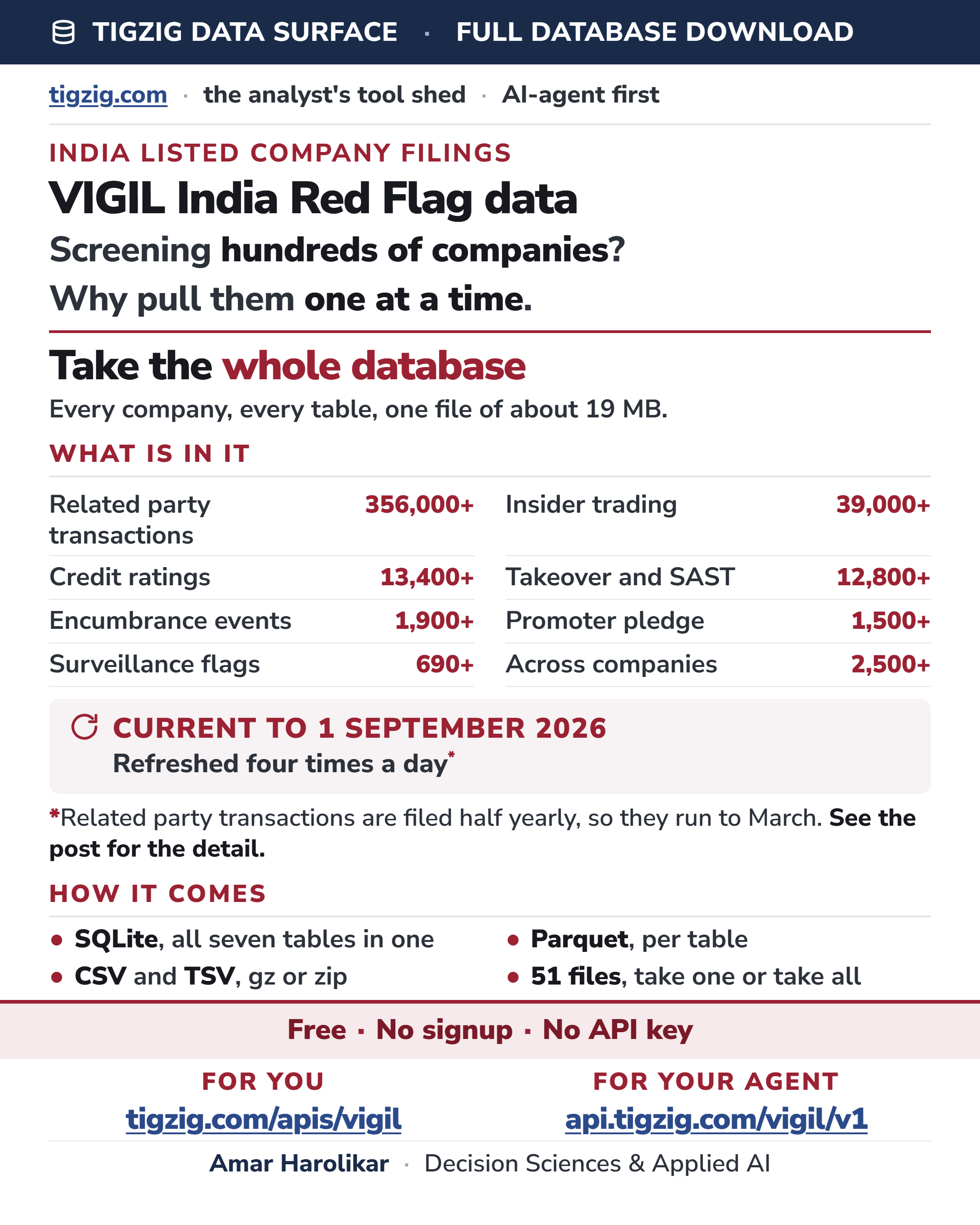
The whole VIGIL India red flag database is now published for download. So if you are screening a few hundred companies one API call at a time, take the lot instead. A single API call downloads the whole database. Or download it manually if you would like.
If you are going to schedule this rather than pull it by hand, read the manifest first. It sits at api.tigzig.com/vigil/v1/downloads/manifest and carries the row counts, the file sizes and a generated_at stamp, so a job can check whether anything has changed before it downloads anything.
The files answer conditional requests as well. Send If-None-Match with the ETag you got last time and you get back a 304 with no body when nothing has changed. The rebuild runs four times a day, so a job polling more often than that is downloading the same bytes over and over, and that one header removes all of it.
It is current to 1 September and rebuilt four times a day. Related party transactions are the exception, because those are filed half yearly and run to March, and the next set arrives once the September half closes.
Docs
- For you: tigzig.com/apis/vigil
- For your agent: api.tigzig.com/vigil/v1
What is in it
The downloads and APIs cover related party transactions, insider trading, credit ratings, promoter pledge, encumbrance events, takeover and SAST filings, and the surveillance flags.
Around 2,500 listed companies and about 426,000 rows in all.
One SQLite file with all seven tables in it comes to roughly 18 MB. If you only want a slice, every table is published on its own as parquet, CSV or TSV, gzipped or zipped, which is 51 files in total.
Detailed docs, the data dictionary, how the data is pulled, the validations carried out and the anomalies detected are all available on the VIGIL site in their respective sections: tigzig.com/vigil
A few quick points on the data
Related party transactions is the largest by a wide margin, and these are filed on a consolidated basis, so a company's rows cover the listed entity together with its subsidiaries rather than the parent on its own. Some groups file under several hundred entity names, which is worth knowing before you count rows per company and read it as activity.
Credit ratings, insider trading, the takeover and SAST filings and the encumbrance events accumulate over time, so they are event streams you can run a date filter over. Promoter pledge and the surveillance flags are current snapshots instead, replaced on each run, so they tell you where things stand today and carry no history.
Working on something similar? How I work covers the rates, the availability and what I take on.