US Unemployment Is 4.3%. The Stuff Underneath Says Otherwise. 2M Jobless Over Six Months, Up 3 Straight Years.
Published: June 11, 2026
US unemployment is 4.3%. The curve even looks like it is calming down. The data underneath says otherwise. 2 million Americans have now been jobless for more than half a year. Nearly double of early 2023. Three straight years of rising, with no give-back.
The headline moved 3.5% to 4.3% during that time. When long-term unemployment pulls away from the headline like this, that is the 2008 pattern. Covid never had this shape, rehiring was too fast. This one is a slow grind.
It also fits the picture from my last week's note: consumer sentiment at a 73-year low, valuations near 145-year highs.
And the question I keep coming back to: is AI doing to the jobless floor what dot-com did? Too early to call. Watching it.
Analysis, tools and early warning indicators at: tigzig.com
US Labour Market Note - 5-Slide Deck
Browse the slides or download the PDF
Full Deck Content (Text Format)
Text below was extracted from the source deck. Chart visuals stay in the PDF and as slide images above the post.
Slide 1 - The 4.3% is hiding a problem
US unemployment · May 2026 data
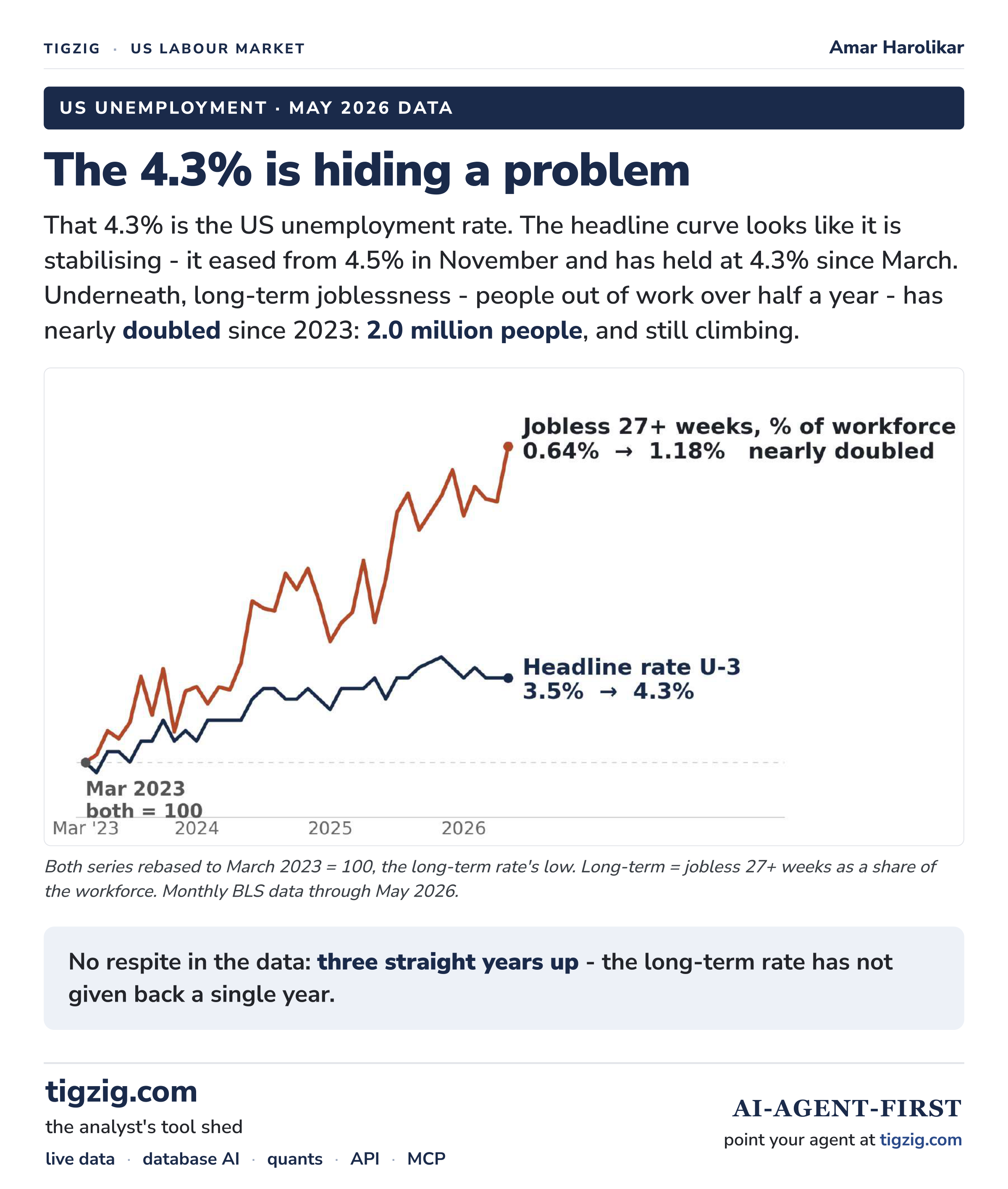
That 4.3% is the US unemployment rate. The headline curve looks like it is stabilising - it eased from 4.5% in November and has held at 4.3% since March. Underneath, long-term joblessness - people out of work over half a year - has nearly doubled since 2023: 2.0 million people, and still climbing.
Chart: long-term unemployment rate vs headline U-3, both rebased to March 2023 = 100 (the long-term rate's low). Long-term = jobless 27+ weeks as a share of the workforce. Monthly BLS data through May 2026.
No respite in the data: three straight years up - the long-term rate has not given back a single year.
Slide 2 - We have seen this shape before
Angle 1: the crisis signature
Chart: headline U-3 (navy) and the long-term rate (terracotta), both rebased to January 2006 = 100. Shaded bands = recessions.
Into 2008 the long-term line did not just rise - it towered over the headline, about 6x its pre-crisis level while U-3 only doubled. That divergence is the signature of a market where people stop getting re-hired.
Covid was the exception: millions did cross 27 weeks, but rehiring was so fast the surge unwound within about a year. Today's rise has the slow-grind 2008 shape.
The gap is opening again - with no recession to blame. That is the red flag.
Slide 3 - The mix is moving to the part that scars
Angle 2: composition
Chart: every unemployed person, split by how long they have been jobless. Each month adds to 100%. The terracotta band (27+ weeks) is the story.
When the terracotta band widens, it means the people who lost their jobs months ago are still searching - re-hiring has stalled. That is exactly what it has been doing since 2023.
The long-term share fell to 17.8% after Covid (Feb 2023). It is back to 27.5% now. The GFC extreme was 45.5%.
Short-term unemployment is healthy churn. Long-term is the part that scars - skills fade, employers screen it out. More than one in four of the unemployed are now past that line.
Slide 4 - Is AI the next dot-com?
Angle 3: the structural question
Chart: the long-term rate (grey line) with its average in each calm stretch between crises (terracotta bars). One step up, then a 15-year plateau.
Measured against the whole workforce, long-term joblessness has stepped up once in 25 years: from 0.53% to 0.81% in the dot-com era, when work moved to the web. The GFC and Covid spiked and fell back - cyclical episodes, both of them.
This cycle has not played out: 1.18% in May and still rising - it has not topped out, let alone settled.
*Too early to call. The test comes when this cycle finally turns: does the rate settle back near 0.8%, or on a new, higher floor? That is the chart to watch.*
Slide 5 - Previous analysis, data tools, sources & method
Previous analysis - this series
Markets at a record while the economy hurts - peak valuations, record-low consumer sentiment. 8 Jun 2026.
Irrational exuberance: S&P at 7,400 - the last two times this setup held, the index halved. 17 May 2026.
Are we headed for stagflation-lite? - the Fed caught between inflation and weak jobs. 28 Mar 2026.
The data tools
U-1 (15+ weeks), U-3 and U-6 are live on tigzig.com -> Tremor - a macro early-warning dashboard, 100+ indicators with validation built in. The 27+ duration series came via FRED.
Agent-first portal with MCP servers and free APIs: agents.tigzig.com - point your AI at it.
Sources & method
BLS household survey, via FRED: U-3
UNRATE· durationUEMPLT5UEMP5TO14UEMP15T26UEMP27OV(27+ wks = "long-term"). Pulled 10 June 2026; cross-checked to the BLS Employment Situation.27+ share = long-term / total unemployed. 27+ rate = long-term / workforce.
BLS seasonally adjusts each duration series independently, so the buckets sum to total unemployment with a small residual. The survey samples ~60,000 homes, so single months are noisy. October 2025 has no reading (government shutdown).
Working on something similar? How I work covers the rates, the availability and what I take on.