The Warnings on the AI Bubble Keep Getting Stronger
Published: November 16, 2026
The warnings on the AI bubble keep getting stronger. In the last two weeks they have come from the Fed, the IMF, the Bank of England, the BIS and a Nobel Prize winning economist.
The Fed
In a New York Fed survey of market contacts, AI was the most cited risk, with concerns about valuations and financing. Vice Chair for Supervision Michelle Bowman said on 10 Nov that if AI revenues fall short "we could see a sharp correction in equity prices for AI firms, higher financing costs, and reduced access to credit."
IMF
Managing Director Kristalina Georgieva, 16 Nov: "We have a world economy that is standing on one leg on the AI leg. If this leg wobbles, that can lead to financial stability troubles."
Bank of England
Governor Andrew Bailey, 9 Nov: "Bubble spotting is an imprecise science. But, let's recognise that such a risk exists, which we should do."
BIS
Alexandre Tombini, its chief representative for the Americas, 3 Nov:
▸ "The optimism surrounding AI in financial markets may not last, despite its transformative promise."
▸ "Disappointment in returns could trigger a sudden stop in financing, with potential knock-on effects on financial markets."
NBER paper
A new NBER working paper from Columbia Business School maps the debt and contracts behind the AI build-out. In its model, debt pays for nearly 60% of the new investment. In its low-productivity case, investors lose $16.9T, against $8.8T without the new build-out. Lenders lose about 42% of what they put in.
Stiglitz
Nobel Prize winning economist Joseph Stiglitz, 14 Nov: "I think the AI bubble is a bubble."
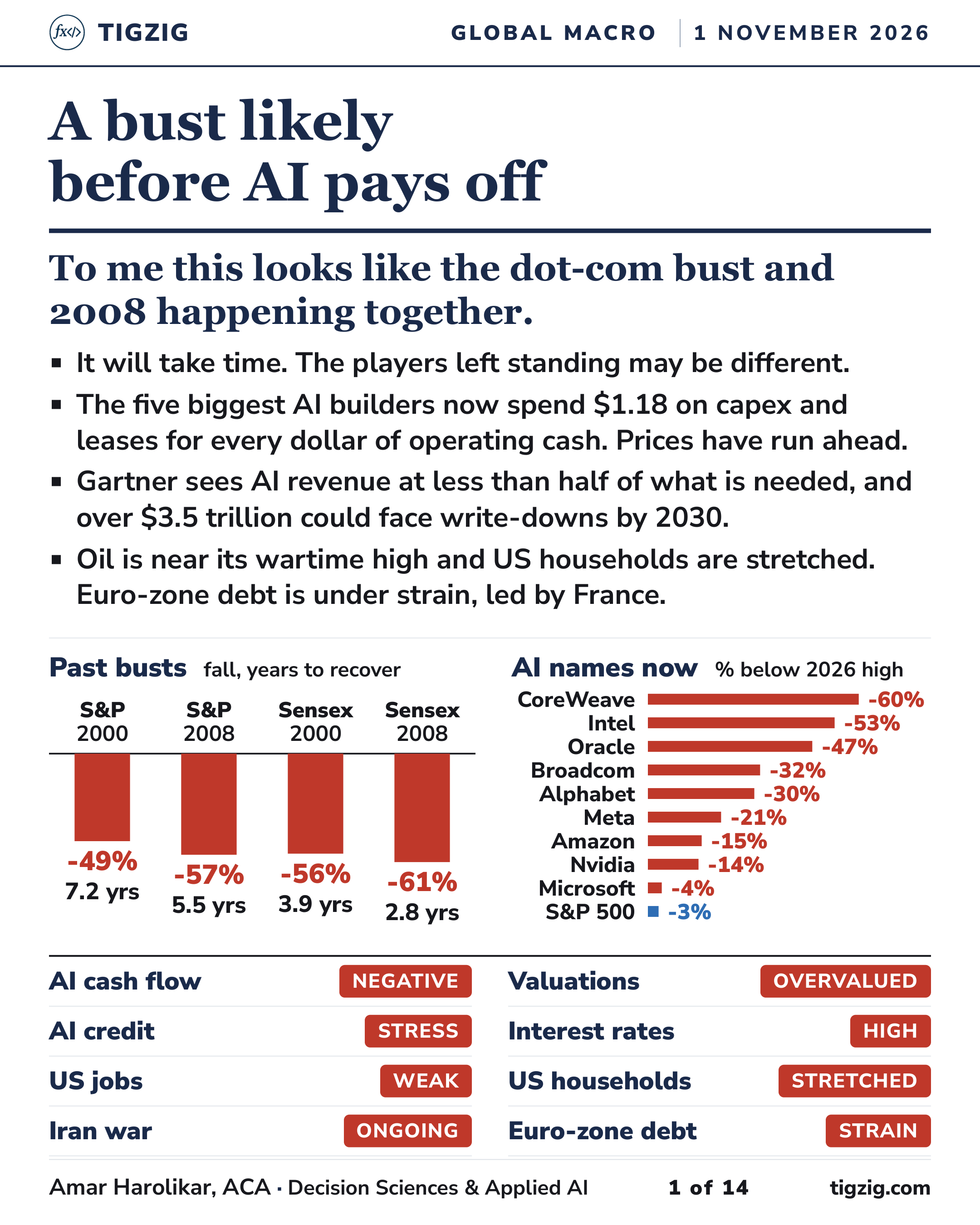
My earlier analysis: A bust likely before AI pays off, 1 Nov
tigzig.com/post/ai-selloff-red-flags-piling-up-nov2026
A few quick points
▸ The Fed survey was run by New York Fed staff in September and October with 23 contacts at broker-dealers, banks, funds and advisers. The Fed says it is not its own view. AI-enabled cyberattacks were also among the AI concerns.
▸ The Bowman and Tombini speeches carry the usual note that the views are their own.
▸ The IMF estimates circular financing among AI companies at a little over $1T, two-thirds of it debt-funded. Georgieva: "It's not a huge size, but it is a rapid increase." (CNBC)
▸ They also see the upside. Bowman says AI is "boosting economic growth and productivity". She also says the banks, insurers and funds with exposure to AI financing are mostly "well capitalized and have stable funding", though the complex structures make counterparty risk hard to assess. The Fed's report says the banking sector "remained sound and resilient overall".
▸ Georgieva called recent market swings "orderly". Bailey, in the same Zurich speech: "I am an optimist on AI, digital technology and most probably robotics too."
▸ Stiglitz added: "You can't tell a bubble until it breaks. But you can be fairly sure." (Mint)
On the NBER paper
▸ It is a working paper by Stijn Van Nieuwerburgh and Zijin Su, first draft 1 Nov. It has not been peer reviewed yet.
▸ The model has three outcomes for AI productivity: very good, middle and very bad. The authors set the chances at 25%, 50% and 25%. The $16.9T loss is the very bad case, the one where AI adds little to productivity.
▸ In that case shareholders lose $14.6T and lenders $2.1T.
▸ The model's firms build 277.5 GW of new compute, 55% more than the paper judges best for society, because each firm does not count the revenue it takes from its rivals.
▸ Earlier warnings: a crescendo on AI debt and returns, 23 Oct
tigzig.com/post/ai-warnings-crescendo-oct2026
▸ The IMF's manifesto of warnings, 17 Oct
tigzig.com/post/imf-warnings-ai-credit-strain-oct2026
▸ Is this the first card in a domino? SoftBank, 10 Nov
tigzig.com/post/softbank-first-domino-write-off-nav-fall-nov2026
This is my analysis of public sources, for information only. Not investment advice
Working on something similar? How I work covers the rates, the availability and what I take on.