IMF's Manifesto of Warnings: In the Same Week, AI Credit Came Under Strain
Published: October 17, 2026
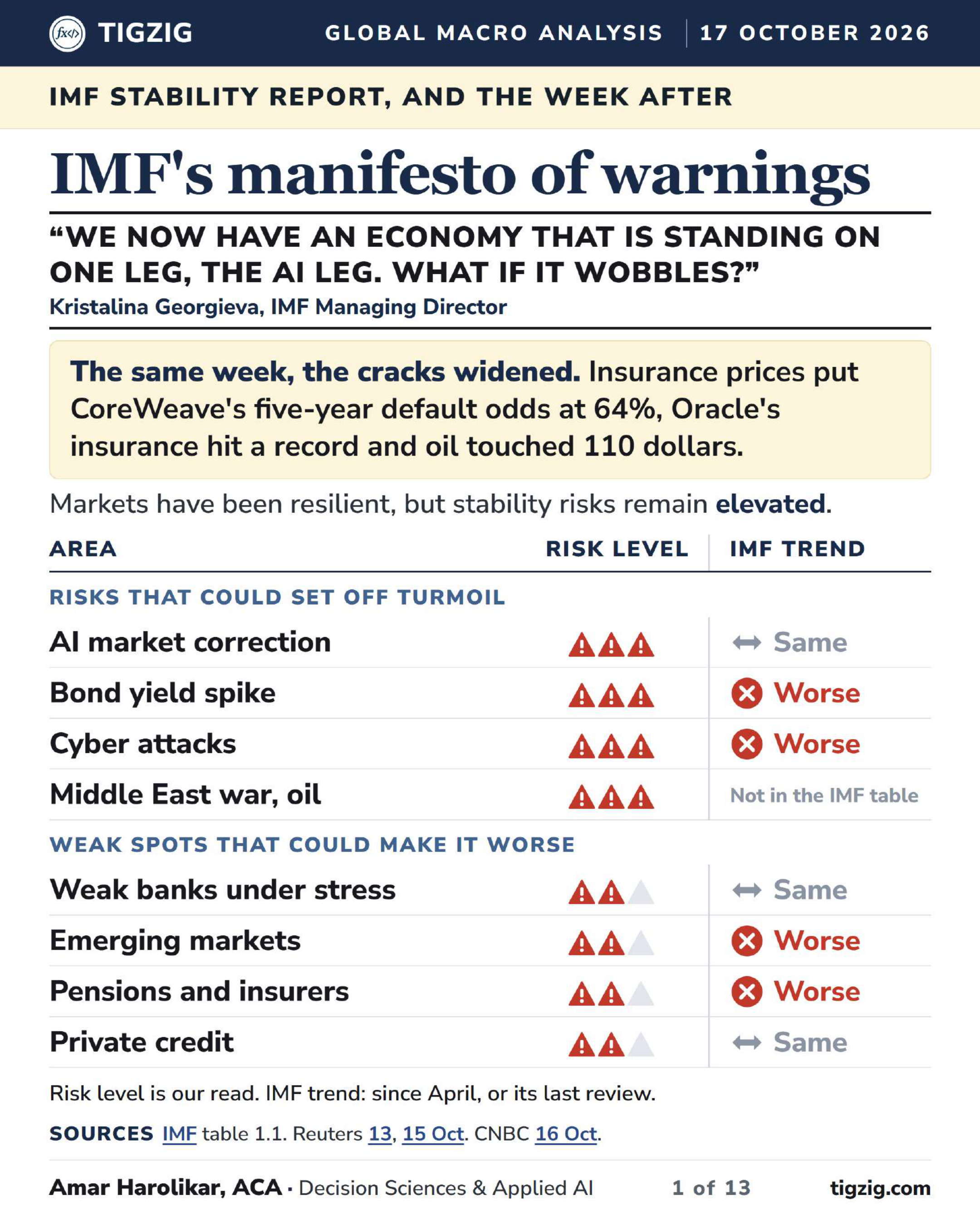
In the week the IMF warned about AI, bond yields and cyber attacks, AI credit came under strain. Insurance on CoreWeave's debt passed 1,000 basis points and Oracle's hit a record. The timing was a coincidence. I do not know yet if this is the start of something bigger or a short down cycle, but my sense is that where one crack shows, more tend to follow.
And the warnings have been piling up all year, from the BIS in June to the Financial Stability Board chair and the bond market in September.
The IMF says markets have been resilient, but stability risks remain elevated. Of the three risks it sees setting off market turmoil, bond yields and cyber attacks are getting worse, and an AI correction is about the same.
It counts 14 circular AI deals since 2023, about 300 billion dollars of equity and 650 billion of debt in exchange for 1.4 trillion of future orders. It calls this wrong-way risk, where the stakes and loans lose value at the same time as the orders tied to them.
The same week, AI-linked shares fell hard. CoreWeave fell 25%, and its insurance price implies a 64% chance of default within five years, from about 30% a year ago. Brent closed near 110 dollars, its highest close since May.
Ten-year yields in the US, UK, Germany and Japan all hit their highest in 17 to 30 years this year.
Free cash flow at the five hyperscalers fell from 70 billion dollars in the September 2023 quarter to 2.2 billion in the June 2026 quarter. Alphabet, Amazon and Oracle were negative, and Microsoft carried most of what was left. Their debt went from 259 to 483 billion over the same period.
What is holding: the IMF raised world growth for 2026 to 3.1%, banks stay broadly resilient in its stress test and household debt burdens have eased. Those forecasts assume oil averages 96 dollars this year.
Previous analysis at tigzig.com/analysis
A few points on the numbers
The IMF trend column compares with April, or with when the IMF last looked at a risk. Cyber was not in the April report. The risk level triangles are my read, and the Middle East war row is my addition, since the IMF table does not score it.
The 64% is Reuters' conversion of CoreWeave's insurance price at 1,000 basis points. Insurance prices include a premium for risk, so they tend to run above the real chance of default.
Free cash flow is operating cash minus capital spending and finance lease repayments, as in my 28 September analysis. Oracle's quarters end a month early. The five's equity grew faster than their debt, so the strain is in cash flow more than on their balance sheets.
The growth forecasts are from the IMF World Economic Outlook, as reported by Reuters. Its sharp AI unwind scenario takes 0.4% off world output by 2028 directly, and 1.1% once falling asset prices and higher yields are added.
Oracle's default insurance was 139 basis points in December 2025 (Reuters) and 282 on 15 October (CNBC).
Prices are Yahoo Finance closes to 16 October. Yields are from FRED, the Bank of England, the Bundesbank and Japan's finance ministry. The deck has all the sources with hyperlinks.
My earlier analysis on this
The AI build meets the bond rout, 28 September. Capital spending took 99% of the five hyperscalers' operating cash in the June quarter, and their borrowing nearly doubled: tigzig.com/post/ai-hyperscalers-debt-bond-rout-sep2026
The bond market rout, 25 September. The US 10-year closed above 5% for the first time since 2007: tigzig.com/post/bond-market-rout-sep2026
Andrew Bailey, who chairs the Financial Stability Board, warned the G20 on 28 August that markets remain vulnerable to a disorderly correction: tigzig.com/post/fsb-chair-bailey-warning-sep2026
A correction in AI valuations is looking more likely, 31 August, argued by ECB economists, an asset manager and a bond investor: tigzig.com/post/ai-valuation-correction-aug2026
The BIS, the central bank for central banks, charted the AI boom beside railway mania and the dot-com boom in June: tigzig.com/post/bis-ai-boom-red-flag-central-banks-jun2026
IMF's Manifesto of Warnings, October 2026
Browse the slides or download the PDF
Full Deck Content (Text Format)
Text below was extracted from the source deck. Chart visuals stay in the PDF and as slide images above the post.
Slide 1
TIGZIGGlobal Macro Analysis 17 October 2026
IMF stability report, and the week after
IMF's manifesto of warnings
"We now have an economy that is standing on one leg, the AI leg. What if it wobbles?"Kristalina Georgieva, IMF Managing Director
The same week, the cracks widened. Insurance prices put CoreWeave's five-year default odds at 64%, Oracle's insurance hit a record and oil touched 110 dollars.
Markets have been resilient, but stability risks remain elevated.
| Area | Risk level | IMF trend |
|---|---|---|
| Risks that could set off turmoil | ||
| AI market correction | Same | |
| Bond yield spike | Worse | |
| Cyber attacks | Worse | |
| Middle East war, oil | Not in the IMF table | |
| Weak spots that could make it worse | ||
| Weak banks under stress | Same | |
| Emerging markets | Worse | |
| Pensions and insurers | Worse | |
| Private credit | Same |
Risk level is our read. IMF trend: since April, or its last review.
SourcesIMF table 1.1. Reuters 13, 15 Oct. CNBC 16 Oct.
Amar Harolikar, ACA · Decision Sciences & Applied AI1 of 13tigzig.com
Slide 2
TIGZIGThe three risks
Three risks could set off market turmoil, the IMF says. Two are getting worse
| 1. AI market correction | 2. Sharp rise in bond yields | 3. Cyber attacks | |
|---|---|---|---|
| IMF trend | Same | Worse | Worse |
| Trigger | AI investment and profits turn out weaker or less durable | Inflation returns, or fiscal worries push up yields | A successful attack on a key bank or market system |
| Context | Core AI firms are profitable and valuations have eased, but leverage is rising | Bonds price almost every other asset, and debt and rollover risks are unresolved | Finance is more digital and relies on a few cloud and software providers |
| Key fact | Growing evidence that AI can be delivered with less investment | A rise could come in a disorderly way | Almost no time to patch in over 70% of exploited flaws this year, up 20 points |
| IMF: impact could be | SIGNIFICANT | SEVERE | SEVERE |
These risks alone do not necessarily threaten stability, the IMF says. They could become systemic if weak spots amplify them (page 10).
SourceIMF, Global Financial Stability Report, October 2026, chapter 1 and table 1.1.
Amar Harolikar · Decision Sciences & Applied AI2 of 13tigzig.com
Slide 3
TIGZIGCircular AI deals
14 circular AI deals since 2023 carry what the IMF calls wrong-way risk
Wrong-way risk: the stakes and loans lose value at the same time as the orders tied to them.
"If there are questions about the monetization in AI, the equity investments will deplete in value, the debt may be difficult to service, and the revenue commitments in the future may not materialize." Jason Wu, IMF assistant director, report briefing, 13 Oct, on a "triple whammy"
Investors About 10 firms, led by the hyperscalers. Generally financially sound. AI firms Financially weaker AI firms. A handful get much of the money. 300 billion dollars invested as equity 1.4 trillion dollars of future orders, for cloud services and chips Plus 650 billion dollars of debt raised in the deals, about 320 billion of it by the AI firms
The IMF does not name the firms. Deals of this shape include Amazon, Google and Microsoft, which invest in Anthropic and sell it computing, and Nvidia, which backs CoreWeave and has such deals with OpenAI.
SourcesIMF. Wu: CNBC. Examples: Reuters, via my IPO post and 15 Oct, 16 Oct.
Amar Harolikar · Decision Sciences & Applied AI3 of 13tigzig.com
Slide 4
TIGZIGThe hyperscalers
Hyperscaler free cash flow is near zero. The build is turning to debt
The five: Alphabet, Amazon, Meta, Microsoft and Oracle.
The IMF adds that their balance sheets are still strong. Their equity grew faster than their debt, and some are raising more.
Share of new investment-grade bonds corporate bonds issued by hyperscalers, % of world <1 2024 10 2026
Debt of the five billion dollars 259 Sep 2023 483 Jun 2026
Spending as % of cash capital spending and lease repayments, % of operating cash 36% Q3 2023 99% Q2 2026
Stock-market leverage hedge fund gross stock positions plus margin loans, % of advanced-economy GDP ≈11 2021 peak 10 End 2024 ≈15 Mid 2026
Free cash flow of the five, billion dollars a quarter
Cash from operations minus capital spending and finance lease repayments
33 2023 60 70 54 57 2024 58 60 59 41 2025 36 60 47 6.7 2026 2.2
SourcesIMF figs 1.2, 1.1.4 (2021 read off chart). The five: SEC filings, Oracle to Aug 2026, Q2 2026 leases for 4 of 5; my 28 Sep analysis.
Amar Harolikar · Decision Sciences & Applied AI4 of 13tigzig.com
Slide 5
TIGZIGBond markets
Bond market risk is worse than in April, the IMF says
A rise in yields could come in a disorderly way. Unresolved public debt and rollover risks raise the chance.
Hedge funds held about 9% of US Treasuries in 2025, up from 4% in 2022, mostly through leveraged trades.
So far, market functioning has been orderly, the IMF says, and some leveraged bond trades have unwound without stress. In the report week the US 10-year fell from 5.21 to 5.09.
Can markets absorb it all? Markets worry about huge issuance from governments and companies, said the IMF's Athanasios Vamvakidis.
10-year government bond yields, %
This year, 10-year yields in all four hit their highest in 17 to 30 years.
United States 1995 2005 2015 2025 2026 high 5.31 2002 5.09 United Kingdom 1995 2005 2015 2025 2026 high 5.48 2000 5.42 Germany (data from 2005) 1995 2005 2015 2025 2026 high 3.66 2009 3.45 Japan 1995 2005 2015 2025 2026 high 3.11 1996 2.95
SourcesIMF, Reuters. Yields via TREMOR (FRED, BoE, Bundesbank, Japan MoF), US Treasury for 16 Oct. UK: BoE zero-coupon 10-year, to 14 Oct. Japan to 15 Oct.
Amar Harolikar · Decision Sciences & Applied AI5 of 13tigzig.com
Slide 6
TIGZIGThe report week
The same week, insurance prices put CoreWeave's odds of default at 64%
13 to 16 October 2026. Hotter US inflation data added to the sell-off.
"CoreWeave is quickly becoming the AI trade's canary in the coal mine." Kathleen Brooks, XTB, to Reuters
Chance of default in five years Implied by the price of insurance on its debt
- ≈30% A year ago 64% 15 Oct
Bond yield Sold in June, % 9.7% Sold in June 15% This week
Share price Dollars. Down 56% from May, 25% this week Jan Apr Jul Oct 138 61
Insurance on its debt passed 1,000 basis points, a level seen as distress, and reached about 1,200 this week.
Losses: a net loss of 1.2 billion dollars on 5.1 billion of revenue in 2025. It plans 35 to 39 billion of spending this year.
The other side: a 104 billion dollar backlog at end-June, over 25 billion more since, and Nvidia will buy unsold capacity to 2032.
IMF: neoclouds carry more debt and less profit, and could be weak links.
SourcesCNBC 15 Oct. Reuters 1, 2, 3, 4, 5. Yahoo Finance. IMF.
Amar Harolikar · Decision Sciences & Applied AI6 of 13tigzig.com
Slide 7
TIGZIGThe report week
AI-linked shares were falling before the report, and fell hard that week
Prices to 16 Oct 2026. Red dot: 2026 peak. Oracle adjusted for dividends.
Oracle shares Down 48% from June, 9% this week
- Jan Apr Jul Oct 246 128
Oracle default insurance 5-year swap, basis points 139 Dec ’25 282 Oct ’26
Nebius, a neocloud Down 42% from June, 25% this week Jan Apr Jul Oct 287 165
KOSPI, Korea Down 38% from June, 14% this week Jan Apr Jul Oct 9,115 5,668
S&P 500 2% below its 6 Oct record Jan Apr Jul Oct 7,819 7,659
Credit spreads for Amazon, Alphabet, Meta and Nvidia are also at records, though rising much more slowly, and they have stronger balance sheets.
The other side: TSMC posted a sixth straight record profit and sees fourth-quarter revenue up 58% on a year earlier.
SourcesYahoo Finance. Reuters Dec 2025, 15 Oct, 16 Oct. CNBC 15 Oct, TSMC.
Amar Harolikar · Decision Sciences & Applied AI7 of 13tigzig.com
Slide 8
TIGZIGThe report week
The same week, oil hit 110 dollars and finance leaders planned drills for AI cyber attacks
13 to 16 October 2026
Oil
Brent crude, dollars a barrel January to 16 October 2026 Jan Apr Jul Oct 118 110
Brent closed near 110 dollars on 16 October, its highest close since May, as Iran stepped up attacks on ships in the Strait of Hormuz.
IMF: oil at 130 dollars into 2027 would cut 2027 world growth by half a point and lift world inflation to 5.2%, its World Economic Outlook says.
AI cyber risk
In over 70% of cases this year, software makers had almost no time to patch a flaw before it was exploited, 20 points more than a year ago. IMF
G7 finance leaders
Signed off exercises against AI cyber attacks. The IMF warns that frontier AI helps attackers as well as defenders.
Bank of England
Banks can no longer assume their defences are immune to AI-enabled cyber attacks, its deputy governor said.
SourcesCNBC 16 Oct. Reuters 13 Oct, 16 Oct. IMF. Brent: Yahoo Finance.
Amar Harolikar · Decision Sciences & Applied AI8 of 13tigzig.com
Slide 9
TIGZIGWhat is holding
What is still holding, the IMF says
"The global economy has been resilient, but that resilience is reaching its limits." Silvana Tenreyro, IMF chief economist, 13 Oct
IMF growth forecast for 2026, %
Change since July, points World 3.1% +0.1 India 7.0% +0.6 China 4.5% -0.1 United States 2.3% no change United Kingdom 1.3% +0.3 Euro area 1.1% +0.2
AI investment is the main support, offsetting the oil shock. World growth is seen at 3.4% in 2027.
Banks would stay broadly resilient in the IMF stress test, and household debt burdens have eased.
Even a sharp AI unwind is unlikely to mean a global recession, Petya Koeva Brooks of the IMF told Reuters. That scenario takes 0.4% off world output by 2028 directly, and 1.1% with falling asset prices and higher yields.
These forecasts assume oil averages 96 dollars a barrel this year and Hormuz reopens by March 2027.
The catch: only 32 countries now produce 95% of world growth, down from 54 in April.
SourcesIMF World Economic Outlook, as reported by Reuters 13 Oct, 13 Oct. IMF GFSR.
Amar Harolikar · Decision Sciences & Applied AI9 of 13tigzig.com
Slide 10
TIGZIGThe weak spots
The weak spots that could turn a shock into a crisis
Banks Medium risk
In the IMF stress test (AI correction, energy shock, long yields up 300 basis points) the system stays well capitalised, but banks holding 22% of global bank assets end up weak, up from 18%, mainly because this year's test is harsher. US bank lending to non-banks is up 18% this year: manageable but growing, the IMF says.
Private credit Medium risk
Direct lending is nearly 2 trillion dollars. Some measures of default have fallen, partly as loans were extended, but borrowers carry more debt. Of 10 large BDCs, 4, with about 90 billion of assets, have promised borrowers more credit than the cash and credit lines they hold.
Pension funds and insurers Medium risk
Their share of hard-to-sell assets has nearly doubled in a decade. In US mandates, the three largest managers may run more than half of institutional money in private equity and private credit.
Household debt Low risk
Debt burdens have eased and households hold sizable assets. But US credit card delinquencies have risen, and lower-income households are most exposed.
Emerging markets Medium risk
Reserve cover is comfortable in aggregate, but for the weakest the median reserve adequacy ratio (100% = adequate) fell from 72% to 63% in the second quarter of 2026. Some frontier economies borrow in ways that do not show up in standard debt data.
SourceIMF, GFSR October 2026, table 1.1 and chapter 1. Risk level is our read. BDC = business development company.
Amar Harolikar · Decision Sciences & Applied AI10 of 13tigzig.com
Slide 11
TIGZIGIn their words
What they said this month
AI is hitting the job market like a "slow-moving tsunami."
Kristalina Georgieva, IMF Managing Director. Young people entering the job market are most at risk, she said. CNBC, 12 Oct
"If we have a moratorium [on data centres] of some sort in this country, we will be in a recession."
Larry Fink, BlackRock CEO, arguing against curbs on data centres. CNBC, 14 Oct
"Huge interconnectedness... these assets are all held in the same places, in the same portfolios, by the same types of investors."
James Athey, fund manager at Marlborough, on the AI sell-off. Reuters, 16 Oct
"Resilience is not necessarily safety."
Athanasios Vamvakidis, IMF, on strong markets. Reuters, 13 Oct
What the IMF asks for: limits on the borrowing behind AI bets where excessive (margin loans, leveraged ETFs, short-dated options), public debt on a sustainable path, independent central banks, and stronger cyber defences.
Amar Harolikar · Decision Sciences & Applied AI11 of 13tigzig.com
Slide 12
TIGZIGThe warnings so far
The IMF joins a year of warnings and market signals
Jun BIS, the bank for central banks Charted the AI boom beside railway mania and dot-com in its annual report. my post
Jul A BIS working paper Modelled the AI race over-investing about 1.5 to 3 times the efficient level. my post
Jul S&P Global Cut Oracle to one notch above junk on the cost of its AI build. my post
Jul A leveraged AI fund Fell from 45 billion dollars to about 10 billion in weeks after its prime brokers called for margin. my post
Aug ECB economists, on the ECB blog US valuations by the CAPE ratio are close to their historical peak. my post
Aug FSB chair Andrew Bailey, to the G20 Markets remain vulnerable to a potentially disorderly correction that could spread across borders. my post
Sep Bond markets The US 10-year closed above 5%, last seen in 2007. my post
Oct IMF Financial stability risks remain elevated. page 1
Oct CoreWeave Insurance against its default passed 1,000 basis points. page 6
SourcesMy earlier posts on tigzig.com/analysis, each linked, with the original sources inside.
Amar Harolikar · Decision Sciences & Applied AI12 of 13tigzig.com
Slide 13
TIGZIGEarlier analysis
This builds on my earlier analysis
AI, valuations and bonds
Sep The biggest tech build meets the bond rout of 2026Hyperscaler free cash flow near zero, borrowing nearly doubled since 2023.
Sep Bond markets have been warning for months. Now they have started acting.The US 10-year closed above 5% for the first time since 2007.
Aug A correction in AI valuations is looking more likelyNow argued by ECB economists, an asset manager and a bond investor.
May S&P at 7,400. Irrational exuberance.The last two times this setup held, the index halved.
Credit
May Private credit default rate hits a record 6%: a market for lemons?Banks and insurers are deep in it.
Jobs and households
Oct US jobs, September 2026: fewer new jobs, longer searches, pay barely keeping upFirst reports revised down four years in a row.
Oct US consumers: the pressure is building, not yet breakingMore families were behind on loan payments in 2025 than in 2022.
Not investment advice. This is my analysis of public sources, for information only. Care has been taken, but errors are possible. Use of AI. Parts of this work were prepared with AI under my direction. I reviewed, edited and approved every page. The analysis and conclusions are mine.
Amar Harolikar · Decision Sciences & Applied AI13 of 13tigzig.com
Working on something similar? How I work covers the rates, the availability and what I take on.