Bond Markets Have Been Warning for Months. Now They Have Started Acting.
Published: September 25, 2026
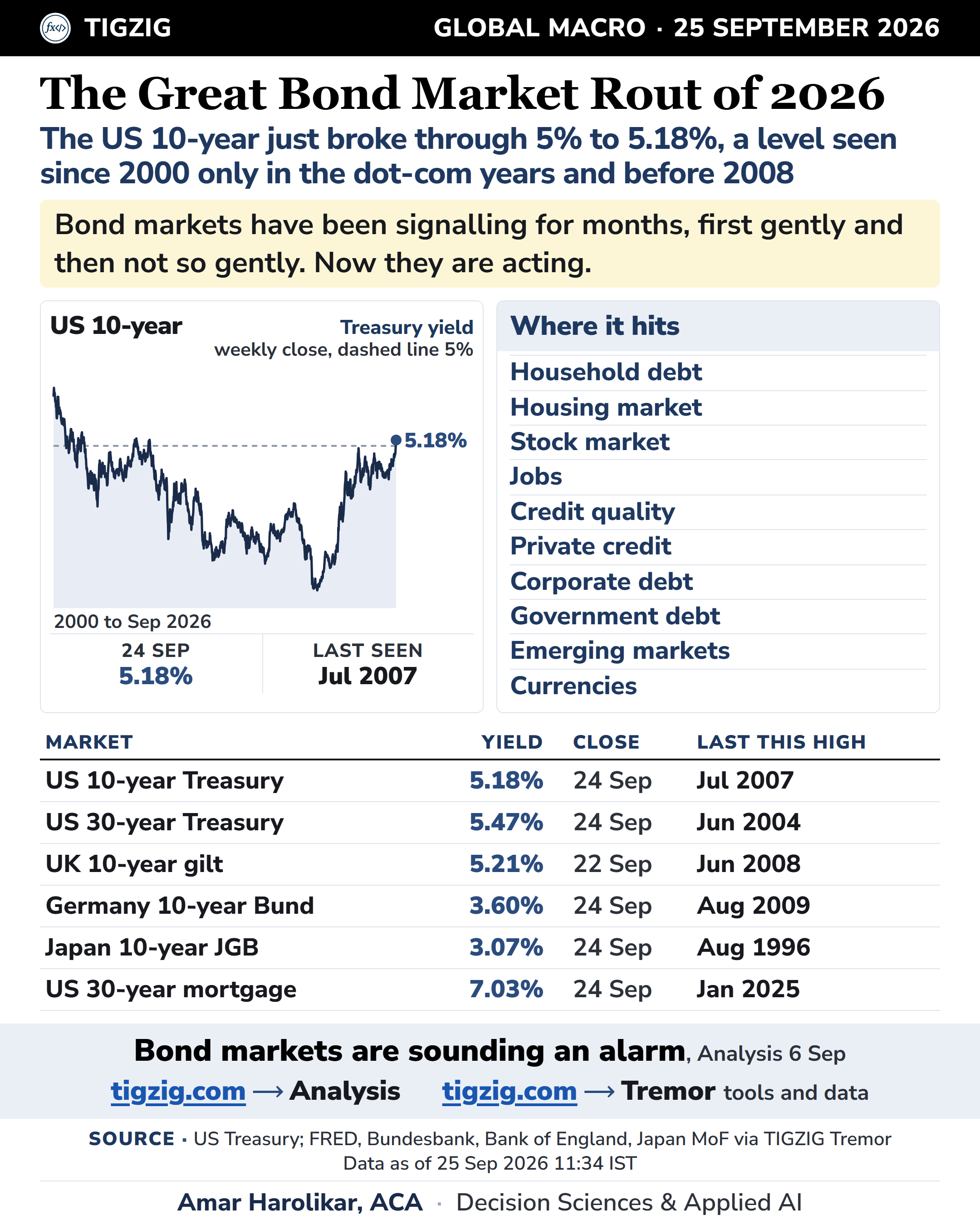
Bond markets have been warning for months, now they have started acting. Last time US-10YR was above 5% was in 2007, just before the Great Financial Crisis of 2008, and prior to that during dot-com boom-bust cycle.
On 6 Sep I wrote that bond markets were sounding an alarm. These are the rates that set mortgages, company refinancing and government borrowing, and the list of what they touch is long, from household debt and housing to stocks, jobs and credit quality.
Bond markets are sounding an alarm
When bond markets move with this velocity and if the momentum continues, the impact is felt across consumers, organizations and government, and on valuations across asset classes.
My earlier analyses covered the pressures beyond bond markets and across the whole range - economy, jobs, AI valuations, markets, banks, credit unions and private credit.
Almost all of this rise is the real cost of money
Expected inflation has barely moved. Expected inflation is 2.35% today, about where it was one and three years ago. Lenders are charging more to lend for ten years.
The 10-year yield has two parts. One is the inflation lenders expect. The other is the return they want on top of it, called the real yield. The inflation-protected Treasury (TIPS) measures that second part directly.
Over one year the 10-year rose 0.99 points. The real yield rose 1.01 and expected inflation fell 0.02.
Over two years the 10-year rose 1.36 points. The real yield did 1.18 of that.
Over three years the 10-year rose 0.67 points. The real yield rose 0.69 and expected inflation fell 0.02.
FRED closes to 23 September. The 10-year and the TIPS yield are both on TREMOR, and expected inflation is the gap between them: tigzig.com/tremor
A note on Japan
Japan's 10-year is at its highest since August 1996. From 2016 until March 2024 the Bank of Japan capped that yield by policy, near zero until late 2022 and below 1% after, so most of the rise since then is the market pricing it again.
Some of my earlier analyses
Bond markets are sounding an alarm, 6 September. The US thirty year was at 5.25 per cent, a level it had not passed since 2007 before this year, and long rates were rising while the Fed was still cutting. Bond markets are sounding an alarm
The Fed is caught, 14 September. Most of the rise in the ten year was the real cost of money, with the market's inflation view barely changed, and a rate rise does not reach oil prices. The Fed is caught
US banks have 2.8 trillion dollars committed to non-bank lenders, and 1.7 trillion of it is already drawn, while Fitch has private credit defaults at a record. US banks and non-bank lending, Q2 2026
A correction in AI valuations looks more likely, and it all rests on free cash flow arriving from 2028. A correction in AI valuations
Working on something similar? How I work covers the rates, the availability and what I take on.