The Fed Is Caught. The Market Has Already Made Most of the Decision for It.
Published: September 14, 2026
The Fed meets on Wednesday and the market has already made most of the decision for it. A quarter point rise sits at 86 per cent on the CME FedWatch tool, against 33 per cent a month ago, and the three month Treasury bill is already at 4.00 per cent, which is exactly where that rise would put the top of the Fed's range.
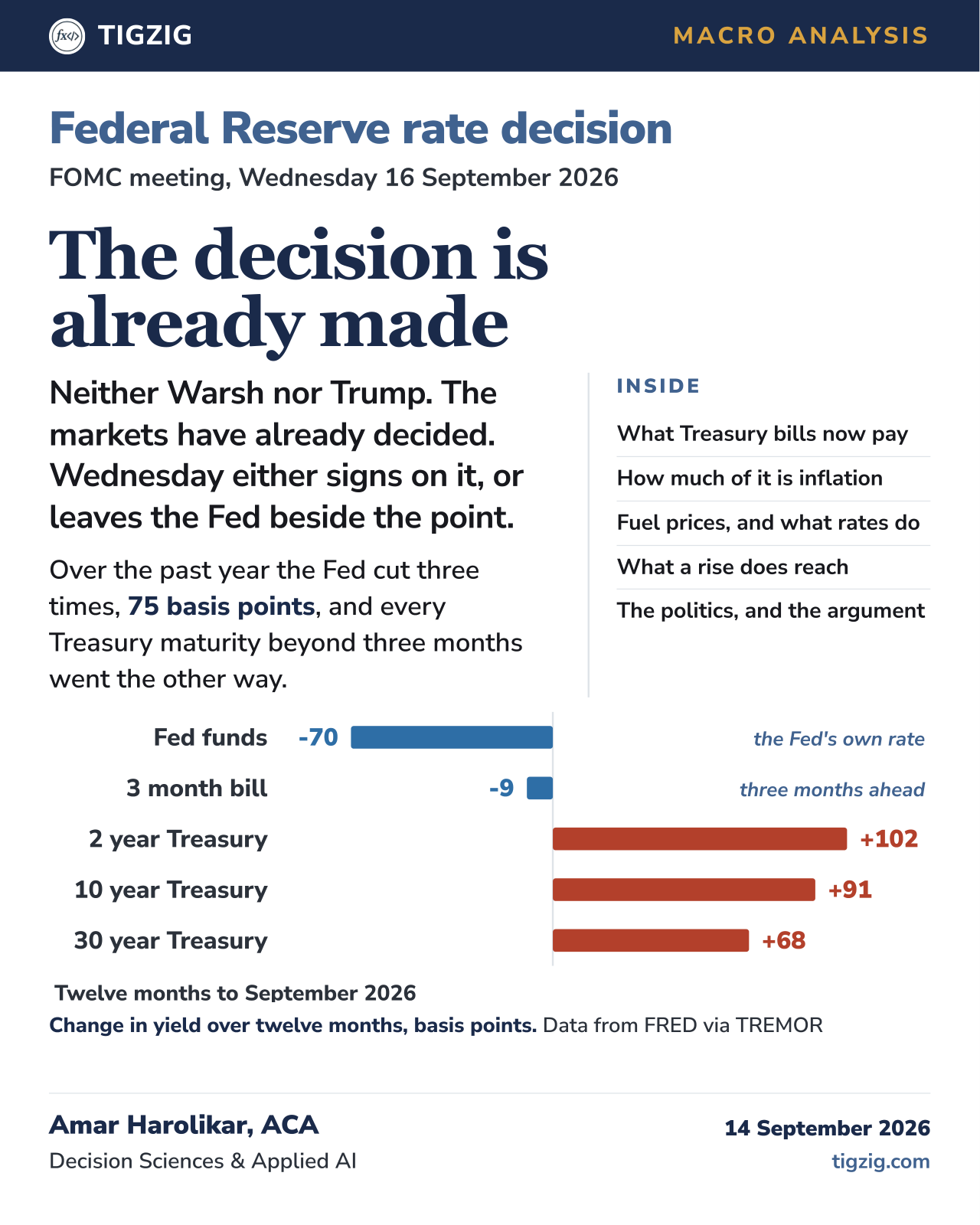
Over the past year the ten year Treasury rose 91 basis points and the inflation protected version of the same bond rose 86. The gap between the two is the inflation rate the market expects, and it moved 5 basis points. So almost the whole rise in the ten year is the real cost of money, and the bond market has barely changed its view on inflation.
That cost gets paid whether the Fed moves on Wednesday or holds. Consumers pay it on mortgages and car loans, companies pay it when they refinance, and governments pay it on every bond they roll over.
A rate rise also does not reach what is pushing prices up. Diesel is up 59.8 per cent over the year and petrol 30.8. Higher interest rates reduce demand for credit. They do not produce oil and they do not reopen a shipping lane.
My previous analysis, Bond markets are sounding an alarm, goes into the consequences of a high rate regime for consumers, organizations and governments, with potential to trigger recessions and corrections across asset classes.
All prior analysis: tigzig.com/analysis
There is politics around this, but the arguments are real
The President, the Vice President and the Treasury Secretary have each said in public that the Fed should not raise, and in some cases that it should cut. That is a broader campaign than the usual one and it comes two months before the midterms.
The Treasury Secretary's argument is a technical one, and my own analysis gets to the same place from the data. A central bank does not normally raise into a supply shock until the second and third round effects show up. Reported by CNBC.
Fed Chairman Kevin Warsh has an answer to that, and it is in his Jackson Hole keynote from 28 August. He makes the case on breadth and duration. Over twelve months 54 per cent of the goods and services in the PCE basket rose by more than 3 per cent, against 32 per cent in the two decades before the pandemic, and he counts 65 months of sustained, elevated inflation.
Two things in the same speech go the other way. He says inflation expectations are well anchored right now, which is what the bond market is saying too, though he immediately adds that they must be closely minded and that such measures tend to look strong and durable until they do not. And he gave no guidance at all about Wednesday.
What I have written as the data came out
On bonds and rates, where this one started. The US thirty year is at 5.37 per cent and before this year it had not been above 5.2 since 2007.
- Bond markets are sounding an alarm
- Many of these macro charts are showing the same thing
- S&P at 7,400. Irrational exuberance.
On the AI build.
And regulators have been warning.
On credit, where the pressure shows up in the numbers first.
The rate series in the deck are from the TREMOR app, tigzig.com/tremor, sourced from public sources like FRED, FDIC and others.
The Fed is caught, September 2026
Browse the slides or download the PDF
Full Deck Content (Text Format)
Text below was extracted from the source deck. Chart visuals stay in the PDF and as slide images above the post.
Slide 1
TIGZIG MACRO ANALYSIS
Federal Reserve rate decision
FOMC meeting, Wednesday 16 September 2026
The decision is already made
Neither Warsh nor Trump. The markets have already decided. Wednesday either signs on it, or leaves the Fed beside the point.
Over the past year the Fed cut three times, 75 basis points, and every Treasury maturity beyond three months went the other way.
Inside
What Treasury bills now pay
How much of it is inflation
Fuel prices, and what rates do
What a rise does reach
The politics, and the argument
Fed funds -70 the Fed's own rate 3 month bill -9 three months ahead 2 year Treasury +102 10 year Treasury +91 30 year Treasury +68 Twelve months to September 2026
Change in yield over twelve months, basis points. Data from FRED via TREMOR
Amar Harolikar, ACA
Decision Sciences & Applied AI
14 September 2026tigzig.com
Slide 2
TIGZIGThe instrument
The instrument
The three month bill is already pricing a rise
The three month bill prices what the market expects the Fed to do over the next three months. A year ago it yielded 4.09 per cent against fed funds at 4.33, below the Fed because cuts were expected. Today it is 4.00 against 3.63, above the top of the target range.
3.7% 4.2% 4.7% 5.3% Jan 2026 the bill goes above Fed funds 3.63% 3 month bill 4.00% Sep 2024 to Sep 2026 Fed funds effective rate and the three month bill. Data from FRED via TREMOR
A quarter point rise would put the top of the range at 4.00, which is where the bill already is. The market has priced one and no more.
The two crossed on 12 January 2026 and the bill has stayed above ever since, and decisively above since July, when the gap first passed 25 basis points.
SourcesFRED daily, via TREMOR. Target range from the Federal Reserve
Amar Harolikar** · **TIGZIG 02 / 11
Slide 3
TIGZIGWhat the long end is pricing
What the long end is pricing
Almost none of the rise is inflation
The Treasury sells two kinds of ten year bond, and the gap between them is the inflation rate the market expects. One pays a fixed 4.95 per cent. The other, TIPS, pays 2.55 plus whatever inflation turns out to be. A buyer is indifferent between them at 2.40 per cent inflation, and that is the market's number.
Sep 2025 Sep 2026 Change
Ten year Treasury 4.04% 4.95% +91bp
Ten year TIPS, the real yield 1.69% 2.55% +86bp
The gap, expected inflation 2.35% 2.40% +5bp
The whole rise in the ten year is the real cost of money. The bond market has repriced borrowing and has not repriced inflation, at any horizon: five year, five year forward expectations moved four basis points.
The Chair says the same thing from the other side. Medium term inflation expectations, in his words, by and large look stable.
SourcesFRED, daily. DGS10, DFII10 and T10YIE. The gap is FRED's own published breakeven and it reproduces exactly as the first row less the second
Amar Harolikar** · **TIGZIG 03 / 11
Slide 4
TIGZIGFuel
Fuel
A rise does not reach the cause
Higher interest rates reduce demand for credit. They do not produce oil, and they do not reopen a shipping lane. The Fed sets its two per cent target on PCE inflation, which is 3.7 per cent. Take out food and energy and it is 3.3. On the consumer price index the core reading is 2.5.
Diesel, at the pump +59.8% $5.97 a gallon Brent, front month +57.3% $104 a barrel Petrol, at the pump +30.8% $4.16 a gallon Energy commodities +28% motor fuel and heating oil Energy, all of it +16.1% electricity and gas too Producer prices, core +4.6% still in the pipe PCE inflation +3.7% what the Fed targets, at 2% PCE, core +3.3% Consumer prices, core +2.5% Fuel to Sep 2026, consumer and producer prices to Aug 2026 Change over twelve months. Data from FRED and EIA via TREMOR
In August alone the gasoline index rose 3.9 per cent while all items rose 0.4.
SourcesConsumer prices are BLS series, taken from FRED via TREMOR. Fuel is the EIA weekly fuel survey, FRED series GASDESW and GASREGW, weekly to 7 September 2026. PCE is from the BEA
Amar Harolikar** · **TIGZIG 04 / 11
Slide 5
TIGZIGThe pipeline
The pipeline
The cost has not fully reached the consumer
Diesel is the number to watch. Gasoline is something households buy, so it shows up in the headline figure and central banks are expected to look through it. Diesel is what moves freight, farms and building sites. It arrives later, inside the price of everything carried.
Producer prices excluding food and energy are rising at 4.6 per cent. The core consumer measures are 2.5 on the consumer price index and 3.3 on PCE.
Producer prices are above both of them.
Producer prices are the costs businesses are already paying. Consumer prices are what those businesses have charged on to the consumer. Producer prices are above both consumer measures, so a part of this cost has not been passed on yet.
None of this has finished. Fuel costs are far above last year and more of that cost is still to come.
SourcesProducer and consumer prices from BLS, FRED series via TREMOR, to August 2026. Diesel and gasoline are the EIA weekly fuel survey, FRED series GASDESW and GASREGW
Amar Harolikar** · ** TIGZIG
05 / 11
Slide 6
TIGZIGThe AI hyperscalers
The AI hyperscalers
Promised, and not yet borrowed
The hyperscalers have committed 2.9 trillion dollars they have not paid for. Total capital spending by the five was 184 billion in the June quarter, so a large part of this is still ahead of them, though JP Morgan Asset Management says a substantial part of the purchase commitments already sits inside near term capex expectations.
AI purchase commitments unconditional, the hyperscalers $1,500bn Data centre lease obligations most of it off balance sheet $1,400bn $184bn of capital spending last quarter Promised and not yet paid for, $bn. The source gives no period. The red bar is total capital spending by the five in the June quarter, covering everything they build
None of it is borrowed yet. What it costs is set in the bond market when each piece is drawn, and that repricing has already happened. JP Morgan Asset Management calls the recent rise in the cost of debt a marginal headwind and says it is not expected to change capex plans. That is the cost of issuance already planned. This is the part that is not.
SourcesCommitments and spreads from JP Morgan Asset Management, 20 August 2026. Capital spending from SEC filings
Amar Harolikar** · **TIGZIG 06 / 11
Slide 7
TIGZIGThe pressure
The pressure
The whole administration is pushing one way
The politics is obvious. The argument underneath it is a real one, and this analysis gets to the same place from the data.
The President, the Vice President and the Treasury Secretary have each said in public that the Fed should not raise, and in some cases that it should cut. That is a broader campaign than the usual one, and it comes two months before the midterms.
The Treasury Secretary's argument is a technical one, and it is the argument this analysis comes back to: a central bank does not normally raise into a supply shock until the second and third round effects show up. Whether those effects have arrived is the real disagreement, and the Chair has an answer.
The pressure has not moved the market for three month Treasury bills. Those are short term government debt, and they had already moved before any of this campaign started.
A month ago the market put a quarter point rise at 33 per cent. It is now 86.5. It was 59 in the first week of September. CME FedWatch, 14 September.
SourcesReported by CNBC, 5 September 2026. Odds from the CME FedWatch tool, 14 September. Meeting dates from the Federal Reserve
Amar Harolikar** · **TIGZIG 07 / 11
Slide 8
TIGZIGThe other side
The other side
What the Chair actually said
His case is that the rise is broad and that it has lasted. Over the past twelve months 54 per cent of the PCE basket rose by more than 3 per cent. Before the pandemic that figure was 32 per cent. He counts 65 months of sustained, elevated inflation.
PCE is 3.7 per cent over twelve months and 4.1 over six, so on his own gauge it is accelerating. He reads the labour market as consistent with full employment, which removes the argument that there is slack to absorb a shock.
Two things in the same speech are a different angle. Medium-term inflation expectations, in his words, by and large look stable, and swap market inflation compensation says the same. And he gave no guidance at all. His own words were that he stands "committed to a discipline, not to a decision."
Wednesday is a projections meeting, so the Committee publishes rate projections from its members alongside the decision. The Chair did not submit one of his own in June, and he has said that publishing forecasts to show how the Fed will react works better in theory than in practice.
SourcesAll figures from the speech in full, 28 August 2026. Meeting and projection dates from the Federal Reserve
Amar Harolikar** · **TIGZIG 08 / 11
Slide 9
TIGZIGMy read
My read
Where I come out
I am not going to call the decision. What I would say is that the decision counts for less than it looks, because the market has already made most of it.
Whether the Fed raises on Wednesday or holds, bond yields have already risen, and somebody pays for that. Consumers pay it on mortgages and car loans. Companies pay it when they refinance. Governments pay it on every bond they roll over.
I wrote about this at the start of September.
Bond markets are sounding an alarm
The thirty year was at 5.25 per cent, a level it had not passed since 2007, and Europe and Japan are moving the same way. That piece sets out the pressures arriving together: valuations, AI debt, delinquencies and charge-offs, oil, private credit and employment.
SourcesThis page is my own view. Everything before it is sourced and linked, and my earlier analysis is at tigzig.com/analysis
Amar Harolikar** · ** TIGZIG
09 / 11
Slide 10
TIGZIGPrevious analysis
Previous analysis
Bonds and rates Sep 2026 Bond markets are sounding an alarm
Sep 2026 Macro charts back at the levels they showed before 2007
Jun 2026 There is no modern playbook for this
The AI build and how it is funded Jul 2026 Three warnings on the AI valuation boom
Aug 2026 A correction in AI valuations looks more likely
What the regulators are saying Sep 2026 The FSB Chair is not hedging
Jun 2026 The BIS red-flagged the AI boom
Credit Aug 2026 US banks, 2.8 trillion committed to non-banks
Aug 2026 NY Fed Q2 household debt, auto and mortgage went up
Aug 2026 FDIC Q2 2026, 102 quarters of bank balances on TREMOR
May 2026 Private credit. A market for lemons
Valuations Aug 2026 Shiller CAPE at 41.2, higher only at the dot-com peak
May 2026 S&P at 7,400. Irrational exuberance
All my analysis
Amar Harolikar** · ** TIGZIG
10 / 11
Slide 11
TIGZIGSources
External sources
This analysis also draws on my earlier work. These are the external sources used.
Federal Reserve H.15 rates and the FOMC calendar
Federal Reserve Warsh at Jackson Hole, 28 August 2026
SEC Quarterly filings for the five hyperscalers
JP Morgan Asset Management Hyperscalers, now also a credit story, 20 August 2026
Vanguard The AI buildout comes to the bond market
CNBC Trump turns up the heat on Warsh, 5 September 2026
BEA Personal consumption expenditures price index
Series in the charts BLS, FRED and Yahoo Finance, pulled through TREMOR
Amar Harolikar** · ** TIGZIG
11 / 11
Working on something similar? How I work covers the rates, the availability and what I take on.