The FSB Chair Is Not Hedging. Andrew Bailey's Blunt Warning Note to the G20.
Published: September 7, 2026
Andrew Bailey, the chair of the Financial Stability Board, who is also the Governor of the Bank of England, has written what I would call a blunt warning note to the G20. Refreshingly straight, no mincing of words, and that is a red flag.
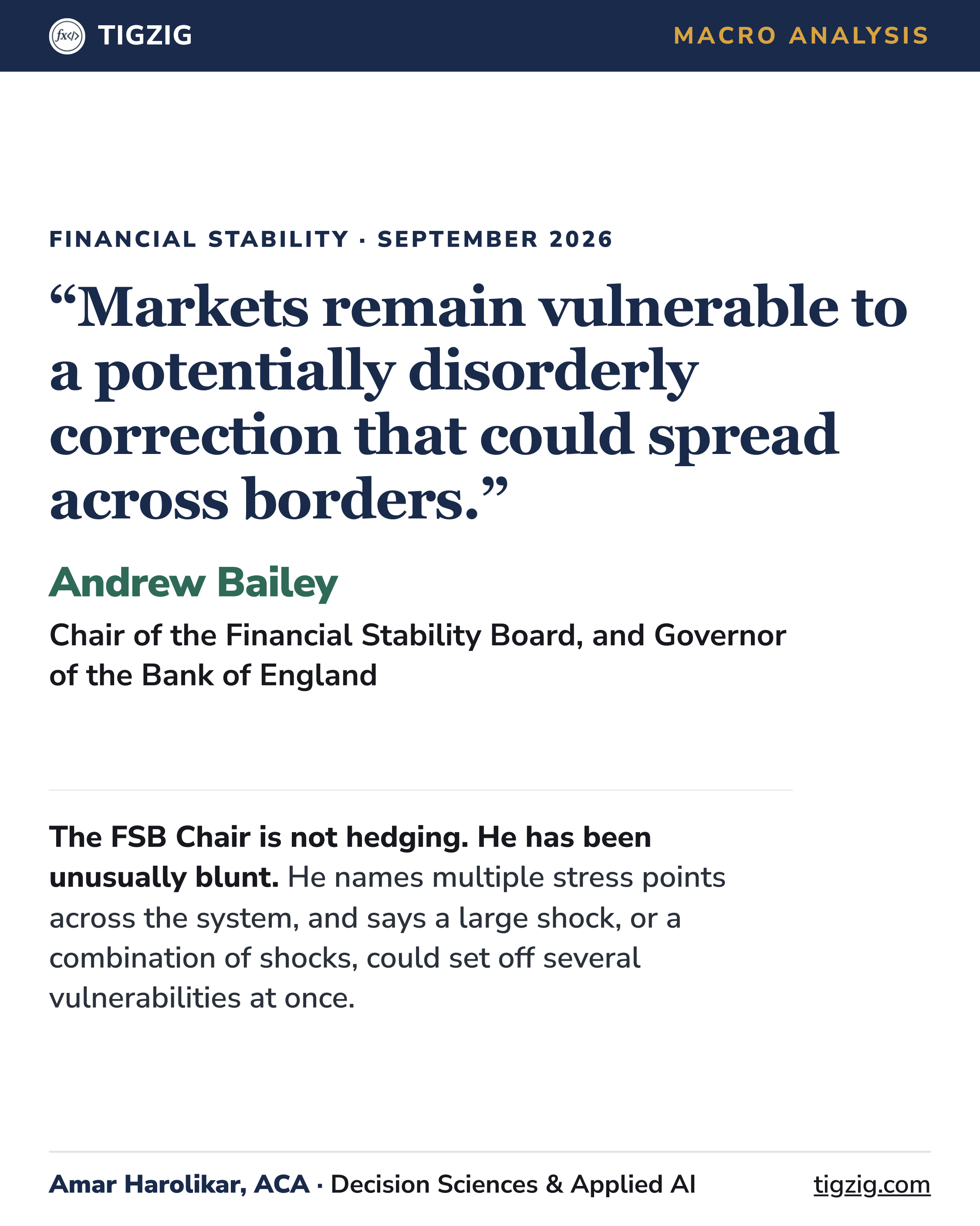
Key point - markets remain vulnerable to a potentially disorderly correction that could spread across borders.
He names multiple factors. Fragilities in sovereign debt markets, vulnerabilities in private credit, stretched asset valuations, particularly AI-related ones. And a rise in the use of leverage in equity markets, including leveraged ETFs and retail momentum strategies.
He also flags frontier AI, which he says is showing increasingly sophisticated autonomy and problem-solving abilities as well as threat capabilities, and may materially alter the speed, scale and economics of cyber risk.
And we already have an example. A 45 billion dollar AI fund running leverage of up to 400 per cent had gone from 45 billion to about 10 in a matter of weeks in July, after all three of its prime brokers, JP Morgan, Goldman Sachs and Bank of America, called for margin.
Link to Andrew Bailey's letter: fsb.org/uploads/P310826.pdf
He is not the only one saying it
He is not the only one saying it, and the one before him was his own deputy.
- Sarah Breeden, Deputy Governor for Financial Stability at the Bank of England, made the private credit case in April using Akerlof's market for lemons. When buyers cannot tell a good risk from a bad one, they price for the worst, and sound borrowers end up paying bad-firm prices. bankofengland.co.uk, the Breeden speech
- The ECB put the valuation argument in writing eleven days before Bailey's letter, saying US valuations measured by the CAPE ratio are close to their historical peak, and that the risk of a boom and bust does not depend on today's prices being rational or irrational. ecb.europa.eu, the blog post
- I wrote this up in July, when the ECB, the Banque de France, the Bank of England, the FSB and the OCC all moved within a month, from writing warnings to running drills. The private credit hub
My earlier analysis on related topics and stress factors
- On the bond side, where the sovereign debt fragilities show up in the numbers. The US thirty year is at 5.25 per cent and before this year it had not been above 5.2 since 2007: Bond markets are sounding an alarm
- On valuations, and what the last two setups like this did: S&P 500, irrational exuberance at 7400
- On private credit, where Fitch put the default rate at a record 6 per cent, and where a growing share of the lending now sits outside the banks: A market for lemons and US banks lending to non-banks
- And on the AI build, which is the part he links back to leverage and concentration: The AI valuation correction
More analysis at tigzig.com/analysis
The FSB Chair Is Not Hedging
Browse the slides or download the PDF
Full Deck Content (Text Format)
Text below was extracted from the source deck. Chart visuals stay in the PDF and as slide images above the post.
Slide 1
TIGZIG MACRO ANALYSIS
Financial stability · September 2026
"Markets remain vulnerable to a potentially disorderly correction that could spread across borders."
Andrew Bailey
Chair of the Financial Stability Board, and Governor of the Bank of England
The FSB Chair is not hedging. He has been unusually blunt. He names multiple stress points across the system, and says a large shock, or a combination of shocks, could set off several vulnerabilities at once.
Amar Harolikar, ACA** · **Decision Sciences & Applied AI
Slide 2
tigzig.comThe letter
The letter
Who is saying it, and where
The Financial Stability Board coordinates financial regulation for the G20. Its chair writes to finance ministers and central bank governors ahead of their meetings, and Andrew Bailey holds that chair. He is also Governor of the Bank of England, though he writes here in the FSB role.
"Market interest rates have risen since the start of the conflict and so financing costs have continued to increase, while valuations of risky assets remain elevated. We therefore cannot be complacent."
Andrew Bailey, Chair of the Financial Stability Board
More reading
FSB Chair's letter to the G20 · 28 Aug 2026
Amar Harolikar** · **tigzig.com
02 / 10
Slide 3
tigzig.comVulnerability one
Vulnerability one
Sovereign debt
"fragilities in sovereign debt markets, including elevated issuance, shortening maturities, and the increased use of leverage by some market participants"
Andrew Bailey, Chair of the Financial Stability Board
The numbers say the same. The US thirty year is at 5.25 per cent and before this year it had not been above 5.2 since 2007. Europe and Japan moved the same way at the same time, and the Fed has been cutting its own rate through all of it.
Norway's sovereign wealth fund, the largest in the world, has proposed cutting Treasuries from 34.1 per cent of its bond holdings to 21.9. Mohamed El-Erian puts the cause at issuance running past what can be counted on in reliable buyers.
More reading
FSB Chair's letter to the G20 · 28 Aug 2026
My analysis Bond markets are sounding an alarm · 6 Sep 2026
CNBC Norway's fund plans to cut its Treasury holdings · 4 Sep 2026
CNBC El-Erian on the government bond sell-off · 4 Sep 2026
Amar Harolikar** · **tigzig.com
03 / 10
Slide 4
tigzig.comVulnerability two
Vulnerability two
Private credit
"vulnerabilities in private credit, including levels of interconnectedness with other parts of the financial system, liquidity mismatch and opacity"
Andrew Bailey, Chair of the Financial Stability Board
His own deputy made this case four months earlier, and named the economics. Sarah Breeden, Deputy Governor for Financial Stability at the Bank of England, used Akerlof's market for lemons: when buyers cannot tell a good risk from a bad one they price for the worst, and sound borrowers pay bad-firm prices.
Fitch put the US private credit default rate at a record 6 per cent in May. US banks had 2.8 trillion dollars committed to non-bank lenders at the end of Q2 2026, with 1.7 trillion of it already drawn.
More reading
FSB Chair's letter to the G20 · 28 Aug 2026
Bank of England Sarah Breeden, This time is different? · 17 Apr 2026
My analysis Private credit, a market for lemons · 28 May 2026
My analysis US banks and non-bank lending, Q2 2026 · 30 Aug 2026
Amar Harolikar** · **tigzig.com
04 / 10
Slide 5
tigzig.comVulnerability three
Vulnerability three
Stretched AI valuations
"stretched asset valuations, particularly artificial intelligence-related investments"
Andrew Bailey, Chair of the Financial Stability Board
The ECB made the same argument eleven days earlier. Its blog of 17 August says US stock market valuations, measured by the CAPE ratio, are close to their historical peak, and that the risk of a boom and bust does not depend on today's prices being rational or irrational.
The Shiller CAPE, Robert Shiller's cyclically adjusted price to earnings ratio, was at 41.1 in August. In 145 years of that series the only stretch higher was the dot-com peak.
The cash flows have been moving the other way. Free cash flow across the Magnificent Seven fell from 148 billion dollars in Q4 2025 to 59 billion in Q2 2026, and three of the seven are now negative.
More reading
FSB Chair's letter to the G20 · 28 Aug 2026
ECB The AI boom: rational enthusiasm or the next dot-com bubble? · 17 Aug 2026
My analysis A correction in AI valuations is looking more likely · 31 Aug 2026
Robert Shiller The CAPE series, monthly since 1881 · shillerdata.com
Amar Harolikar** · **tigzig.com
05 / 10
Slide 6
tigzig.comVulnerability four
Vulnerability four
Leverage in equity markets
"A growing footprint of leveraged entities, such as hedge funds in equity markets, which are also exposed to sovereign debt, increase the scope for contagion risk. As we have seen multiple times in the past, rising leverage is a feature of a maturing financial cycle. While it can reinforce rising markets, it can also intensify declines when sentiment turns, as recent weeks have demonstrated."
Andrew Bailey, Chair of the Financial Stability Board
Situational Awareness peaked at 45 billion dollars at the start of July on reported leverage of up to 400 per cent. It is run by Leopold Aschenbrenner, 24 at the time, who worked on OpenAI's superalignment team until 2024.
Its prime brokers, Goldman Sachs, JPMorgan Chase and Bank of America, called for margin. Most of its leveraged public equity book, reported at around 16 billion dollars, went to Citadel at a discount, and the fund was down to roughly 10 billion within weeks. That is his paragraph with names attached.
More reading
FSB Chair's letter to the G20 · 28 Aug 2026
CNBC How a 45 billion dollar AI fund lost most of it in days · 31 Jul 2026
Amar Harolikar** · **tigzig.com
06 / 10
Slide 7
tigzig.comWhere they meet
Where they meet
The cross-investment
"The issue is not simply that investors are borrowing more, but that leverage is interacting with high valuations and market concentration, in particular the increasing cross-investment between artificial intelligence companies and hyper scalers, in a way that could amplify a future market correction. I remain concerned therefore that a large shock or combination of shocks could concurrently trigger multiple vulnerabilities."
Andrew Bailey, Chair of the Financial Stability Board
Bank of America has put Nvidia's equity commitments across its AI-lab partners at as much as 70 billion dollars, with roughly 30 billion of that into OpenAI. Bloomberg has Microsoft and Nvidia together committing up to 15 billion to Anthropic.
Bloomberg's own reading: these circular deals can create skewed incentives and magnify losses if demand for AI fails to match today's expectations.
More reading
FSB Chair's letter to the G20 · 28 Aug 2026
Bloomberg How Microsoft, OpenAI and Nvidia keep paying each other · 2026
My analysis A correction in AI valuations is looking more likely · 31 Aug 2026
Amar Harolikar** · **tigzig.com
07 / 10
Slide 8
tigzig.comThe other half
The other half
Frontier AI and cyber risk
"The risks associated with frontier AI will not respect national borders. The global financial system is highly interconnected, and cyber disruption can spread across jurisdictions through common technology providers, shared infrastructure, and cross-border financial activity."
Andrew Bailey, Chair of the Financial Stability Board
"Frontier AI may have the ability materially to alter the speed, scale and economics of cyber risk, which could undermine market confidence system-wide, especially due to highly concentrated third-party service providers."
Andrew Bailey, Chair of the Financial Stability Board
He is even-handed about it. He describes models with sophisticated autonomy and problem-solving abilities as well as threat capabilities, and says frontier AI can strengthen cyber defence. What he asks for is preparation: stronger vulnerability management, better response and recovery, and planning for simultaneous disruption across several firms.
More reading
FSB Chair's letter to the G20 · 28 Aug 2026
FSB FSB Chair warns of risks arising from frontier AI models · 31 Aug 2026
Amar Harolikar** · **tigzig.com
08 / 10
Slide 9
tigzig.comMy read
My read
The bluntness is the signal
Regulators choose their words carefully, and a letter to the G20 is drafted, reviewed and signed off before it goes out. When the wording is this direct, the wording itself is a measure of how concerned they are.
And he is not the only one. The ECB put the same argument in writing eleven days earlier, and the Federal Reserve's own May stability report put several of the same stress points at the top of what its market contacts are watching.
More reading
ECB The AI boom: rational enthusiasm or the next dot-com bubble? · 17 Aug 2026
My analysis The Fed's own Financial Stability Report, same stress points · 9 May 2026
My analysis Private credit and BDC stress, regulators arriving · 6 Jun 2026
Amar Harolikar** · **tigzig.com
09 / 10
Slide 10
tigzig.comSources
Sources
Where all of this comes from
FSB Chair's letter to G20 Finance Ministers and Central Bank Governors, 28 August 2026
ECB The AI boom: rational enthusiasm or the next dot-com bubble? 17 August 2026
Bank of England Sarah Breeden, This time is different? 17 April 2026
CNBC The Situational Awareness fire sale, 31 July 2026
Bloomberg AI circular deals, how Microsoft, OpenAI and Nvidia keep paying each other
My analysis Bond markets are sounding an alarm, 6 September 2026
My analysis A correction in AI valuations, 31 August 2026
My analysis Private credit, a market for lemons, 28 May 2026
Robert Shiller The CAPE series, monthly since 1881, from shillerdata.com
Our own data The series above, plus FRED, Bank of England and Bundesbank, served via tigzig.com → TREMOR
Amar Harolikar** · **tigzig.com
10 / 10
Working on something similar? How I work covers the rates, the availability and what I take on.