A Crescendo of Warnings on AI Debt and Returns: S&P Global, Gartner, Morgan Stanley, the IMF and the World Bank in One Month
Published: October 23, 2026
S&P Global, Gartner, Morgan Stanley, the IMF and the World Bank have all warned about AI debt and returns this month, and their words are blunt, almost shouting. Credit markets are pricing it, and stock markets are following.
The last time I remember warnings and negative indicators piling up like this was 2007. Bear Stearns came soon after, then Lehman. I am not making a forecast. But the pattern is hard to ignore.
Insurance on CoreWeave's debt is above 1,000 basis points, a level seen as distress. Oracle's has more than doubled this year.
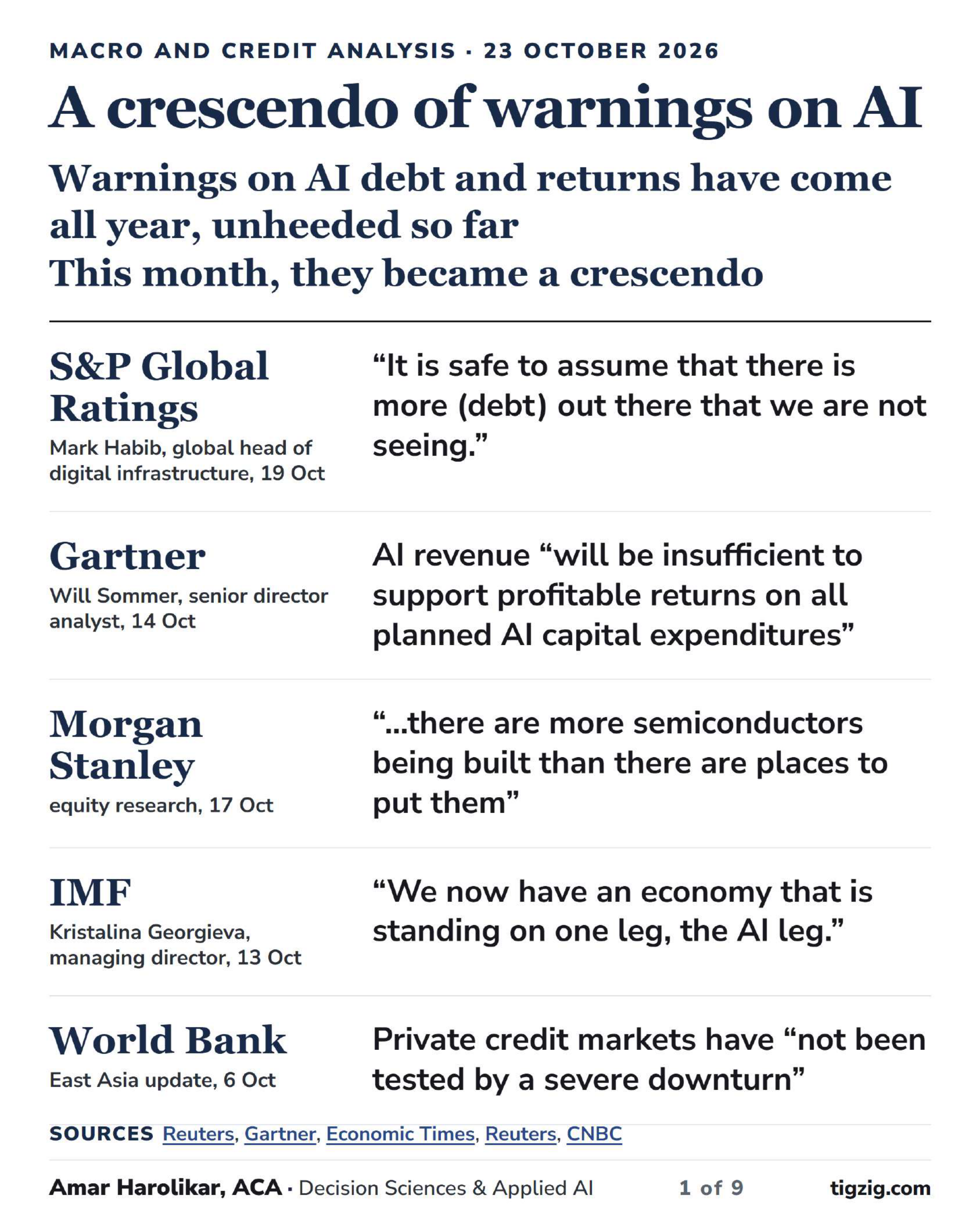
S&P Global Ratings: "It is safe to assume that there is more (debt) out there that we are not seeing."
Gartner: AI revenue to 2030 is forecast at no more than 3.6 trillion dollars, against 8.5 trillion needed for a 12% return.
Morgan Stanley: more chips are being built than there are places to put them, because there is not enough power.
IMF: Kristalina Georgieva says the economy is "standing on one leg, the AI leg."
World Bank: 800 billion of the 2.9 trillion dollars of AI spending planned to 2028 is to come from private credit, markets that are "less visible, and have not been tested by a severe downturn."
Yesterday, 22 Oct, AI stocks pulled markets down from Seoul to New York, and investors turned to Treasuries. The US 10-year fell below 5% for the first time in a month.
When a rating agency, a research firm, a bank, the IMF and the World Bank all say it in the same month, I take it seriously.
This is my analysis of public sources, for information only. Not investment advice.
What moved on 22 Oct, and a few notes
The US 10-year fell 17 basis points to 4.97%, its biggest one-day fall since March 2023, as AI stocks fell and oil jumped, per CNBC. The S&P 500 fell 1.2%, its worst day since July, though most of its stocks rose, per AP.
France's 10-year touched 5.14%, the highest since July 2002, and its premium over Germany hit 177.7 basis points, the widest since November 2011, per Reuters. Belgium's and Italy's premiums widened too. Moody's reviews France's Aa3 rating on 23 Oct, with a negative outlook.
Insurance on Oracle's debt was 308 basis points on 21 Oct, from 141 in January, per CNBC and FactSet. Meta and Nvidia hit records of 108 and 101 this month, per the FT. Insurance prices include a risk premium, so they run above the real chance of default.
The IMF's 1.1% hit to world GDP by 2028 assumes AI investment drops steeply and asset prices fall. The direct hit is 0.4%, and the IMF says even the steep case is not likely to mean a global recession.
The other side: S&P sees no disconnect that forces a rating change now. Gartner says the hyperscalers' wide revenue base could sustain AI spending for years. The IMF raised its 2026 world growth forecast to 3.1%.
My earlier analysis on this
US housing, 22 Oct. Mortgage rates are above 2007-08 levels and pending sales are at a record low: tigzig.com/post/us-housing-freeze-oct2026
A bond shock could spread faster, 18 Oct. Hedge funds hold a near-record share of Treasuries, much of it on borrowed money: tigzig.com/post/hedge-funds-treasuries-leverage-oct2026
IMF's manifesto of warnings, 17 Oct. The week the IMF warned about AI, insurance on CoreWeave's debt passed 1,000 basis points: tigzig.com/post/imf-warnings-ai-credit-strain-oct2026
The biggest tech build meets the bond rout, 28 Sep. Capital spending took 99% of the five hyperscalers' operating cash flow in the June quarter: tigzig.com/post/ai-hyperscalers-debt-bond-rout-sep2026
Bond markets have started acting, 25 Sep. The US 10-year closed above 5% for the first time since 2007: tigzig.com/post/bond-market-rout-sep2026
A correction in AI valuations is looking more likely, 31 Aug. A central bank, an asset manager and a bond investor make the case: tigzig.com/post/ai-valuation-correction-aug2026
Other analysis at tigzig.com/analysis
A crescendo of warnings on AI debt and returns
Browse the slides or download the PDF
Full Deck Content (Text Format)
Text below was extracted from the source deck. Chart visuals stay in the PDF and as slide images above the post.
Slide 1
Macro and credit analysis · 23 October 2026
A crescendo of warnings on AI
Warnings on AI debt and returns have come all year, unheeded so far This month, they became a crescendo
S&P Global Ratings Mark Habib, global head of digital infrastructure, 19 Oct “It is safe to assume that there is more (debt) out there that we are not seeing.”
Gartner Will Sommer, senior director analyst, 14 Oct AI revenue “will be insufficient to support profitable returns on all planned AI capital expenditures”
Morgan Stanley equity research, 17 Oct “…there are more semiconductors being built than there are places to put them”
IMF Kristalina Georgieva, managing director, 13 Oct “We now have an economy that is standing on one leg, the AI leg.”
World Bank East Asia update, 6 Oct Private credit markets have “not been tested by a severe downturn”
SourcesReuters, Gartner, Economic Times, Reuters, CNBC Amar Harolikar, ACA · Decision Sciences & Applied AI1 of 9tigzig.com
Slide 2
S&P Global Ratings
S&P Global says the top hyperscalers likely carry more AI-linked debt than is visible
Mark Habib, global head of digital infrastructure 19 Oct 2026 “It is safe to assume that there is more (debt) out there that we are not seeing.”
**$7T+**AI and data centre spending by the top six hyperscalers, SpaceX among them, 2025 to 2030 6 of 6expected to have negative free operating cash flow in 2026 and 2027 2029the earliest S&P projects a recovery (August report)
- Hard to see: where joint ventures, special purpose vehicles and guarantees are not reported or rated, “we might not have the visibility,” Habib said.
The other side: “For now, we don’t have the view that there is a major disconnect that needs to force our ratings to change at this point,” Habib said.
SourcesReuters 19 Oct, S&P Global Ratings 27 Aug Amar Harolikar · Decision Sciences & Applied AI2 of 9tigzig.com
Slide 3
Gartner
Gartner forecasts at most $3.6T of AI revenue to 2030, against $8.5T needed
Will Sommer, senior director analyst 14 Oct 2026 AI revenue “will be insufficient to support profitable returns on all planned AI capital expenditures.”
AI revenue to 2030 Needed for a 12% return, against the forecast
$8.5T Needed $3.6T Forecast $3.5T+ of AI spending could face impairment by 2030 at today’s pace.
80%+ of neocloud providers expected to stop operating independently by 2030.
Too much capacity: “At the moment, we have more compute capacity than we have demand,” Gartner’s John Lovelock said on 19 Oct.
The other side: Hyperscalers “have massive and highly diversified revenue sources that could plausibly sustain AI investments for years.”
SourcesGartner 14 Oct, CNBC 19 Oct Amar Harolikar · Decision Sciences & Applied AI3 of 9tigzig.com
Slide 4
Morgan Stanley and Goldman Sachs
Morgan Stanley and Goldman Sachs say power may limit the AI build-out
Morgan Stanley, equity research 17 Oct 2026 “…there are more semiconductors being built than there are places to put them.”
US data centre power shortfall Gigawatts, Morgan Stanley estimate
32 GW To 2028 68 GW By 2029 About a third short: the 32 GW gap is about 34% of what data centres need through 2028.
Chip orders at risk: customers could push out delivery or cancel, the report warned.
Goldman’s Jason Tofsky: power is “probably the forever bottleneck.” 86 projects were cancelled or delayed this year, 76 over local opposition.
The other side: Morgan Stanley expects Nvidia and Broadcom to meet their 2027 forecasts. Slower building could also give demand time to catch up, Axios notes.
SourcesEconomic Times 17 Oct, Axios 20 Oct Amar Harolikar · Decision Sciences & Applied AI4 of 9tigzig.com
Slide 5
IMF
The IMF’s Georgieva says the economy is standing on one leg, the AI leg
Jason Wu, assistant director, monetary and capital markets 13 Oct 2026 “If there are questions about the monetization in AI, the equity investments will deplete in value, the debt may be difficult to service, and the revenue commitments in the future may not materialize.”
Circular deals: since 2023, 14 deals put about $300B of equity into weaker AI firms, alongside $650B of debt raised in the deals, for $1.4T of promised future revenue.
1.1% off world GDP by 2028 if AI investment drops steeply and asset prices fall, 1.8% in the US.
Emerging markets would be hit as investors cut risk, said the IMF’s Athanasios Vamvakidis.
The other side: Even that steep case is not likely to mean a global recession, the IMF’s Petya Koeva Brooks said. Vamvakidis says valuations are not currently stretched, as earnings stay strong. My 17 Oct analysis: two of the three risks the IMF sees, bond yields and cyber attacks, are getting worse. IMF’s manifesto of warnings
SourcesReuters 13 Oct, CNBC 13 Oct, Business Today 19 Oct Amar Harolikar · Decision Sciences & Applied AI5 of 9tigzig.com
Slide 6
World Bank
The World Bank says over a quarter of planned AI spending will come from untested private credit
World Bank, East Asia and Pacific update 6 Oct 2026 Private credit markets are “less visible, and have not been tested by a severe downturn.”
AI-related share of private credit activity %, 2025 vs the prior five-year average
18% Prior 5-yr average 34% 2025 $0.8T of $2.9T of AI spending planned for 2025 to 2028 is to come from private credit.
About 6% of US GDP: AI-related capital spending on the bank’s measure, similar to the 2000 peak in IT investment.
East Asia exposed: six economies shipped $1.4T of AI goods in the year to April.
The other side: The bank raised its East Asia growth forecast to 4.5%. It said a correction may not mean a bust for AI, only that investment had run ahead of demand.
SourcesCNBC 6 Oct Amar Harolikar · Decision Sciences & Applied AI6 of 9tigzig.com
Slide 7
Stock markets
AI stocks fell hard on 22 Oct. Four Asian markets are 14% to 39% off their highs
Index level, end-2025 to 22 Oct 2026. Red dot: the 2026 high. Navy dot: 22 Oct close. S&P 500 +12% YTD, 2% below high
- Jan Apr Jul Oct 7,819 7,663 Nasdaq +12% YTD, 6% below high Jan Apr Jul Oct 27,600 26,009 Russell 2000 +12% YTD, 9% below high Jan Apr Jul Oct 3,068 2,784 Taiwan +59% YTD, 8% below high Jan Apr Jul Oct 49,823 46,041 Kospi, Korea +31% YTD, 39% below high Jan Apr Jul Oct 9,115 5,534 Nikkei, Japan +25% YTD, 13% below high Jan Apr Jul Oct 72,366 62,908 Hang Seng -11% YTD, 18% below high Jan Apr Jul Oct 27,968 22,935 Shanghai -8% YTD, 14% below high Jan Apr Jul Oct 4,243 3,658 Nifty 50, India -13% YTD, 14% below high Jan Apr Jul Oct 26,329 22,688
22 Oct: S&P 500 -1.2%, its worst day since July. Nasdaq -2.6%, Kospi -3.5%, Hang Seng -3.0%, Nikkei -2.7%.
SourcesYahoo Finance via YFIN · AP 22 Oct Amar Harolikar · Decision Sciences & Applied AI7 of 9tigzig.com
Slide 8
Bond and credit markets
Investors turned to Treasuries, while insuring AI debt got costlier
This year, 10-year yields in the US, UK, Germany and Japan hit 17 to 30-year highs. US 10-year yield %, since 1995
- 1995 2005 2015 2025 2002 2026 high 5.31 4.97 Flight to safety. The US 10-year fell to 4.97% on 22 Oct, below 5% for the first time in a month, as AI stocks fell and oil jumped.
Default insurance on AI borrowers 5-year credit default swap, bp, 20 to 21 Oct 1,000: distress 1,066 CoreWeave 432 SoftBank 308 Oracle 108 Meta Oct record 101 Nvidia Oct record Bond yields %, latest reading 4.97% US 10-yr 22 Oct 7.24% Oracle 2032 14 Oct 15.97% CoreWeave 2031 20 Oct
France: its 10-year touched 5.14%, the highest since 2002, and its gap over Germany the widest since 2011. Moody’s rules on 23 Oct.
US mortgage rate 7.32% on 22 Oct, after 7.40% a week earlier, the highest since late 2023.
The other side: Janus Henderson, a CoreWeave bondholder, calls the sell-off “a little bit of overreacting.”
SourcesTREMOR · CNBC 22 Oct, 22 Oct, 20 Oct, 14 Oct · Reuters 22 Oct, FT via Hedgeweek Amar Harolikar · Decision Sciences & Applied AI8 of 9tigzig.com
Slide 9
My analysis
My earlier analysis
22 OctUS housing, October 2026 Mortgage rates are above 2007-08 levels and unsold new homes are near their highest since 2007.
18 OctA bond shock could spread faster Hedge funds held 6.6% of US Treasuries in June, near their record, much of it on borrowed money.
17 OctIMF’s manifesto of warnings The week the IMF warned about AI, insurance on CoreWeave’s debt passed 1,000 basis points.
28 SepThe biggest tech build meets the bond rout Capital spending took 99% of the five hyperscalers’ operating cash flow in the June quarter.
25 SepBond markets have started acting The US 10-year closed above 5% for the first time since 2007.
31 AugA correction in AI valuations is looking more likely A central bank, an asset manager and a bond investor make the case.
Not investment advice. This is my analysis of public sources, for information only. Care has been taken, but errors are possible. Use of AI. Parts of this work were prepared with AI under my direction. I reviewed, edited and approved every page. The analysis and conclusions are mine.
SourcesOther analysis at tigzig.com/analysis. Sources for each page are on that page. Amar Harolikar · Decision Sciences & Applied AI9 of 9tigzig.com
Working on something similar? How I work covers the rates, the availability and what I take on.