US Bank Loan Data Is Now Updated Through Q2 2026 on TREMOR. NY Fed, FDIC and the FFIEC Call Reports, All Three in One Place.
Published: September 4, 2026
US bank loan data is now updated on Tremor. Free to download. NY Fed, FDIC and the FFIEC Call Reports, all three now through Q2 2026.
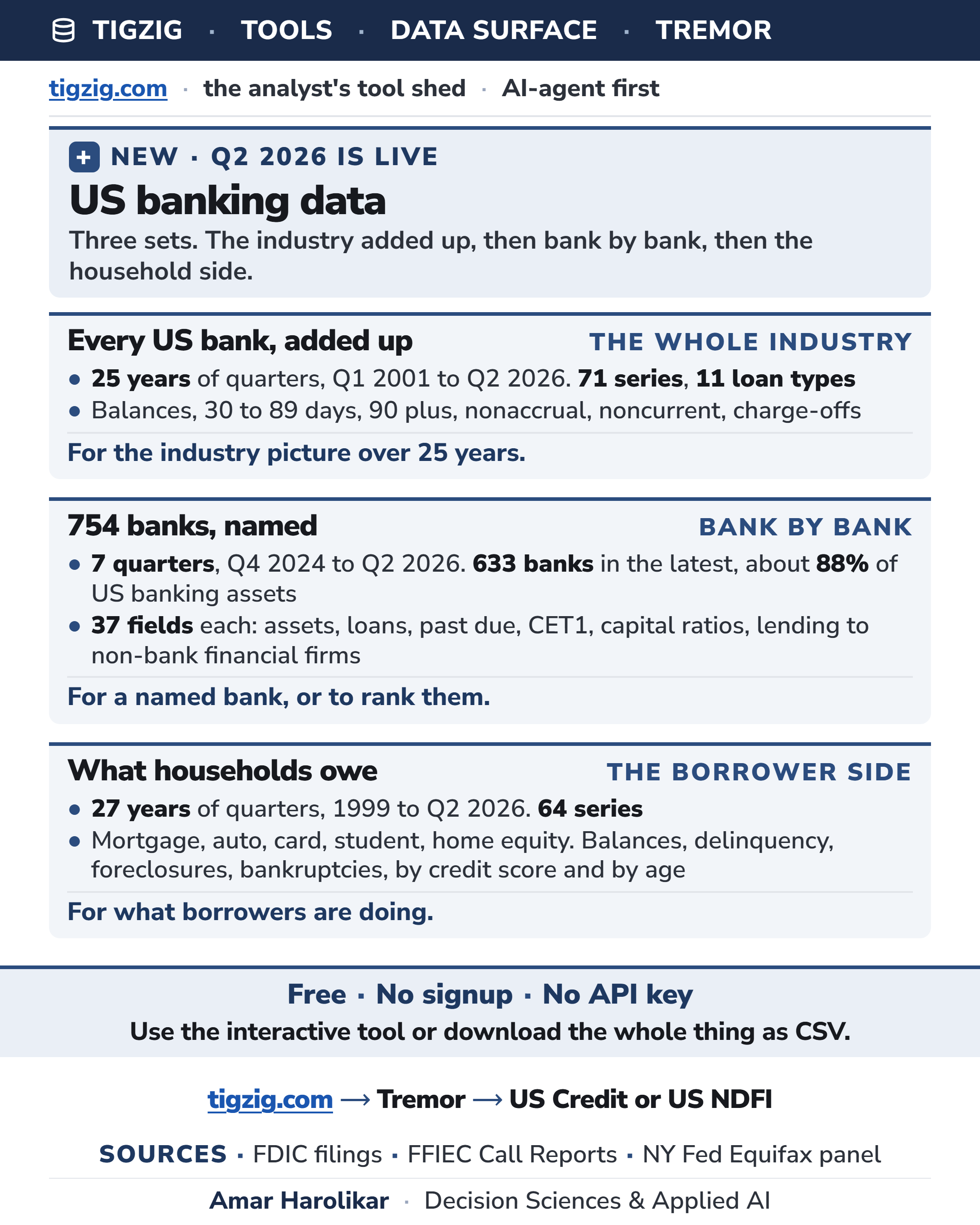
Three sets in one place. Every US bank added up, back to 2001. 754 banks one at a time, with their capital and their lending to non-bank financial firms. And households, from the NY Fed and Equifax credit panel, back to 1999.
Quick points
- I was expecting this quarter to look worse, and most of it came off the top instead.
- On the bank books, the FDIC side, loans 90 days late or on nonaccrual are 0.93 percent of all US bank lending. Cards came down from 1.64 to 1.44 percent. Commercial and real estate eased a little as well.
- On the household side, the NY Fed panel, which counts balances already written off, the headline 90 plus flow came down from 3.26 percent two quarters ago to 2.57 percent.
- Two went the other way. Auto is the only retail number that rose on the bank side, and on the NY Fed side mortgage 90 plus flow has now risen in six of the last seven quarters. Levels on most of these are still well above 2019, so one quarter of easing is not much to go on.
Free, no signup, no API key.
- TREMOR tool and manual download: tigzig.com/tremor ➜ US Credit / US NDFI
- TREMOR API hub: tigzig.com/apis/tremor
The bank and NY Fed numbers will not tally
If you are comparing the bank and NY Fed numbers side by side, they won't tally ... they are measuring different things.
- Bank FDIC and the Call Reports come from what lenders file about their own books.
- The NY Fed panel is built the other way round, from credit files, a 5 percent random sample of Equifax records, so it picks up consumer borrowing wherever it sits, including the part that has moved off bank balance sheets.
- The definitions differ as well. NY Fed 90 plus includes balances that have already been charged off and are still showing on the credit report. FDIC pulls charge-offs out of delinquency and reports them separately.
- So credit cards at 12.92 percent on the NY Fed panel and credit cards at 1.44 percent on the FDIC books are both right. The lens differs.
- The bank charge-off number has two more wrinkles. It is a flow for the period, a quarter or a year, where the NY Fed figure is a stock of balances sitting on the credit file, and a written-off balance stays on that file for years after the bank has taken it off its own books.
- The bank number is also net of recoveries, and collections keep arriving on loans written off, which is minused from the charge-off line in that quarter.
Getting the data itself
On getting the data itself, all of it can be downloaded by hand from the tool. The FDIC and NY Fed sets are also on the open API, no key and no signup, so you can pull them straight into a sheet or a script. Details are on the Tremor page, or at the API hub: tigzig.com/apis/tremor
The bank by bank file is the one exception. That is still a manual download from the tool.
My earlier writeups on Q2 bank loans and delinquencies
- FDIC, and what the loan book is now made of: FDIC Q2 2026 numbers are live on TREMOR
- NY Fed households, auto and mortgage against Q3 2007: NY Fed Q2 2026 household debt
- Bank lending to non-banks, 754 banks one at a time: US banks had $2.8 trillion committed to non-bank lenders
Working on something similar? How I work covers the rates, the availability and what I take on.