Is Foreign Money Coming Back to India? Foreign Investors Bought US$4.1bn in Five Days, but Be Cautious Before Calling It a Trend
Published: November 8, 2026
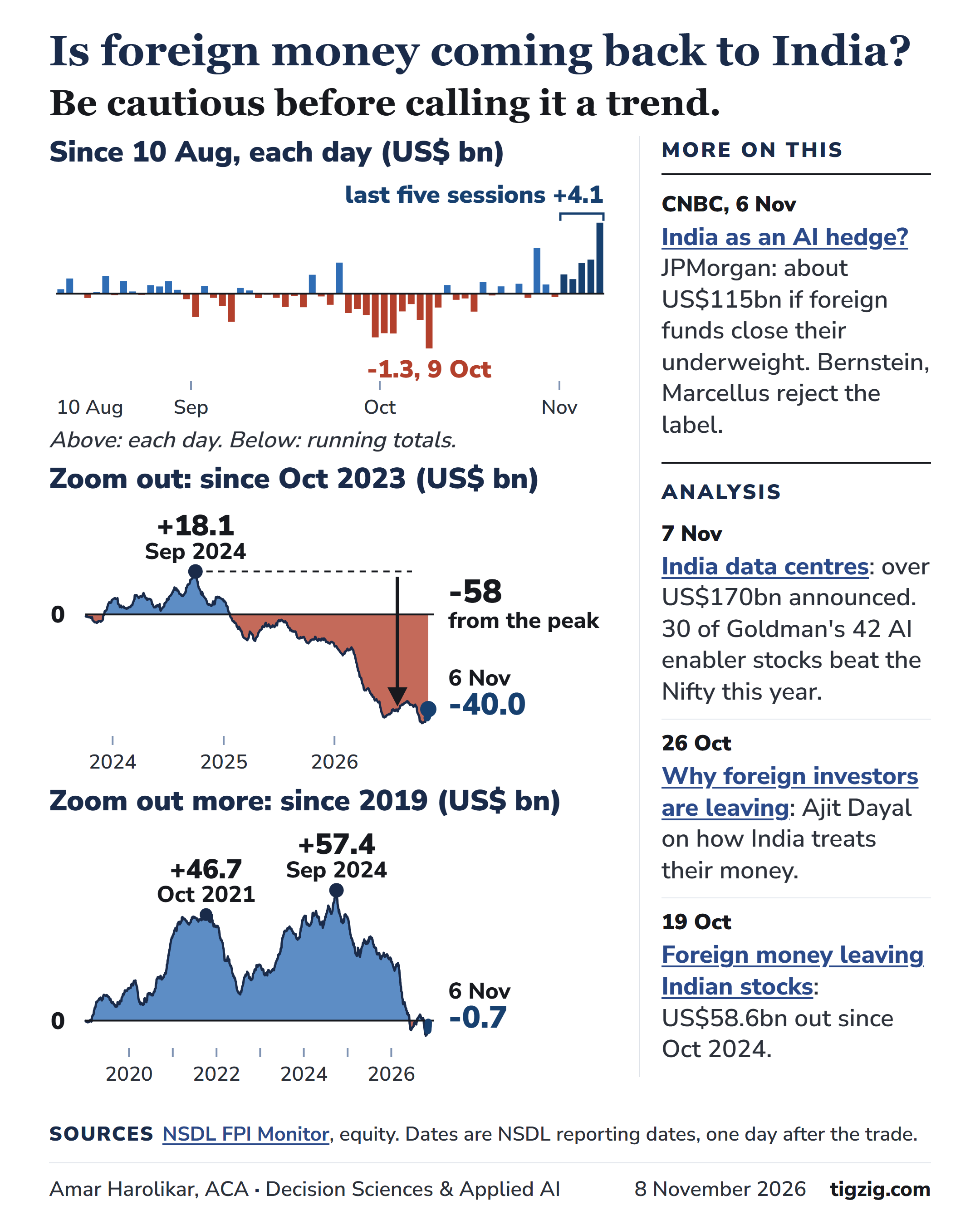
Too early to call foreign buying of Indian shares a trend, with a bunch of factors in play. Foreign investors bought US$4.1bn in the five days to 6 Nov (NSDL), the third-biggest 5-day run in dollars since 2005 and the biggest in rupees.
The AI hedge.
CNBC on 6 Nov calls India an AI hedge, a place for money leaving the AI sell-off. It quotes JPMorgan on potential inflows of around US$115bn if foreign funds close their underweight. It also quotes Bernstein and Marcellus against the label. Its NSDL figures match mine.
cnbc.com/2026/11/06/india-ai-tech-hedge-nifty50.html
Value against returns.
Templeton says the Nifty trades below its 10-year average forward multiple, while Bernstein says India still trades at a premium to other emerging markets. Returns lag: to 6 Nov the Nifty is down about 15% in dollars since Sep 2024 and the S&P 500 is up about 28%. Ajit Dayal blames how India treats foreign money: capital gains tax on pension funds that pay no tax at home, changing rules and a policy of pushing the rupee down.
tigzig.com/post/fpi-why-foreign-investors-leaving-india-oct2026
tigzig.com/post/fpi-foreign-money-leaving-india-oct2026
The AI Infra build.
More than US$170bn is announced for AI data centres in India and forecasts for 2030 run from 5.6 to 12 GW against 1.3 to 1.8 GW today. 30 of Goldman's 42 listed AI enabler stocks have beaten the Nifty this year. About three quarters of the announced money is still early stage, so not all of it will be built.
tigzig.com/post/india-data-centres-engineering-construction-power-nov2026
A potential AI Valuation bubble.
The technology is real, but valuations have run ahead and I do not know how a correction would travel. An AI sell-off could send money to India, as CNBC argues. A big bust with global stress is, I think, more likely to send money to safety first: foreign investors net sold US$12.0bn of Indian shares in 2008 and US$8.3bn in Mar 2020, then bought US$17.5bn in 2009 and US$29.4bn in Apr to Dec 2020. It could also be down first and up fast. OpenAI has cut its funding target and Alphabet had its worst day ever on 29 Oct.
tigzig.com/post/ai-selloff-red-flags-piling-up-nov2026
tigzig.com/post/ai-valuation-correction-aug2026
The one-pager zooms out in three steps.
A rebound since mid-Oct, a deep hole since Oct 2023 and a net of about zero since 2019.
The hole is US$58bn of net selling from the 30 Sep 2024 peak. The last bounce, US$5.2bn bought in Jul and Aug, was sold off within two months, with US$7.3bn net sold in Sep and Oct. 99% of the buying in the five days to 6 Nov came through the stock exchanges and domestic institutions sold about Rs 19,000 crore into it.
Data notes
▸ NSDL dates each day's trades one business day later, so its 6 Nov entry is the trading day of 5 Nov. NSE's provisional figures for 6 Nov (FII +Rs 13,750 crore, DII -Rs 5,969 crore) are not in NSDL yet.
▸ For the same trading days (30 Oct to 5 Nov) NSDL's exchange route is Rs 38,519 crore and NSE shows Rs 35,809 crore. The primary market adds Rs 452 crore. The rest of the gap is unexplained, and NSE's figure is provisional.
▸ Since the 16 Oct low, 21% of NSDL's net equity buying came through the primary market, mostly on 23, 28 and 29 Oct.
▸ Since 2019 the net is -US$0.7bn on NSDL's own US$ figures. My 19 Oct post said US$58.6bn out since Oct 2024, to 30 Sep 2026. October added US$3.6bn of selling and the five days bought back US$4.1bn.
▸ The Nifty and S&P 500 in dollars use Yahoo closes at NSDL's rupee rate, from 26 Sep 2024. My 19 Oct post used NSE's Nifty50 USD index (-22% and +33%); this method gives -23% and +34% to 19 Oct.
▸ Jul to Oct monthly NSDL US$ equity: +2.1bn, +3.1bn, -3.8bn, -3.6bn. The 2008, 2009 and 2020 figures are NSDL's monthly US$ totals. The early-stage share is Cushman & Wakefield's.
Working on something similar? How I work covers the rates, the availability and what I take on.