AI Gains Could Mean Job Cuts: McKinsey Advises Redeployment, While Oracle Cuts Jobs and Microsoft Offers Buyouts to 27% of Staff
Published: October 27, 2026
With AI, the same work can be done with fewer people. But it costs extra money - the AI bill. Keeping the rest busy is not enough: their work has to add to profit, or the business has to let them go.
Most businesses are unlikely to grow sales fast enough to create that much profitable work.
And the AI bill keeps growing: McKinsey cites one estimate that company spending on large language models tripled over 12 months to the end of 2025. Its advice is to redeploy staff, and that needs higher-value work to move them to.
No business can stay out of AI. The hyperscalers take a double hit. They pay for AI like everyone else, and they raise huge sums to build the data centres. Oracle says AI adoption has reduced its workforce. Microsoft is offering buyouts to 27% of its staff.
The McKinsey report: The AI value curve: the economics of applying AI to existing work
A few points
Microsoft's offer is voluntary. The 60,000 and the absence of a target come from a person briefed on the plan, CNBC reports. More than 30% of those eligible took Microsoft's voluntary retirement offer earlier this year. It covers staff in the US, Canada, India and the UK. Staff decide in early December and leave on 31 Dec.
Oracle had about 162,000 staff in May 2025 and about 141,000 in May 2026, per its annual reports. It gives staff numbers only once a year. Its 2026 restructuring plan cites the adoption of AI. After 31 August, Oracle added about $700 million to the plan. That takes it to about $2.8 billion. Costs so far are mostly severance pay.
The list on page 1 covers announced cuts. Some companies link them to AI directly. Others cite efficiency while they spend more on AI.
McKinsey itself says highly paid expert roles are unlikely to be replaced by AI, and its figures measure the tasks within each job that AI can take on. The job-cuts read is mine.
McKinsey's figures come from a model. It gives a world view and a US view only, and the per-role numbers are read from its charts. Its figures leave out one-time costs such as platforms, training and change management.
Earlier related analysis
Staff at Anthropic are becoming managers of AI agent teams, 19 Oct. Anthropic's report on how work changed inside the company: tigzig.com/post/anthropic-employment-agent-teams-oct2026
The biggest tech build meets the bond rout of 2026, 28 Sep. Hyperscaler spending, free cash flow and debt: tigzig.com/post/ai-hyperscalers-debt-bond-rout-sep2026
A correction in AI valuations is looking more likely, 31 Aug. The view now comes from a central bank, an asset manager and a bond investor: tigzig.com/post/ai-valuation-correction-aug2026
Could this time be different? 24 Oct. Past drawdowns, AI valuations and cracks across markets and the economy: tigzig.com/post/drawdowns-this-time-different-oct2026
Full Deck Content (Text Format)
Text below was extracted from the source deck. Chart visuals stay in the PDF and as slide images above the post.
Slide 1
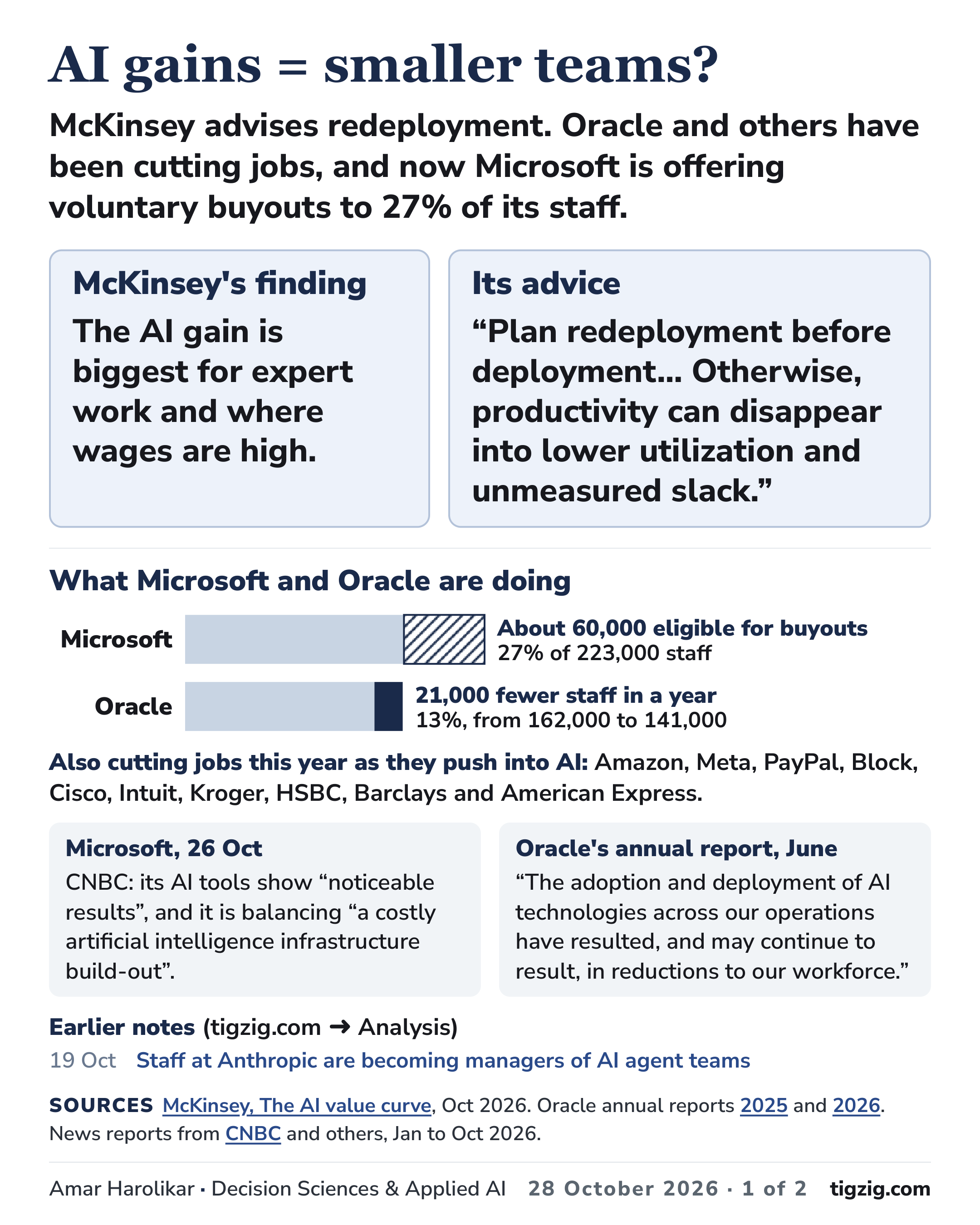
AI gains = smaller teams?
McKinsey advises redeployment. Oracle and others have been cutting jobs, and now Microsoft is offering voluntary buyouts to 27% of its staff.
McKinsey's finding
The AI gain is biggest for expert work and where wages are high.
Its advice
"Plan redeployment before deployment... Otherwise, productivity can disappear into lower utilization and unmeasured slack."
What Microsoft and Oracle are doing
Microsoft
- About 60,000 eligible for buyouts 27% of 223,000 staff Oracle 21,000 fewer staff in a year 13%, from 162,000 to 141,000
Also cutting jobs this year as they push into AI: Amazon, Meta, PayPal, Block, Cisco, Intuit, Kroger, HSBC, Barclays and American Express.
Microsoft, 26 Oct CNBC: its AI tools show "noticeable results", and it is balancing "a costly artificial intelligence infrastructure build-out".
Oracle's annual report, June "The adoption and deployment of AI technologies across our operations have resulted, and may continue to result, in reductions to our workforce."
Earlier notes (tigzig.com ➜ Analysis)
19 Oct Staff at Anthropic are becoming managers of AI agent teams
SourcesMcKinsey, The AI value curve, Oct 2026. Oracle annual reports 2025 and 2026. News reports from CNBC and others, Jan to Oct 2026.
Amar Harolikar · Decision Sciences & Applied AI28 October 2026 · 1 of 2tigzig.com
Slide 2
The McKinsey report
The AI gain is biggest for expert work and where wages are high
AI saving per hour, by role Selected roles, per hour of work AI takes on, US$ Global average US Chief executives $20 $91 Lawyers $15 $72 Financial managers $14 $62 Registered nurses $12 $33 Software developers $6 $33 Accountants $5 $32 Schoolteachers $3 $15 Admin assistants $1.5 $16 Waiters −$2 −$8 HVAC mechanics −$2 −$12
Expert hours pay most. AI takes on routine preparation, so experts spend more of their time on judgment.
The country decides. AI costs about the same everywhere. Sales and office work pays under US wages but may not yet where wages are lower.
Some work costs more with AI at today's wages.
Beyond tech and finance
Healthcare gains almost as much per hour as finance. Education has the largest share of hours AI can take on.
8 of 18 industries, US$ per hour Share of hours AI can take Finance and insurance $13.9 26% Healthcare $13.5 12% Tech, media, telecom $13.2 27% Professional services $11.0 26% Education $8.8 29% Government $6.7 21% Manufacturing $4.6 13% Retail and wholesale $4.0 11%
The report also covers how a 30% rise in AI costs would remove about a third of the gain, a test for when an AI agent pays, and the one-time set-up costs its figures leave out.
This is my analysis of public sources, for information only. Care has been taken, but errors are possible. Use of AI. Parts of this work were prepared with AI under my direction. I reviewed, edited and approved every page. The analysis and conclusions are mine.
Amar Harolikar · Decision Sciences & Applied AI28 October 2026 · 2 of 2tigzig.com
Working on something similar? How I work covers the rates, the availability and what I take on.